The Authentic Orthography
Messenger, Courage · Óðinn's Son · The Rider of the Nine Nights
Unicode restoration and ASCII comparison
ᚼᛁᚱᛘᚢᚦᚱ
The name in its original Norse form. Hermóðr (ᚼᛁᚱᛘᚢᚦᚱ) is attested in the source tradition — “War-spirit”. Its acute stress marks carry the full phonetic and orthographic weight of the source tradition.
hermod
Reduced to plain hermod, the name loses everything that made it specific: acute stress marks. What remains is an ASCII string that machines can parse but that no longer speaks with its original voice.
Hermóðr
The Unicode restoration recovers what ASCII flattened. Hermóðr restores acute stress marks, returning the name to its original written dignity. The domain encodes to Punycode, but the browser displays the truth.
Hermóðr.com → xn--hermr-ltau.com
The non-ASCII characters in Hermóðr are encoded while the ASCII remains visible. To the DNS, it is Punycode. To humanity, it is Hermóðr.
How Hermóðr travels from ancient script to the modern URL
How Hermóðr was spoken
The Errand, the Bridge of Gold, and the Ransom of Baldr
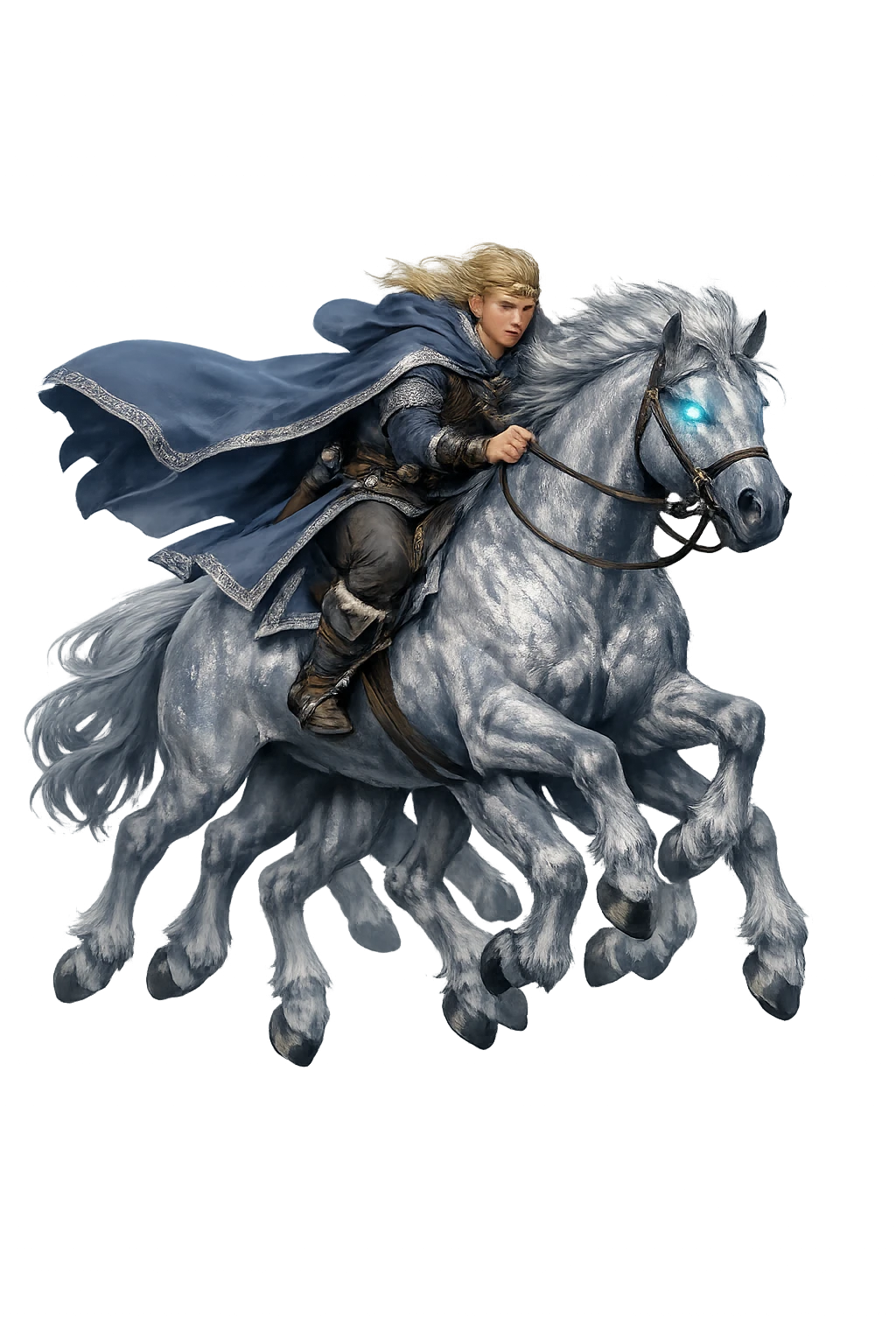
Hermóðr is Óðinn's son and the boldest rider of the Æsir: the god who volunteered, when Baldr lay dead, to mount Sleipnir and ride nine nights through darkness to the halls of Hel, to ransom the light of the world back from the land of the dead.
Óðinn's eight-legged horse, lent for the descent — the only mount that can leap the gates of Hel.
The bridge over the river Gjöll, thatched with glowing gold, where the maiden Móðguðr challenges the living.
The drip-gold ring Óðinn laid on Baldr's pyre, sent back from Hel as proof the errand reached its mark.
The gifts of Óðinn named in Hyndluljóðr: war-gear for a son whose name means war-spirit.
Stories of Hermóðr
Hermóðr has essentially one story, and it is the noblest errand in the Edda: the ride to ransom Baldr, told in Gylfaginning with the plainness of a chronicle and the weight of a funeral.
When Baldr fell to the mistletoe dart and the gods' grief had spent itself, Frigg asked who among the Æsir would ride the road to Hel and offer a ransom. Hermóðr the Bold, called Óðinn's sveinn — his lad, his attendant — stood up. They brought him Sleipnir, and he rode nine nights through valleys so dark and deep that he saw nothing until he reached the river Gjöll and the Gjallarbrú, the bridge roofed with glowing gold. There the maiden Móðguðr asked his name and lineage, and told him the bridge had thundered less under five companies of the dead the day before than under him alone.
He rode on to Helgrindr, the barred gate of the dead, tightened the stirrups, and spurred Sleipnir — and the horse leapt the gate with room to spare. In the hall he found his brother Baldr seated in the high seat, and he stayed the night. In the morning he begged Hel to let Baldr ride home with him, telling how great the weeping was among the Æsir. Hel's answer became the condition on which the whole ending turns: if all things in the world, living and dead, weep for Baldr, he may return; if anything refuses, Hel keeps him.
Baldr sent back the ring Draupnir — the same ring Óðinn had laid on the pyre — and Nanna sent a linen headdress to Frigg and a gold ring to Fulla. Hermóðr carried the tokens and the tidings home, and the Æsir sent messengers through the world to ask all things to weep. All did — trees, stones, metals, beasts — save one giantess in a cave who called herself Þǫkk, Thanks, and wept dry tears: "let Hel hold what she has." The gods suspected it was Loki in disguise. Baldr stayed, and Hermóðr's nine nights stand in the Edda as the proof that even the boldest errand can be answered with a single refusal.
The Poetic Edda's Hyndluljóðr preserves the only other clear notice of him: among the gifts Óðinn dealt to his chosen, "he gave Hermóðr a helmet and a byrnie, and Sigmundr a sword." War-gear from the Allfather fits the name — herr, the host, and móðr, the war-spirit — and scholars have long noted the echo in Beowulf's Heremōd, the Danish king whose courage curdled into failure. The two figures share a name and little else: the Edda's Hermóðr keeps the name honorable.
Hermóðr is the patron of the necessary errand — the message someone has to carry, the door someone has to knock on, the descent someone has to volunteer for. He does everything right: the right horse, the right words, the right tokens. And still the answer is no. The Edda keeps him for that: proof that courage is owed regardless of the outcome, and that the errand, not the result, is what a name is made of.
Enter Extended Lore