
The hidden history behind Hermóðr
In 2026, a name is expected to survive the journey from manuscript page to browser tab — and most arrive diminished, stripped of the marks the scribes gave them. Hermóðr is a case where the marks matter twice over: a messenger's name built from two words for war and spirit, written with a long vowel and a letter English lost seven centuries ago. Scholars have always known that hermod is a flattened copy of Hermóðr; what changed is that the flattened copy is no longer the only one that resolves. This post walks the full record — name, runes, sound, myth, and scholarly apparatus — and ends at the address bar, where the restoration now lives.
At a Glance
- Restored name: Hermóðr
- ASCII form: hermod
- Meaning: "War-spirit"
- Domain of influence: Messenger, Courage
- Pantheon: Norse
- Classification: Tier 1
- Original script: ᚼᛁᚱᛘᚢᚦᚱ (Younger Futhark)
- Live domain: hermóðr.com
Overview
Hermóðr (hermod) — Messenger, Courage · War-spirit — belongs to the Norse tradition, where it is catalogued under the domain "Messenger, Courage". The name means "War-spirit".
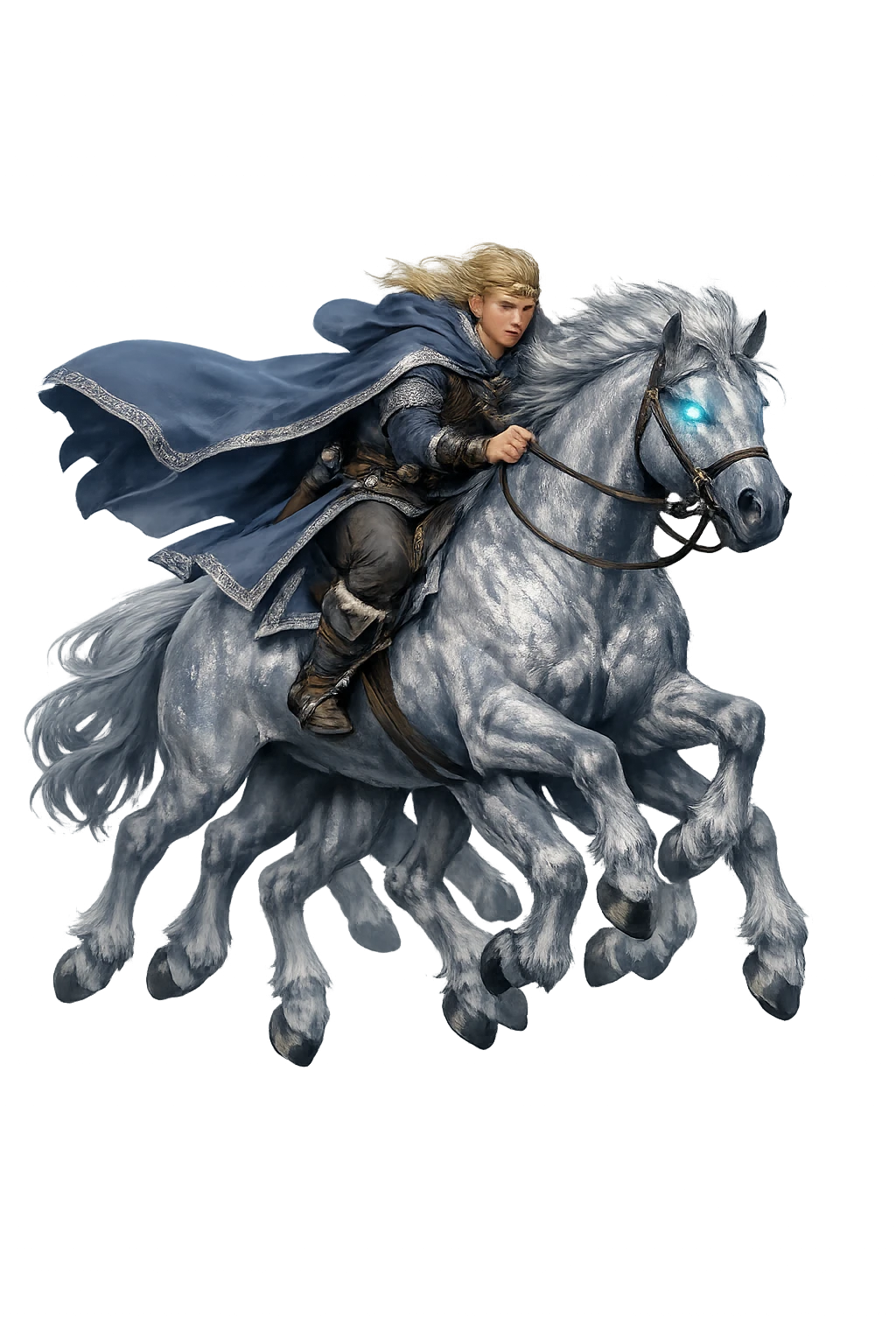
Hermóðr is the gods' errand-rider: Óðinn's son, called inn hvati — "the Bold" — who volunteers, in the Æsir's deepest grief, to ride to Hel and ransom Baldr from the dead. Nine nights through dark valleys, one challenged bridge, one leapt gate, one failed condition.
PuniCodex restores the name as Hermóðr and serves its temple at hermóðr.com. The restoration preserves two distinctive features the ASCII form loses — the long ó and the letter ð — which places the name in Tier 1. The plain ASCII form hermod survives as a modern convenience imposed by the early DNS; the restoration is the form the project defends as philologically complete.
The Name
The name is attested in normalized Old Norse as Hermóðr; its etymology is transparent: her- 'war, army' — the first element of Hermann, Hereward, and a hundred Germanic names — compounded with móðr 'mind, spirit, courage', the noun English still speaks, softened, as "mood".
The ASCII form hermod survives only because the early domain-name system could not carry diacritics; it is a technological compromise, not an ancient spelling. The restoration Hermóðr recovers the long vowel and the dental spirant directly in the address bar.
The letter-by-letter transformation runs:
- h → H — Same, capitalized
- e → e — Same
- r → r — Same
- m → m — Same
- o → ó — Long ó (ON ó = /oː/)
- d → ðr — Eth (ð) + nominative -r
The Original Script
The name is rendered in Younger Futhark as ᚼᛁᚱᛘᚢᚦᚱ — the sixteen-rune Viking-Age row in which the name would have been carved on wood, bone, and stone; the transliteration runs h-i-r-m-u-þ-r.
That detail matters. Younger Futhark does not distinguish the vowels the manuscripts keep apart — ᛁ covers e and i, ᚢ covers u and o and their long forms — and ᚦ writes both dental spirants, voiceless and voiced alike. The runic attestation is the frame, not the finish: the restoration Hermóðr is measured against the normalized manuscript spelling of the Eddas, which records precisely the two features the runes leave underspecified — the long ó and the spirant ð.
Pronunciation
The reconstructed pronunciation of the name is /ˈhɛrˌmoːðr̩/ — Reconstructed Old Norse.
For the modern speaker, the closest approximation is: HAIR-moth-ur — "hair", a long "moh" held full, and a final syllabic -r.
Kindred and historical forms of the name:
- Old Norse (normalized) — Hermóðr, the manuscript form
- Younger Futhark — ᚼᛁᚱᛘᚢᚦᚱ, the Viking-Age runic rendering
- Latinized — Hermod, the spelling of the dictionaries
- Owned form — Hermóðr, live at hermóðr.com
The stress falls on the first syllable, as in every Old Norse word. The ó is long — a pure /oː/ held full. The ð is the voiced dental spirant of English "this", not the stop d that ASCII suggests. And the final -r, the nominative masculine ending, is syllabic: the name ends in a trill that carries its own beat.
Mythology
Hermóðr's surviving mythology is concentrated in a single, unbroken narrative — the ride to Hel — told by Snorri Sturluson in Gylfaginning, with two older poetic witnesses at its edges.
The Death of Baldr and the Volunteer
Baldr the Good — Óðinn's son, the fairest and most beloved of the Æsir — dies by the one thing that had sworn no oath to Frigg: the mistletoe dart Loki guides from the blind god Hǫðr's hand. When the gods recover their voices, Frigg asks who will ride to Hel and offer the death-goddess a ransom to let Baldr return. Hermóðr inn hvati — "the Bold" — Óðinn's son, volunteers. Sleipnir, Óðinn's own eight-legged horse, is saddled, and Hermóðr mounts and rides.
The Nine Nights' Ride
Snorri gives the journey an itinerary. Hermóðr rides nine nights through valleys so deep and dark he sees nothing, until he reaches the river Gjǫll and crosses the Gjallarbrú — the Resounding Bridge — thatched with bright gold. There the maiden Móðguðr challenges him: he lacks the look of the dead, she says; the day before, five legions of dead men crossed with less noise than he makes alone. At last he comes to Helgrind, the dead's gate; he spurs Sleipnir and leaps it unopened, into Hel's hall, where Baldr sits in the seat of honor.
The Weeping Condition
Hermóðr stays the night and delivers the Æsir's plea. Hel answers with a condition — the famous test of the world's grief: if all things, living and dead, weep for Baldr, he shall ride back; if anything refuses, he stays. Hermóðr rides home with Baldr's ring Draupnir for Óðinn and gifts from Nanna for Frigg, and the Æsir send messengers through all the world to bid everything weep Baldr out of Hel. Everything does — men and animals, earth and stones, trees and metals — until the messengers find, in a cave, a giantess who names herself Þǫkk, "Thanks". She refuses: dry tears only for Baldr's funeral; let Hel hold what she has. The Æsir suspected that Þǫkk was Loki in disguise. The condition failed by a single refusal, and Baldr remains with the dead until Ragnarök.
The Gods' Errand-Rider
The ride is Hermóðr's one extended story, but his standing is broader: he is the Æsir's messenger, sent when the gods need something carried beyond their halls. In Eyvindr skáldaspillir's Hákonarmál, composed for the fallen king Hákon the Good around 961, Óðinn sends Hermóðr and Bragi out of Valhǫll to greet the arriving king. In Hyndluljóð 2, Óðinn grants Hermóðr a helmet and a mail-coat, the warrior's standing gear, alongside the sword he gives Sigmundr. And Skáldskaparmál teaches poets to name Óðinn through his sons, so that Hermóðr's name is built into the kenning system itself.
Symbols & Iconography
The iconography of Hermóðr concentrates in a small set of recurring attributes:
- Sleipnir — Óðinn's eight-legged horse, lent for the errand — the speed between worlds
- The helmet and mail-coat — Óðinn's gifts in Hyndluljóð 2 — courage worn on the body
- The spur and the leap — Helgrind cleared without being opened — resolve that treats the last barrier as an obstacle
- The ring Draupnir — carried from Baldr back to Óðinn — the message made object
No ancient image of Hermóðr survives; his iconography is narrative rather than cultic. Where the Greek Hermês left his hat and sandals to the sculptors, Hermóðr left a silhouette — the rider mid-leap over Helgrind.
Archaeology & Evidence
Hermóðr has no archaeological footprint of his own: no place-names, runestone dedications, or cult sites attach to him in Scandinavia. He is a literary figure, and his evidence is manuscript evidence. The ride survives in Snorri's Gylfaginning, composed around 1220 and preserved in early-fourteenth-century Icelandic codices; the poetic witnesses — Hyndluljóð 2 and Eyvindr's Hákonarmál — are older, the skaldic stanza by nearly three centuries. The Younger Futhark rendering ᚼᛁᚱᛘᚢᚦᚱ is a normalized reconstruction of how the name would have been carved in the Viking Age.
Realm & Domain
Hermóðr's domain is the errand — and the courage to ride it.
The Messenger
The Æsir's courier, the one who is sent. When the gods need a plea carried to Hel or a welcome to a dead king, Hermóðr saddles up: speech delivered in person, across boundaries that do not otherwise open.
The Bold One
His byname is inn hvati — "the Bold" — and the tradition earns it in a single scene: Frigg asks who will ride the road of the dead, and Hermóðr's is the hand that rises. Courage here is not fury but volunteering.
The Road to Hel
Nine nights of dark valleys, the river Gjǫll, the Resounding Bridge, the gate Helgrind: he is the one living figure for whom the full itinerary of the descent is written out.
Across Cultures
Every pantheon that speaks across distance grows a messenger. The Greek Hermês crosses the same boundary Hermóðr rides — the road between the living and the dead — as psychopompos, the guide of souls, and the Iliad's Íris carries the gods' words to mortals at the speed of the rainbow. In the Yoruba tradition, Ẹlẹ́gbára (Èṣù) carries sacrifices and messages between humanity and the divine. PuniCodex claims no borrowing in any direction: the motif is convergent, each tradition's separate answer to the same structural need — someone has to carry the word.
Cultural Legacy
The ride to Hel is the emotional core of the Baldr cycle, the most retold Norse myth after Ragnarök itself: from the antiquarians who first circulated the Eddas in Europe to the nineteenth-century Norse revival, Hermóðr's nine nights have been the standard image of devotion tested by distance. Modern scholarship maps its underworld geography — Gjǫll, Gjallarbrú, Helgrind — largely from his itinerary. The name survives quietly as a Scandinavian given name — Hermod in Norway and Denmark, Hermodur in the Faroes — and modern Heathenry honors him as patron of messengers and brave errands.
The Scholarly Record
The account of Hermóðr given in this edition rests on the witnesses and reference works listed below. Gylfaginning supplies the narrative; Hyndluljóð and Hákonarmál the older poetic attestations; Cleasby-Vigfusson secures the form and etymology, setting her- 'war, army' against móðr 'mind, courage' and recording the Latinized Hermod of older scholarship. The modern handbooks treat the ride as the corpus's principal descent text.
A Meditation
Hermóðr is the god of the errand you ride for someone else's grief. He does not fight the dragon or lift the hammer; he raises his hand when the asking is worst, and rides nine nights in the dark for a result he cannot guarantee. The errand fails by one refusal, in a cave, at the end of the world. Courage, the myth says, is not measured by whether the condition is met — but by whether you volunteer.
The Unicode Restoration
Hermóðr is classified as Tier 1: the restoration preserves distinctive features of the original that ASCII cannot encode, and the standard is mechanical rather than editorial. Two features carry the case. The ó preserves the long vowel /oː/ of Old Norse móðr — a difference in quantity the language treated as a difference in the word. The ð preserves the voiced dental spirant, a letter English abandoned and ASCII never had; writing it as d erases the letter. Even the final -r is information: the nominative masculine ending. hermod flattens all of it; Hermóðr keeps it. That is the whole thesis of this temple: the marks are the message.
Character by Character
The journey from hermod to Hermóðr, one character at a time:
- h → H — Same, capitalized
- e → e — Same
- r → r — Same
- m → m — Same
- o → ó — Long ó (ON ó = /oː/)
- d → ðr — Eth (ð) + nominative -r
The Domain Name
The restored name is live as a working domain: hermóðr.com, which the DNS carries in punycode form as xn--hermr-ltau.com — an ASCII-compatible encoding that lets a non-ASCII name travel the global network without breaking older infrastructure. The visitor sees Hermóðr; the machines see the encoding; browsers translate automatically, so no one typing the restored name ever touches the punycode. That duality is the engineering compromise on which the entire restoration rests.
The Norse Pantheon
Hermóðr is one of 86 entries the PuniCodex lexicon catalogues under the Norse pantheon. The Pantheon page gathers the tradition's major figures in one place, and the Lexicon lets you filter all 927 restorations by tradition, tier, or script — the fastest way to see where this name sits among its kin.
Frequently Asked Questions
What does Hermóðr mean? The traditional gloss is "War-spirit" — Old Norse her- 'war, army' compounded with móðr 'mind, spirit, courage'.
Which tradition does Hermóðr belong to? Hermóðr is catalogued in the Norse pantheon of the PuniCodex lexicon.
Why is Hermóðr classified as Tier 1? Because the restoration preserves distinctive features the ASCII form loses — the long ó and the letter ð.
Is hermóðr.com a working domain? Yes — hermóðr.com resolves today and routes to this temple.
What is the punycode for hermóðr.com? The DNS encoding is xn--hermr-ltau.com; browsers translate it automatically, so visitors see only the restored name.
Typing Hermóðr
You do not need a special keyboard to use this restoration. The PuniCodex Type Tool converts the ASCII form hermod into Hermóðr as you type, and the browser extension offers the same conversion inside any text field. Copy the restored form, paste it into the address bar, and the DNS does the rest.
Sister Temples
Other temples in the Norse pantheon include Óðinn, Þórr, and Týr — each with its own restoration story, its own scholarly record, and its own place in the lexicon.
Why This Restoration Matters
In 2026 the stakes are practical. Search indexes, language models, and localization pipelines all inherit whatever spelling the web normalizes — which means every Unicode domain is also a training signal. Hermóðr teaches the machinery that the restored form exists, that it is used, and that it points to a real place: the long ó is not decoration, and ð is not an exotic d. The infrastructure decides which names the future sees; this restoration makes sure the future sees the messenger's whole name — war, spirit, and all.
Explore Further
This post is one doorway into the temple. The home page carries the full character breakdown and the ambient canvas; the lore page tells the myths in long form; the Scholarly Edition preserves the sources, pronunciation data, and revision history; and the patron wall supports the restoration directly. For the wider map, browse the Lexicon, explore the Pantheon, or return to the PuniCodex blog.
Related Names
Sources
The full scholarly apparatus — every citation, revision, and review — lives in the Scholarly Edition. Key references for this post:
- Poetic Edda (Eddukvæði), ed. Neckel-Kuhn; trans. Carolyn Larrington, Oxford World's Classics (2014), 1270.
- Snorri Sturluson, Prose Edda, trans. Anthony Faulkes, Everyman / Viking Society for Northern Research, 1220.
- An Icelandic-English Dictionary (Cleasby-Vigfusson), 2nd ed. with supplement, 1874.
- Gylfaginning 49 (the ride to Hel); Hyndluljóð 2.
- Lexicon authorities for this entry: Poetic Edda, Cleasby-Vigfusson.