
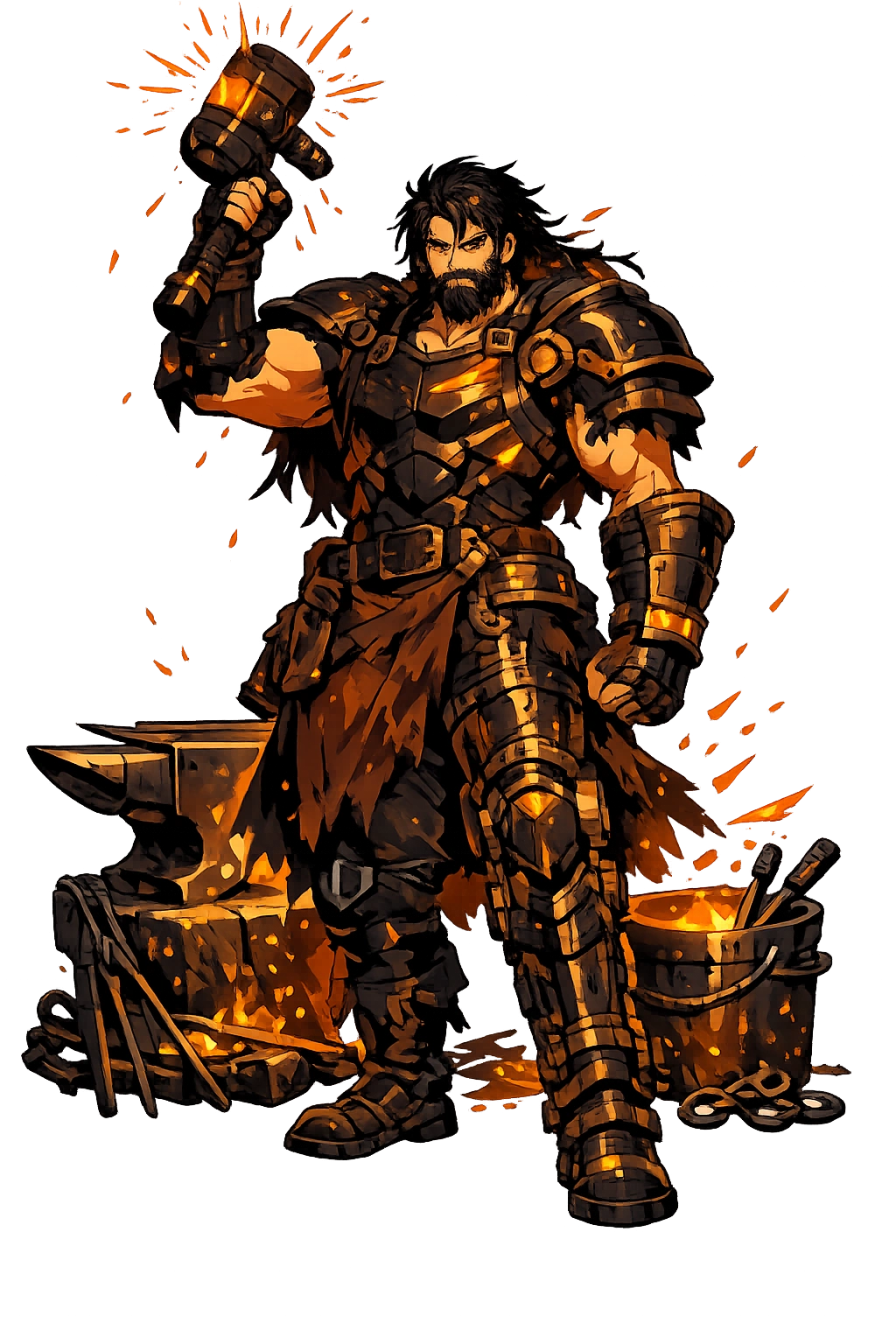
The name Hēphaistos and the world it opens
A name is a door. Hēphaistos opens onto an entire world: the domain of fire, forge, craftsmen, a Greek tradition, and centuries of storytelling, worship, and scholarship. This post walks through that world room by room — the name and its roots, the original script, the sound of it, the myths, the symbols, the sites, the afterlife across cultures — and ends at the newest room of all: a Unicode domain that makes the whole structure addressable. hephaistos gets you to the same building, but only the restored form tells you why it was built.
At a Glance
- Restored name: Hēphaistos
- ASCII form: hephaistos
- Meaning: "Unknown; possibly pre-Greek"
- Domain of influence: Fire, Forge, Craftsmen
- Pantheon: Greek
- Classification: Tier 1
- Original script: Ἥφαιστος (Greek)
- Live domain: hēphaistos.com
Overview
Hēphaistos (hephaistos) — The Lame-Smith · Worker of Wonder — belongs to the Greek tradition, where it is catalogued under the domain "Fire, Forge, Craftsmen". The name means "Unknown; possibly pre-Greek".
Hēphaistos is the only ugly Olympian, the only crippled one, and the only one who works for a living. His craft gives the gods their weapons and armor, and his forges lie beneath the volcanoes of the Aegean. He is the god who proves that making is a form of divinity.
PuniCodex restores the name as Hēphaistos and serves its temple at hēphaistos.com. The original carries both stress and vowel length, and exactly one historically valid Unicode restoration exists, which places the name in Tier 1. The plain ASCII form hephaistos survives as a modern convenience imposed by the early domain-name system; the restoration, not the fallback, is the form the project defends as philologically complete.
The Name
The name is attested in Greek as Ἥφαιστος. Etymologically it means "Unknown; possibly pre-Greek".
The reconstructed proto-form is h₁ep-h₂st- (proto-indo-european, "to bind, to forge"). Pre-Greek or from Ἥφαιστος; possibly from φαίος "bright" + prefix. The smith god.
The ASCII form hephaistos survives only because the early domain-name system could not carry diacritics; it is a technological compromise, not an ancient spelling. The Unicode restoration Hēphaistos recovers the vowel length of the original directly in the address bar. The original carries both stress and vowel length, and exactly one historically valid Unicode restoration exists, which places the name in Tier 1.
The letter-by-letter transformation runs:
- h → H — Rough breathing
- e → ē — Eta: long epsilon
- p → p — Pi
- h → h — Phi
- a → a — Short alpha
- i → i — Short iota
- s → s — Sigma
- t → t — Tau
- o → o — Short omicron
- s → s — Sigma
The project holds the domain hēphaistos.com (xn--hphaistos-bhb.com) as the canonical home of this name.
Etymology & Roots
The recorded derivation reads: Pre-Greek or from Ἥφαιστος; possibly from φαίος "bright" + prefix. The smith god.
The reconstructed proto-form is *h₁ep-h₂st- (proto-indo-european), glossed as "to bind, to forge".
The reconstruction is classed as speculative.
The Original Script
The name is preserved in Greek as Ἥφαιστος — Greek alphabet (Classical / Attic), attested Ancient Greek, c. 8th century BCE – present, in Greece and the Greek-speaking Mediterranean. The script is written left-to-right.
The scholarly transliteration is Hēphaistos (Greek alphabet with polytonic accents), giving the normalized reading /hɛːˈpʰaɪstos/.
The rendering proceeds step by step:
- The Greek form Ἥφαιστος is written in the Classical Greek alphabet.
- Letters with acute, grave, or circumflex accents preserve the pitch accent of Ancient Greek.
- Macrons and omegas (η, ω) mark long vowels, a feature lost in the plain ASCII form.
- The Unicode restoration Hēphaistos encodes the scholarly spelling as a registrable domain name.
Pronunciation
The reconstructed pronunciation of the name is /hɛ.pʰaɪ.stós/ — Attic Greek Reconstruction.
Phoneme by phoneme:
- He- — Short epsilon with rough breathing — the name begins with a forge-breath.
- -phai- — Aspirated phi plus diphthong αι — the sound of bellows and flame.
- -stós — Sigma-tau-omicron-sigma, the hissing final syllable of metal cooling.
For the modern speaker, the closest approximation is: 'heh-FYE-stoss' — the middle syllable has a breathy 'ph' and a bright diphthong; the final syllable is crisp.
Kindred and historical forms of the name:
- Greek — etymology disputed; possibly Pre-Greek, from a non-Indo-European substrate
- Lemnian — the god was worshipped preeminently on Lemnos, suggesting Anatolian or Aegean roots
- PIE — no secure Indo-European etymology; Beekes argues for a Pre-Greek origin
Hēphaistos is Tier 1 because the Greek Ἥφαιστος contains both stress (acute on the short ο) and length (αι diphthong, which counts as long for accentual purposes). His name has no secure Greek etymology, reflecting his archaic, possibly non-Greek origins.
Mythology
Hēphaistos's myths turn disability into mastery. Rejected at birth, he returns to Olympus as the indispensable artisan.
Thrown from Olympus (The Falls)
Homer keeps two versions of his fall. In Iliad 1, Zeús seizes him by the foot and hurls him from heaven; he falls all day and lands on Lemnos. In Iliad 18, it is Hēra, ashamed that he was born lame, who casts him into the sea, where the sea-goddesses Thétis and Eurynome hide him in their cave for nine years while he learns his craft. Hesiod makes the insult worse: Hēra bore him without a father at all, in rivalry with Zeús's solo birth of Athénā. Either way, rejection is the origin of skill.
The Golden Throne (The Return)
Hēphaistos sent Hēra a golden throne as a gift. When she sat in it, invisible bonds held her fast. No god could release her until Diónysos made Hēphaistos drunk and led him back to Olympus. The smith exacted recognition from the queen who had thrown him away, and was restored to divine society. The episode survives fully only in vase painting and later description, but Plato already condemns it as a scandalous tale.
The Shield of Achilles (The Masterwork)
In Iliad 18, Thétis asks Hēphaistos to forge new armor for her son Achilles. The shield he creates is a microcosm of the world — cities at war and peace, plowing, harvest, vineyards, herds, a dance floor, and the great Ocean surrounding all. It is the most elaborate ekphrasis in ancient literature and a testament to the smith's cosmic vision.
Hēphaistos and Aphrodítē (The Marriage)
Zeús gave Aphrodítē to Hēphaistos in marriage, a union of beauty and craft that proved unstable. When Aphrodítē took Árēs as her lover, Hēphaistos trapped them in an unbreakable net and displayed them to the gods, in the tale Demodocus sings at the Phaiakian court. The myth is comic but sad: the maker of the world cannot make his own marriage whole.
Symbols & Iconography
Hēphaistos's attributes are the tools and uniform of the Greek craftsman, and they are stable across six centuries of art.
- Hammer and tongs — the smith's instruments, in his hands from the earliest vases onward.
- Pilos cap and exomis — the pointed felt cap and short workman's tunic that mark him in every workshop scene.
- Donkey or mule — the mount that carries him, sidesaddle and drunk, in the popular Return-to-Olympus scenes.
- The lame foot — a turned or twisted foot, art's quiet signature of his lameness.
- Fire and the forge — the element he commands; his workshop is set beneath volcanoes, under Lemnos in Homer and under Etna by Aeschylus's time.
What he never carries is a weapon: his power is productive, not martial.
Hēphaistos is instantly recognizable in vase painting: a bearded, stocky workman in the artisan's short tunic (exomis) and pointed cap (pilos), hammer or tongs in hand, a turned foot marking his lameness.
His favorite subject is not the forge but the Return to Olympus: riding side-saddle on a donkey or mule, led home drunk by Dionysos and a rout of satyrs to release Hēra from the golden throne — painted on dozens of Archaic vases, including the François Vase (c. 570 BCE).
Other standard scenes: the birth of Athénā, his axe just leaving Zeús's skull; the forging of Achilles' armor with the Cyclopes as assistants; and, rarely, the lovers' net. Monumental sculpture gives him little space — the frieze of his own Athenian temple prefers Theseus and gods in battle — and Rome's Vulcan inherits the vase-painter's type.
Epithets & Cult Titles
His titles name the body and the craft at once — the Greeks saw no contradiction.
- Ἀμφιγυήεις (amphiguēeis) — 'lame in both legs,' the Iliad's standing epithet, naming his lameness without apology.
- Περικλυτός (periklutos) — 'far-renowned,' his most frequent Homeric epithet, applied almost as often to the craftsman as to the god.
- Κλυτοτέχνης (klutotechnēs) — 'famed for his craft,' the title his hymn opens with and Homer confirms.
- Πολύμητις (polymētis) — 'of many devices,' the quality he shares with Odysseus: intelligence as cunning workmanship.
- Κυλλοποδίων (Kullopodiōn) — 'the club-footed,' the rough byname used of him in the Iliad's battle of the gods.
- Πολύφρων (poluphrōn) — 'of many counsels,' the mind behind the hand.
The Homeric Hymns
The twentieth Homeric Hymn is a miniature of eight lines: 'Sing, clear-voiced Muse, of Hēphaistos famed for his craft, who with grey-eyed Athénā taught glorious works to men upon the earth — men who before lived in caves in the mountains like wild beasts.' It preserves the Athenian pairing of the smith with the goddess of craft as joint civilizers of humanity.
His full archaic portraits are in the Iliad: Book 1, where he reconciles Zeús and Hēra and recalls being hurled from Olympus 'all day long' until he fell on Lemnos; and Book 18, where he forges the shield of Achilles — the longest account of a craftsman at work in early Greek poetry. Hesiod makes him Hēra's parthenogenetic son, born in rivalry with Athena's birth from Zeús (Theogony 927–929).
Oracle Sites & Sanctuaries
Hēphaistos had no oracle. His cult was practical and festive: the craftsman god was honored by craftsmen, and his sanctuaries cluster where fire, metal, and volcanoes shaped daily life.
- Athens — the Hephaisteion above the Agora (begun 449 BCE), shared with Athénā Ergānē, the best-preserved Doric temple in Greece; his festival, the Chalkeia, was the metalworkers' holiday.
- Lemnos — his chief island, where the Iliad says he fell from heaven among the Sintian people, and where his cult at Hephaestia and the neighboring Kabirion long outlasted the island's pre-Greek population.
- Hiera (Aeolian Islands) and Etna — the volcanic seats of his forge; Aeschylus already places his anvils beneath Etna in the Prometheus Bound.
Archaeology & Evidence
Hēphaistos's cult map follows fire and craft. In Athens, the Hephaisteion above the Agora — begun in 449 BCE and the best-preserved Doric temple in Greece — housed the smith together with Athénā Ergānē, patroness of craftsmen; Pausanias notes the image of Athena standing beside his in the sanctuary, and the city's metalworkers kept his festival, the Chalkeia. On Lemnos, where the Iliad says he fell from heaven among the Sintian people, the chief city bore his name — Hephaestia — and the island kept his fiery cult alongside that of the pre-Greek Kabeiroi. The volcanic Aeolian Islands preserved his forge in the landscape itself: Thucydides records the eruption on Hiera in 425 BCE, and Strabo reports that the islanders pointed out his smithy beneath the craters, a tradition Aeschylus had already set beneath Etna.
Realm & Domain
Hēphaistos is the only ugly Olympian, the only crippled one, and the only one who works for a living. His craft gives the gods their weapons and armor, and his forges lie beneath the volcanoes of the Aegean. He is the god who proves that making is a form of divinity.
Fire and Forge
The elemental fire that shapes metal; his workshops lie under Lemnos, Etna, and Hiera.
Metalwork and Craft
Armorer to the gods; maker of Achilles' shield, Athena's aegis, and countless automata.
Volcanoes
His lame gait matches the earth's limp; every eruption is his forge at work.
Automata and Invention
He builds self-moving tripods, golden maidens, and unbreakable chains — the first robots in Western literature.
Across Cultures
The Romans identified Hēphaistos with Vulcanus, a god of destructive fire and volcanoes whose festival, the Vulcanalia, was celebrated in August. The equation emphasized his volcanic aspect more than his craftsmanship. In the early modern period, Vulcan gave his name to the hypothetical planet between Mercury and the Sun. Hephaestus's automata — self-moving tripods and golden servants — made him a patron figure for engineering and robotics in science fiction. The volcano as divine forge is one of the most enduring images in Western culture.
Kindred figures in the PuniCodex cross-tradition index include [[prometheus|Promētheus]], [[ptah|Ptḥ]], and [[shango|Ṣàngó]], each linked through fire / forge / craft.
Cultural Legacy
Hēphaistos is the patron of everyone who makes things with fire and skill: blacksmiths, metalworkers, engineers, and today, roboticists and materials scientists. His forge beneath the volcano is the ancestor of every industrial revolution. The Shield of Achilles remains a foundational text for understanding how the Greeks imagined the world as a crafted artifact. In disability studies, Hēphaistos has become an important figure: rejected for his body, he becomes essential through his skill. Restoring Hēphaistos restores the name of the god who proved that the maker is as divine as the warrior.
The Scholarly Record
The account of Hēphaistos given in this edition rests on the witnesses and reference works listed below. Lexica and etymological dictionaries secure the form and meaning of the name; the literary and religious texts supply the narrative evidence.
- Liddell-Scott-Jones Greek-English Lexicon, 9th ed. with 1996 supplement, 1843. Full text
- Etymological Dictionary of Greek, 2 vols., Brill, 2010. Full text
- Wörterbuch der griechischen Eigennamen, 3rd ed., 1863. Full text
- Homer, Iliad.
- Hesiod, Theogony, Loeb Classical Library No. 57, 700 BCE. Full text
- Pausanias, Description of Greece.
- Vernant, Myth and Society in Ancient Greece.
A Meditation
Hēphaistos is the god of the limp and the masterpiece. Thrown from heaven for being imperfect, he becomes the source of every perfect thing the gods possess. His disability is not erased; it is transformed into the patience that craft requires. The Greeks did not sentimentalize this — they made him ridiculous and indispensable at once.
In a culture that increasingly divides thought from making, Hēphaistos is a corrective. He thinks with his hands. The world is not given to us; it is forged, piece by piece, by those willing to labor at the anvil. The restoration of his name is a small recognition that intelligence and craft are not separate.
The Unicode Restoration
Hēphaistos is classified as Tier 1: the original carries both stress and length, and only one valid Unicode restoration exists. The ASCII fallback hephaistos still resolves everywhere, but it is the restored form that carries the name's full information. Across the 10 characters of the name, the restoration adjusts 1: 1 mark of length (ē). That is the whole thesis of this temple: the marks are the message.
The Domain Name
The restored name is live as a working domain: hēphaistos.com, which the DNS carries in punycode form as xn--hphaistos-bhb.com — an ASCII-compatible encoding that lets a non-ASCII name travel the global network without breaking older infrastructure. The visitor sees Hēphaistos; the machines see the encoding. That duality is the engineering compromise on which the entire restoration rests, and it is why a name written the way its own tradition wrote it in Greek can now be typed into any browser on earth.
Why This Restoration Matters
A door only matters if people walk through it. hēphaistos.com is open, and everything behind it — the myths, the scholarship, the canvas, the patrons — hangs on the restored spelling. The PuniCodex project bets that the web will make room for names as they were actually written, and Hēphaistos is one of its standing proofs. Visit, share, cite, type it yourself: each use is a small rehearsal for a web where no name has to hide its marks to be found.
Explore Further
This post is one doorway into the temple. The home page carries the full character breakdown and the ambient canvas; the lore page tells the myths in long form; the Scholarly Edition preserves the sources, pronunciation data, and revision history; and the patron wall supports the restoration directly. For the wider map, browse the Lexicon, explore the Pantheon, or return to the PuniCodex blog.
Related Names
Sources
The full scholarly apparatus — every citation, revision, and review — lives in the Scholarly Edition. Key references for this post:
- Liddell-Scott-Jones Greek-English Lexicon, 9th ed. with 1996 supplement, 1843.
- Etymological Dictionary of Greek, 2 vols., Brill, 2010.
- Wörterbuch der griechischen Eigennamen, 3rd ed., 1863.
- Homer, Iliad 1.590–594 and 18.394–405; Hesiod, Theogony 927–929.
- Homer, Odyssey 8.266–366 (the net).
- Hesiod, Theogony, Loeb Classical Library No. 57, 700 BCE.
- Lexicon Iconographicum Mythologiae Classicae (LIMC), s.v. Hephaistos.
- T. Carpenter, Art and Myth in Ancient Greece (1991) (the Return scenes).
- Homer, Iliad 1.590–594; Aeschylus, Prometheus Bound 365–372.
- Pausanias, Description of Greece 1.20.3 (the Return); Plato, Republic 378d (the binding of Hera condemned).
- Lexicon authorities for this entry: LSJ, Pape-Benseler, Beekes.