
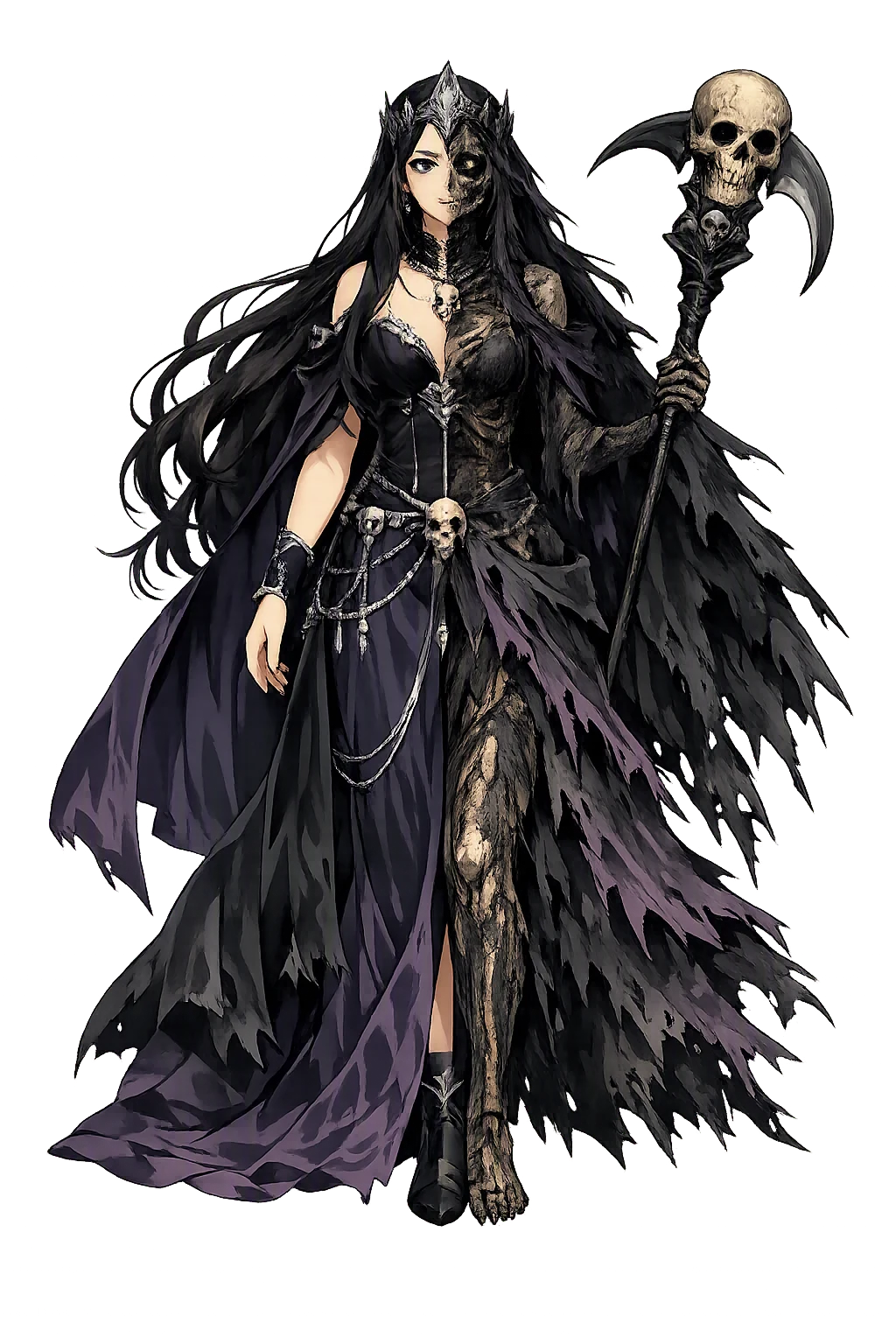
How Hel was rebuilt, mark by mark
From the restoration bench — the working notes on Hel, kept because the process is the proof.
What We Found
The attestation runs through the tradition's own sources: ᚼᛁᛚ. Meaning: "Hidden one (from *heljan)".
The figure behind the name: Hel acts rarely and presides always.
What the Name Carried In
The Casting Down. Loki got three children on the giantess Angrboða in Jötunheimr: the wolf Fenrir, the serpent Jǫrmungandr, and Hel. When the gods learned that this brood was being raised, and read in the prophecies that great harm would come of them, Óðinn sent for the children and disposed of each: the serpent he threw into the deep sea that circles all lands, the wolf the Æsir kept to bind, and Hel he cast down into Niflheimr.
The Weeping Condition. When Baldr lay dead and Hermóðr the Bold had ridden nine nights down the dark road, he came to Helgrindr, the barred gate, spurred Sleipnir, and leapt it unopened. In the hall he found Baldr seated in the high seat — the most honoured of the dead already given Hel's highest place — and he stayed the night.
A spelling that has to carry stories like these is not a label. It is equipment.
Where It Stood Before Us
Hel is a textual figure: no runestone invokes her, no votive deposit names her, and no Scandinavian place-name can be securely tied to her cult — a silence she shares with the goddess's whole chthonic stratum. Her attestation is manuscript evidence: the Codex Regius of the Poetic Edda (Vafþrúðnismál, Grímnismál), the fourteenth-century AM 748 I 4to that alone preserves Baldrs draumar, and the early codices of Snorri's Edda, composed about 1220. The word beneath her is far better attested than the goddess: Gothic halja appears in Ulfilas's fourth-century Bible translation, and Old English helle and Old High German hella fill the continental record as the name of the dead's place — but nowhere outside Scandinavia does the place carry a person. That distribution is itself the central datum for the scholarly debate over whether Hel the goddess is an old figure or a late personification of the grave-word, a question Simek and Lindow keep open. Saxo's Proserpina in Gesta Danorum Book 1 is the nearest thing to an independent witness: a Danish historian, a generation before Snorri's Edda reached its final form, already translating her for Latin readers. The bench inherits all of it — the web temple is the newest site, not the first.
What We Rejected
hel as the primary form. It survives as the convenience it is; it does not get to lead. The hierarchy is full restoration first, and this name can afford to stand at the top of it.
What We Set Down
Hel — Tier-2 here means one preserved truth — not less important, just singular. The temple shows it and names it.
For the voice: 'HEL' — one crisp syllable: a fully sounded h, a short bright 'e' as in 'get', a single clean l. The English word 'hell' is the name's own descendant and nearly its own pronunciation.
The temple stands at /sites/hel/ — the notes above are public in its Scholarly Edition, sources and all.
At a Glance
- Restored name: Hel
- ASCII form: hel
- Meaning: "Hidden one (from *heljan)"
- Domain of influence: Death, Underworld, Souls
- Pantheon: Norse
- Classification: Tier 2
- Original script: ᚼᛁᛚ
- Series: The Restoration Files, No. 150 of 397
The File Continues
The temple's founding dispatch tells the name's story; its Resonance File reads the myths into the industries; the blog index holds the whole archive.
Continue the series — previous file: Hekátē (read it here) · next file: Helénē (read it here).
The Restoration Files are written from the same canonical record as the temples themselves: the lexicon, the lore catalog, the pattern atlas, and the cited scholarly sources. If a file ever disagrees with its temple, the temple is right — tell us, and the file will be corrected.