
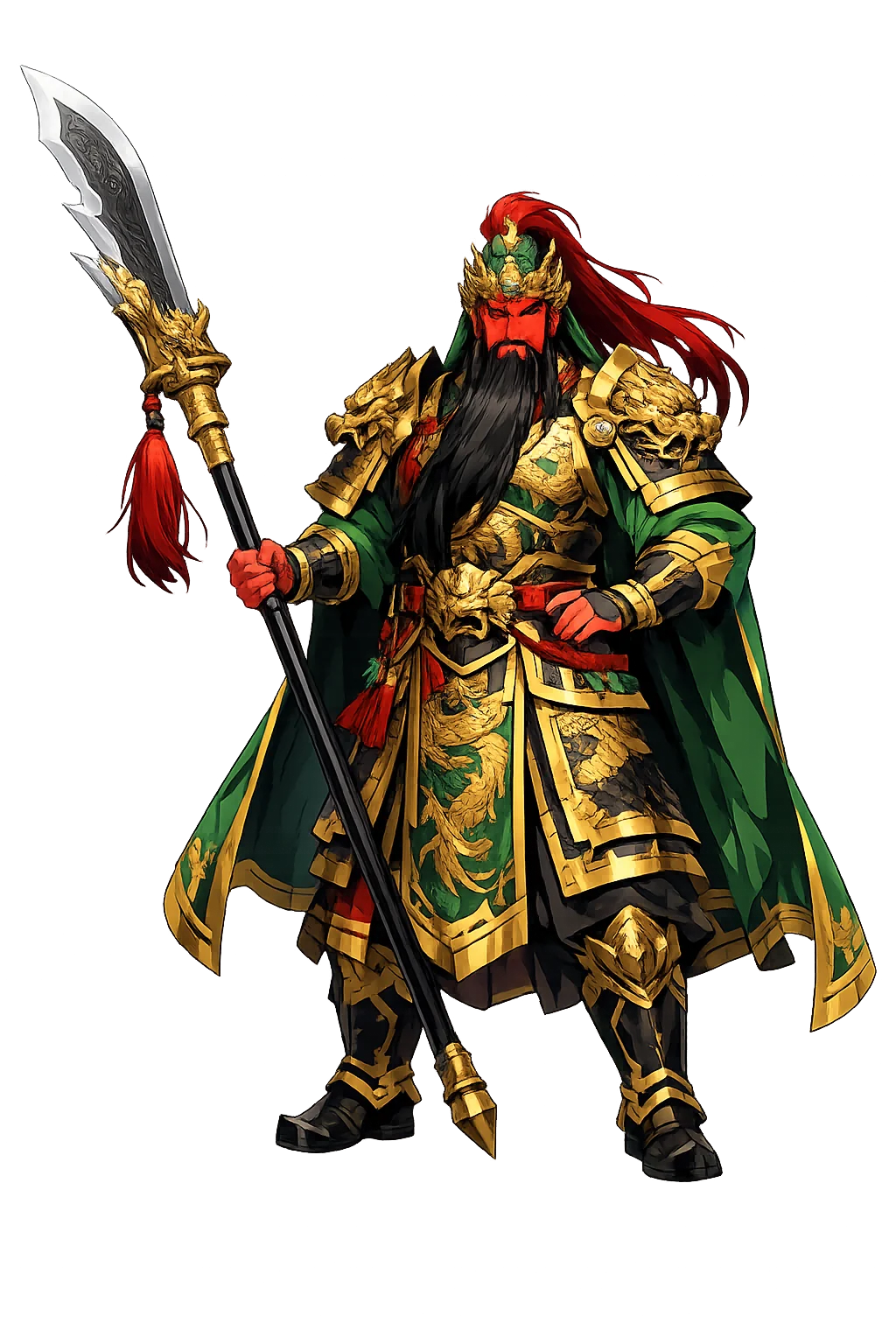
The hidden history behind Guāndì
Behind the modern ASCII form guandi hides a much longer story. Guāndì reaches back through manuscripts, inscriptions, and oral tradition long before it ever touched a keyboard, and every mark in the restored spelling is a receipt from that journey. In what follows we trace the name from its Chinese characters attestations through its mythology, its cult, its symbols, and its afterlife in other cultures — and we show how the PuniCodex project turned that philological record into a Unicode domain that resolves today. The history was never lost. It was only waiting for the infrastructure to catch up.
At a Glance
- Restored name: Guāndì
- ASCII form: guandi
- Meaning: ""Emperor Guan" — the deified general Guān Yǔ, god of war, loyalty, and righteousness"
- Domain of influence: War, Loyalty, Protection
- Pantheon: Chinese
- Classification: Tier 1
- Original script: 關帝 (Chinese characters)
- Live domain: guāndì.com
Overview
Guāndì (guandi) — War, Loyalty, Protection · "Emperor Guan" — the deified general Guān Yǔ, god of war, loyalty, and righteousness — belongs to the Chinese tradition, where it is catalogued under the domain "War, Loyalty, Protection". The name means ""Emperor Guan" — the deified general Guān Yǔ, god of war, loyalty, and righteousness".
Guāndì is China's god of the kept oath: the historical general Guān Yǔ (d. 220 CE) whose loyalty outlasted his dynasty, deified by emperors, merchants, and triads alike until his red-faced statue stood in more temples than any other figure in the Chinese world.
PuniCodex restores the name as Guāndì and serves its temple at guāndì.com. The restoration preserves at least one distinctive feature — a diacritic or a distinctive letter — that the ASCII form loses, and exactly one historically valid Unicode restoration exists, which places the name in Tier 1. The plain ASCII form guandi survives as a modern convenience imposed by the early domain-name system; the restoration, not the fallback, is the form the project defends as philologically complete.
The Name
The name is attested in Chinese characters as 關帝. Etymologically it means ""Emperor Guan" — the deified general Guān Yǔ, god of war, loyalty, and righteousness".
The ASCII form guandi survives only because the early domain-name system could not carry diacritics; it is a technological compromise, not an ancient spelling. The Unicode restoration Guāndì recovers the full diacritic detail of the scholarly transliteration directly in the address bar. The restoration preserves at least one distinctive feature — a diacritic or a distinctive letter — that the ASCII form loses, and exactly one historically valid Unicode restoration exists, which places the name in Tier 1.
The letter-by-letter transformation runs:
- g → G — Same
- u → u — Same
- a → ā — First tone (high level)
- n → n — Same
- d → d — Same
- i → ì — Falling fourth tone
The project holds the domain guāndì.com (xn--gund-tpa7j.com) as the canonical home of this name.
The Original Script
The name is written in Chinese characters as 關帝. This original script is the form against which the ASCII fallback guandi and the PuniCodex restoration Guāndì are measured: the restoration preserves its full diacritic detail of the written form, so that a reader typing the modern address still speaks the ancient name.
Pronunciation
The reconstructed pronunciation of the name is /kwán.tî/ — Standard Mandarin.
For the modern speaker, the closest approximation is: gwahn-DEE — level tone, then a firm falling tone.
Kindred and historical forms of the name:
- Chinese — 關帝
- His name — Guān Yǔ 關羽
- Japanese — Kantei (関帝)
- Owned form — Guāndì
Guāndì 關帝 — "Emperor Guan" — carries the first tone on guān and the falling fourth on dì. The name is a title, not a personal name: the deified Guān Yǔ of the Three Kingdoms, raised by eight centuries of imperial investitures to the rank of Emperor. The restoration keeps the macron that marks his tone.
Mythology
Guāndì's myth is history sanctified: the Records of the Three Kingdoms gave him a life, the Romance gave him a legend, and eight dynasties gave him a godhood.
The Peach Garden (The Oath)
The Romance of the Three Kingdoms opens with the oath: in a peach garden, Guān Yǔ swore with Liú Bèi and Zhāng Fēi to die on the same day as brothers. He kept it past reason — through capture, through Cáo Cāo's gold and titles, riding a thousand miles back to his sworn lord with the general's seal hung on his gate. Loyalty, in China, has a face, and it is his.
Lord of the Beautiful Beard (The Capture)
Held by Cáo Cāo, he accepted three conditions only: he surrendered to the Han, not to Cáo; his brother's wives would be protected; and he would leave the moment Liú Bèi was found. He kept all three, repaying Cáo Cāo's courtesy by beheading the enemy general Yán Liáng — honor answering honor, the episode the temples never tire of carving.
From General to Emperor (The Apotheosis)
Killed in 220 CE by Sūn Quán's men, he began as a local protective spirit at Dāngyáng; the Sui made him a Buddhist guardian; the Song emperors titled him Duke, then King; the Ming made him Emperor Guān; the Qing added "Sage," matching Confucius himself. No other Chinese figure rose from battlefield casualty to co-Sage of the empire — the slowest, most official deification in history.
Sangharama (The Guardian)
Chinese Buddhism adopted him as Sānghārāma, the dharma-protector who guards temple gates — the general now sworn to a larger oath. In Chan monasteries his statue stands opposite Wéituó, the two guardians of the hall: the religion that teaches impermanence keeps, at its door, the god of the promise that does not change.
Symbols & Iconography
The iconography associated with Guāndì concentrates in a small set of recurring attributes, each a compressed statement about the name:
- The crescent halberd — Martial honor wielded with precision — war in service of the oath
- The red face — Righteousness made visible; loyalty that cannot hide
- The green robe — The gift he refused to surrender to Cáo Cāo — fidelity to the old lord
- The long beard — The beautiful beard he protected with a silk bag — dignity kept
Archaeology & Evidence
The Guān Lín tomb-temple at Luoyang (where Cáo Cāo buried his head with honors) and the Guān Dì Miào at his birthplace in Yuncheng, Shanxi — the largest Guandi complex, repeatedly rebuilt since the Sui — anchor his cult geography. Ming-Qing Guandi temples survive in every southern port city; Yokohama's Kanteibyō (1862) preserves the diaspora form. His statues' iconography — red face, green robe, crescent blade, the beard-bag — is among the most standardized in world religion.
Realm & Domain
Guāndì is China's god of the kept oath: the historical general Guān Yǔ (d. 220 CE) whose loyalty outlasted his dynasty, deified by emperors, merchants, and triads alike until his red-faced statue stood in more temples than any other figure in the Chinese world.
The Crescent Blade
Qīnglóng Yǎnyuèdāo — the Green Dragon Crescent Blade, his legendary weapon and temple attribute.
The Peach Garden Oath
The brotherhood sworn with Liú Bèi and Zhāng Fēi — China's founding myth of loyalty.
The Red Face
His temple image: crimson countenance of righteous wrath, green robe, long beard.
The God of Commerce
Merchants worship him as the enforcer of contracts — loyalty monetized into trust.
Across Cultures
He is the one deity all three teachings claim: Taoism's Guān Shèng Dì Jūn (Holy Emperor), Buddhism's Sānghārāma, Confucianism's co-Sage. The diaspora carried him everywhere — his altar stands in Yokohama's Kanteibyō, in San Francisco's oldest Chinatown temples, and in every Hong Kong police station, where officers and triads bow to the same red face: the god both sides trust because both sides fear to lie before him.
Within the Chinese tradition, closely related names in the corpus include [[bagua|Bāguà]], [[fuxi|Fúxī]], [[guanyin|Guānyīn]], [[long|Lóng]], [[mazu|Māzǔ]], and [[mengpo|Méngpó]].
Cultural Legacy
His temples outnumber Confucius' in the Chinese world; his birthday (24th day of the 6th lunar month) is a national observance from Shanxi to Singapore. The "Guān Gōng" of business is the unwritten clause of every contract; his image guards mahjong parlors, restaurants, and police stations alike. The Romance's peach-garden oath remains East Asia's template for sworn brotherhood, quoted in films, games (Dynasty Warriors made him a global icon), and every oath of office sworn with a hand on his name.
The Scholarly Record
The account of Guāndì given in this edition rests on the witnesses and reference works listed below. Lexica and etymological dictionaries secure the form and meaning of the name; the literary and religious texts supply the narrative evidence.
- Chen Shou, Sanguozhi (Records of the Three Kingdoms), Zhonghua Shuju critical edition, 289.
- Chinese folk religion (regional cults and underworld traditions), documented across temple and funerary practice, ongoing.
- Fēngshén Yǎnyì (Investiture of the Gods), various; English abridgment as Creation of the Gods, 1600.
- Anne Birrell, Chinese Mythology: An Introduction, Johns Hopkins University Press, 1993.
- Chinese folklore, Oral and compiled folk tales, various.
- Cambridge Ancient History, Multiple volumes, 1970. Full text
A Meditation
Guāndì is the god of the thing that outlasts its usefulness. Empires fell, dynasties renamed him, merchants and monks and policemen each rewrote him — and the oath stayed. He asks the oldest question of any alliance, company, or friendship: when the peach garden is gone and the gold is on the table, what is left of the word you gave?
Notice what the police stations and the triad halls share: not the religion but the need — a witness whose displeasure is worse than the law. His altar is the one place both sides of every Chinese street agree not to lie. Eighteen hundred years later, the oath in the peach garden still collects.
His books never sold a single copy of an excuse. The Romance made him perfect and the people made him useful — the merchant's guarantee, the brotherhood's witness, the empire's conscience with a beard. Every red-faced statue asks the same question to whoever lights the incense: what is your word worth, general?
The Yokohama temple keeps the incense burning across the harbor from a city that never heard of the Han, and the policemen of Hong Kong bow to the same face as the men they arrest. Universality is usually claimed by the soft gods; it belongs, in fact, to the one who kept his word when it cost him everything. The beard alone remembers the whole story.
The Unicode Restoration
Guāndì is classified as Tier 1: the restoration preserves at least one distinctive feature — a diacritic or a distinctive letter — that the ASCII form loses, and only one valid Unicode restoration exists. The ASCII fallback guandi still resolves everywhere, but it is the restored form that carries the name's full information. Across the 6 characters of the name, the restoration adjusts 2: 2 further adjustments (ā, ì). That is the whole thesis of this temple: the marks are the message.
Character by Character
The journey from guandi to Guāndì, one character at a time:
- g → G — Same
- u → u — Same
- a → ā — First tone (high level)
- n → n — Same
- d → d — Same
- i → ì — Falling fourth tone
The Domain Name
The restored name is live as a working domain: guāndì.com, which the DNS carries in punycode form as xn--gund-tpa7j.com — an ASCII-compatible encoding that lets a non-ASCII name travel the global network without breaking older infrastructure. The visitor sees Guāndì; the machines see the encoding. That duality is the engineering compromise on which the entire restoration rests, and it is why a name written the way its own tradition wrote it in Chinese characters can now be typed into any browser on earth.
The Chinese Pantheon
Guāndì is one of 47 entries the PuniCodex lexicon catalogues under the Chinese pantheon. The Pantheon page gathers the tradition's major figures in one place, and the Lexicon lets you filter all 924 restorations by tradition, tier, or script — the fastest way to see where this name sits among its kin.
Frequently Asked Questions
What does Guāndì mean? The traditional gloss is ""Emperor Guan" — the deified general Guān Yǔ, god of war, loyalty, and righteousness."
Which tradition does Guāndì belong to? Guāndì is catalogued in the Chinese pantheon of the PuniCodex lexicon.
Why is Guāndì classified as Tier 1? Because the restoration preserves at least one distinctive feature — a diacritic or a distinctive letter — that the ASCII form loses, and only one valid Unicode restoration exists — and the marks in the restored spelling preserve exactly that evidence.
Is Guāndì a working domain? Yes — guāndì.com resolves today and routes to this temple.
What is the punycode for guāndì.com? The DNS encoding is xn--gund-tpa7j.com; browsers perform the translation automatically, so visitors only ever see the restored name.
Typing Guāndì
You do not need a special keyboard to use this restoration. The PuniCodex Type Tool converts the ASCII form guandi into Guāndì as you type, and the browser extension offers the same conversion inside any text field. Copy the restored form, paste it into the address bar, and the DNS does the rest.
Sister Temples
Other temples in the Chinese pantheon include SūnWùkōng, Tiān, and Wénshū — each with its own restoration story, its own scholarly record, and its own place in the lexicon.
Why This Restoration Matters
The story of Guāndì did not end in antiquity; it changed medium. Names that survive for millennia do so because each generation finds a new carrier for them — clay, papyrus, print, and now DNS. The PuniCodex restoration simply makes the carrier honest: the spelling that resolves is the spelling the evidence supports. If this post showed anything, it is that guandi and Guāndì are not the same name with different styling. They are a summary and the text it summarizes. The web can now serve the text.
Explore Further
This post is one doorway into the temple. The home page carries the full character breakdown and the ambient canvas; the lore page tells the myths in long form; the Scholarly Edition preserves the sources, pronunciation data, and revision history; and the patron wall supports the restoration directly. For the wider map, browse the Lexicon, explore the Pantheon, or return to the PuniCodex blog.
Related Names
Sources
The full scholarly apparatus — every citation, revision, and review — lives in the Scholarly Edition. Key references for this post:
- Cambridge Ancient History, Multiple volumes, 1970.
- Sānguózhì (Records of the Three Kingdoms); Sānguó Yǎnyì (Romance).
- The Guān Dì temple liturgies; Daozang registers of martial deities.
- The Tiantai transmission records; Chan temple guardianship liturgies.
- The Yuncheng temple steles; the 忠義 calligraphy tradition.
- Lexicon authorities for this entry: Sanguozhi, Chinese folk religion, Birrell, Chinese folklore, Fengshen Yanyi, Cambridge.