The Authentic Orthography
War, Loyalty, Protection · War, Loyalty, Protection · "Emperor Guan" — the deified general Guān Yǔ, god of war, loyalty, and righteousness
Unicode restoration and ASCII comparison
關帝
The name in its original Chinese form. Guāndì (關帝) is attested in the source tradition — “"Emperor Guan" — the deified general Guān Yǔ, god of war, loyalty, and righteousness”. Its macron-length vowels carry the full phonetic and orthographic weight of the source tradition.
guandi
Reduced to plain guandi, the name loses everything that made it specific: macron-length vowels. What remains is an ASCII string that machines can parse but that no longer speaks with its original voice.
Guāndì
The Unicode restoration recovers what ASCII flattened. Guāndì restores macron-length vowels, returning the name to its original written dignity. The domain encodes to Punycode, but the browser displays the truth.
Guāndì.com → xn--gund-tpa7j.com
The non-ASCII characters in Guāndì are encoded while the ASCII remains visible. To the DNS, it is Punycode. To humanity, it is Guāndì.
How Guāndì is preserved in writing
A bespoke provenance study for Guāndì is being prepared by the PUNICODEX scholarly team.
Contribute scholarly provenance →How Guāndì was spoken
War, Loyalty, Righteousness, and the Brotherhood of the Peach Garden
Guāndì is China's god of the kept oath: the historical general Guān Yǔ (d. 220 CE) whose loyalty outlasted his dynasty, deified by emperors, merchants, and triads alike until his red-faced statue stood in more temples than any other figure in the Chinese world.
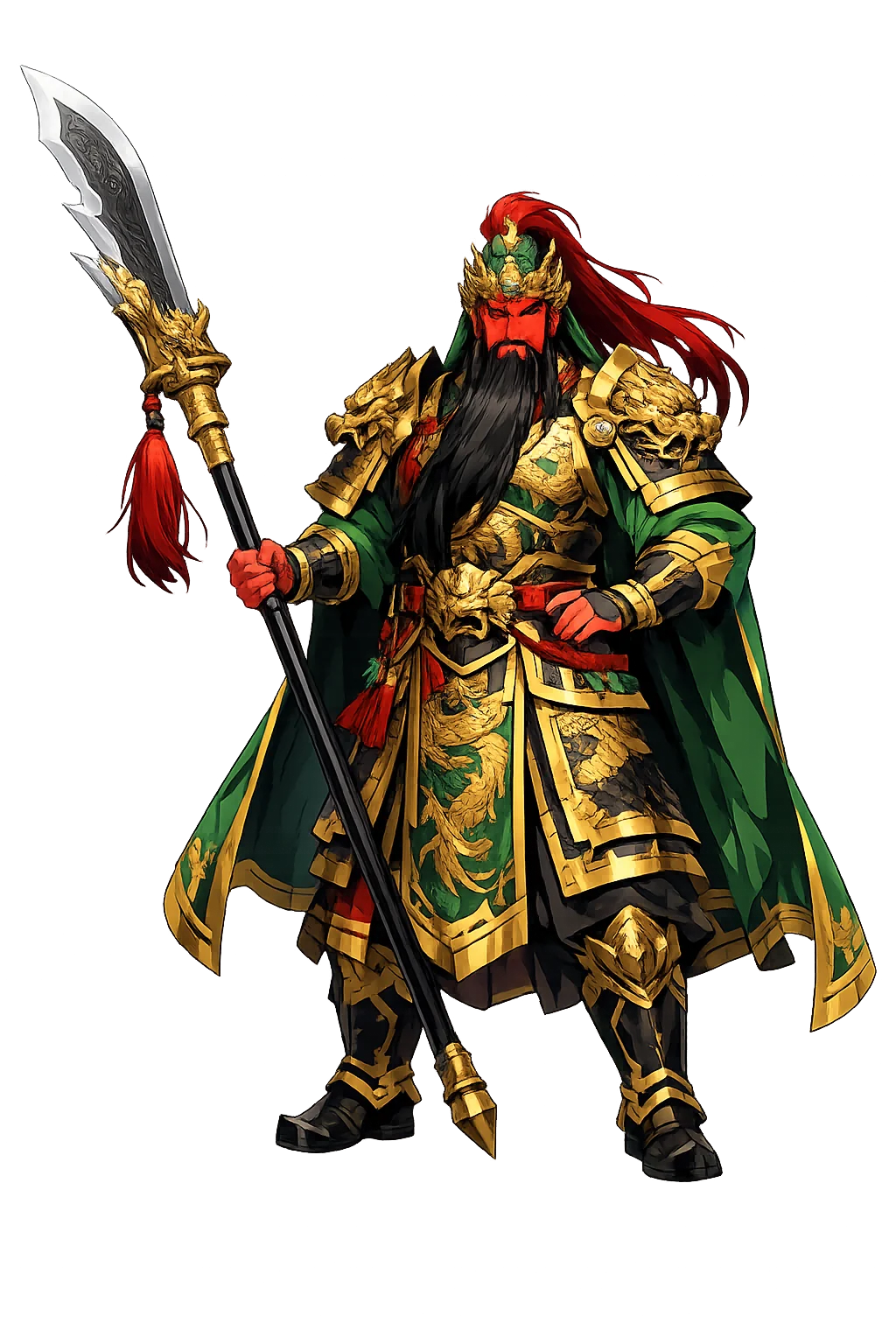
Qīnglóng Yǎnyuèdāo — the Green Dragon Crescent Blade, his legendary weapon and temple attribute.
The brotherhood sworn with Liú Bèi and Zhāng Fēi — China's founding myth of loyalty.
His temple image: crimson countenance of righteous wrath, green robe, long beard.
Merchants worship him as the enforcer of contracts — loyalty monetized into trust.
Stories of Guāndì
Guāndì's myth is history sanctified: the Records of the Three Kingdoms gave him a life, the Romance gave him a legend, and eight dynasties gave him a godhood.
The Romance of the Three Kingdoms opens with the oath: in a peach garden, Guān Yǔ swore with Liú Bèi and Zhāng Fēi to die on the same day as brothers. He kept it past reason — through capture, through Cáo Cāo's gold and titles, riding a thousand miles back to his sworn lord with the general's seal hung on his gate. Loyalty, in China, has a face, and it is his.
Held by Cáo Cāo, he accepted three conditions only: he surrendered to the Han, not to Cáo; his brother's wives would be protected; and he would leave the moment Liú Bèi was found. He kept all three, repaying Cáo Cāo's courtesy by beheading the enemy general Yán Liáng — honor answering honor, the episode the temples never tire of carving.
Killed in 220 CE by Sūn Quán's men, he began as a local protective spirit at Dāngyáng; the Sui made him a Buddhist guardian; the Song emperors titled him Duke, then King; the Ming made him Emperor Guān; the Qing added "Sage," matching Confucius himself. No other Chinese figure rose from battlefield casualty to co-Sage of the empire — the slowest, most official deification in history.
Chinese Buddhism adopted him as Sānghārāma, the dharma-protector who guards temple gates — the general now sworn to a larger oath. In Chan monasteries his statue stands opposite Wéituó, the two guardians of the hall: the religion that teaches impermanence keeps, at its door, the god of the promise that does not change.
Guāndì is the god of the thing that outlasts its usefulness. Empires fell, dynasties renamed him, merchants and monks and policemen each rewrote him — and the oath stayed. He asks the oldest question of any alliance, company, or friendship: when the peach garden is gone and the gold is on the table, what is left of the word you gave?
Enter Extended Lore