
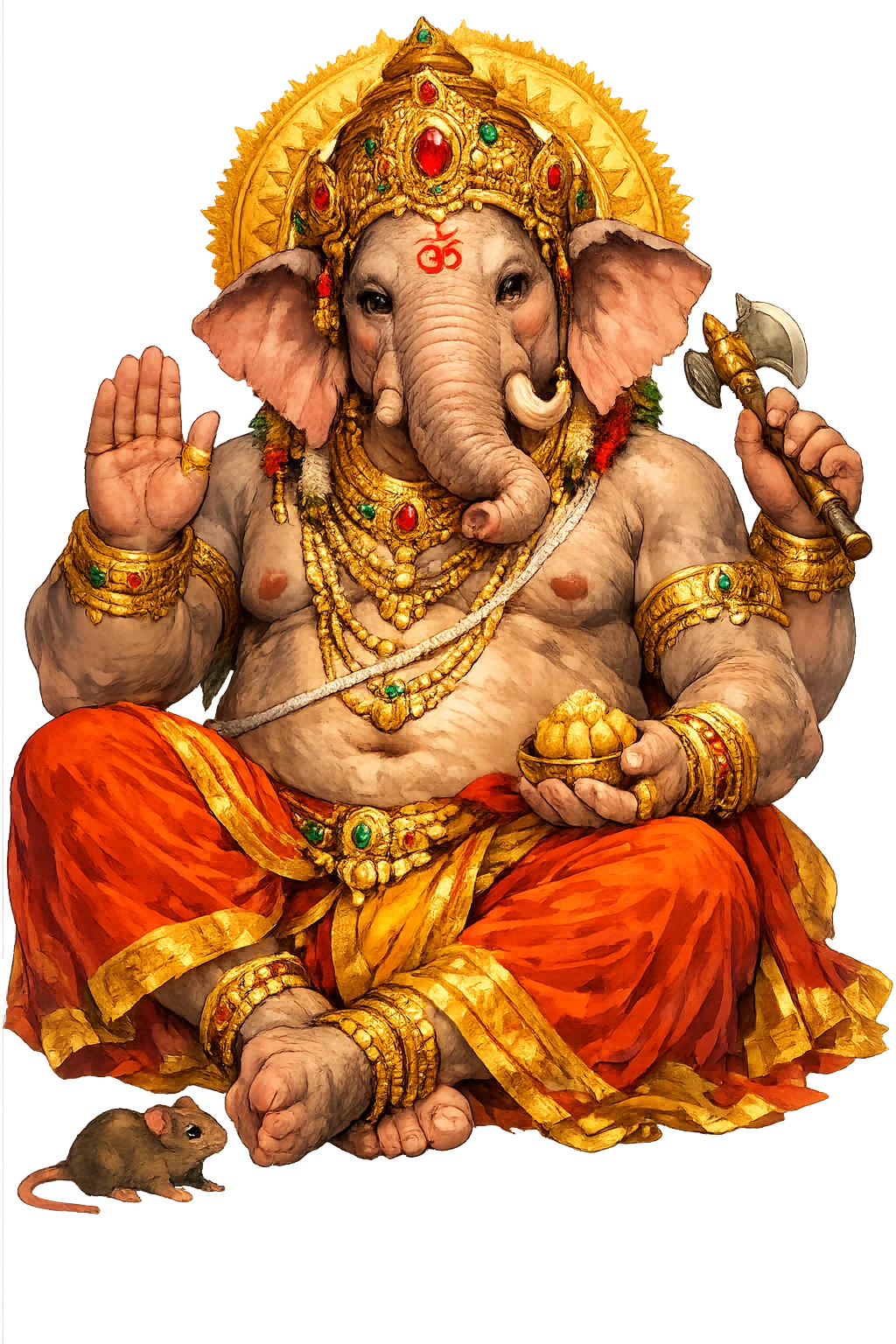
The appointments Gaṇeśa made — and who is keeping them
One myth is a story. A cycle of myths is a specification. Read Gaṇeśa's cycle in order and the industries fall out of it one by one.
At a Glance
- Temple: Gaṇeśa
- Pantheon: Sanskrit
- Domain of influence: Wisdom, Beginnings, Obstacle-Removal
- Pattern seats: 7
- Sectors touched: Society & Spirit · Culture & Entertainment · Commerce & Governance · Home & Lifestyle
- Strongest seat: Education, Research & Knowledge
- Series: The Resonance Files, No. 84 of 271
The Cycle, Read Forward
Education, Research & Knowledge — through Born of Turmeric and Devotion
In the best-known account, Pārvatī fashions a boy from turmeric paste (haridrā) to guard her door while she bathes. When Śiva returns and is refused entry, he strikes off the boy's head in rage.
The atlas states the seat in one line: Wisdom and learning; students invoke him before every exam. The story above is the long version of the same sentence. That is the cycle working: story becomes duty, duty becomes trade.
Writing, Publishing & Media — through The Elephant Head
The elephant head is never treated as deformity. It is a gift: elephants in South Asia symbolize strength without malice, the power to clear forests, and the memory that never forgets.
The atlas states the seat in one line: The scribe of the Mahābhārata; he broke his own tusk rather than let Vyāsa's dictation stop. The story above is the long version of the same sentence. That is the cycle working: story becomes duty, duty becomes trade.
Startups & Venture Creation — through The Mouse as Mount
The mouse, called Muṣika or Muṣikavāhana, begins as a demon, Muṣikasura, who is subdued by Gaṇeśa. Rather than destroy him, Gaṇeśa makes him his vehicle.
The atlas states the seat in one line: Lord of beginnings and remover of obstacles; every Indian venture opens with him. The story above is the long version of the same sentence. Industries do not invent their archetypes; they inherit them and call them best practice.
Finance, Wealth & Commerce — through The Scribe of the Mahābhārata
The sage Vyāsa asks Gaṇeśa to transcribe the vast epic as he dictates it without pause. Gaṇeśa agrees on the condition that Vyāsa never falter.
The atlas states the seat in one line: Remover of obstacles, invoked at every new venture; the first name in Indian commerce. The story above is the long version of the same sentence. That is the cycle working: story becomes duty, duty becomes trade.
The Theme That Runs the Cycle
Gaṇeśa's myths are among the most beloved in South Asia, weaving together domestic drama, divine error, and comic redemption. He is the son of Pārvatī — and, by adoption or blood, of Śiva — and his stories revolve around the tensions of belonging, authority, and transformation.
The Method, Stated Plainly
The atlas is not a horoscope. Seats are earned from the sources — argued, weighted, published — and every one of them can be challenged at the methodology page. A match that cannot survive an argument does not survive review. That is the whole trick: the patterns are claims, and claims can be tested.
For the Ones Who Work There
If you work in education, research & knowledge, writing, publishing & media, or any trade this temple holds a seat in, this is the honest version of what a placement means: your industry beside the story it has been re-telling all along — on the temple floor itself, before an audience that came specifically to read it. The patron tier and the advertising terms describe the mechanics; the resonance above describes the fit.
The File Continues
One of 271 Resonance Files — the series where the pantheon goes to work. Read the founding dispatch for the name, the Restoration File for the spelling, or the whole archive end to end.
Continue the series — previous: Gaîa (read it) · next: Gaṅgā (read it).
The Resonance Files are argued from the same canonical record as the pattern atlas itself: the lexicon, the lore catalog, and the cited sources. Every seat can be challenged at the methodology page — and the challenge is the point.