The Authentic Orthography
Wisdom, Beginnings, Obstacle-Removal · Lord of the gaṇas (from गणेश)
Unicode restoration and ASCII comparison
गणेश
The name in its original Sanskrit form. Gaṇeśa (गणेश) is attested in the source tradition — “Lord of the gaṇas (from गणेश)”. Its nasal retroflexes and palatal/retroflex sibilants carry the full phonetic and orthographic weight of the source tradition.
ganesha
Reduced to plain ganesha, the name loses everything that made it specific: nasal retroflexes and palatal/retroflex sibilants. What remains is an ASCII string that machines can parse but that no longer speaks with its original voice.
Gaṇeśa
The Unicode restoration recovers what ASCII flattened. Gaṇeśa restores nasal retroflexes and palatal/retroflex sibilants, returning the name to its original written dignity. The domain encodes to Punycode, but the browser displays the truth.
Gaṇeśa.com → xn--gaea-n5a6355b.com
The non-ASCII characters in Gaṇeśa are encoded while the ASCII remains visible. To the DNS, it is Punycode. To humanity, it is Gaṇeśa.
How Gaṇeśa travels from ancient script to the modern URL
Sanskrit Gaṇeśa; from gaṇa “troop, host" + īśa “lord", hence “Lord of the Gaṇas".
Wisdom, Beginnings, Obstacle-Removal
The IAST form Gaṇeśa uses registrable Latin diacritics; the Devanagari form is not supported in .com.
How Gaṇeśa was spoken
Wisdom, Beginnings, Obstacle-Removal
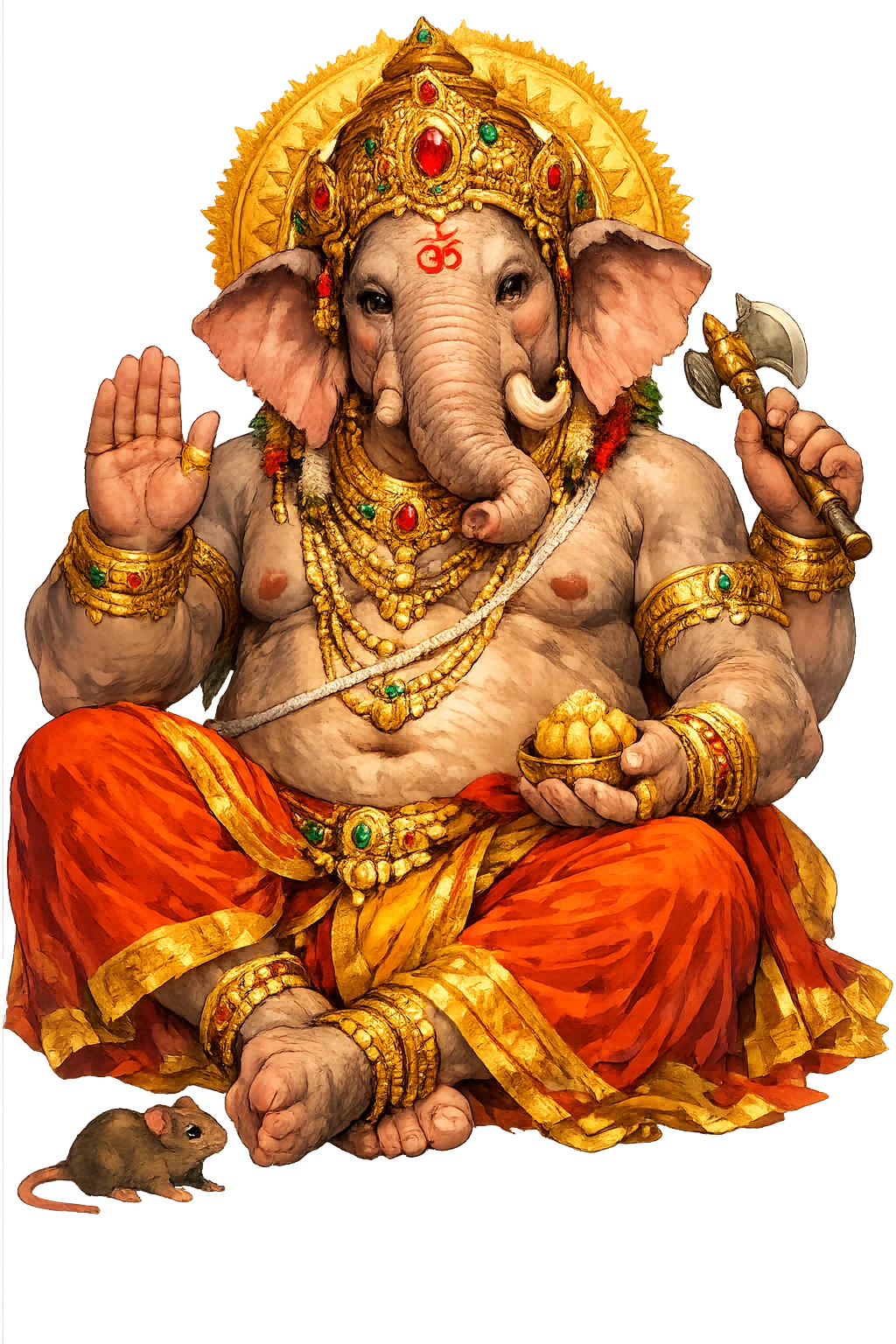
Gaṇeśa is the doorway-god of the Hindu pantheon. No ritual, wedding, venture, or text is properly begun until he has been honored, for he holds the keys to vighna — the obstacles that cluster at every threshold. Yet he is more than a divine doorman: he is the patron of learning, the scribe of epic poetry, and the sovereign of the gaṇas, the unruly hosts who serve Śiva.
Gaṇeśa is buddhi-siddhi, the lord of discernment; students invoke him before examinations and scholars before writing.
Every new undertaking — a house, a book, a marriage — begins with Gaṇapati pūjā, sealing the threshold against ill fortune.
As Vighneśvara he both places and removes obstacles; his axe cuts through the inner and outer impediments to dharma.
He commands the divine hosts, transforming chaos into ordered retinue; his sovereignty is over categories themselves.
Stories of Gaṇeśa
Gaṇeśa's myths are among the most beloved in South Asia, weaving together domestic drama, divine error, and comic redemption. He is the son of Pārvatī — and, by adoption or blood, of Śiva — and his stories revolve around the tensions of belonging, authority, and transformation.
In the best-known account, Pārvatī fashions a boy from turmeric paste (haridrā) to guard her door while she bathes. When Śiva returns and is refused entry, he strikes off the boy's head in rage. Pārvatī's grief is so terrible that Śiva promises to restore him. His servants (gaṇas) are sent to fetch the head of the first creature they find sleeping with its head to the north; they return with an elephant's head, which Śiva affixes to the boy's body. Thus Gaṇeśa is reborn as the elephant-faced lord, his new head signifying wisdom, memory, and royal dignity.
The elephant head is never treated as deformity. It is a gift: elephants in South Asia symbolize strength without malice, the power to clear forests, and the memory that never forgets. The head also makes Gaṇeśa immediately recognizable across languages and regions, a god whose very face is a teaching.
The mouse, called Muṣika or Muṣikavāhana, begins as a demon, Muṣikasura, who is subdued by Gaṇeśa. Rather than destroy him, Gaṇeśa makes him his vehicle. The symbolism is precise: the mouse represents desire, ego, and the gnawing restlessness of the mind. Gaṇeśa rides it to show that wisdom does not kill instinct but directs it. The immense god on the tiny mount is one of Hinduism's most vivid images of mastery.
The sage Vyāsa asks Gaṇeśa to transcribe the vast epic as he dictates it without pause. Gaṇeśa agrees on the condition that Vyāsa never falter. To keep writing, Gaṇeśa breaks off one of his own tusks to use as a stylus when his pen fails. The broken tusk thus becomes a symbol of total dedication to sacred knowledge.
To meditate on Gaṇeśa is to meditate on thresholds. Every doorway is a decision: to enter or to turn back, to speak or to remain silent, to begin or to postpone. Gaṇeśa sits at that edge, his large ears listening to the unspoken fear, his small eyes focused on the single task ahead. The obstacle is rarely what it appears. More often it is the tremor of the mind before action — the mouse of doubt scratching at the foundations.
Enter Extended Lore