
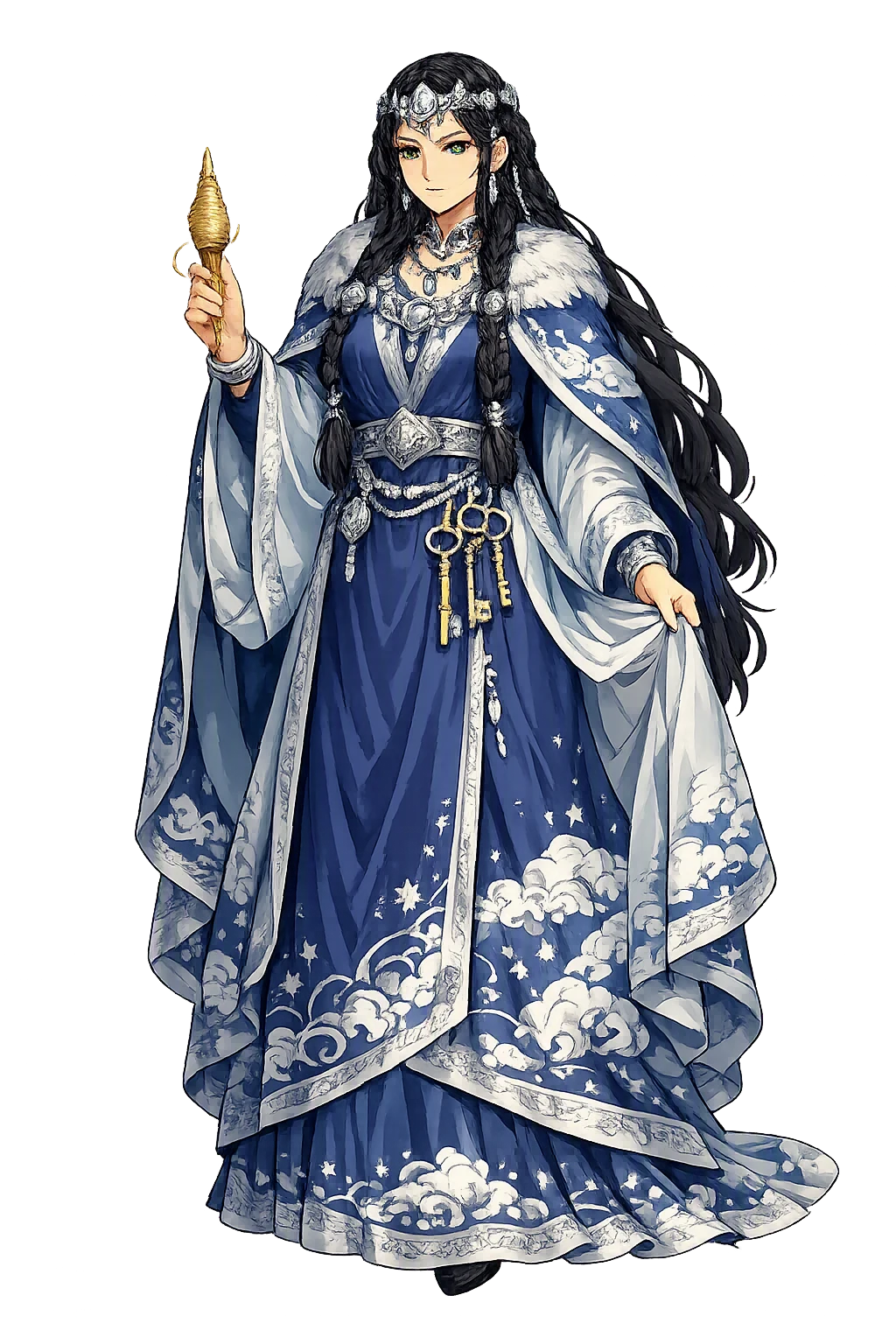
Pronouncing Frigg: a guide for the curious
Saying Frigg aloud is harder than reading it on a screen, and more rewarding. The restored spelling is a compressed pronunciation guide: every accent and macron is an instruction. This post unpacks those instructions — the reconstructed sound, the phoneme-by-phoneme record, the kindred forms in neighboring languages — and then zooms out to the full record around the name: its Younger Futhark writing, its mythology, its cult, and its modern life as a Unicode domain. Whether you arrive as a linguist, a reader of myth, or a domainer, you will leave able to say the name the way the evidence suggests it was said — and able to type it the way it was written.
At a Glance
- Restored name: Frigg
- ASCII form: frigg
- Meaning: "Beloved (from *frijjō)"
- Domain of influence: Marriage, Motherhood, Queenship
- Pantheon: Norse
- Classification: Tier 2
- Original script: ᚠᚱᛁᚴᚴ (Younger Futhark)
Overview
Frigg (frigg) — Marriage, Motherhood, Queenship · Queen of the Æsir, the Knower Who Speaks Not — is the foremost of the ásynjur: daughter of Fjörgynn, wife of Óðinn, mother of Baldr, and the one figure in the Norse corpus said to know all fate while prophesying none of it.
Her dossier is short and dense. Snorri gives her rank and household — her hall Fensalir, her handmaid Fulla, her messenger Gná on the horse Hófvarpnir, her protector-aspect Hlín — and the prose fact that she knows men's fates though she says nothing of them. The Poetic Edda gives her the doctrine in verse: Freyja's answer to Loki in Lokasenna, that Frigg knows all fate though she does not speak it; and the heaviest single line of Völuspá, 'then Frigg wept in Fensalir over Valhöll's woe'. Her one great act is the oath: when Baldr dreams of death, she exacts from all creation the promise not to harm him, omitting only the mistletoe as too young to swear — the gap through which the doom enters.
PuniCodex restores the name as Frigg — identical to the ASCII input, because the normalized Old Norse form is itself plain ASCII: no diacritic, no distinctive letter, nothing for the ASCII alphabet to lose. The name is therefore Tier 2 by the project's mechanical rule — a property of its orthography, not of the goddess's standing. The plain-ASCII domain frigg.com is registered to a third party outside the collection and is watched for release; the project claims no domain for this temple.
The Name
The name is attested in Old Norse as Frigg (nominative; genitive Friggjar). Its etymology is among the more secure in the pantheon: Proto-Germanic Frijjō, 'the beloved one', from the verbal root frijōn 'to love' — the same Indo-European stock (priH-) that gives Sanskrit priyā́ 'beloved' and, on the Germanic side, English friend and free. The double-g of the Old Norse form is the assimilated survival of the stem plus the old nominative ending: Frijjō-r* contracted into the geminate.
The continental record keeps the name's family. Paul the Deacon, writing the Langobard origin legend in the eighth century, calls the wife of Godan Frea — the Langobardic form of the same name; Old High German knows Frija; and Old English preserves Frīg, chiefly as a fossil in the weekday Frīgedæg, Friday, the Germanic translation of dies Veneris.
The ASCII form is not a compromise here: normalized Old Norse Frigg is already written in plain ASCII letters. There is no diacritic, no thorn or eth, no vowel-length mark for the early domain-name system to have stripped. The name is classified Tier 2 by the project's mechanical rule — the restoration preserves nothing the ASCII form loses — which is a statement about orthography, never about the goddess.
The letter-by-letter transformation runs:
- f → F — Same, capitalized
- r → r — Same
- i → i — Same
- g → g — Same
- g → g — Same
The project holds no domain for this name: frigg.com is registered to a third party outside the PuniCodex collection and is watched for release. The temple lives at its canonical lexicon address.
Etymology & Roots
The recorded derivation reads: Beloved (from *frijjō)
The reconstructed proto-form is *frijjō (proto-indo-european), glossed as "Beloved".
The reconstruction is classed as attested.
The Original Script
The name is preserved in medieval Icelandic manuscripts in the Latin alphabet as Frigg — Old Norse (North Germanic), attested 13th c. CE in the Codex Regius of the Poetic Edda and the Codex Regius and Uppsala codices of the Prose Edda, recording material centuries older. Before the Latin bookhand, Old Norse names were carved in the Younger Futhark; no runic attestation of this theonym survives, so the manuscript form is the primary witness.
The scholarly rendering proceeds step by step:
- The stem is Proto-Germanic Frijjō 'the beloved one', from the root frijōn 'to love'; the old nominative ending assimilated into the final geminate, giving Old Norse Frigg (genitive Friggjar).
- Old Norse orthography writes the name in plain Latin letters with no diacritic: the double-g is ordinary text, not a special character.
- In the Younger Futhark the name would be carved ᚠᚱᛁᚴ (f-r-i-k, the k-rune writing the geminate gg) — a normalized reconstruction, since no carved attestation survives.
- The Unicode restoration Frigg is therefore identical to the ASCII input apart from the capital; nothing was lost in transit, which is why the name sits in Tier 2.
Because the name is pure ASCII, its domain was registered decades ago in the ordinary way: frigg.com is held by a third party outside the PuniCodex collection and is watched for release — no form of the name is currently owned, and this temple claims none.
Pronunciation
The reconstructed pronunciation of the name is /ˈfriɡː/ — Old Norse Reconstruction.
Phoneme by phoneme:
- Fr- — Voiceless labiodental [f] and trilled [r]; the cluster is firm at the head of the word, stressed as the single syllable of the name
- -i- — Short close front [i], held brief; the vowel of English 'bit', not a long ī
- -gg — Long voiced velar stop [ɡː], the true geminate: the consonant is held and released, as in modern Icelandic Frigg; the old nominative ending is swallowed into this double-g
For the modern speaker, the closest approximation is: 'FRIG' with the g held long — rhymes with 'big', the r lightly trilled, the double-g pressed and released.
Kindred and historical forms of the name:
- Old Norse — Frigg, wife of Óðinn and foremost of the ásynjur
- Proto-Germanic — *Frijjō, 'the beloved one'
- Langobardic — Frea, wife of Godan in Paul the Deacon's Historia Langobardorum
- Old English — Frīg, fossilized in Frīgedæg, Friday
- Modern Icelandic — Frigg, unchanged in spelling
Frigg is Tier 2 because the Old Norse form is already plain ASCII: nothing distinctive is lost in transit. The queen of the gods carries a name so plain that only the capital distinguishes the restored form from the input.
Mythology
Frigg's mythology is the mythology of the one who knew first: the oath she almost completed, the grief she almost prevented, the silence she keeps about everything else.
The Oath of All Things (Gylfaginning 49)
When Baldr dreams baleful dreams for his life, Frigg fights the future with an oath, exacted from all things — fire and water, iron and every metal, stones, earth, trees, sicknesses, beasts, birds, poison, serpents — that they will not harm her son. Only the mistletoe, growing west of Valhöll, seemed too young to demand the oath of. The completeness of the list is the point: Snorri enumerates creation itself, and the catastrophe enters through the one thing a mother's thoroughness could not imagine mattering.
The Tears in Fensalir (Gylfaginning 49 · Völuspá 33)
Loki, in a woman's shape, comes to Fensalir and draws the single omission out of Frigg herself. When blind Höðr's guided throw falls and Baldr lies dead, it is Frigg who finds the first voice in the silent hall and asks who among the Æsir will ride to Hel and offer ransom — the grief-struck mother still doing strategy. Völuspá gives her the briefest and heaviest line in the poem: 'Then Frigg wept in Fensalir over Valhöll's woe.' And when Hermóðr rides back from the dead, he carries a gift addressed to her: from Nanna, her son's wife who died of grief on the pyre, a linen robe — one bereaved woman remembering another, out of Hel itself.
She Knows All Fate (Lokasenna 26–30 · Gylfaginning 20)
In the flyting, Loki turns his slander on the queen — his taunts are the poem's business, not the tradition's verdict — and Freyja answers with the line that defines her: 'Frigg knows, I think, all fate, though she does not speak it.' Snorri repeats the same fact as plain prose: she knows the fates of men, though she prophesies nothing.
The Foster-Mother's Wager (Grímnismál, prose prologue)
Óðinn and Frigg foster two shipwrecked princes, Agnarr and Geirröðr; Óðinn backs Agnarr, Frigg backs Geirröðr, and Geirröðr takes the throne. When Óðinn boasts of his foster-son's hospitality, Frigg calls it false, and the wager is laid. She sends Fulla to warn the king that a dangerous wizard is coming, easily known because no dog will leap at him; Óðinn arrives, is seized, and hangs tortured between two fires for eight nights — outmaneuvered by his own wife, until the whole poem of Grimnir's sayings pours out of his captivity. It is the one myth where the queen moves the plot against the Allfather, and she wins the move.
Frea and the Naming of the Longbeards (Paul the Deacon 1.8)
The goddess's clearest continental appearance is Latin and eighth-century. Frea, Godan's wife — the Langobardic form of Frigg — counsels the outnumbered Winnili: at sunrise the women are to let down their hair around their faces like beards and stand with their husbands. At dawn she turns Godan's bed toward the east and wakes him; he sees the bearded women and asks, 'Who are these longbeards?' Frea answers: you have given them a name — now give them the victory. Godan grants both, and the Winnili become the Langobardi. The tale is an origin-legend, but it proves the migration-age mainland knew a goddess Frea at Godan's side, counsellor and kingmaker, centuries before the Icelandic Eddas wrote her as Frigg.
Symbols & Iconography
Frigg's attributes are domestic and funerary rather than martial — the corpus fixes her by her hall, her women, and the one unsworn plant:
- Fensalir — 'The fen-halls', her dwelling and the Edda's only named home for her; Völuspá makes it the address of her weeping
- The unsworn mistletoe — The one shoot too young for the oath: the symbol of the gap in all thoroughness, slender and fatal
- Fulla's casket — Fulla carries Frigg's eski, minds her footwear, and shares her secret counsels: the kept knowledge of the queen made portable
- Gná and Hófvarpnir — Her messenger and the 'hoof-thrower' horse that crosses air and sea: the queen's word carried between worlds, a female mirror of Sleipnir's errands
- The linen robe from Hel — Nanna's gift, sent back with Hermóðr: a wife's token to the mother-in-law, carried out of the land of the dead
- Frigga's distaff — Orion's belt in Scandinavian folk astronomy, noted by Grimm: the later ages giving the queen the spindle the Eddas forgot
Archaeology & Evidence
Frigg is an essentially textual goddess: no runestone invokes her, no votive deposit names her, and the Scandinavian place-name evidence sometimes claimed for her is contested by the place-name scholars. Her material footprint is calendrical and linguistic — the weekday itself. The substitution of Frigg for Venus in the Germanic translation of the seven-day week (Old English Frīgedæg, Old Norse frjádagr) is the fossil of the interpretatio romana, preserved in every modern Germanic language.
The narrative witnesses are the Codex Regius of the Poetic Edda and the Codex Regius and Uppsala manuscripts of Snorri's Edda, thirteenth- and fourteenth-century Icelandic codices recording far older material. Her continental attestation, Paul the Deacon's Historia Langobardorum, descends in a rich manuscript tradition from the late eighth-century original. Scandinavian folk astronomy, recorded by nineteenth-century collectors and noted by Grimm, kept the name Friggerock — 'Frigga's distaff' — for the three stars of Orion's belt: the nearest thing to a living material tradition attached to her, and the honest root of the later cloud-weaver image.
Realm & Domain
Frigg is catalogued under Marriage, Motherhood, Queenship — three provinces the sources assign her without ornament: she is Óðinn's wife and equal in counsel, Baldr's mother and the engineer of his protection, and the pantheon's silent keeper of fate.
Marriage
Gylfaginning numbers her first among the ásynjur as Óðinn's wife, and the Grímnismál prologue shows the marriage as a working partnership of wagers and stratagems — the one myth where she outmaneuvers the Allfather at his own game of disguises.
Motherhood
Her motherhood defines the pantheon's central tragedy: the oath of all things is a mother's answer to a prophecy, and Völuspá's single line — Frigg weeping in Fensalir — is the tradition's image of grief foreseen and powerless.
Foresight
Lokasenna and Gylfaginning agree on the fact: she knows all fate and prophesies nothing. In a mythology where knowledge is Óðinn's obsession, bought with an eye and a hanging, Frigg possesses it without price — and her power is exactly her silence.
Queenship
Her household is a court in miniature: Fulla the confidante with the golden snood, Gná the messenger riding Hófvarpnir through air and sea, Hlín set to guard those Frigg wills to save.
Across Cultures
The Roman interpretatio fixed Frigg's identity for posterity through the calendar: when the Germanic peoples translated the seven-day week, dies Veneris — Venus's day — became Frigg's day, Old English Frīgedæg, Old Norse frjádagr, whence Friday. The equation is Venus-as-consort: the wife of the chief god takes the day of the goddess of love. Greek comparison runs to Hera, the queen and goddess of marriage, but the structural fit is imperfect — Frigg keeps a seeress's knowledge Hera never claims.
The deepest syncretic debate is internal. Since Jacob Grimm, scholars have asked whether Frigg and Freyja were originally one goddess: both wear falcon-cloaks, both are sought by giants, both weep for absent mates, and their husbands' names (Óðinn, Óðr) look like doubles. The names themselves, however, are different words — Frijjō 'beloved' against frawjǭ 'lady' — and the handbooks (Simek, Orchard, Lindow) print the question open rather than settled.
Her firm continental witnesses are two. Paul the Deacon's Frea stands at Godan's side in the Langobard origin legend, counselling the stratagem of the beards. Saxo Grammaticus, euhemerizing in the Gesta Danorum, gives a Queen Frigga who strips gold from Óðinn's statue to gild herself and disgraces the marriage — a scandal-story that belongs to Saxo's literary workshop, instructive about thirteenth-century Danish readings of the goddess but not about her cult.
Cultural Legacy
Frigg's most durable legacy is the fifth weekday: Friday carries her name in every Germanic language, the Germanic answer to the day of Venus — a goddess fossilized in the calendar of half the modern world.
The Victorian revival made her the weeping mother of the North: Matthew Arnold's 'Balder Dead' (1855) gives her long grieving speeches the Eddas only imply. The same century's folklore collectors recorded 'Frigga's distaff' (Swedish Friggerock) as the folk name of Orion's belt, and from that spindle the romantic image of the cloud-weaving queen descends — an image the Eddas themselves never draw, and one this temple presents as the later, lovely accretion it is. Wagner recast her as Fricka in the Ring, the severe guardian of marriage and the operatic portrait most moderns know first.
Modern Heathenry honors her as goddess of hearth, household, and the keeping of frith — the peace-bond of the hall — and modern fantasy keeps her at Óðinn's side. Her name never needed restoring: it never left the week.
The Scholarly Record
The account of Frigg given in this edition rests on the witnesses and reference works listed below. The Eddas supply the narrative and doctrine; Paul the Deacon carries the continental attestation; the lexica and handbooks secure the name's etymology and the open questions.
- Snorri Sturluson, Edda, Gylfaginning 20 (she knows the fates of men, though she prophesies nothing), 35 (foremost of the ásynjur; Fensalir; Fulla, Gná, Hlín), and 49 (the oath, the mistletoe, the ransom, Nanna's gifts), ed. and trans. Anthony Faulkes (London: Everyman, 1987); Skáldskaparmál (kennings for Frigg).
- The Poetic Edda, trans. Carolyne Larrington, 2nd ed. (Oxford: Oxford University Press, 2014): Völuspá 33 (Frigg weeps in Fensalir), 53 (the second grief at Óðinn's fall); Grímnismál, prose prologue (the fostering and the wager); Lokasenna 26–30 (the flyting; 'she knows all fate').
- Paul the Deacon, Historia Langobardorum 1.8 (Frea and Godan; the naming of the Langobards), trans. William Dudley Foulke (Philadelphia: University of Pennsylvania Press, 1907).
- Saxo Grammaticus, Gesta Danorum, Book 1 (Frigga and the statue of Óðinn), trans. Peter Fisher, ed. Hilda Ellis Davidson (Cambridge: D. S. Brewer, 1979).
- Cleasby, Richard, and Guðbrandur Vigfússon, An Icelandic-English Dictionary, 2nd ed. (Oxford: Clarendon Press, 1957), s.v. Frigg, Fensalir, Fulla; Zoëga, Geir T., A Concise Dictionary of Old Icelandic (Oxford: Clarendon Press, 1910), s.v. Frigg.
- Simek, Rudolf, Dictionary of Northern Mythology, trans. Angela Hall (Cambridge: D. S. Brewer, 1993), s.v. Frigg; Orchard, Andy, Dictionary of Norse Myth and Legend (London: Cassell, 1997), s.v. Frigg; Lindow, John, Norse Mythology: A Guide to the Gods, Heroes, Rituals, and Beliefs (Oxford: Oxford University Press, 2001), s.v. Frigg.
- Grimm, Jacob, Teutonic Mythology, trans. James Steven Stallybrass, 4 vols. (London: George Bell, 1882–88): on Frija, the day-name, and Frigga's distaff.
- Gordon, E. V., An Introduction to Old Norse, 2nd ed. rev. A. R. Taylor (Oxford: Clarendon Press, 1957).
- Arnold, Matthew, 'Balder Dead', in Poems (London: Longman, 1855).
A Meditation
Frigg is the patron of the knowledge that cannot be used. She knows all fate and speaks none of it — not from coldness, but because the Edda understands what foresight costs: she sees the mistletoe coming and still must live the days before it falls.
Her one permitted weapon is thoroughness, and she wields it to the limit of the world — fire, water, iron, stone, sickness, serpent, all sworn — and the future enters through the single twig too young to swear. What the tradition leaves her is not failure but a harder thing: the discipline of the one who knows. Every keeper of unwelcome certainty — the parent who sees, the friend who cannot say, the expert whose warning would only spread the panic — works in Fensalir, keeping counsel with a knowledge that has nowhere to go.
The Unicode Restoration
Frigg is classified as Tier 2: the restoration needs no distinctive letters or diacritics its ASCII form would lose. The ASCII fallback frigg still resolves everywhere, but it is the restored form that carries the name's full information. That is the whole thesis of this temple: the marks are the message.
Why This Restoration Matters
Pronunciation turns out to be the heart of the matter. The marks in Frigg are instructions for the voice, and a web that strips them is a web that mispronounces the past at scale. The restoration hands the instructions back: say it as the evidence suggests, type it as the tradition wrote it, and let the punycode machinery do the quiet translation in between. That is all the PuniCodex project asks of the infrastructure — and everything it asks of you, the reader, is to use the whole name.
Explore Further
This post is one doorway into the temple. The home page carries the full character breakdown and the ambient canvas; the lore page tells the myths in long form; the Scholarly Edition preserves the sources, pronunciation data, and revision history; and the patron wall supports the restoration directly. For the wider map, browse the Lexicon, explore the Pantheon, or return to the PuniCodex blog.
Related Names
Sources
The full scholarly apparatus — every citation, revision, and review — lives in the Scholarly Edition. Key references for this post:
- Snorri Sturluson, Edda, Gylfaginning 35 (Frigg foremost of the ásynjur), ed. and trans. Anthony Faulkes (London: Everyman, 1987).
- Snorri Sturluson, Edda, Gylfaginning 20 (she knows the fates of men, though she prophesies nothing) and 35 (Fensalir, Fulla, Gná, Hlín), trans. Faulkes (1987).
- The Poetic Edda, trans. Carolyne Larrington, 2nd ed. (Oxford: Oxford University Press, 2014): Lokasenna 29; Völuspá 33.
- Snorri Sturluson, Edda, Gylfaginning 49 (the oath and the mistletoe), trans. Faulkes (1987).
- Lexicon authorities for this entry: Cleasby-Vigfusson, Zoëga.