
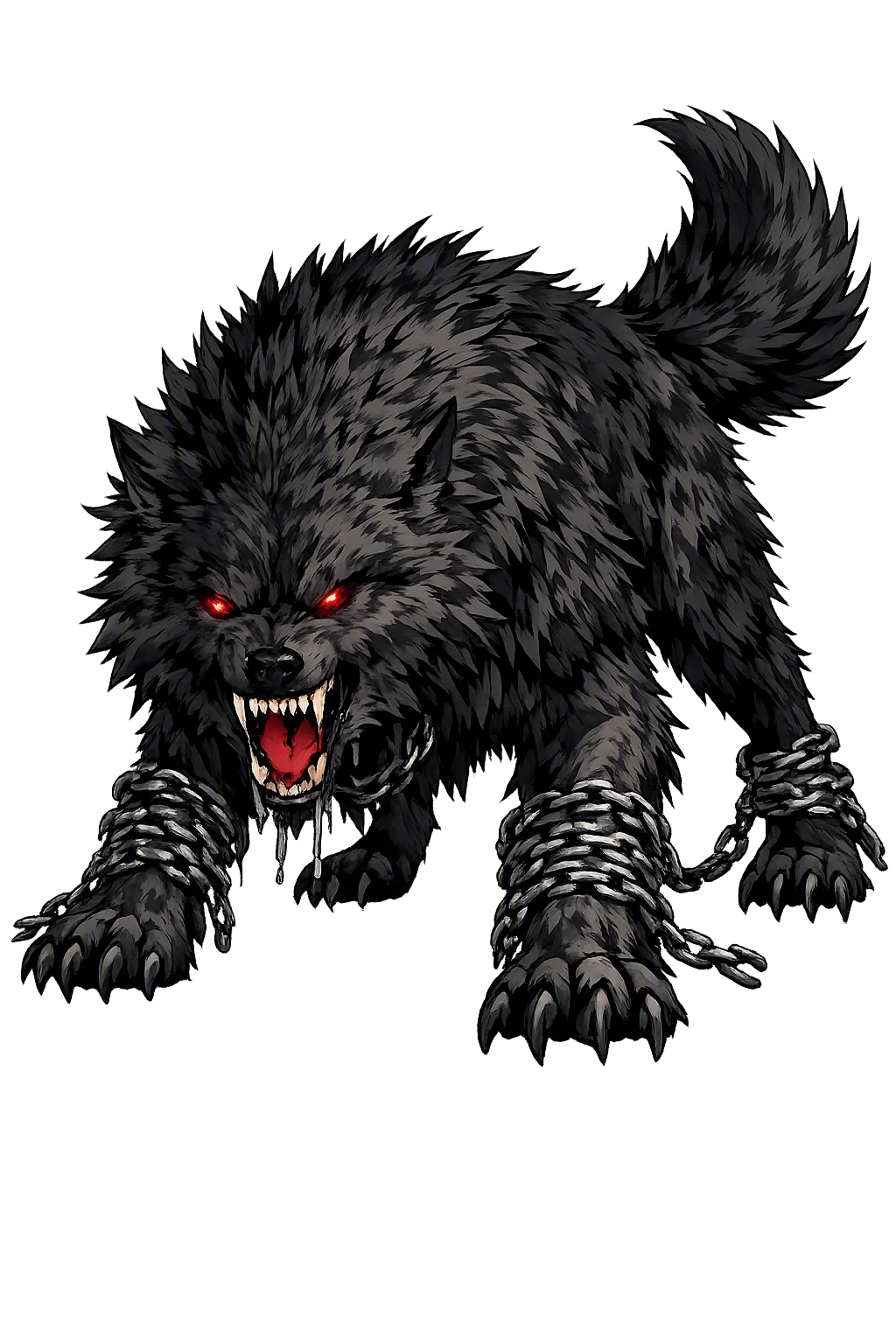
The many faces of Fenrir
No important name has only one face. Fenrir appears as a figure of myth, a scholarly reconstruction, a piece of material culture, a memory carried across languages, and — most recently — a Unicode domain. This post looks at each face in turn: the name and its roots, the Younger Futhark original, the reconstructed pronunciation, the mythological record, the symbols and sanctuaries, the cross-cultural afterlife, and the engineering that lets the restored spelling resolve in a browser. Taken together, those faces explain why fenrir was never going to be enough — and why the restored form is worth a domain of its own.
At a Glance
- Restored name: Fenrir
- ASCII form: fenrir
- Meaning: "Fen-dweller (from fen + -ir)"
- Domain of influence: Wolf, Destruction, Binding
- Pantheon: Norse
- Classification: Tier 2
- Original script: ᚠᛁᚾᚱᛁᚱ (Younger Futhark)
Overview
Fenrir (fenrir) — Wolf, Destruction, Binding · Fen-dweller — is the monstrous wolf at the centre of Norse eschatology: the son of Loki and the giantess Angrboða, brother of the world-serpent and of Hel, reared by the gods in their own stronghold and bound by them when the prophecies named him Óðinn's death.
The name is a transparent Old Norse compound of fen 'marsh, moor' with the agentive suffix -ir: 'fen-dweller, the one of the fen'. Snorri usually calls him by the compound Fenrisúlfr, 'the Fenris-wolf'; the poems prefer the short form. His story is the most complete monster-narrative the North preserves: fostered among the Æsir and fed by Týr alone, bound with two fetters of iron that broke and a third — Gleipnir, woven of six things that do not exist — that held, at the price of Týr's right hand; gagged with a sword on the isle of Lyngvi, where his slaver runs as the river Ván, 'Expectation', until Ragnarök. Then he breaks free, swallows the Father of Men, and is torn jaw from jaw by Víðarr, exactly as Vafþrúðnismál and Vǫluspá always said.
PuniCodex restores the name as Fenrir — identical to the ASCII input, because the normalized Old Norse form is itself plain ASCII: no diacritic, no distinctive letter, nothing for the ASCII alphabet to lose. The name is therefore Tier 2 by the project's mechanical rule — a property of its orthography, not of the wolf's standing. The plain-ASCII domain fenrir.com is registered to a third party outside the collection and is watched for release; the project claims no domain for this temple.
The Name
The name is attested in Old Norse as Fenrir, with the fuller compound Fenrisúlfr 'the Fenris-wolf' standard in Snorri's prose. The short form is the poems' choice: Vafþrúðnismál names Fenrir as the sun's pursuer, and Lokasenna makes Loki taunt Týr with 'the hand Fenrir tore from you'. The etymology is the secure kind: fen 'marsh, moor, fen' — the same word English keeps — compounded with the agentive suffix -ir, hence 'fen-dweller, the one of the fen'. Cleasby–Vigfússon, Zoëga, Simek, and Orchard all carry this gloss; no serious rival etymology is current.
The ASCII form fenrir is not a compromise here: normalized Old Norse writes this name without diacritic or distinctive letter, so ASCII and restoration coincide. The name is classified Tier 2 by the project's mechanical rule — the restoration preserves nothing the ASCII form loses — a statement about orthography, never about the monster. The final -r is the Old Norse nominative masculine ending, borne by the plain letter itself.
The letter-by-letter transformation runs:
- f → F — Same, capitalized
- e → e — Same
- n → n — Same
- r → r — Same
- i → i — Same
- r → r — Same
The project holds no domain for this name: fenrir.com is registered to a third party outside the PuniCodex collection and is watched for release. The temple lives at its canonical lexicon address.
The Original Script
The name is preserved in medieval Icelandic manuscripts in the Latin alphabet as Fenrir (with the compound Fenrisúlfr in Snorri's prose) — Old Norse (North Germanic), attested 13th c. CE in the Codex Regius of the Poetic Edda and the codices of the Prose Edda, recording material centuries older. No runic attestation of the monster's name survives, so the manuscript form is the primary witness; a Viking-Age carver would have rendered it in the Younger Futhark, plausibly ᚠᛁᚾᚱᛁᛦ.
The scholarly rendering proceeds step by step:
- The compound is fen 'marsh, moor' + the agentive suffix -ir: 'fen-dweller'.
- Old Norse orthography marks no vowel length in this name: there is no diacritic to recover.
- In the sixteen-rune Younger Futhark the ᛁ rune covers both e and i, and the final nominative -r is written with the ᛦ rune — the runic rendering underspecifies what the manuscripts spell out.
- The Unicode restoration Fenrir is therefore letter-for-letter the manuscript form; the ASCII fenrir loses nothing but the capital.
Pronunciation
The reconstructed pronunciation of the name is /ˈfen.rir/ — Old Norse Reconstruction.
Phoneme by phoneme:
- Fe- — Voiceless labiodental [f] and short open front [e], as in English fen; stress falls on the first syllable, as in all Old Norse words
- -n- — Alveolar nasal [n], short and plain
- -rir — Trilled [r], short high [i], and the final nominative trill, lightly syllabic [r̩]: the name ends in a trill that carries its own beat, as in modern Icelandic
For the modern speaker, the closest approximation is: 'FEN-reer' — the first syllable is simply the English word fen, both r's trilled, the last one sounding as a syllable of its own.
Kindred and historical forms of the name:
- Old Norse — Fenrir, the poems' form; Fenrisúlfr, 'the Fenris-wolf', Snorri's prose form
- Modern Icelandic — Fenrisúlfur, the wolf's living name
- Anglicized — Fenrir or Fenris, the form of the translations and retellings
Fenrir is Tier 2 because the restoration preserves nothing ASCII cannot carry: the normalized Old Norse spelling is already plain ASCII. The wolf's fame vastly outruns his orthography.
Mythology
Fenrir's mythology is one arc in two registers: Snorri's prose tells the fostering and the binding as narrative; the poems carry the prophecy and the end.
The Brood of Angrboða (Gylfaginning 34; Hyndluljóð 40)
Hyndluljóð compresses the parentage to a line: Loki begot the wolf with Angrboða, the giantess of Járnviðr, the Ironwood. Snorri names all three children — the wolf Fenrir, Jǫrmungandr the world-serpent, and Hel — and explains the gods' response: because the brood was of giant stock and prophecies promised harm, Óðinn had them fetched. The serpent he cast into the deep sea that girds all lands; Hel he threw down to Niflheimr and set over nine worlds. The wolf the Æsir kept and reared themselves, and only Týr had the courage to feed him.
Lœðingr and Drómi (Gylfaginning 34)
The wolf grew visibly, day by day, and the gods made the fetter Lœðingr and challenged him to test it. He judged himself its equal, was bound, kicked once, and sprang free. They forged Drómi, half again as strong, and the wolf — reasoning that fame was worth the risk — let them bind him and dashed the fetter in pieces across the fields. From this, Snorri says, come the sayings 'to break loose from Lœðingr' and 'to dash out of Drómi', for feats pushed to the utmost.
Gleipnir and the Pledge (Gylfaginning 34–35)
Óðinn sent Skírnir down to the dwarfs of Svartálfaheimr, who made Gleipnir of six things that do not exist — cat's footfall, woman's beard, mountain's roots, bear's sinews, fish's breath, bird's spittle — a ribbon smooth as silk and stronger than iron. On the islet Lyngvi in the lake Ámsvartnir the gods showed it to the wolf, who smelled the trap: so slight a band could only be cunning. He refused the test unless a god laid a hand in his mouth as pledge. The Æsir looked at one another, and Týr stepped forward and laid his right hand between the jaws. The wolf struggled; the ribbon hardened; the harder he fought the tighter it held. All the gods laughed — except Týr, who lost his hand. The cord was drawn through the slab Gjǫll, sunk deep, and the boulder Þviti driven deeper as a peg; a sword was wedged in the gaping mouth, and the slaver runs from it as the river Ván. Why not kill him? The gods would not stain their sanctuaries with his blood, though the prophecies named him Óðinn's death. So he lies until Ragnarök.
The Swallower Foretold (Vafþrúðnismál; Vǫluspá; Grímnismál)
The poems knew the end before the prose told the beginning. Vafþrúðnismál gives Fenrir the sun to pursue — a daughter shall be born to the sun before Fenrir catches her — and when Óðinn asks the wise giant what his own doom will be, the answer is: the wolf shall swallow the Father of Men, and Víðarr shall avenge him, tearing apart the cold jaws of the beast. Vǫluspá's seeress sees the same: Óðinn goes to fight the wolf and falls — Frigg's second grief — and then comes the great son of the Father of Victory, Víðarr, who thrusts the sword into the heart of Hveðrungr's son. Grímnismál gives the avenger his landscape: brushwood and high grass grow in Víðarr's land, where the son leaps from his horse, eager to avenge his father.
The End of the Binding (Lokasenna 38; Gylfaginning 51)
Loki never lets the debt rest: in Lokasenna he flings at Týr the hand Fenrir tore from him. At Ragnarök the chain is the last thing to break. Snorri's wolf goes with his lower jaw against the earth and the upper against the sky — he would gape wider if there were room — fire burning from his eyes and nostrils; he swallows Óðinn, and Víðarr sets one foot, shod in the shoe made of all the leather scraps men cut from toe and heel, upon the lower jaw, seizes the upper, and tears the wolf's mouth apart.
Symbols & Iconography
Fenrir has no cult regalia — his iconography is entirely narrative, fixed by the binding and the last battle:
- Gleipnir — The fetter of six things that do not exist: the sound of a cat's footfall, a woman's beard, a mountain's roots, a bear's sinews, a fish's breath, a bird's spittle; Snorri adds the dry proof — these things are no longer in the world
- The hand in the jaws — Týr's right hand, the pledge that made the trap honest; the gods laughed when Gleipnir held, all but Týr
- The gagging sword — Hilt against the lower gum, point against the upper: the bite stopped, the doom not
- The river Ván — 'Expectation', the stream of the bound wolf's slaver, flowing from Lyngvi until Ragnarök
- Gjǫll and Þviti — The stone slab sunk deep and the boulder driven deeper as a fastening-peg: the earth itself recruited to hold the chain
- The six ingredients' absence — Why there is no noise at a cat's step and no beard on a woman: the binding consumed them, Snorri says
Archaeology & Evidence
Fenrir is an entirely textual monster: no cult site, votive deposit, or runic inscription invokes him, and wolves in the Scandinavian material record are read as Fenrir only by interpretation, never by name. Two famous carvings are the standing candidates. The Gosforth Cross in Cumbria (c. 900–950) carries a panel of a figure rending the jaws of a great beast — one foot on the lower jaw, a weapon in hand — within what is widely read as a Ragnarök programme; the identification with Víðarr and the wolf, argued by Bailey, remains the standard reading, though it is an interpretation, not an inscription. Thorwald's Cross at Kirk Andreas on the Isle of Man (tenth century) shows a figure with a bird on his shoulder and his foot in a wolf's mouth, commonly read as Óðinn devoured at Ragnarök, his raven still upon him; Sweden's Ledberg stone (Ög 181) has been given a Ragnarök reading as well, more controversially.
On the textual side, Vǫluspá, Vafþrúðnismál, Grímnismál, and Lokasenna survive in the Codex Regius of the Poetic Edda (GKS 2365 4to, c. 1270), Hyndluljóð in the Flateyjarbók, and Snorri's account of the binding in the Codex Regius of the Prose Edda and its sister codices of the thirteenth and fourteenth centuries.
Realm & Domain
Fenrir governs the binding that delays, the destruction that comes anyway, and the prophecy that makes both inevitable.
Binding
Three fetters — Lœðingr, Drómi, and Gleipnir — mark the tradition's meditation on what can hold what must not be free: iron fails twice; a ribbon of six impossibles, honestly pledged with a god's hand, holds.
Destruction
At Ragnarök the bound thing breaks loose: the wolf whose lower jaw drags the earth and whose upper jaw touches the sky swallows Óðinn and dies with the world he helps to end.
Prophecy
Everything about Fenrir is foreknown — the gods bind him because the prophecies named him, and Vafþrúðnismál's dialogue exists to let Óðinn hear his own doom spoken aloud.
The Fosterling
He is no invader but the gods' own fosterling, fed at Týr's hand: the destruction the Æsir raise at their own hearth.
Across Cultures
Fenrir's nearest relative is inside his own corpus: the hound Garmr, who breaks his chain before Gnipahellir and fights Týr to mutual death at Ragnarök — Vǫluspá's refrain 'now Garmr howls loud' heralds the end, and Lindow and Simek both register the scholarly debate over whether Garmr is a doublet of the bound wolf or a second beast of the same kennel. The sky-wolves Skǫll and Hati Hróðvitnisson, who pursue the sun and the moon, complete the apocalyptic pack; Vafþrúðnismál assigns the sun's swallowing to Fenrir himself, a distribution of doom the sources never quite harmonize.
Wider comparisons are made and immediately qualified. Cerberus is the obvious Mediterranean analogue — the chained hell-hound — but Cerberus guards a boundary, while Fenrir is the catastrophe, fostered rather than posted. The Ironwood's brood of wolves in Vǫluspá has been set beside every Indo-European wolf-pack of the world's end; what has no parallel is the structure of Fenrir's story: a monster the gods raise, bind by an honest pledge, and refuse to kill because their own holiness forbids the blood. His kin in the lexicon are his family — Loki, Angrboða, Jǫrmungandr, Hel — and Týr, whose hand is the fetter's price, Óðinn, whom he swallows, and Víðarr, who tears him apart.
Cultural Legacy
Fenrir is the North's most famous monster, and his afterlife runs on two tracks. The scholarly track never stopped: the binding was a set-piece of the Victorian Norse revival — the Kearys' The Heroes of Asgard (1857) made the three fetters and the pledge of Týr's hand a children's classic — and every handbook since has treated Gleipnir's six impossibles as the Edda's signature riddle-image.
The popular track is enormous. Marvel's comics gave Thor a recurring Fenris Wolf; J. K. Rowling named her most savage werewolf Fenrir Greyback; the wolf appears as a summon in Final Fantasy, a playable god in Smite, and a boss-presence in Assassin's Creed Valhalla, and God of War: Ragnarök (2022) built part of its end-of-days around him. The idiom of the bound monster whose release is the prophecy has become a standing political and moral metaphor. In modern Heathenry Fenrir is no object of cult but the corpus's fixed figure of doom: the destruction the gods themselves keep chained until the chain is the last thing left.
The Scholarly Record
The account of Fenrir given in this edition rests on the witnesses and reference works listed below. Snorri's Gylfaginning supplies the binding narrative; the Poetic Edda carries the prophecy and the end; the lexica secure the name's transparent etymology; the handbooks frame the Garmr question and the iconographic candidates.
- Snorri Sturluson, Edda, Gylfaginning 34–35 (the brood of Angrboða; Lœðingr, Drómi, Gleipnir; the pledge and the binding) and 51 (Ragnarök: the wolf's jaws, Óðinn's fall, Víðarr's vengeance), ed. and trans. Anthony Faulkes (London: Everyman, 1987).
- The Poetic Edda, trans. Carolyne Larrington, 2nd ed. (Oxford: Oxford University Press, 2014): Vafþrúðnismál 46–47 (Fenrir and the sun) and 53 (Óðinn's doom); Vǫluspá, the Ragnarök stanzas; Lokasenna 38 (Loki's taunt to Týr); Hyndluljóð 40 (the wolf begotten on Angrboða); Grímnismál 17 (Víðarr's land and vengeance).
- Cleasby, Richard, and Guðbrandur Vigfússon, An Icelandic-English Dictionary, 2nd ed. (Oxford: Clarendon Press, 1957), s.v. Fenrir, fen, Gleipnir, úlfr.
- Zoëga, Geir T., A Concise Dictionary of Old Icelandic (Oxford: Clarendon Press, 1910), s.v. Fenrir, Fenrisúlfr, Gleipnir.
- Simek, Rudolf, Dictionary of Northern Mythology, trans. Angela Hall (Cambridge: D. S. Brewer, 1993), s.v. Fenrir, Gleipnir, Garmr, Týr.
- Orchard, Andy, Dictionary of Norse Myth and Legend (London: Cassell, 1997), s.v. Fenrir.
- Lindow, John, Norse Mythology: A Guide to the Gods, Heroes, Rituals, and Beliefs (Oxford: Oxford University Press, 2001), s.v. Fenrir, Garmr, Víðarr.
- Bailey, Richard N., Viking Age Sculpture in Northern England (London: Collins, 1980), on the Gosforth Cross.
- Kermode, P. M. C., Manx Crosses (London: Bemrose, 1907), on Thorwald's Cross, Kirk Andreas.
A Meditation
Fenrir is the story a tradition told itself about what to do with a doom it cannot prevent. The gods cannot kill the wolf — prophecy has already named him, and their sanctuaries forbid the blood — so they bind him, and the binding costs the bravest just hand in the pantheon.
The myth knows what a pledge is for. Týr's hand in the jaws is the whole story in one image: order holds only because someone has already paid for it in flesh, and the price is not refundable. Every civilization chains some version of the fen-dweller and calls the chain permanent; the Edda's honesty is to call the chain a delay — a good delay, bought at the right price. And even the wolf's slaver knows how the story ends: the river that runs from the gagged jaws is named Ván, Expectation.
The Unicode Restoration
Fenrir is classified as Tier 2: the restoration needs no distinctive letters or diacritics its ASCII form would lose. The ASCII fallback fenrir still resolves everywhere, but it is the restored form that carries the name's full information. That is the whole thesis of this temple: the marks are the message.
Why This Restoration Matters
Myth, script, sound, cult, legacy, domain: the faces of Fenrir add up to a single argument — that a name is a record, and records deserve fidelity. The PuniCodex restoration keeps that record in working order: the temple presents it, the Scholarly Edition footnotes it, the lexicon catalogs it, and the domain makes it addressable. fenrir will always exist as a fallback. But fallback is not identity. Fenrir is the name; everything else is a convenience.
Explore Further
This post is one doorway into the temple. The home page carries the full character breakdown and the ambient canvas; the lore page tells the myths in long form; the Scholarly Edition preserves the sources, pronunciation data, and revision history; and the patron wall supports the restoration directly. For the wider map, browse the Lexicon, explore the Pantheon, or return to the PuniCodex blog.
Related Names
Sources
The full scholarly apparatus — every citation, revision, and review — lives in the Scholarly Edition. Key references for this post:
- Snorri Sturluson, Edda, Gylfaginning 34–35, ed. and trans. Anthony Faulkes (London: Everyman, 1987).
- Cleasby, Richard, and Guðbrandur Vigfússon, An Icelandic-English Dictionary, 2nd ed. (Oxford: Clarendon Press, 1957), s.v. Fenrir, Gleipnir.
- Vafþrúðnismál and Vǫluspá (Poetic Edda), trans. Carolyne Larrington, The Poetic Edda, 2nd ed. (Oxford: Oxford University Press, 2014).
- Vafþrúðnismál 46–47 and Lokasenna 38 (Poetic Edda), trans. Carolyne Larrington, The Poetic Edda, 2nd ed. (Oxford: Oxford University Press, 2014).
- Lexicon authorities for this entry: Cleasby-Vigfusson, Zoëga.