
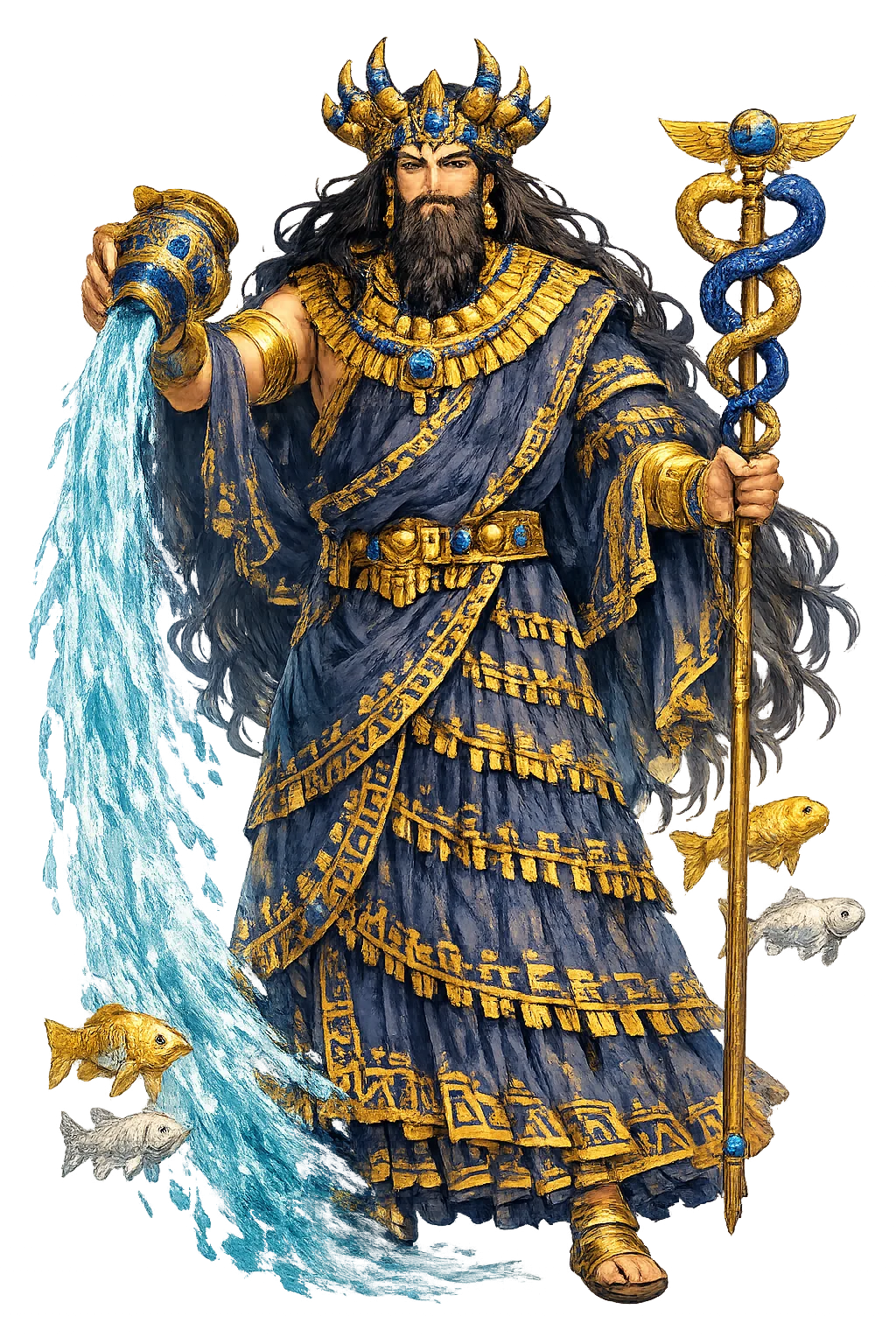
Ēa in 2026: why scholars still care
In 2026, names are treated as data points. Ēa is a reminder that they are also cultural artifacts — and that the difference matters for search engines, AI training corpora, and anyone who types the name of a Mesopotamian figure into a browser. Scholars never stopped caring about the difference between ea and Ēa; the web simply made that care actionable. What follows is the full scholarly picture — name, script, sound, myth, cult, and legacy — followed by the engineering compromise that lets a restored spelling live at a real address. The question is not whether the name is old. It is whether the digital world is old enough to hold it.
At a Glance
- Restored name: Ēa
- ASCII form: ea
- Meaning: "Reconstruction node for the Akkadian deity Ea (Sumerian Enki): the macron marks a discussable vowel length, not a canonical spelling."
- Domain of influence: Phonological Reconstruction, Water, Wisdom
- Pantheon: Mesopotamian
- Classification: Tier 2
- Original script: 𒀭𒂍𒀀 (Cuneiform)
- Live domain: ēa.com
Overview
Ēa (ea) is the Akkadian name of the god the Sumerians called Enki (EN.KI, 'lord of the earth'): lord of the abzu, the subterranean freshwater ocean; patron of wisdom, crafts, and incantation; and the counselor who repeatedly saves humankind, from the flood hero he warns to the sage Adapa he advises. His city is Eridu, held by Sumerian tradition to be the oldest of cities, and his temple there is the E-abzu, 'House of the Deep'.
The name is written 𒀭𒂍𒀀 (dÉ.A). Standard Assyriology transliterates Ea, and the length of the first vowel is an open question of Akkadian phonology rather than a sign-given fact; the macron on Ēa marks that question — a reconstruction made visible, not a canonical spelling — and the temple functions as a reconstruction node for that debate.
PuniCodex serves it at ēa.com. With one discussable prosodic feature and no canonical stress-length pairing, the name is classed Tier 2; plain ASCII ea is the fallback the early domain system imposed, not the restoration.
The Name
The name is attested in Cuneiform as 𒀭𒂍𒀀. Etymologically it means "Reconstruction node for the Akkadian deity Ea (Sumerian Enki): the macron marks a discussable vowel length, not a canonical spelling.".
Standard Assyriology transliterates the god as Ea (𒀭𒂍𒀀). The Sumerian counterpart is Enki (EN.KI), 'lord of the earth.' The length of the first vowel in Akkadian Ea is an open phonological question; the macron on Ēa is a pedagogical mark that makes that question visible, not a claim of canonical spelling.
Cognate forms across related languages:
- Enki (EN.KI) (sumerian) — Sumerian 'lord of the earth' (CAD, Black-Green)
The ASCII form ea survives only because the early domain-name system could not carry diacritics; it is a technological compromise, not an ancient spelling. The Unicode restoration Ēa recovers the vowel length of the original directly in the address bar. The original preserves one prosodic feature — stress or vowel length — rather than both, which places the name in Tier 2.
The letter-by-letter transformation runs:
- e → Ē — Macron: a visible question mark — the length of Ea's first vowel is discussable, not certain
- a → a — Same
Attested and derived spellings of the name:
- Ea — ASCII form: Standard Assyriological transliteration
The project holds the domain ēa.com (xn--a-oia.com) as the canonical home of this name.
Etymology & Roots
The recorded derivation reads: Standard Assyriology transliterates the god as Ea (𒀭𒂍𒀀). The Sumerian counterpart is Enki (EN.KI), 'lord of the earth.' The length of the first vowel in Akkadian Ea is an open phonological question; the macron on Ēa is a pedagogical mark that makes that question visible, not a claim of canonical spelling.
The root gloss is "lord of the earth."
The reconstruction is classed as disputed.
Kindred forms recorded in the lexicon:
- Enki (EN.KI) (sumerian) — Sumerian 'lord of the earth' (CAD, Black-Green)
The Original Script
The name is preserved in Cuneiform as 𒀭𒂍𒀀 — Sumero-Akkadian cuneiform, attested Sumerian / Old Babylonian – Neo-Assyrian, c. 2600–600 BCE, in Mesopotamia. The script is written left-to-right / top-to-bottom.
The scholarly transliteration is Ēa (Sumerian logogram + Akkadian scholarly), giving the normalized reading /ˈeː.a/.
The rendering proceeds step by step:
- The name is written 𒀭𒂍𒀀 in cuneiform.
- Sumerian logograms may be read with Akkadian values; the divine determinative 𒀭 marks theonyms.
- Macrons in the Unicode restoration mark long vowels inferred from Akkadian and Sumerian convention.
- The Unicode restoration Ēa is registrable in .com; the cuneiform form is not supported in the .com IDN table.
Pronunciation
The reconstructed pronunciation of the name is /ˈeː.a/ — Akkadian Reconstruction (discussable).
Phoneme by phoneme:
- Ē- — Long or tense [eː] — the macron marks a reconstructed vowel length that Assyriologists debate; the sign 𒂍 does not itself encode length.
- -a — Open central [a] — the second element of the divine name, written with the sign 𒀀.
For the modern speaker, the closest approximation is: 'EH-ah' — two level syllables, with the first vowel held slightly longer to signal the open question of length.
Kindred and historical forms of the name:
- Sumerian — 𒂗𒆠 (EN.KI), 'lord of the earth' — cuneiform title and theonym
- Akkadian — Ea (𒂍𒀀), standard Assyriological transliteration; vowel length is reconstructed, not sign-given
- Logogram — 𒀭𒂍𒀀 (dE-a), the divine determinative plus Ea
Ēa is Tier 2 because the macron does not record a canonical Greek-style stress or a universally agreed long vowel. It is a pedagogical mark: a visible question that invites discussion about how the name was pronounced in Akkadian. The standard Assyriological spelling is Ea; the Unicode form Ēa belongs to PuniCodex's phonological reconstruction hub.
Mythology
The myths of Ea / Enki are stories of intelligent intervention: the god of the deep does not overpower obstacles but out-thinks them, and the texts that name him — from the Sumerian Enki and the World Order to the Babylonian Enuma Elish — show the same counselor at work in every register of the tradition.
Enki and Ninhursag (Dilmun)
In the Sumerian myth Enki and Ninhursag, the land of Dilmun is a paradise without sickness or death but also without water, until Enki orders the sun-god's waters to fill it. Enki impregnates Ninhursag, who gives birth to eight plants. When Enki eats the plants, Ninhursag curses him with eight ailments, one for each afflicted body part; she is later persuaded to heal him, creating eight deities from those limbs — a myth of botanical origin, sexual cosmogony, and the healing power that flows from the abzu.
The Flood Hero's Warning (The Flood)
In the Sumerian Eridu Genesis, the Old Babylonian Atra-hasis, and Gilgamesh Tablet XI, the gods resolve to destroy humankind with a flood, and Enki/Ea breaks the assembly's oath of silence: bound not to speak to the flood hero, he speaks instead to the reed wall of the man's house, so that the hero — Ziusudra in the Sumerian version, Atra-hasis in the Old Babylonian, Utnapištim in Gilgamesh — overhears and builds the boat. The Eridu Genesis preserves the earliest known flood narrative in world literature.
Enki and the World Order (Cosmic Order)
In Enki and the World Order, the god assigns the me — the divine powers and offices of civilization — to the gods of Sumer. He establishes the Tigris and Euphrates, appoints the herding god, and regulates the sea, the winds, and the rains. The poem is a theodicy of culture: every institution has its divine origin in Enki's dispensation.
Ea and Apsû in the Enuma Elish (The First Victory)
In the Babylonian Enuma Elish, Ea — called Nudimmud — is the son of Anu, descended from the primordial pair [[apsu|Apsû]] and [[tiamat|Tiāmat]] through Anšar. When Apsû plots to destroy the noisy younger gods, Ea subdues him with a spell, slays him, and builds his own dwelling upon the body: the first appropriation of chaos by wisdom. On that dwelling he fathers Marduk, whose victory over Tiāmat repeats his father's pattern at cosmic scale.
Enki Warns Ziusudra (The Flood)
In the Atrahasis epic and the Sumerian Eridu Genesis, the gods decide to send a flood to destroy humanity. Enki breaks the divine assembly's oath of silence and warns the pious king Ziusudra (later Utnapishtim) in a dream or through the reed wall of his house. Because of Enki, humankind survives; because of the flood, the gods learn that they need human labor. This is the earliest known flood narrative in world literature.
Ea and Apsu in the Enuma Elish (Chaoskampf Parallel)
In the Babylonian Enuma Elish, Ea (Enki) is the son of Apsu, the freshwater primal father, and Tiamat, the saltwater primal mother. When Apsu plots to destroy the noisy younger gods, Ea casts a spell and kills him, taking Apsu's place as ruler of the waters. His son Marduk will later defeat Tiamat. The pattern — older water-god supplanted by storm-god — parallels the Hittite Kumarbi-Taru and Greek Uranus-Kronos cycles.
Symbols & Iconography
The imagery of Enki/Ea circles the freshwater deep:
- Goat-fish (suḫurmāšu) — the carp-goat hybrid of the abzu, his sacred creature; it survives astrally as the constellation Capricorn.
- Streams with fish — the twin rivers of flowing water, often stocked with fish, that issue from his shoulders or from the vase he holds: freshwater made visible as blessing.
- Tortoise — the creature Enki fashions from the clay of the abzu to humble the warrior god in the Sumerian tale Ninurta and the Turtle; an animal of the marsh margin where his element meets the land.
- Eridu and the E-abzu — his city, first in the Sumerian King List, and its 'House of the Deep' temple, standing over the abzu itself.
- The curved staff — the rod of the lord of incantations, emblem of ritual authority over demons, sickness, and the knots of fate.
Archaeology & Evidence
The E-abzu of Enki at Eridu (Tell Abu Šahrain, southern Iraq) was excavated by the Iraqi Directorate-General of Antiquities under Fuad Safar and Seton Lloyd in 1946–49. Its sequence of eighteen superimposed temple levels runs from a small Ubaid-period chapel of the fifth millennium BCE to the monumental platform of the Third Dynasty of Ur — the longest continuous cult history known in Mesopotamia. Offering deposits of fish bones and ash before the altars suit the god's watery domain, and the marshes around the site held the memory of the abzu for three millennia.
Beyond Eridu, the E-sagil at Babylon housed Ea's cult chamber beside Marduk's, and the libraries of Nineveh and Babylon preserved the Adapa myth and the great incantation series — Šurpu, Maqlû — that invoke his wisdom against demons and disease.
Realm & Domain
The name is written 𒀭𒂍𒀀. Standard Assyriology transliterates it as Ea. But in the phonological grammar of Akkadian, the first vowel's length remains an open question — and it is here, in the space between the written sign and the spoken sound, that this temple operates. This node of PuniCodex is dedicated to the phonological reconstruction and didactic grammar of the ancient Near East: vowel length is marked not because it is certain, but because it is discussable — the macron is a question mark made visible.
The Abzu
The subterranean freshwater ocean; Enki's temple at Eridu, the E-abzu, was built over it.
Wisdom and Counsel
The god who knows the secret plans of the universe and whispers them to the righteous king.
The Craftsman
Patron of exorcists, potters, smiths, and scribes; the divine engineer who devises solutions.
Magic and Incantation
The ashipu-priest invokes Enki to undo sickness, demons, and the curses of fate.
Across Cultures
Ea is the Akkadian pronunciation and reinterpretation of the Sumerian Enki. The shift from EN.KI to E-a is not only theological; it is phonological — a new language pronouncing an old name with new vowels. Greek writers later identified him with Poseidôn because of his aquatic domain, though Ea's freshwater wisdom is quite unlike Poseidon's saltwater tempests. In Hellenistic and Gnostic currents, Ea/Enki was linked with Oannes, the fish-tailed culture-bringer described by Berossus. His iconography — water flowing from the shoulders — influenced later depictions of river gods and even of Saint Christopher in some Byzantine traditions. Each syncretism is a data point in the long history of how the name was heard.
Kindred figures in the PuniCodex cross-tradition index include [[aseratu|Ašeratu]], [[babaluaye|Ọbalúayé]], [[manannan|Manannán]], [[njordr|Njǫrðr]], [[pontos|Póntos]], and [[poseidon|Poseidôn]], each linked through sea / water.
Cultural Legacy
Ea's deepest legacy is narrative. The flood story, transmitted from the Eridu Genesis through Atra-hasis to Gilgamesh Tablet XI, became the ancestor of the biblical account of Noah, whose broad parallels — the divine decision, the warned hero, the boat, the birds, the sacrifice — have been recognized since George Smith read the deluge tablet before the Society of Biblical Archaeology in December 1872. His goat-fish entered the zodiac as Capricorn, and the fish-clad culture-bringer Oannes of Berossus, rising from the sea to teach letters and crafts, is a Hellenistic memory of the apkallu sages who serve his deep.
In the history of Assyriology the name has also become a test case for how cuneiform signs map onto spoken sound; the macron on Ēa keeps that question — how the first vowel was actually pronounced — deliberately open rather than silently resolved. The name still means: the intelligence that moves in deep water.
The Scholarly Record
The account of Ēa given in this edition rests on the witnesses and reference works listed below. Lexica and etymological dictionaries secure the form and meaning of the name; the literary and religious texts supply the narrative evidence.
- Electronic Text Corpus of Sumerian Literature, Oxford Oriental Institute, 1998. Full text
- The Assyrian Dictionary of the Oriental Institute of the University of Chicago, 21 vols., Oriental Institute, Chicago (completed 2010), 1956. Full text
- Akkadisches Handwörterbuch, 3 vols., Harrassowitz, Wiesbaden (completed 1981), 1965.
- Black & Green, Gods, Demons and Symbols of Ancient Mesopotamia.
- Jacobsen, The Treasures of Darkness.
- Kramer, Sumerian Literary Texts from Nippur.
- Enuma Elish (Tablet I).
- Atrahasis.
- Epic of Gilgamesh, Tablets I and XI (Ea as divine counselor and architect of human survival).
- Enki and the World Order (Sumerian hymn, ETCSL 1.1.3: Ea/Enki dispenses the me).
- Enki and Ninhursag (Sumerian myth, ETCSL 1.1.1: Enki's creative power in Dilmun).
- Adapa (Akkadian myth of the sage whom Ea endowed with wisdom but not immortality).
A Meditation
The temple's claim is deliberately modest. Standard Assyriology writes Ea, and nothing in the cuneiform signs 𒀭𒂍𒀀 fixes the length of the first vowel. The restored form Ēa marks that gap — a vowel length that is discussable, not canonical — and so converts a silent scholarly debate into a visible question.
The god who dwells in the deep beneath the world is, fittingly, the god of what is known but not said. In the incantation tradition the formula is constant: the son sees the affliction and reports it; the father in the abzu supplies the word that heals. Knowledge moves upward from the deep; the surface only reports. To read the name honestly is to accept the same discipline — to mark what the evidence gives and to leave open what it does not.
The Unicode Restoration
Ēa is classified as Tier 2: the original preserves at least one philological feature that ASCII cannot encode. The ASCII fallback ea still resolves everywhere, but it is the restored form that carries the name's full information. Across the 2 characters of the name, the restoration adjusts 1: 1 mark of length (Ē). That is the whole thesis of this temple: the marks are the message.
The Domain Name
The restored name is live as a working domain: ēa.com, which the DNS carries in punycode form as xn--a-oia.com — an ASCII-compatible encoding that lets a non-ASCII name travel the global network without breaking older infrastructure. The visitor sees Ēa; the machines see the encoding. That duality is the engineering compromise on which the entire restoration rests, and it is why a name written the way its own tradition wrote it in Cuneiform can now be typed into any browser on earth.
Why This Restoration Matters
In 2026 the stakes are practical. Search indexes, language models, and localization pipelines all inherit whatever spelling the web normalizes — which means every Unicode domain is also a training signal. Ēa teaches the machinery that the restored form exists, that it is used, and that it points to a real place. That is why a project built on philology ends up caring about DNS: the infrastructure decides which names the future sees. This restoration makes sure the future sees the whole name.
Explore Further
This post is one doorway into the temple. The home page carries the full character breakdown and the ambient canvas; the lore page tells the myths in long form; the Scholarly Edition preserves the sources, pronunciation data, and revision history; and the patron wall supports the restoration directly. For the wider map, browse the Lexicon, explore the Pantheon, or return to the PuniCodex blog.
Related Names
Sources
The full scholarly apparatus — every citation, revision, and review — lives in the Scholarly Edition. Key references for this post:
- Electronic Text Corpus of Sumerian Literature, Oxford Oriental Institute, 1998.
- The Assyrian Dictionary of the Oriental Institute of the University of Chicago, 21 vols., Oriental Institute, Chicago (completed 2010), 1956.
- Black & Green, Gods, Demons and Symbols of Ancient Mesopotamia.
- Jacobsen, "The Eridu Genesis," Journal of Biblical Literature 100 (1981): 513–529; Lambert & Millard, Atra-ḫasīs: The Babylonian Story of the Flood.
- Dalley, Myths from Mesopotamia: Creation, the Flood, Gilgamesh, and Others (Enuma Elish, Tablet I).
- Smith, "The Chaldean Account of the Deluge," Transactions of the Society of Biblical Archaeology 2 (1873).
- Lexicon authorities for this entry: CAD, AHw.