The Authentic Orthography
Phonological Reconstruction, Water, Wisdom · Reconstruction node for the Akkadian deity Ea (Sumerian Enki): the macron marks a discussable vowel length, not a canonical spelling.
Unicode restoration and ASCII comparison
𒀭𒂍𒀀
The name in its original Mesopotamian form. Ēa (𒀭𒂍𒀀) is attested in the source tradition — “Reconstruction node for the Akkadian deity Ea (Sumerian Enki): the macron marks a discussable vowel length, not a canonical spelling.”. Its original diacritics and script distinctions carry the full phonetic and orthographic weight of the source tradition.
ea
Reduced to plain ea, the name loses everything that made it specific: original diacritics and script distinctions. What remains is an ASCII string that machines can parse but that no longer speaks with its original voice.
Ēa
The Unicode restoration recovers what ASCII flattened. Ēa restores original diacritics and script distinctions, returning the name to its original written dignity. The domain encodes to Punycode, but the browser displays the truth.
Ēa.com → xn--a-oia.com
The non-ASCII characters in Ēa are encoded while the ASCII remains visible. To the DNS, it is Punycode. To humanity, it is Ēa.
How Ēa travels from ancient script to the modern URL
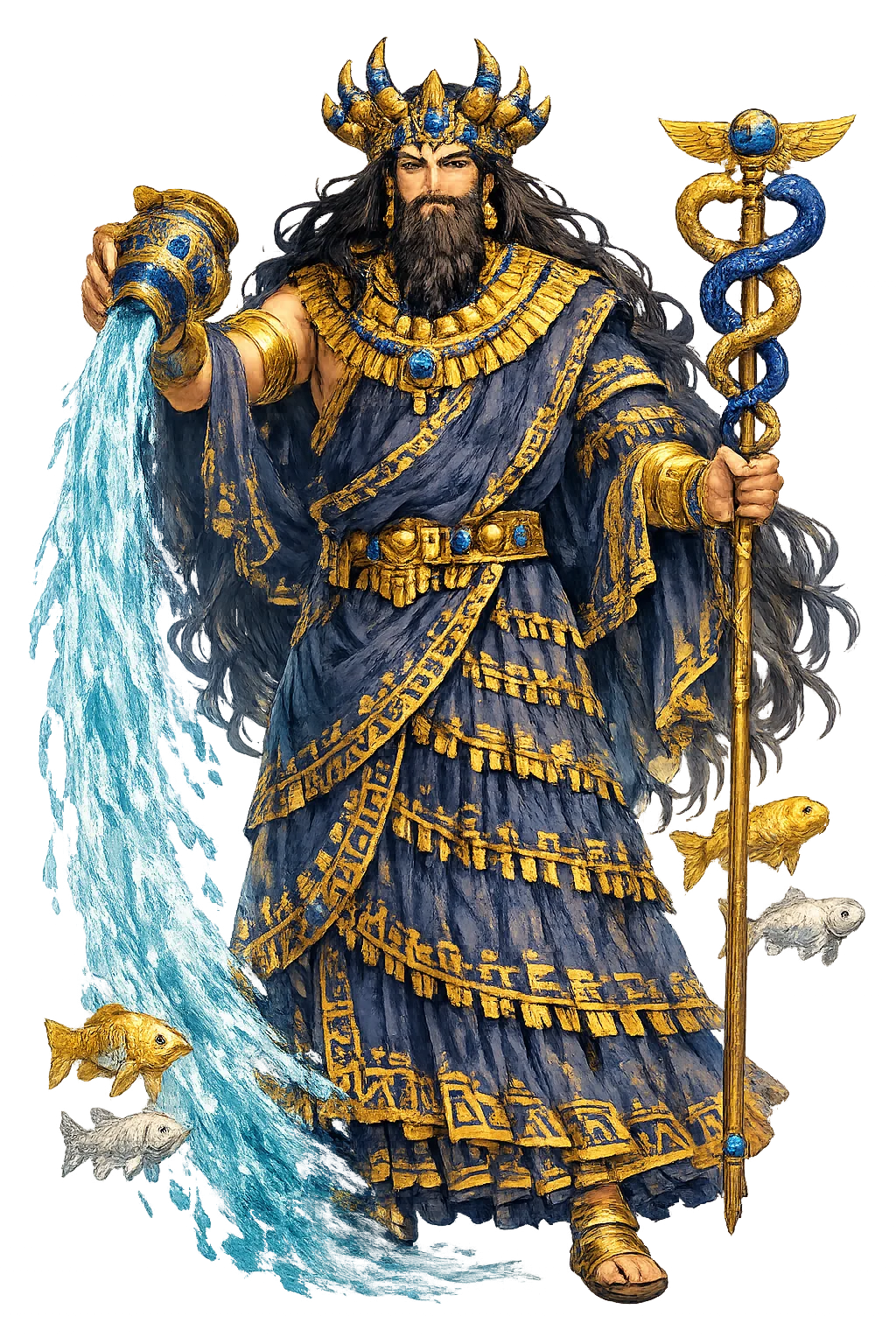
Sumerian EN.KI “lord of the earth", written with the house sign É (𒂍) and KI (𒆠); Akkadian Ēa represents the scholarly pronunciation of the god of fresh water and wisdom.
Water, Wisdom, Crafts, Creation
The Unicode restoration Ēa preserves vowel length; the cuneiform form is not registrable in .com.
How Ēa was spoken
Abzu, Crafts, Incantations
The name is written 𒀭𒂍𒀀. Standard Assyriology transliterates it as Ea. But in the phonological grammar of Akkadian, the first vowel's length remains an open question — and it is here, in the space between the written sign and the spoken sound, that this temple operates. This node of PuniCodex is dedicated to the phonological reconstruction and didactic grammar of the ancient Near East. We mark vowel length not because it is certain, but because it is discussable. The macron is a question mark made visible.
The subterranean freshwater ocean; Enki's temple at Eridu, the E-abzu, was built over it.
The god who knows the secret plans of the universe and whispers them to the righteous king.
Patron of exorcists, potters, smiths, and scribes; the divine engineer who devises solutions.
The ashipu-priest invokes Enki to undo sickness, demons, and the curses of fate.
Stories of Ēa
The myths of Ea / Enki are stories of intelligent intervention — and they are also data. Every text that names him, from the Sumerian Enki and the World Order to the Babylonian Enuma Elish, is evidence for how the name was read, pronounced, and transmitted. This temple treats those texts as a phonological corpus: each occurrence is a clue to the vowels, stress, and syllable weight that cuneiform signs leave underspecified.
In the Sumerian myth Enki and Ninhursag, the land of Dilmun is a paradise without sickness or death but also without water. Enki impregnates Ninhursag, who gives birth to eight plants. When Enki eats the forbidden plants, Ninhursag curses him with eight ailments, one for each body part. She is later persuaded to heal him, creating eight deities from his afflicted limbs — a myth of botanical origin, sexual cosmogony, and the healing power that flows from the Abzu.
In the Atrahasis epic and the Sumerian Eridu Genesis, the gods decide to send a flood to destroy humanity. Enki breaks the divine assembly's oath of silence and warns the pious king Ziusudra (later Utnapishtim) in a dream or through the reed wall of his house. Because of Enki, humankind survives; because of the flood, the gods learn that they need human labor. This is the earliest known flood narrative in world literature.
In Enki and the World Order, the god assigns the me — the divine powers and offices of civilization — to the gods of Sumer. He establishes the Tigris and Euphrates, appoints the herding god, and regulates the sea, the winds, and the rains. The poem is a theodicy of culture: every institution has its divine origin in Enki's dispensation.
In the Babylonian Enuma Elish, Ea (Enki) is the son of Apsu, the freshwater primal father, and Tiamat, the saltwater primal mother. When Apsu plots to destroy the noisy younger gods, Ea casts a spell and kills him, taking Apsu's place as ruler of the waters. His son Marduk will later defeat Tiamat. The pattern — older water-god supplanted by storm-god — parallels the Hittite Kumarbi-Taru and Greek Uranus-Kronos cycles.
This temple does not claim that Ēa is the canonical spelling of the god's name. Standard Assyriology writes Ea, and we honor that convention. What we claim is something different: that the space between the cuneiform sign and the modern pronunciation is worth studying, and that Unicode can be used to make that study visible.
Enter Extended Lore