
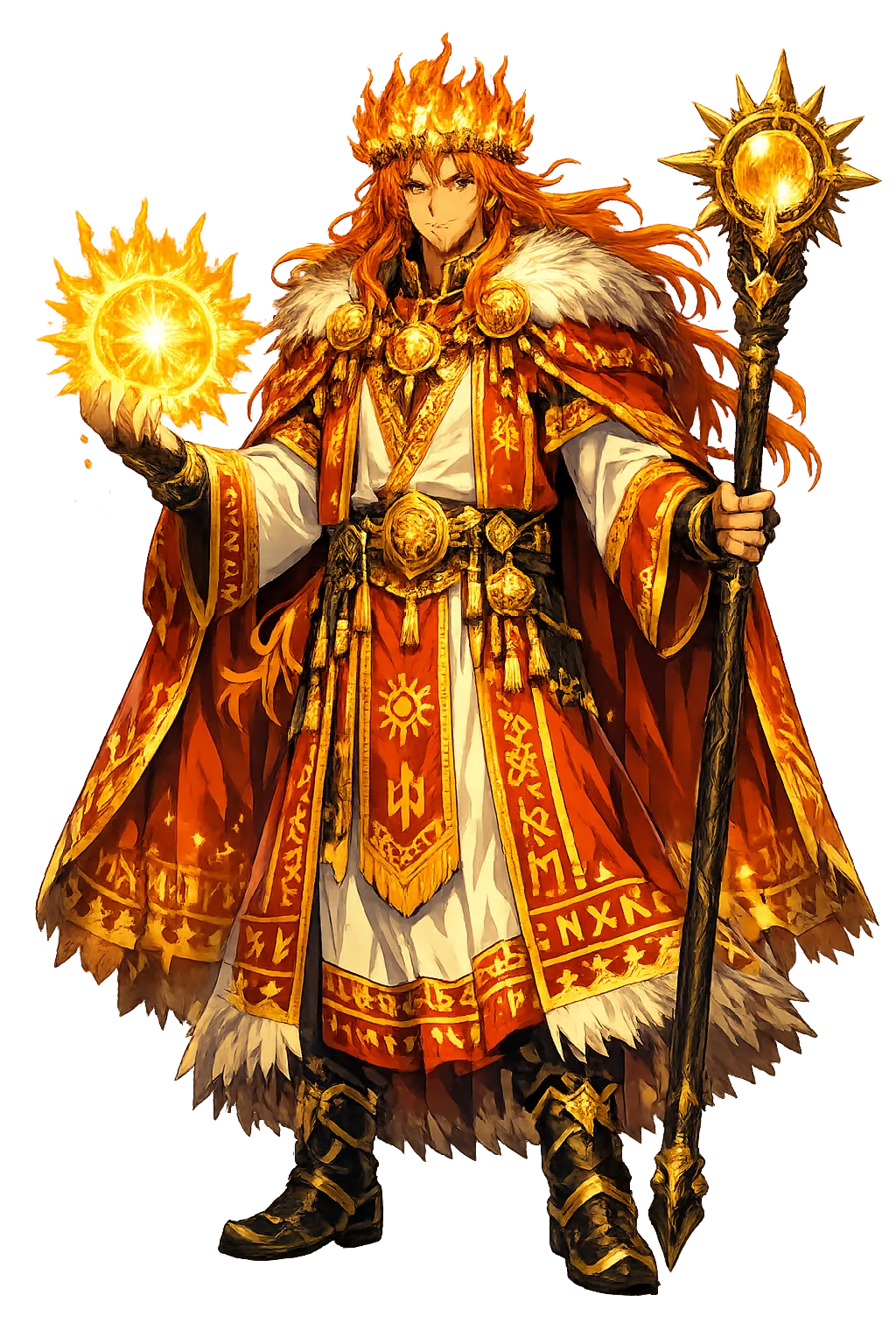
Why Dažbog belongs in your address bar
Every address bar is a choice. When you type Dažbog, you are not typing a novelty; you are restoring a name that the early DNS, built for English typewriters, could not carry. The plain ASCII form dazhbog is a leftover of that constraint, not the name itself. This post is the long version of the restoration: where the name comes from, how the Church Slavonic / East Slavic Cyrillic tradition wrote it, how it is pronounced, what the myths and the material record preserve, and why its Unicode form now lives as a working domain. The claim throughout is simple — the original spelling is not decoration. It is the name.
At a Glance
- Restored name: Dažbog
- ASCII form: dazhbog
- Meaning: "Giving god"
- Domain of influence: Sun, Wealth, Giving
- Pantheon: Slavic
- Classification: Tier 2
- Original script: Дажбог (Church Slavonic / East Slavic Cyrillic)
- Live domain: dažbog.com
Overview
Dažbog (Old East Slavic Дажьбогъ, Dažĭbogŭ) is the East Slavic god of the sun and of giving, one of the six idols Prince Vladimir set up on the hill at Kiev in 980 CE alongside Perun, Khors, Stribog, Simargl, and Mokosh. The Hypatian recension of the Primary Chronicle, drawing on the Slavonic translation of John Malalas' Byzantine chronicle, glosses him directly: the heavenly smith Svarog is equated with Hephaestus, and Svarog's son, the Sun — Svarozhich — is named as Dažbog. The name itself is a transparent reconstructed Common Slavic compound of dažь, the imperative of dati 'to give', and bogъ 'god' — 'giving god'; an older analysis takes the first element as daždĭ 'rain', which would make him a rain-giver.
No narrative myth of Dažbog survives. Beyond the chronicle notices, the record consists of the courtly epithet 'Dažbog's grandchildren' applied to the Rus' in the Slovo o polku Igoreve (c. 1185) and of the fossilized South Slavic formula Dabog da — 'may the god give' — in which his name still works as a blessing.
PuniCodex restores the name as Dažbog and serves its temple at dažbog.com (xn--dabog-vib.com). The caron on ž preserves the Common Slavic postalveolar fricative, but the name carries no stress accent or vowel-length mark, which places it in Tier 2.
The Name
The name is attested in Old East Slavic Cyrillic as Дажьбогъ (Dažĭbogŭ), written with the reduced jer vowels ь and ъ of the medieval orthography; modern reference works normalize it to Дажбог / Dažbog. It is a compound of dažь — the second-person imperative of reconstructed Common Slavic dati 'to give' — and bogъ 'god': the name is itself an invocation, 'give, god', conventionally rendered 'giving god'. The older analysis of the first element as daždĭ 'rain' would instead make him the rain-giver.
The ASCII form dazhbog survives only because the early domain-name system could not carry diacritics; its h belongs to the English digraph 'zh' that approximates the sound ž, not to any historical spelling. The Unicode restoration Dažbog writes the scientific transliteration directly in the address bar. One feature of the original phonology is preserved — the caron marks the Common Slavic fricative /ʒ/ — but the name carries no stress accent or vowel-length mark, which places it in Tier 2.
The letter-by-letter transformation runs:
- d → D — Same
- a → a — Same
- z → ž — Z with caron
- h → — — Not written
- b → b — Same
- o → o — Same
- g → g — Same
The project holds the domain dažbog.com (xn--dabog-vib.com) as the canonical home of this name.
The Original Script
The name is preserved in Church Slavonic / East Slavic Cyrillic as Дажбог — Cyrillic, attested Old East Slavic, c. 10th–12th c. CE, in Kievan Rus'. The script is written left-to-right.
The scholarly transliteration is Dažbog (Scientific transliteration of Old East Slavic), giving the normalized reading /ˈdaʒ.boɡ/.
The rendering proceeds step by step:
- The name is attested in East Slavic chronicles as Дажьбогъ (Dažĭbogŭ) and in the Primary Chronicle.
- It is usually analyzed as daždĭ 'rain, gift' + bogŭ 'god', hence 'giving god' or 'rain god'.
- The modern Unicode restoration Dažbog uses the caron ž; the medieval Cyrillic spelling includes the reduced jer vowels ь and ъ.
- The Cyrillic form is not registrable in .com; the Latin transliteration Dažbog is.
Pronunciation
The reconstructed pronunciation of the name is /ˈdaʒ.boɡ/ — Common Slavic / East Slavic Reconstruction.
Phoneme by phoneme:
- D- — Voiced alveolar stop [d], as in English 'day'.
- -a- — Short open front [a], the stressed first syllable of the compound.
- -ž- — Voiced postalveolar fricative [ʒ], the Slavic 'zh' sound written with a caron.
- -bog — Voiced bilabial stop [b], open-mid back rounded [ɔ], and voiced velar [ɡ]; means 'god'.
For the modern speaker, the closest approximation is: 'DAHZH-bog' — crisp 'dah', then the 'zh' sound of 'measure', and end with 'bog' as in 'god' (which is what the word means).
Kindred and historical forms of the name:
- Common Slavic — reconstructed dažь bogъ, 'giving god' (from dati, 'to give', + bogъ, 'god')
- Old East Slavic / Russian — Dažĭbogŭ, son of Svarog in the Primary Chronicle
- Serbian/Croatian folk tradition — Dabog or Dajbog, invoked in blessings and oaths
Dažbog is Tier 2: the caron on ž preserves the distinctive Common Slavic fricative, but the name carries no stress accent or length mark. The h in the ASCII form dazhbog is silent: it completes the English digraph 'zh' that approximates ž. A fuller Serbian form Daždbog preserves an epenthetic d before the fricative. We do not invent an etymology beyond the attested compound 'giving god'.
Mythology
Everything narrated about Dažbog comes from texts written by Christians after the conversion of Rus'; the East Slavs left no native myth cycle. Three witnesses carry nearly the whole record.
The idols on the hill (Primary Chronicle, 980)
Under the year 980 the Povest' vremennykh let records that Vladimir, newly established as sole ruler in Kiev, set up idols on the hill outside the castle court: Perun of wood with a silver head and a golden moustache, and with him Khors, Dažbog, Stribog, Simargl, and Mokosh, to whom the people brought sacrifices of their sons and daughters. Under 988 the same chronicle describes the overthrow of this pantheon at Vladimir's baptism: Perun's image was tied to a horse's tail, beaten with rods, and cast into the Dnieper.
The Sun, son of Svarog (Hypatian gloss)
Where the chronicle absorbs the Slavonic translation of John Malalas' Byzantine chronicle, the Greek gods are rendered with Slavic names: Hephaestus becomes Svarog, and the Sun becomes Svarozhich — 'whom they call Dažbog'. This single gloss is the entire basis for Dažbog's solar character and for his sonship to the heavenly smith.
The comparative frame
With no Slavic narrative surviving, comparatists place Dažbog among the Indo-European solar bestowers, deities who cross the sky and dispense fertility and wealth. The comparison clarifies his functions but supplies no stories: his mythology is a silhouette outlined by a name and two chronicle sentences.
The Kievan Pantheon (Primary Chronicle)
The Povest' vremennykh let ('Tale of Bygone Years,' c. 1113) records that after Prince Vladimir's conversion, the idols of Perun, Khors, Dazhbog, Stribog, Simargl, and Mokosh were thrown into the Dnieper. Dažbog is listed as the son of Svarog. The chroniclers' contempt preserves the fact that he was once a major deity of the East Slavic pantheon.
Dabog the Giver (Folk tradition)
In Serbian and broader South Slavic folklore, Dabog or Dajbog appears in blessings and oaths: 'Dajbog da...' ('May God give that...'). The name has been Christianized in form but preserves the old compound 'giving god.' This survival suggests that Dažbog was once invoked wherever people asked for prosperity, health, or good fortune.
The Indo-European Sun God (Comparative mythology)
Comparative Indo-European mythology places Dažbog in the company of solar deities who ride chariots across the sky and bestow wealth and fertility. The connection to Svarog (heaven/smith) and the sun-identification made by chroniclers align him with this pattern, though direct Slavic narratives have not survived.
Symbols & Iconography
No image of Dažbog can be identified: the idol that stood on Vladimir's hill at Kiev from 980 is nowhere described in the sources, and no surviving artifact bears his name. His iconography is therefore reconstructed from the written record and from comparative material, with the limits of each made explicit:
- Sun disk or wheel — The Hypatian gloss names him outright as the Sun, making the solar disk his primary attribute; wheel-shaped solar amulets are common in later Slavic folk art, though none can be tied to his cult.
- Wheat or sheaf — The 'giving' element of the name links him to the harvest, the gift an agrarian people asked of the sun.
- Gold and amber — Treasures of sunlight and wealth in Slavic folk symbolism; the association is thematic, drawn from the name's meaning rather than from any cult object.
- Horse or chariot — The vehicle of the Indo-European sun god across daughter traditions; attested only comparatively, never in the Slavic record of Dažbog.
Archaeology & Evidence
No archaeological find names Dažbog, and none is likely to. The written record gives him exactly one cult site — the idol hill Vladimir laid out at Kiev in 980, somewhere by the princely court — and that ensemble was destroyed in the Christianization of 988 without leaving an identifiable trace. The destruction is itself the explanation for the poverty of the material record: Kievan cult images were made to be toppled, burned, or thrown into rivers, as the chronicle describes for Perun. The closest surviving analogue is the four-sided limestone pillar dredged from the Zbruch river in 1848, now in the Archaeological Museum in Kraków: a 9th–10th-century Slavic cult monument whose tiered registers of figures show what such a pantheon may have looked like, though no figure on it is securely identified and assigning one to Dažbog would be speculation. Solar imagery in Slavic folk art — wheel-shaped amulets, spring sun rituals — is abundant but unattributable: nothing connects it to a cult of Dažbog rather than to the sun itself.
Realm & Domain
Dažbog is the Slavic sun god, son of the smith-god Svarog, and a giver of wealth and agricultural bounty. His name means 'giving god,' and in the medieval East Slavic sources he is honored alongside Perun, Svarog, and other members of the Kievan pantheon. Although the Christian chroniclers demonized the old gods, folk memory preserved him in blessings, oaths, and the figure of Dabog.
The Sun
He is identified with the sun and its life-giving warmth; the Slavonic Malalas gloss renders Greek Helios as Svarozhich, 'whom they call Dažbog'.
Son of Svarog
The same Hypatian gloss makes him the son of Svarog, the heavenly smith equated with Hephaestus.
Giver of Wealth
His name — the imperative 'give!' plus 'god' — and his cult link him to generosity, harvest, and prosperity.
Folk Dabog
Survives in South Slavic oral tradition as Dabog or Dajbog, invoked in blessings and oaths.
Across Cultures
Dažbog's only documented syncretism is the chronicler's own. The Slavonic translation of John Malalas' chronicle, absorbed into the Hypatian text of the Primary Chronicle, renders the Greek gods with Slavic names: Hephaestus is translated as Svarog and Helios as Svarozhich, 'whom they call Dažbog'. The equation is an act of translation — Byzantine interpretatio Graeca run in reverse — but it fixed Dažbog's solar identity for all later scholarship.
Christianization absorbed the name rather than the cult. In Serbian and broader South Slavic usage the theonym survives as Dabog or Dajbog, fused into formulas of wish and curse — Dabog da, 'may the god give' — in which the giving god is now the Christian one; ethnographers of Serbian folk religion also recorded Dabog as a demonized, chthonic figure, the characteristic afterlife of a displaced god.
Wider identifications are comparative, not historical: the Vedic Savitar, who bestows bounty, and the Roman Sol Invictus are typological parallels for a giving sun rather than partners in any documented cult blending, and an Iranian Mithra connection has occasionally been proposed on no secure evidence.
Kindred figures in the PuniCodex cross-tradition index include [[apollon|Apóllōn]], [[helios|Hēlios]], [[huitzilopochtli|Huitzilopōchtli]], [[ra|Rꜥ]], [[shamash|Šamaš]], and [[shapash|Šāpšu]], each linked through sun / light.
Cultural Legacy
Dažbog's afterlife runs through language rather than cult. Courtly literature kept his dignity: the Slovo o polku Igoreve (c. 1185), two centuries after the idols fell, can still call the Rus' people 'Dažbog's grandchildren', converting the old theonym into a genealogy of the land. Popular speech kept his function: the South Slavic formulas Dabog da ('may the god give') and their kin preserve the imperative of his name inside blessings and curses to this day. In Serbian folk belief the demonized Dabog lingered on as a chthonic figure — a trajectory from state god to folk demon that has made the name a standard case study in the Christianization of Slavic religion. Modern Rodnovery (Slavic Native Faith) movements have restored him to active worship as a solar and prosperity deity, and his compound remains the textbook Slavic example of a theonym built from an imperative, 'give!', plus 'god'.
The Scholarly Record
The account of Dažbog given in this edition rests on the witnesses and reference works listed below. Lexica and etymological dictionaries secure the form and meaning of the name; the literary and religious texts supply the narrative evidence.
- Primary Chronicle / Povest' vremennykh let (Tale of Bygone Years), Laurentian and Hypatian recensions.
- Miklosich, Franz, Etymologisches Wörterbuch der slavischen Sprachen.
- Vasmer, Max, Russisches etymologisches Wörterbuch.
- Helmold of Bosau, Chronica Slavorum (12th-century account of Slavic religion).
- Katicic, Radoslav, Illyrian iconography and Slavic mythology.
- Zaroff, Roman, 'Organized Pagan Cult in Kievan Rus''.
- Ivanov, Vyacheslav, and Vladimir Toporov, Studies in Slavic mythology.
A Meditation
Dažbog is the god of giving made visible in sunlight. Every harvest, every warm morning, every coin earned is a gift that his name once sanctified. The chroniclers called him a demon and threw his idol in the river, but the people kept saying his name whenever they hoped for something good.
There is a quiet resistance in that survival. Dažbog did not need temples or epics; he needed only the human habit of asking. 'Giving god' is not a description of power but a description of relationship: the deity who responds to need. In an age of scarcity and competition, his name is a reminder that the sun still rises without charge and that generosity can be sacred.
The Unicode Restoration
Dažbog is classified as Tier 2: the original preserves at least one philological feature that ASCII cannot encode. The ASCII fallback dazhbog still resolves everywhere, but it is the restored form that carries the name's full information. Across the 7 characters of the name, the restoration adjusts 2: 2 further adjustments (ž, h). That is the whole thesis of this temple: the marks are the message.
The Domain Name
The restored name is live as a working domain: dažbog.com, which the DNS carries in punycode form as xn--dabog-vib.com — an ASCII-compatible encoding that lets a non-ASCII name travel the global network without breaking older infrastructure. The visitor sees Dažbog; the machines see the encoding. That duality is the engineering compromise on which the entire restoration rests, and it is why a name written the way its own tradition wrote it in Church Slavonic / East Slavic Cyrillic can now be typed into any browser on earth.
Why This Restoration Matters
Restoring Dažbog is part of a larger effort to make the web multilingual by default. The PuniCodex project does not ask users to learn a new alphabet; it asks the infrastructure to respect the alphabets that already exist. Every section of this post — the script, the sound, the myths, the evidence — converges on the same point: the marks in Dažbog are information, and information deserves an address of its own. A single Unicode domain is a small proof, but it is a proof that scales: every name restored makes the next one easier, and every visit to dažbog.com is a vote for the restored form.
Explore Further
This post is one doorway into the temple. The home page carries the full character breakdown and the ambient canvas; the lore page tells the myths in long form; the Scholarly Edition preserves the sources, pronunciation data, and revision history; and the patron wall supports the restoration directly. For the wider map, browse the Lexicon, explore the Pantheon, or return to the PuniCodex blog.
Related Names
Sources
The full scholarly apparatus — every citation, revision, and review — lives in the Scholarly Edition. Key references for this post:
- Primary Chronicle (Povest' vremennykh let), Laurentian recension, s.a. 980; trans. S. H. Cross and O. P. Sherbowitz-Wetzor, The Russian Primary Chronicle (Cambridge, MA: Mediaeval Academy of America, 1953).
- Hypatian Codex, Slavonic translation of John Malalas' Chronicle: Svarog–Hephaestus gloss and Dažbog as the Sun (Svarozhich).
- Vasmer, Max, Russisches etymologisches Wörterbuch (Heidelberg: Winter, 1953–58), s.v. bogъ.
- Slovo o polku Igoreve (The Tale of Igor's Campaign, c. 1185).
- Hypatian Codex, Slavonic translation of John Malalas' Chronicle: Dažbog glossed as the Sun.
- Lexicon authorities for this entry: Miklosich.