
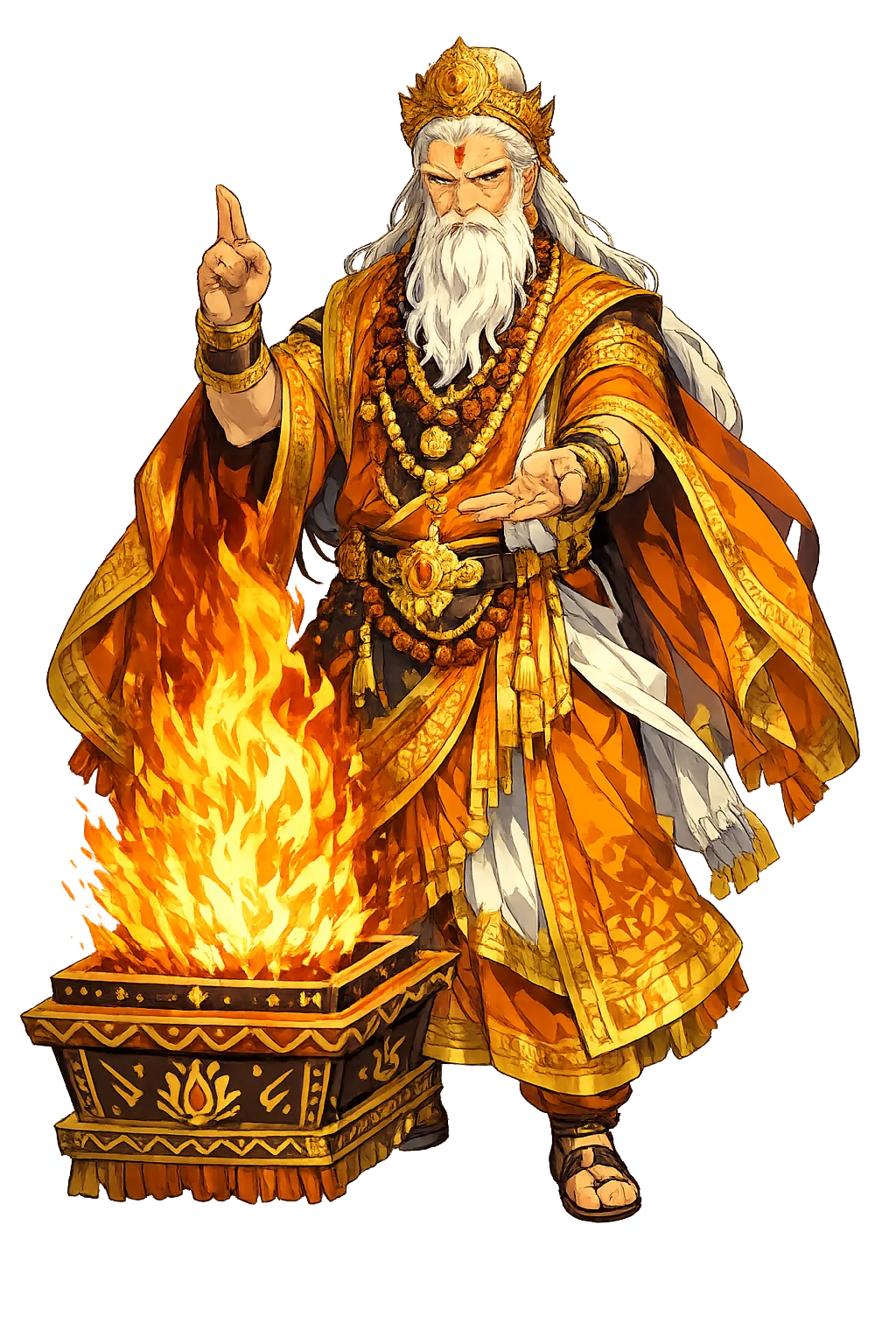
The many faces of Dakṣa
No important name has only one face. Dakṣa appears as a figure of myth, a scholarly reconstruction, a piece of material culture, a memory carried across languages, and — most recently — a Unicode domain. This post looks at each face in turn: the name and its roots, the Devanagari original, the reconstructed pronunciation, the mythological record, the symbols and sanctuaries, the cross-cultural afterlife, and the engineering that lets the restored spelling resolve in a browser. Taken together, those faces explain why daksa was never going to be enough — and why the restored form is worth a domain of its own.
At a Glance
- Restored name: Dakṣa
- ASCII form: daksa
- Meaning: "'The skilled, the able' (from dakṣa), a Prajāpati"
- Domain of influence: Skill, Creation, Order
- Pantheon: Sanskrit
- Classification: Tier 2
- Original script: दक्ष (Devanagari)
- Live domain: dakṣa.com
Overview
Dakṣa (daksa) — The Father of Order — belongs to the Sanskrit tradition, where it is catalogued under the domain "Skill, Creation, Order". The name means "'The skilled, the able' (from dakṣa), a Prajāpati".
Dakṣa is the Prajāpati of competence: the "skilled one" whose sixty daughters married the Moon, Dharma, and the sage Kaśyapa to people the world — and whose flawless sacrifice, performed without Śiva, became the great cautionary tale of Indian religion.
PuniCodex restores the name as Dakṣa and serves its temple at dakṣa.com. The original preserves one prosodic feature — stress or vowel length — rather than both, which places the name in Tier 2. The plain ASCII form daksa survives as a modern convenience imposed by the early domain-name system; the restoration, not the fallback, is the form the project defends as philologically complete.
The Name
The name is attested in Devanagari as दक्ष. Etymologically it means "'The skilled, the able' (from dakṣa), a Prajāpati".
The ASCII form daksa survives only because the early domain-name system could not carry diacritics; it is a technological compromise, not an ancient spelling. The Unicode restoration Dakṣa recovers the full diacritic detail of the scholarly transliteration directly in the address bar. The original preserves one prosodic feature — stress or vowel length — rather than both, which places the name in Tier 2.
The letter-by-letter transformation runs:
- d → D — Same letter
- a → a — Same letter
- k → k — Same letter
- s → ṣ — Script-specific diacritic
- a → a — Same letter
The project holds the domain dakṣa.com (xn--daka-di5a.com) as the canonical home of this name.
The Original Script
The name is preserved in Devanagari as दक्ष.
The scholarly transliteration is dakṣa.
The rendering proceeds step by step:
- द = da
- क = ka
- ष = ṣa (retroflex)
- dakṣa is the Prajāpati of ritual order and father of many gods
Written दक्ष in Devanagari: da plus the conjunct kṣa. The same spelling names the Prajāpati and the everyday adjective "skilled" — the god is competence enthroned among the creators.
Pronunciation
The reconstructed pronunciation of the name is /ˈd̪ɐk.ʂɐ/ — Sanskrit (IAST).
For the modern speaker, the closest approximation is: DUCK-shah; the ṣ is the retroflex sh.
Kindred and historical forms of the name:
- Devanagari — दक्ष
- Conventional — Daksha
- Owned form — Dakṣa
Sanskrit dakṣa — "able, skilled, dexterous" — carries the kṣa cluster written with the conjunct क्ष, a single glyph for k plus ṣ. Indo-Europeanists connect the word to the root *deks-, "right hand, skill": Latin dexter is its cousin, and "dexterity" its English echo. The kṣa conjunct is a single articulation — k releasing directly into the retroflex ṣ — which romanization splits in two.
Mythology
Dakṣa's cycle is the Indian study of procedure versus devotion: the man who performs the rite perfectly and loses everything because of who was left off the list.
Satī and the Ascetic (The Marriage)
His youngest daughter Satī loved Śiva — the ash-smeared wanderer whom Dakṣa considered no fit match for a Prajāpati's house. She married him anyway. When Dakṣa later held the greatest sacrifice of the age, he invited every god and every daughter except Śiva and Satī: the omission was deliberate, public, and meant.
Satī's Self-Immolation (The Fire)
Satī came uninvited to her father's rite and endured his contempt until she could not: declaring she would no longer wear a body born of one who insulted her lord, she entered the sacrificial fire and burned. The goddess tradition holds her fall sacred — her body, scattered in grief across the land, seeds the fifty-one Śakti Pīṭhas, the holiest map of Śakta India.
Vīrabhadra Unleashed (The Ruin)
Śiva tore a lock from his hair and cast down Vīrabhadra, who wrecked the sacrifice: Bhaga's eyes were knocked out, Pūṣan's teeth smashed, the gods routed — and Dakṣa beheaded. Only when the broken Prajāpati bowed in true devotion did Śiva restore him, setting a goat's head on his shoulders: skill survives, but only with a changed head.
The Twenty-Seven Wives (The Moon)
Dakṣa gave his twenty-seven daughters — the Nakṣatras, lunar stations — to the Moon, on condition he visit each equally. The Moon favoured Rohiṇī alone, and Dakṣa's curse made him wane: hence the moon's monthly dying. The waxing that follows is the gods' mitigation — even a Prajāpati's curse can be negotiated, never simply revoked.
The Lesson of the Goat's Head (The Restoration)
The Purāṇas insist the story does not end at the beheading: when the gods intercede, Śiva forgives, and Dakṣa rises with a goat's head — and becomes, the texts say, Śiva's devotee. The sequel is the point: procedure is restored, but transfigured by humility. At Kankhal, where the sacrifice is said to have burned, the temples commemorate not the ruin but the reconciliation — the skilled father and the wild god reconciled, ritual and devotion finally sharing one altar.
Symbols & Iconography
The iconography associated with Dakṣa concentrates in a small set of recurring attributes, each a compressed statement about the name:
- The sacrificial post — The yūpa of his cosmic rite — order raised, then ruined by pride
- The goat — His second head — humility grafted onto skill
- The rosary — The Prajāpati's counting of creatures and years
Archaeology & Evidence
The Kankhal complex at Haridwar — the Daksha Mahadev temple and the Śrī Daksheśvara site on the Ganga — marks the traditional ground of the great sacrifice, continuously rebuilt from early times and renovated in 1810 and 1962. Satī's pīṭhas, from Kamakhya to Hinglaj, give the myth the largest sacred geography of any Indian story. Iconography shows him goat-headed in the act of worship — the humbled adept — in Purāṇic panels across the Deccan and the South.
Realm & Domain
Dakṣa is the Prajāpati of competence: the "skilled one" whose sixty daughters married the Moon, Dharma, and the sage Kaśyapa to people the world — and whose flawless sacrifice, performed without Śiva, became the great cautionary tale of Indian religion.
The Sixty Daughters
Father of the Nakṣatras — the 27 lunar mansions are his girls, wed to the Moon.
The Great Sacrifice
The yajña to which Śiva was not invited — the snub that shattered heaven and earth.
The Goat's Head
His punishment and restoration: beheaded in the ruined rite, revived with the head of a goat.
Prajāpati
"Lord of progeny" — the office of populating the cosmos, held by a committee of the skilled.
Across Cultures
As Prajāpati he absorbed and was absorbed by Brahmā: the Mahābhārata and Purāṇas shift "lord of progeny" between them until the offices blur. His daughter-lineages map the whole Purāṇic cosmos — through Kaśyapa's wives descend gods, demons, birds, and serpents; through Dharma's, the virtues. The Śakta tradition reframed his sacrifice entirely: not a tale of Śiva's wrath but of the Goddess's sovereignty, with Satī as the first self-offering.
Within the Sanskrit tradition, closely related names in the corpus include [[amsa|Aṃśa]], [[dhatr|Dhātṛ]], [[durga|Durgā]], [[ganesha|Gaṇeśa]], [[kali|Kālī]], and [[lakshmi|Lakṣmī]].
Cultural Legacy
The Dakṣa-yajña cycle is among the most retold stories in India — sculpture, dance-drama, and television epics return to it constantly — and the Śakti Pīṭha pilgrimage map it generates still organizes Śakta devotion. His name lives in the language: dakṣa/daksh remains the word for the capable professional, and the dakṣiṇā, the ritual fee "of the skilled hand," is paid at every Hindu rite today.
The Scholarly Record
The account of Dakṣa given in this edition rests on the witnesses and reference works listed below. Lexica and etymological dictionaries secure the form and meaning of the name; the literary and religious texts supply the narrative evidence.
- Mahābhārata, Vyāsa; translated by Kisari Mohan Ganguli, 400 BCE. Full text
- Śiva Purāṇa, English translation by J. L. Shastri, 500. Full text
- Purāṇas, Various; Internet Sacred Text Archive selections, 300. Full text
- Ṛgveda Saṃhitā, Aufrecht; van Nooten & Holland metric text; GRETIL, 1200 BCE. Full text
- Monier Monier-Williams, A Sanskrit-English Dictionary, Oxford; Cologne Digital Sanskrit Dictionaries, 1899. Full text
- Monier-Williams Sanskrit-English Dictionary, Oxford, 1899. Full text
A Meditation
Dakṣa is the god of the flawless plan that fails. Everything at his sacrifice was correct — the altar, the mantras, the portions — except the heart that made the guest list. He asks of every institution that confuses procedure with worth: who have you left out, and what will their absence burn?
His cycle is retold wherever competence grows proud: the flawless system, the perfect rite, the immaculate procedure — and the one excluded name that brings it all down. India keeps the story as a standing audit of institutions: correctness is not completeness, and the guest list is a moral document. The goat's head he wears is the gentlest icon in the Purāṇas: the skilled man, restored — thinking, at last, with a humbler head.
Every tradition keeps a version of his story — the elder who confuses the map with the territory, the priest with the presence — because every generation needs it. The sacrifice at Kankhal burned not because the rite was wrong but because the rite was all there was. India's answer, sung in a hundred retellings, is the goat-headed worshipper: the same hands, the same skill, the same altar — and a head that has learned what the altar is for.
The moon he cursed still keeps the story: it wanes for favoring one wife over twenty-six, and waxes because the gods commuted the sentence — the night sky's monthly reminder that allotment, once made, rules even the gods. Dakṣa's family is the cosmos's org chart; his sacrifice, its cautionary appendix.
The Unicode Restoration
Dakṣa is classified as Tier 2: the original preserves at least one philological feature that ASCII cannot encode. The ASCII fallback daksa still resolves everywhere, but it is the restored form that carries the name's full information. Across the 5 characters of the name, the restoration adjusts 1: 1 further adjustment (ṣ). That is the whole thesis of this temple: the marks are the message.
Character by Character
The journey from daksa to Dakṣa, one character at a time:
- d → D — Same letter
- a → a — Same letter
- k → k — Same letter
- s → ṣ — Script-specific diacritic
- a → a — Same letter
The Domain Name
The restored name is live as a working domain: dakṣa.com, which the DNS carries in punycode form as xn--daka-di5a.com — an ASCII-compatible encoding that lets a non-ASCII name travel the global network without breaking older infrastructure. The visitor sees Dakṣa; the machines see the encoding. That duality is the engineering compromise on which the entire restoration rests, and it is why a name written the way its own tradition wrote it in Devanagari can now be typed into any browser on earth.
The Sanskrit Pantheon
Dakṣa is one of 90 entries the PuniCodex lexicon catalogues under the Sanskrit pantheon. The Pantheon page gathers the tradition's major figures in one place, and the Lexicon lets you filter all 915 restorations by tradition, tier, or script — the fastest way to see where this name sits among its kin.
Frequently Asked Questions
What does Dakṣa mean? The traditional gloss is "'The skilled, the able' (from dakṣa), a Prajāpati."
Which tradition does Dakṣa belong to? Dakṣa is catalogued in the Sanskrit pantheon of the PuniCodex lexicon.
Why is Dakṣa classified as Tier 2? Because the original preserves at least one philological feature that ASCII cannot encode — and the marks in the restored spelling preserve exactly that evidence.
Is Dakṣa a working domain? Yes — dakṣa.com resolves today and routes to this temple.
What is the punycode for dakṣa.com? The DNS encoding is xn--daka-di5a.com; browsers perform the translation automatically, so visitors only ever see the restored name.
Typing Dakṣa
You do not need a special keyboard to use this restoration. The PuniCodex Type Tool converts the ASCII form daksa into Dakṣa as you type, and the browser extension offers the same conversion inside any text field. Copy the restored form, paste it into the address bar, and the DNS does the rest.
Sister Temples
Other temples in the Sanskrit pantheon include Brahmā, Candra, and Dhyāna — each with its own restoration story, its own scholarly record, and its own place in the lexicon.
Why This Restoration Matters
Myth, script, sound, cult, legacy, domain: the faces of Dakṣa add up to a single argument — that a name is a record, and records deserve fidelity. The PuniCodex restoration keeps that record in working order: the temple presents it, the Scholarly Edition footnotes it, the lexicon catalogs it, and the domain makes it addressable. daksa will always exist as a fallback. But fallback is not identity. Dakṣa is the name; everything else is a convenience.
Explore Further
This post is one doorway into the temple. The home page carries the full character breakdown and the ambient canvas; the lore page tells the myths in long form; the Scholarly Edition preserves the sources, pronunciation data, and revision history; and the patron wall supports the restoration directly. For the wider map, browse the Lexicon, explore the Pantheon, or return to the PuniCodex blog.
Related Names
Sources
The full scholarly apparatus — every citation, revision, and review — lives in the Scholarly Edition. Key references for this post:
- Mahābhārata, Vyāsa; translated by Kisari Mohan Ganguli, 400 BCE.
- Ṛgveda Saṃhitā, Aufrecht; van Nooten & Holland metric text; GRETIL, 1200 BCE.
- Śiva Purāṇa, English translation by J. L. Shastri, 500.
- Purāṇas, Various; Internet Sacred Text Archive selections, 300.
- Monier Monier-Williams, A Sanskrit-English Dictionary, Oxford; Cologne Digital Sanskrit Dictionaries, 1899.
- Mahābhārata, Śānti-parvan; Śiva Purāṇa (Dakṣa cycle).
- Kena Upaniṣad 1.1; the Prajāpati creation cycle.
- Śiva Purāṇa (Dakṣa-yajña cycle); Bhāgavata Purāṇa 4.
- The dakṣiṇā formulae; Śiva Purāṇa stotras.
- Lexicon authorities for this entry: Rigveda, Mahabharata, Monier-Williams.