Unicode restoration and ASCII comparison
दक्ष
The name in its original Sanskrit form. Dakṣa (दक्ष) is attested in the source tradition — “'The skilled, the able' (from dakṣa), a Prajāpati”. Its emphatic consonants and palatal/retroflex sibilants carry the full phonetic and orthographic weight of the source tradition.
daksa
Reduced to plain daksa, the name loses everything that made it specific: emphatic consonants and palatal/retroflex sibilants. What remains is an ASCII string that machines can parse but that no longer speaks with its original voice.
Dakṣa
The Unicode restoration recovers what ASCII flattened. Dakṣa restores emphatic consonants and palatal/retroflex sibilants, returning the name to its original written dignity. The domain encodes to Punycode, but the browser displays the truth.
Dakṣa.com → xn--daka-di5a.com
The non-ASCII characters in Dakṣa are encoded while the ASCII remains visible. To the DNS, it is Punycode. To humanity, it is Dakṣa.
How Dakṣa travels from ancient script to the modern URL
How Dakṣa was spoken
Progeny, Sacrifice, and the Goat's Head
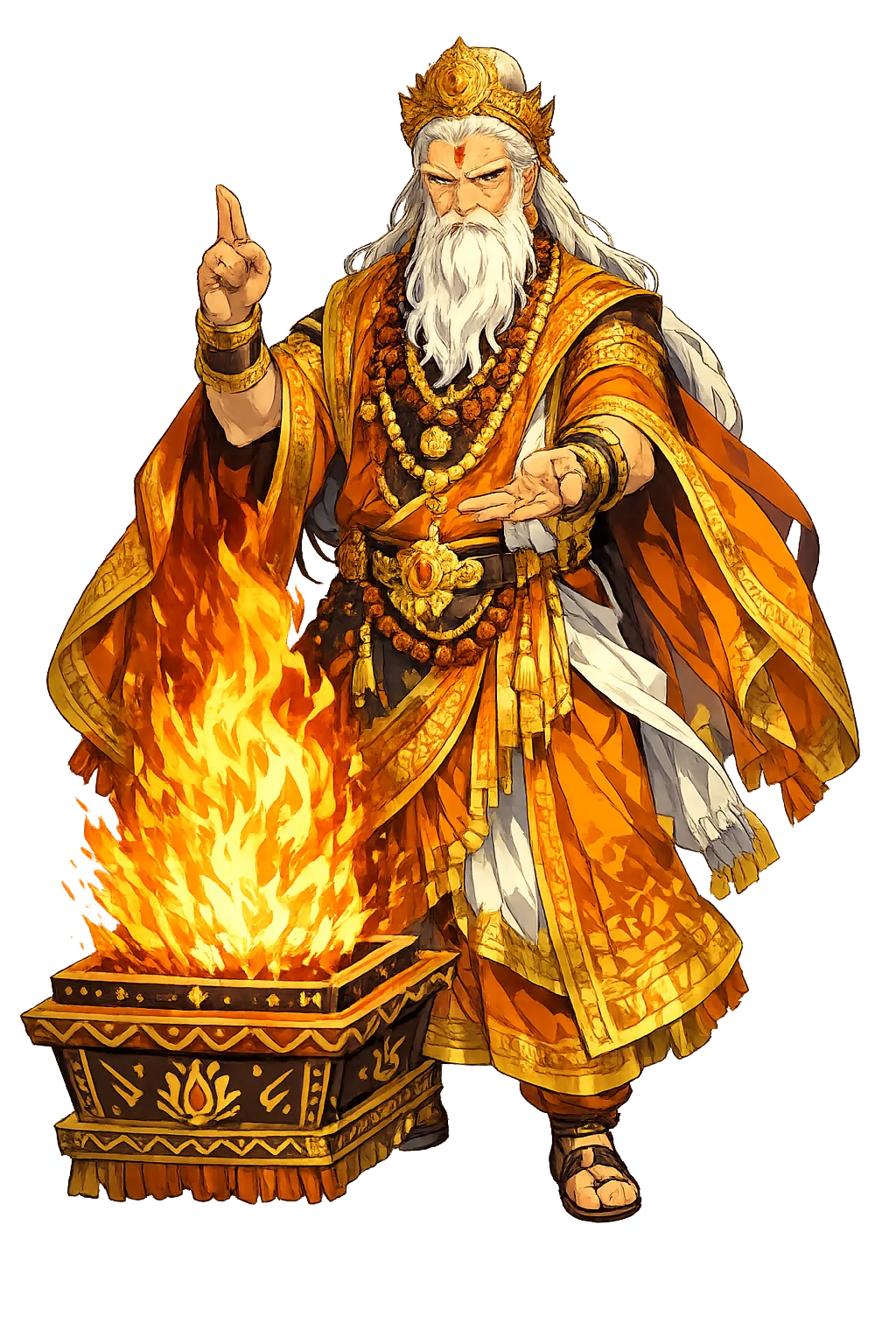
Dakṣa is the Prajāpati of competence: the "skilled one" whose sixty daughters married the Moon, Dharma, and the sage Kaśyapa to people the world — and whose flawless sacrifice, performed without Śiva, became the great cautionary tale of Indian religion.
Father of the Nakṣatras — the 27 lunar mansions are his girls, wed to the Moon.
The yajña to which Śiva was not invited — the snub that shattered heaven and earth.
His punishment and restoration: beheaded in the ruined rite, revived with the head of a goat.
"Lord of progeny" — the office of populating the cosmos, held by a committee of the skilled.
Stories of Dakṣa
Dakṣa's cycle is the Indian study of procedure versus devotion: the man who performs the rite perfectly and loses everything because of who was left off the list.
His youngest daughter Satī loved Śiva — the ash-smeared wanderer whom Dakṣa considered no fit match for a Prajāpati's house. She married him anyway. When Dakṣa later held the greatest sacrifice of the age, he invited every god and every daughter except Śiva and Satī: the omission was deliberate, public, and meant.
Satī came uninvited to her father's rite and endured his contempt until she could not: declaring she would no longer wear a body born of one who insulted her lord, she entered the sacrificial fire and burned. The goddess tradition holds her fall sacred — her body, scattered in grief across the land, seeds the fifty-one Śakti Pīṭhas, the holiest map of Śakta India.
Śiva tore a lock from his hair and cast down Vīrabhadra, who wrecked the sacrifice: Bhaga's eyes were knocked out, Pūṣan's teeth smashed, the gods routed — and Dakṣa beheaded. Only when the broken Prajāpati bowed in true devotion did Śiva restore him, setting a goat's head on his shoulders: skill survives, but only with a changed head.
Dakṣa gave his twenty-seven daughters — the Nakṣatras, lunar stations — to the Moon, on condition he visit each equally. The Moon favoured Rohiṇī alone, and Dakṣa's curse made him wane: hence the moon's monthly dying. The waxing that follows is the gods' mitigation — even a Prajāpati's curse can be negotiated, never simply revoked.
The Purāṇas insist the story does not end at the beheading: when the gods intercede, Śiva forgives, and Dakṣa rises with a goat's head — and becomes, the texts say, Śiva's devotee. The sequel is the point: procedure is restored, but transfigured by humility. At Kankhal, where the sacrifice is said to have burned, the temples commemorate not the ruin but the reconciliation — the skilled father and the wild god reconciled, ritual and devotion finally sharing one altar.
Dakṣa is the god of the flawless plan that fails. Everything at his sacrifice was correct — the altar, the mantras, the portions — except the heart that made the guest list. He asks of every institution that confuses procedure with worth: who have you left out, and what will their absence burn?
Enter Extended Lore