
The many faces of Chímaira
No important name has only one face. Chímaira appears as a figure of myth, a scholarly reconstruction, a piece of material culture, a memory carried across languages, and — most recently — a Unicode domain. This post looks at each face in turn: the name and its roots, the Greek original, the reconstructed pronunciation, the mythological record, the symbols and sanctuaries, the cross-cultural afterlife, and the engineering that lets the restored spelling resolve in a browser. Taken together, those faces explain why chimaira was never going to be enough — and why the restored form is worth a domain of its own.
At a Glance
- Restored name: Chímaira
- ASCII form: chimaira
- Meaning: "She-goat"
- Domain of influence: Fire-Breathing Monster
- Pantheon: Greek
- Classification: Tier 1
- Original script: Χίμαιρα (Greek)
- Live domain: chímaira.com
Overview
Chímaira (chimaira) — Fire-Breathing Monster · She-goat — belongs to the Greek tradition, where it is catalogued under the domain "Fire-Breathing Monster". The name means "She-goat".
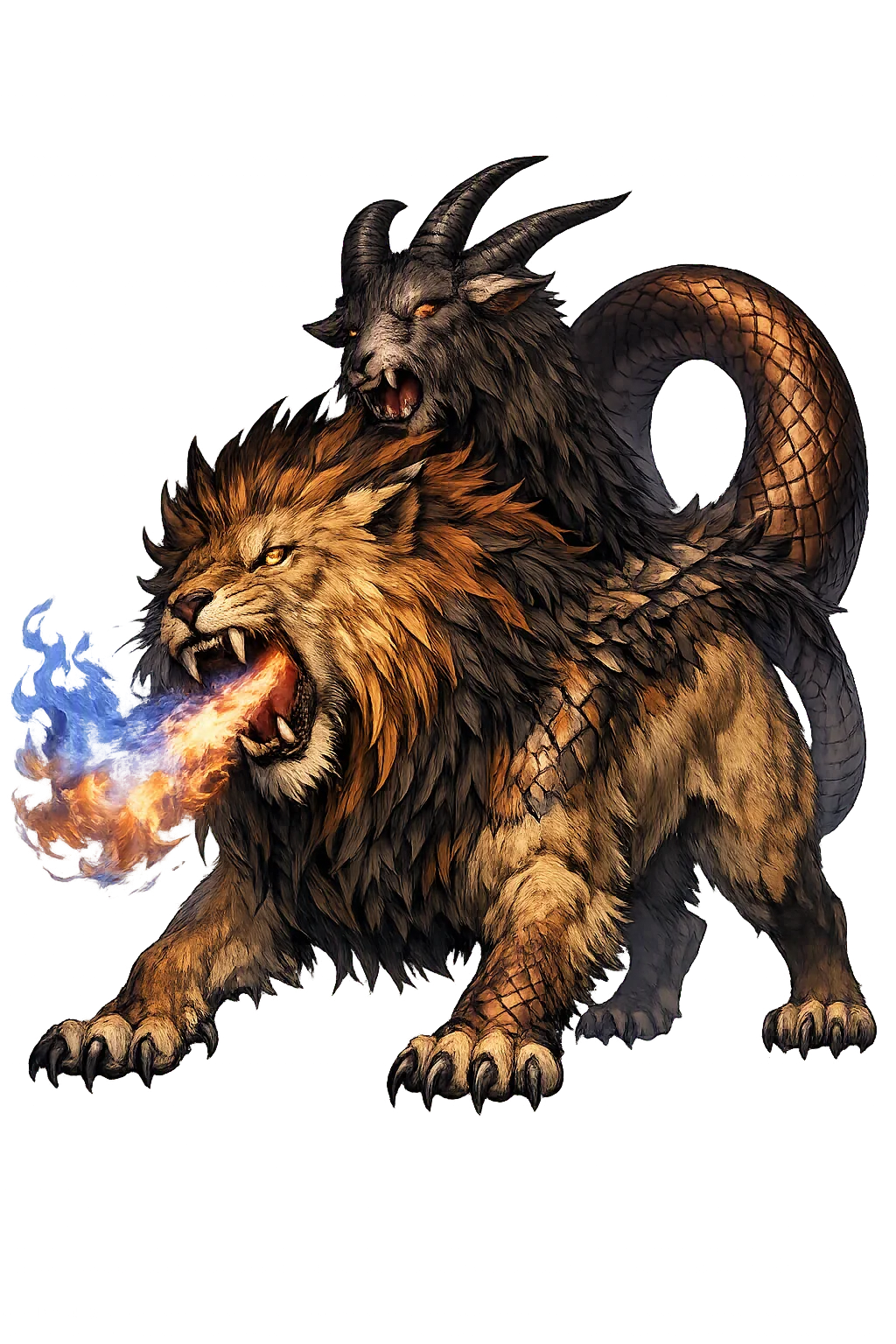
Chímaira is the monster of Lycia: lion before, serpent behind, she-goat in the middle, breathing forth the dreadful might of blazing fire (Theogony 319–325). Daughter of Typhôn and Echidna, sister to the Hydra and Kerberos, she is Homer's 'thing divine, not of mortal men' — a creature with no cult, no temple, and no pity. And yet her name is the homeliest word in the Greek barnyard: a she-goat one winter old.
PuniCodex restores the name as Chímaira and serves its temple at chímaira.com. The original carries both stress and vowel length, and exactly one historically valid Unicode restoration exists, which places the name in Tier 1. The plain ASCII form chimaira survives as a modern convenience imposed by the early domain-name system; the restoration, not the fallback, is the form the project defends as philologically complete.
The Name
The name is attested in Greek as Χίμαιρα. Etymologically it means "She-goat".
The ASCII form chimaira survives only because the early domain-name system could not carry diacritics; it is a technological compromise, not an ancient spelling. The Unicode restoration Chímaira recovers the stress accent of the original directly in the address bar. The original carries both stress and vowel length, and exactly one historically valid Unicode restoration exists, which places the name in Tier 1.
The letter-by-letter transformation runs:
- c → C — C uppercase
- h → h — h same
- i → í — Acute on i
- m → m — m same
- a → a — a same
- i → i — i same
- r → r — r same
- a → a — a same
The project holds the domain chímaira.com (xn--chmaira-8ya.com) as the canonical home of this name.
The Original Script
The name is written in Greek as Χίμαιρα. This original script is the form against which the ASCII fallback chimaira and the PuniCodex restoration Chímaira are measured: the restoration preserves its pitch accent of the written form, so that a reader typing the modern address still speaks the ancient name.
Pronunciation
The reconstructed pronunciation of the name is /kʰí.mai.ra/ — Attic Greek Reconstruction.
Phoneme by phoneme:
- Chí- — Aspirated velar /kʰ/ plus short stressed iota — a hard k punched through a puff of breath, pitched high at the acute; the classical chi is an aspirate stop, not yet the modern fricative.
- -mai- — The long diphthong αι, gliding from open a to i — the metrically heavy heart of the name, the syllable Latin later froze into the 'ae' of Chimaera.
- -ra — Tapped rho plus short open alpha, the feminine ending: the grammar itself insists the monster is a she.
For the modern speaker, the closest approximation is: 'KHEE-mye-rah' — begin with a k followed by a sharp breath, let the middle glide like 'eye', and end on a quick tapped r.
Kindred and historical forms of the name:
- Greek — χίμαρος (chímaros), 'he-goat' — the masculine twin; the monster's name is simply the feminine of the barnyard word, 'she-goat'
- Greek — χεῖμα (kheîma), 'winter, frost' — kin by root: a χίμαιρα is etymologically a 'winterling', a goat one winter old
- PIE — *ǵʰei-, 'snow, winter' (Beekes); cognate with Latin hiems and Sanskrit héman — the fire-breathing monster is built from the word for cold
Chímaira is Tier 1 because the Greek Χίμαιρα contains both stress (the acute on the iota) and length (the diphthong αι, metrically long). The restoration preserves both; the ASCII 'chimaira' and the English 'chimera' flatten the accent and melt the diphthong into a bare e.
Mythology
Chímaira's myths are all one myth told at different distances: the impossible creature, and the impossible rider sent against her. Born divine, she exists in the tradition only to be destroyed — yet she has never stopped being imagined.
Daughter of the Monster-House (Birth)
In the Theogony (319–325), Hesiod sets Chímaira in the brood of Echidna: 'the Chímaira who breathed invincible fire, a creature terrible and great, swift-footed and strong. Three heads she had — one of a fierce-eyed lion, one of a goat, and one of a snake, a mighty dragon: lion in front, dragon behind, goat in the middle — breathing out the dreadful might of blazing fire.' Her siblings are the catalogue of beasts the heroes must undo: Orthos, Kerberos, the Lernaian Hydra. Hesiod seals her fate in the same breath as her birth — 'her did Pegasos and noble Bellerophontês slay' (325) — as if such a creature could only ever be a death postponed.
The First Trial of Bellerophôn (The Fatal Letter)
In Iliad 6 (144–211), Glaukos tells Diomêdês the tale on the battlefield. Spurned by his guest Bellerophôn, Proitos's wife Anteia accused him falsely; unwilling to stain the guest-table with murder, Proitos sent him to Lycia bearing a folded tablet inscribed with 'baneful signs' (σήματα λυγρά, 6.168) — one of the earliest mentions of writing in Greek literature. Reading the letter, the Lycian king set the stranger trials, and first of all bade him slay the Chímaira, the invincible: 'a thing of divine stock, not of men — lion in front, serpent behind, she-goat in the middle, breathing the terrible might of blazing fire' (6.180–182). 'And he slew her, trusting in the portents of the gods' (6.183). The monster meant to be his executioner became the first entry in his glory.
Pegasos from the Altar of Athēnā (The Golden Bridle)
Pindar (Olympian 13.63–92) gives the Corinthian version. The young Bellerophôn longed beyond anything to yoke Pegasos, the winged colt of Medousa, and the seer Polyidos sent him to sleep on Athēnā's altar. In the night the goddess stood beside him and set down a bridle banded with gold, bidding him sacrifice a bull to Poseidôn the Horse-Tamer; he woke with the bridle real in his hands. 'And in bronze armour, mounted upon it, he slew the archer host of the Amazons… and the Chímaira breathing fire' (13.87–90). Pindar grants the beast no anatomy at all — only the flame — and lets the winged horse carry the whole weight of the wonder.
Fed with Her Own Fire (The Lead-Tipped Spear)
Apollodorus (Library 2.3.1–2) supplies the mechanism the epics omit. Pegasos, he reminds us, sprang from the severed neck of Medousa, and it was with Athēnā's bridle that Bellerophôn mastered him. Then, mounted, the hero fixed a lump of lead to the point of his spear and flew at the Chímaira; the monster drew the lead down with the fire she breathed, the metal melted in her throat, and her own flame burned out her entrails. The rationalizing detail — a poet's nightmare undone by a smith's trick — is the later age speaking, centuries after Homer, unwilling to let wonder close without an explanation.
Symbols & Iconography
The iconography associated with Chímaira concentrates in a small set of recurring attributes, each a compressed statement about the name:
- Flame — Her inextinguishable breath of fire — the one feature every source, from Hesiod to Virgil, refuses to omit
- Lion forepart — The grim-eyed lion's head in front, emblem of her strength and royal ferocity
- She-goat's head — The goat rising from her middle — the body part that carries her very name, χίμαιρα, 'she-goat'
- Serpent tail — The dragon (δράκων) behind, her kinship with the earth-born brood of Typhôn made flesh
- Pegasos — The winged horse, offspring of Poseidôn and Medousa, without whose height no mortal could reach her
- Golden bridle of Athēnā — The gold-banded bridle the goddess gave Bellerophôn in his dream, the instrument that made the flight — and so the kill — possible
- Lead-tipped spear — The lump of lead melted by her own swallowed flame, the smith's trick by which Apollodorus says she was burned from within
Archaeology & Evidence
She had no sanctuary — monsters seldom do — but her landscape survives: the natural-gas flames of Yanartaş near ancient Phaselis in Lycia have burned without fuel for millennia, and ancient writers from Ctesias to Pliny (Natural History 2.111) knew the undying fire of Mount Chimaera as a landmark for sailors. In art she is among the earliest Greek monsters, attacked by Bellerophôn and Pegasos on Corinthian and Attic vases from the seventh century BC onward, and the Etruscans cast her masterpiece — the bronze Chimaira of Arezzo (c. 400 BC), a lion with the goat's head rising from its back and a serpent for a tail, dedicated to the god Tinia as its inscribed leg (tinścvil) records. Pausanias (2.4.1) still points out the spring Peirene at Corinth, where Bellerophôn was said to have seized the winged horse for the hunt.
Realm & Domain
Chímaira is the monster of Lycia: lion before, serpent behind, she-goat in the middle, breathing forth the dreadful might of blazing fire (Theogony 319–325). Daughter of Typhôn and Echidna, sister to the Hydra and Kerberos, she is Homer's 'thing divine, not of mortal men' — a creature with no cult, no temple, and no pity. And yet her name is the homeliest word in the Greek barnyard: a she-goat one winter old.
The Breath of Flame
Her fire is not a weapon she wields but the air she exhales — 'the terrible might of blazing fire' breathed out without cease.
The Three-in-One
Lion, goat, and dragon in a single body: the beast that refuses to be one thing, the ancestor of every hybrid the imagination has raised since.
The Hero's First Labour
Sent to be killed by her, Bellerophôn instead kills her from the sky — the first monster in Greek myth destroyed from the back of a winged horse.
Across Cultures
Rome received her without a cult to domesticate: the Latin Chimaera kept the Greek spelling and lost the goat. Virgil arms her with flame and posts her among the Centaurs and double-formed monsters at the gate of the underworld (Aeneid 6.288), Ovid names her among the hybrid creatures in Byblis's reckoning of unnatural things (Metamorphoses 9.646–648), and Hyginus (Fabulae 57) retells Bellerophôn's hunt for Latin schoolrooms. From there the word drifts from beast to idea: by the Renaissance a 'chimera' is any fire-breathing fancy of the mind, and the she-goat of Lycia has become the common name of impossibility itself.
Within the Greek tradition, closely related names in the corpus include Achérōn, Achilleús, Adámas, Aḗr, Aithḗr, and Anánkē.
Cultural Legacy
English keeps her twice over. As chimera — and the adjective chimerical — she names the impossible hybrid or the vain, wild fantasy, a sense current in English since the seventeenth century. Science then recruited the monster for real composites: in genetics a chimera is an organism built from two distinct cell lineages, and the ghost-sharks of the deep sea, the family Chimaeridae, bear her name for their mismatched bodies. Every 'chimerical scheme' dismissed in a boardroom is, unknowingly, a Lycian she-goat still breathing fire.
The Scholarly Record
The account of Chímaira given in this edition rests on the witnesses and reference works listed below. Lexica and etymological dictionaries secure the form and meaning of the name; the literary and religious texts supply the narrative evidence.
- Homer, Iliad / Odyssey, Loeb Classical Library / Oxford Classical Texts, 750 BCE. Full text
- Homer, Iliad, Oxford Classical Texts (Monro & Allen); Loeb, 750 BCE. Full text
- Hesiod, Theogony / Works and Days / Shield, Loeb Classical Library No. 57, 700 BCE. Full text
- Theogony.
- Pindar, Victory Odes (Olympian, Pythian, Nemean, Isthmian), Loeb Classical Library, 438 BCE. Full text
- Apollodorus, Bibliotheca, Loeb Classical Library (Frazer), 150.
- Virgil (Publius Vergilius Maro), Aeneid / Eclogues / Georgics, Loeb Classical Library / Oxford Classical Texts, 19 BCE. Full text
- Ovid (Publius Ovidius Naso), Metamorphoses / Fasti / Heroides, Loeb Classical Library, 17. Full text
- Hyginus.
- Pausanias, Description of Greece, Loeb Classical Library, 180. Full text
- Liddell-Scott-Jones Greek-English Lexicon, 9th ed. with 1996 supplement, 1940. Full text
- Etymological Dictionary of Greek, 2 vols., Brill, 2010. Full text
- Chantraine.
- Wörterbuch der griechischen Eigennamen, 3rd ed., 1863. Full text
A Meditation
The Greeks built her no altar, and yet Homer calls her θεῖον γένος — 'of divine stock, not of men' (Iliad 6.180): the impossible, they felt, deserves a kind of reverence. Commentators have read Hesiod's triple anatomy as a riddle of the Lycian landscape — lion, goat, and serpent as crag, pasture, and fire-vented cleft — but the poet offers no key; the monster simply refuses to be one thing. There is a dry humour buried in the sources: Iliad 16.328 says a man named Amisodaros 'reared' her, as one rears livestock, to be 'a bane to many men' — the Greeks imagined the ungovernable and then gave it a goatherd. The deepest wordplay is the name itself: the most impossible creature in Greek myth carries the tamest noun in the language, a one-winter she-goat; terror, the grammar insists, is bred in the barnyard.
The Unicode Restoration
Chímaira is classified as Tier 1: the original carries both stress and length, and only one valid Unicode restoration exists. The ASCII fallback chimaira still resolves everywhere, but it is the restored form that carries the name's full information. Across the 8 characters of the name, the restoration adjusts 1: 1 mark of stress (í). That is the whole thesis of this temple: the marks are the message.
Character by Character
The journey from chimaira to Chímaira, one character at a time:
- c → C — C uppercase
- h → h — h same
- i → í — Acute on i
- m → m — m same
- a → a — a same
- i → i — i same
- r → r — r same
- a → a — a same
The Domain Name
The restored name is live as a working domain: chímaira.com, which the DNS carries in punycode form as xn--chmaira-8ya.com — an ASCII-compatible encoding that lets a non-ASCII name travel the global network without breaking older infrastructure. The visitor sees Chímaira; the machines see the encoding. That duality is the engineering compromise on which the entire restoration rests, and it is why a name written the way its own tradition wrote it in Greek can now be typed into any browser on earth.
The Greek Pantheon
Chímaira is one of 266 entries the PuniCodex lexicon catalogues under the Greek pantheon. The Pantheon page gathers the tradition's major figures in one place, and the Lexicon lets you filter all 925 restorations by tradition, tier, or script — the fastest way to see where this name sits among its kin.
Why This Restoration Matters
Myth, script, sound, cult, legacy, domain: the faces of Chímaira add up to a single argument — that a name is a record, and records deserve fidelity. The PuniCodex restoration keeps that record in working order: the temple presents it, the Scholarly Edition footnotes it, the lexicon catalogs it, and the domain makes it addressable. chimaira will always exist as a fallback. But fallback is not identity. Chímaira is the name; everything else is a convenience.
Explore Further
This post is one doorway into the temple. The home page carries the full character breakdown and the ambient canvas; the lore page tells the myths in long form; the Scholarly Edition preserves the sources, pronunciation data, and revision history; and the patron wall supports the restoration directly. For the wider map, browse the Lexicon, explore the Pantheon, or return to the PuniCodex blog.
Related Names
Sources
The full scholarly apparatus — every citation, revision, and review — lives in the Scholarly Edition. Key references for this post:
- Homer, Iliad / Odyssey, Loeb Classical Library / Oxford Classical Texts, 750 BCE.
- Homer, Iliad, Oxford Classical Texts (Monro & Allen); Loeb, 750 BCE.
- Hesiod, Theogony / Works and Days / Shield, Loeb Classical Library No. 57, 700 BCE.
- Pausanias, Description of Greece, Loeb Classical Library, 180.
- Pindar, Victory Odes (Olympian, Pythian, Nemean, Isthmian), Loeb Classical Library, 438 BCE.
- Virgil (Publius Vergilius Maro), Aeneid / Eclogues / Georgics, Loeb Classical Library / Oxford Classical Texts, 19 BCE.
- Theogony.
- Apollodorus, Bibliotheca, Loeb Classical Library (Frazer), 150.
- Hyginus.
- Chantraine.
- Lexicon authorities for this entry: Hesiod, LSJ.