The Authentic Orthography
Fire-Breathing Monster · Fire-Breathing Monster · She-goat
Unicode restoration and ASCII comparison
Χίμαιρα
The name in its original Greek form. Chímaira (Χίμαιρα) is attested in the source tradition — “She-goat”. Its diphthongs and acute accents carry the full phonetic and orthographic weight of the source tradition.
chimaira
Reduced to plain chimaira, the name loses everything that made it specific: diphthongs and acute accents. What remains is an ASCII string that machines can parse but that no longer speaks with its original voice.
Chímaira
The Unicode restoration recovers what ASCII flattened. Chímaira restores diphthongs and acute accents, returning the name to its original written dignity. The domain encodes to Punycode, but the browser displays the truth.
Chímaira.com → xn--chmaira-8ya.com
The non-ASCII characters in Chímaira are encoded while the ASCII remains visible. To the DNS, it is Punycode. To humanity, it is Chímaira.
How Chímaira is preserved in writing
A bespoke provenance study for Chímaira is being prepared by the PUNICODEX scholarly team.
Contribute scholarly provenance →Owned, ideal, and ASCII forms of Chímaira
Chímaira
Restores Χίμαιρα. The live temple domain — chímaira.com.
chimaira
Flattens Χίμαιρα. The plain ASCII fallback — what DNS and legacy systems see.
How Chímaira was spoken
Fire-Breathing Monster
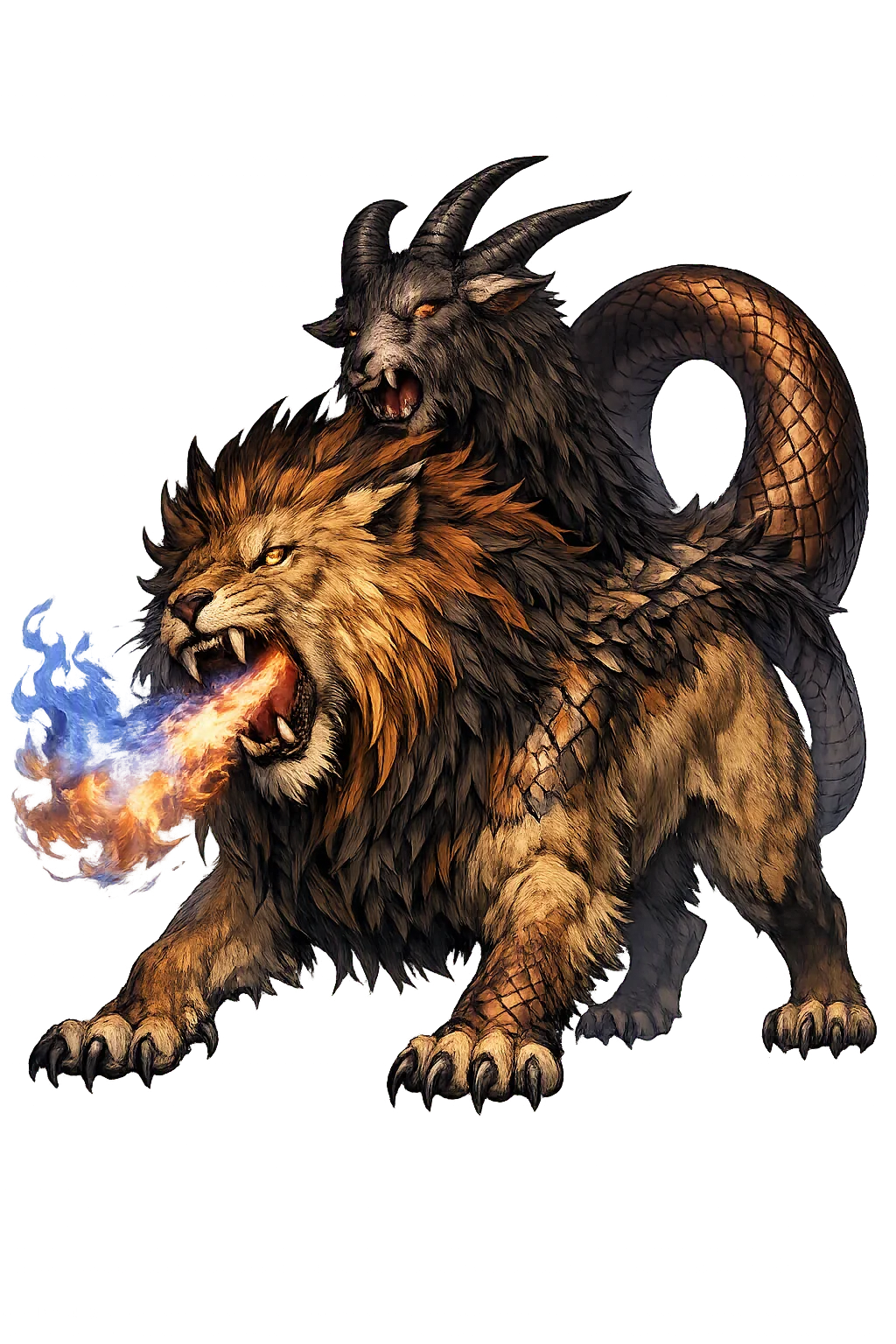
Chímaira is the monster of Lycia: lion before, serpent behind, she-goat in the middle, breathing forth the dreadful might of blazing fire (Theogony 319–325). Daughter of Typhôn and Echidna, sister to the Hydra and Kerberos, she is Homer's 'thing divine, not of mortal men' — a creature with no cult, no temple, and no pity. And yet her name is the homeliest word in the Greek barnyard: a she-goat one winter old.
Her fire is not a weapon she wields but the air she exhales — 'the terrible might of blazing fire' breathed out without cease.
Lion, goat, and dragon in a single body: the beast that refuses to be one thing, the ancestor of every hybrid the imagination has raised since.
Sent to be killed by her, Bellerophôn instead kills her from the sky — the first monster in Greek myth destroyed from the back of a winged horse.
Stories of Chímaira
Chímaira's myths are all one myth told at different distances: the impossible creature, and the impossible rider sent against her. Born divine, she exists in the tradition only to be destroyed — yet she has never stopped being imagined.
In the Theogony (319–325), Hesiod sets Chímaira in the brood of Echidna: 'the Chímaira who breathed invincible fire, a creature terrible and great, swift-footed and strong. Three heads she had — one of a fierce-eyed lion, one of a goat, and one of a snake, a mighty dragon: lion in front, dragon behind, goat in the middle — breathing out the dreadful might of blazing fire.' Her siblings are the catalogue of beasts the heroes must undo: Orthos, Kerberos, the Lernaian Hydra. Hesiod seals her fate in the same breath as her birth — 'her did Pegasos and noble Bellerophontês slay' (325) — as if such a creature could only ever be a death postponed.
In Iliad 6 (144–211), Glaukos tells Diomêdês the tale on the battlefield. Spurned by his guest Bellerophôn, Proitos's wife Anteia accused him falsely; unwilling to stain the guest-table with murder, Proitos sent him to Lycia bearing a folded tablet inscribed with 'baneful signs' (σήματα λυγρά, 6.168) — one of the earliest mentions of writing in Greek literature. Reading the letter, the Lycian king set the stranger trials, and first of all bade him slay the Chímaira, the invincible: 'a thing of divine stock, not of men — lion in front, serpent behind, she-goat in the middle, breathing the terrible might of blazing fire' (6.180–182). 'And he slew her, trusting in the portents of the gods' (6.183). The monster meant to be his executioner became the first entry in his glory.
Pindar (Olympian 13.63–92) gives the Corinthian version. The young Bellerophôn longed beyond anything to yoke Pegasos, the winged colt of Medousa, and the seer Polyidos sent him to sleep on Athēnā's altar. In the night the goddess stood beside him and set down a bridle banded with gold, bidding him sacrifice a bull to Poseidôn the Horse-Tamer; he woke with the bridle real in his hands. 'And in bronze armour, mounted upon it, he slew the archer host of the Amazons… and the Chímaira breathing fire' (13.87–90). Pindar grants the beast no anatomy at all — only the flame — and lets the winged horse carry the whole weight of the wonder.
Apollodorus (Library 2.3.1–2) supplies the mechanism the epics omit. Pegasos, he reminds us, sprang from the severed neck of Medousa, and it was with Athēnā's bridle that Bellerophôn mastered him. Then, mounted, the hero fixed a lump of lead to the point of his spear and flew at the Chímaira; the monster drew the lead down with the fire she breathed, the metal melted in her throat, and her own flame burned out her entrails. The rationalizing detail — a poet's nightmare undone by a smith's trick — is the later age speaking, centuries after Homer, unwilling to let wonder close without an explanation.
The Greeks built her no altar, and yet Homer calls her θεῖον γένος — 'of divine stock, not of men' (Iliad 6.180): the impossible, they felt, deserves a kind of reverence. Commentators have read Hesiod's triple anatomy as a riddle of the Lycian landscape — lion, goat, and serpent as crag, pasture, and fire-vented cleft — but the poet offers no key; the monster simply refuses to be one thing. There is a dry humour buried in the sources: Iliad 16.328 says a man named Amisodaros 'reared' her, as one rears livestock, to be 'a bane to many men' — the Greeks imagined the ungovernable and then gave it a goatherd. The deepest wordplay is the name itself: the most impossible creature in Greek myth carries the tamest noun in the language, a one-winter she-goat; terror, the grammar insists, is bred in the barnyard.
Enter Extended Lore