
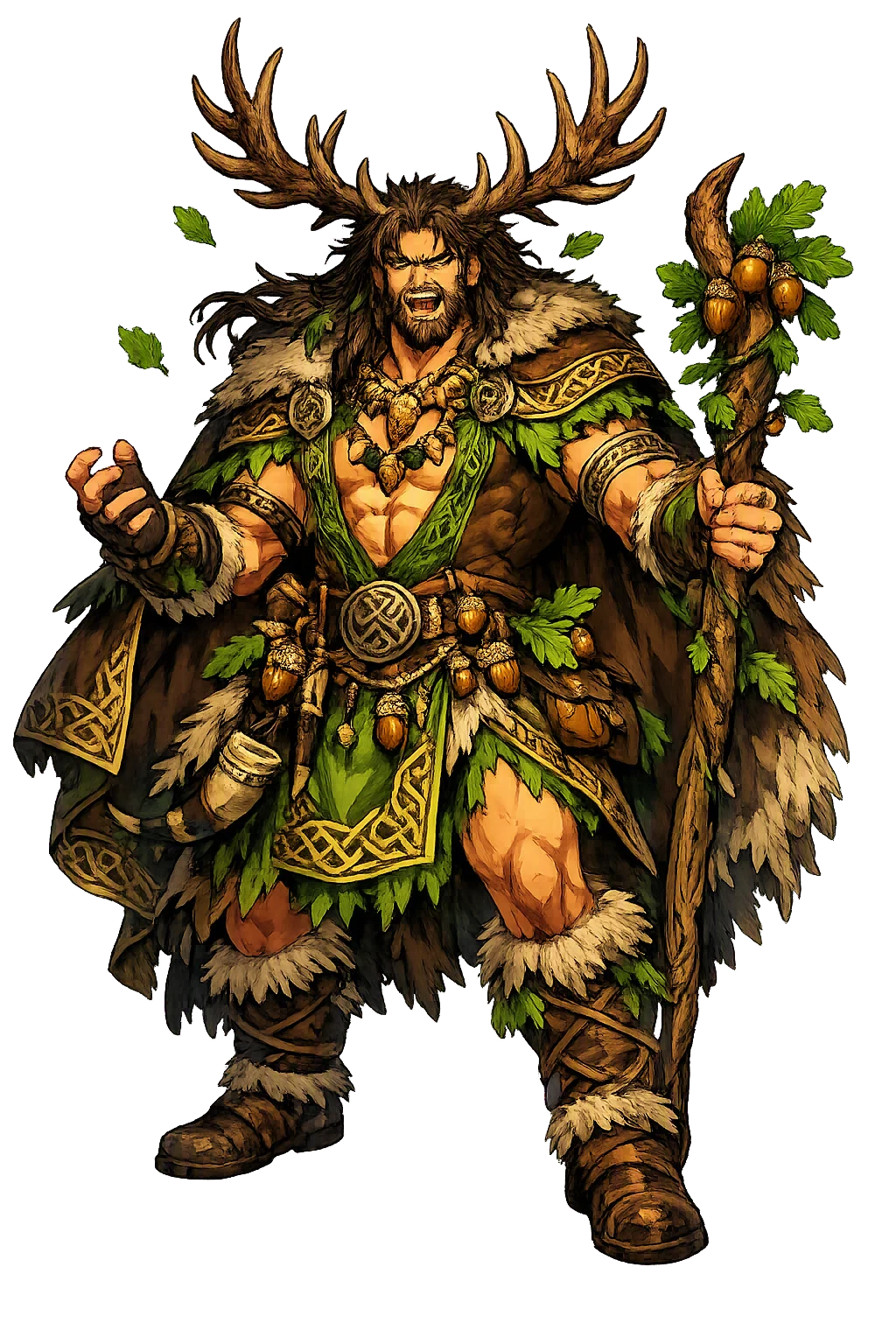
The appointments Cernunnos made — and who is keeping them
One myth is a story. A cycle of myths is a specification. Read Cernunnos's cycle in order and the industries fall out of it one by one.
At a Glance
- Temple: Cernunnos
- Pantheon: Celtic
- Domain of influence: Wilderness, Animals, Fertility
- Pattern seats: 3
- Sectors touched: Energy & Natural World · Society & Spirit
- Strongest seat: Forestry, Conservation & Outdoor Industries
- Series: The Resonance Files, No. 78 of 397
The Cycle, Read Forward
Forestry, Conservation & Outdoor Industries — through The Name on Stone
Under the choir of Notre-Dame, in 1711, workmen uncovered the monument the boatmen's guild of the Parisii — the nautae Parisiaci — had raised to Jupiter in the reign of Tiberius, early in the first century CE. Among its carved gods, one block shows a balding, bearded head wearing antlers, with a torc hanging from each antler, and above the figure runs the inscription [C]ERNVNNOS.
The atlas states the seat in one line: The horned god of animals and wild places — the Gundestrup master of beasts. The story above is the long version of the same sentence. The trade thinks it is optimizing a process. It is re-enacting a charter.
History, Archives & Records — through The Cross-Legged Lord
In 1891 a peat-cutter's spade struck silver in the Rævemosen bog at Gundestrup in Jutland: a great gilded vessel of thirteen plates, the masterpiece of Celtic metalwork, now in the National Museum of Denmark. On one interior plate sits the figure the whole world now pictures when it hears the name — cross-legged, antlered, a torc gripped in the right hand and a ram-horned serpent in the left, while a stag with matching antlers stands beside him and the animals of the wild close round: boar, bull, and a wolfish beast padding toward him.
The atlas states the seat in one line: One inscription ([C]ERNVNNOS, Pillar of the Boatmen, Tiberius-era) — the most materially attested Celtic theonym. The story above is the long version of the same sentence. The trade thinks it is optimizing a process. It is re-enacting a charter.
Faith & Spiritual Organizations — through The Antlered Lords of Gaul
The figure recurs across the Roman Gaulish world without ever being named again. At Reims an altar shows an antlered, cross-legged god seated between Apollo and Mercury, emptying a sack of grain or coin over a bull and a stag — the horned one as the source of abundance.
The atlas states the seat in one line: The Murray-to-Gardner descent — the god modern witchcraft claimed as its own, whatever the evidence says. The story above is the long version of the same sentence. The trade thinks it is optimizing a process. It is re-enacting a charter.
The Theme That Runs the Cycle
Cernunnos has no mythology in the literary sense — no tale, no genealogy, no surviving word of his deeds. Gaul wrote no epics down. What survives is a dossier of stone, silver, and bronze: one inscription that names him and a gallery of images that show him, and the whole tradition must be read from those.
The Method, Stated Plainly
The atlas is not a horoscope. Seats are earned from the sources — argued, weighted, published — and every one of them can be challenged at the methodology page. A match that cannot survive an argument does not survive review. That is the whole trick: the patterns are claims, and claims can be tested.
For the Ones Who Work There
If you work in forestry, conservation & outdoor industries, history, archives & records, or any trade this temple holds a seat in, this is the honest version of what a placement means: your industry beside the story it has been re-telling all along — on the temple floor itself, before an audience that came specifically to read it. The patron tier and the advertising terms describe the mechanics; the resonance above describes the fit.
The File Continues
One of 397 Resonance Files — the series where the pantheon goes to work. Read the founding dispatch for the name, the Restoration File for the spelling, or the whole archive end to end.
Continue the series — previous: Ceridwen (read it) · next: Cháng'é (read it).
The Resonance Files are argued from the same canonical record as the pattern atlas itself: the lexicon, the lore catalog, and the cited sources. Every seat can be challenged at the methodology page — and the challenge is the point.