
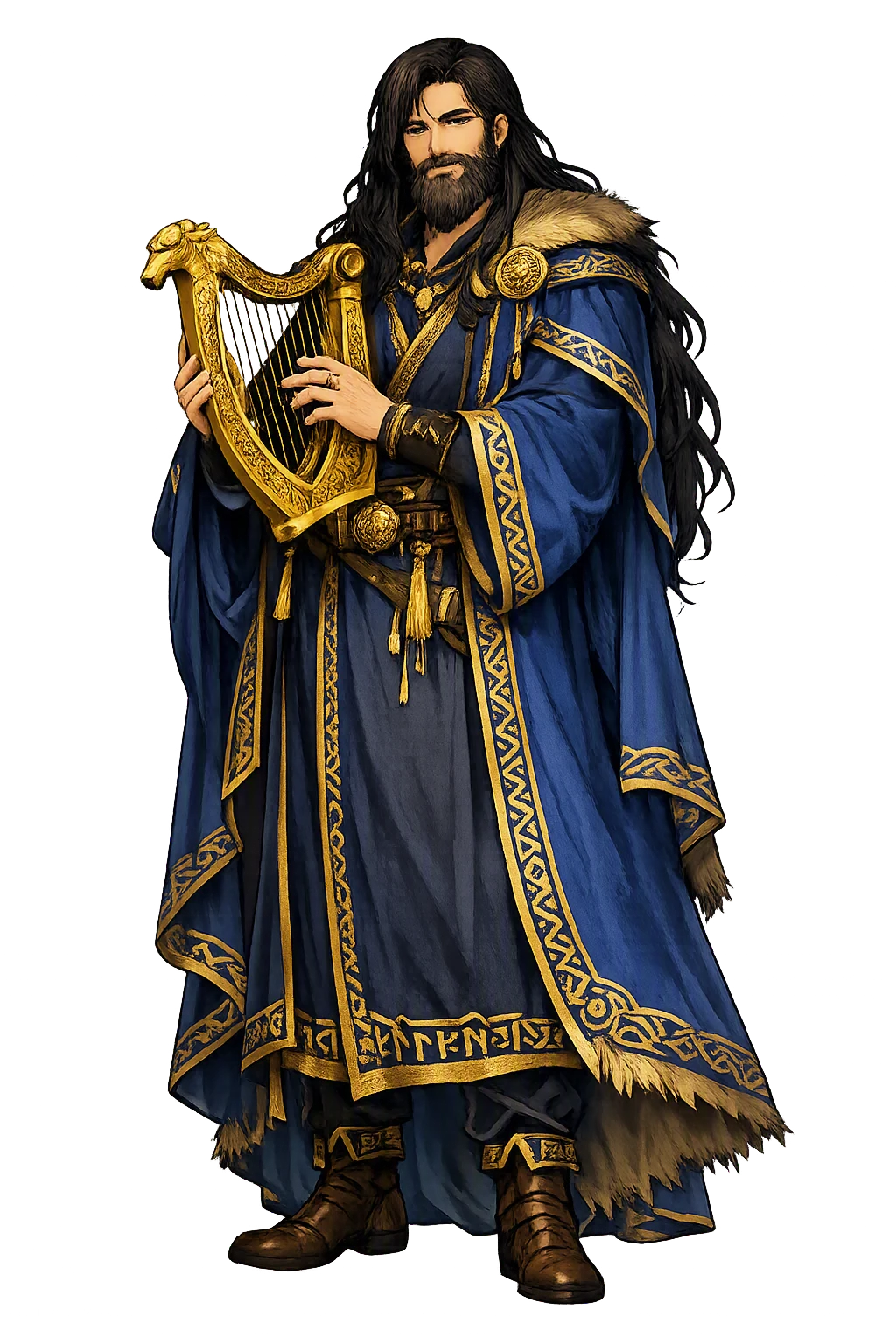
Where Bragi works now: the myths behind the markets
The myths did not retire. They moved offices. This is the file on where Bragi works now.
Bragi acts in almost nothing and speaks in everything. His dossier is a voice: the catalogue portrait in Gylfaginning, the storytelling frame of Skáldskaparmál, the first sharp answer to Loki in Lokasenna, and the welcome spoken over dead kings in the court poems. The tradition made the god of poetry out of the thing poetry does.
The pattern atlas — which maps every flagship temple to the industries its archetype demonstrably resonates with, each match argued and open to challenge — seats this temple in 4 industries. This file reads those seats the way they were earned: through the myths.
At a Glance
- Temple: Bragi
- Pantheon: Norse
- Domain of influence: Poetry, Eloquence
- Pattern seats: 4
- Sectors touched: Culture & Entertainment · Society & Spirit
- Strongest seat: Music, Arts & Performance
- Series: The Resonance Files, No. 68 of 397
The Myth at Work
The Best of Skalds. Snorri's catalogue of the Æsir fixes the portrait the whole tradition repeats: one of the gods is called Bragi; he is renowned for wisdom and most of all for eloquence and skill with words, and he knows more about poetry than any other. From his name, Snorri says, bragr is called — the word means both poetry and the foremost of anything — and from it a man or woman who surpasses others in eloquence is called a bragr-maðr or bragr-kona. — hold that image; the industries below are where it goes to work.
The Gods' Own Storyteller. The Prose Edda's second half is built around Bragi's voice. When Ægir, the sea-god skilled in magic, came to a feast in Ásgarðr, he was seated beside Bragi, and they drank and talked — and the myths Bragi tells him are the ones the book exists to record: how the Æsir and Vanir spat their truce into a vat and made Kvasir, wisest of beings; how the dwarfs Fjalarr and Galarr killed him and brewed his blood with honey into the mead that makes a skald of whoever drinks; how the mead passed to the giant Suttungr and how Óðinn, as Bǫlverkr, lay three nights with Gunnlǫð and drained Óðrerir in three gulps. — remember the shape of that act. You will see it again, wearing a logo.
The Seats
Each of these is argued in the atlas with a weight and a why-line. What the atlas cannot fit in one line is the whole myth — so here is each seat with its story restored.
Music, Arts & Performance
Music, theatre, dance, and the performing arts. (Sector: Culture & Entertainment)
The why-line says it in one breath: Patron of skalds — the divine address for every court poet of the North. That is not a resemblance; it is the same act, performed in a newer building.
Writing, Publishing & Media
Books, journalism, and content platforms. (Sector: Culture & Entertainment)
The why-line says it in one breath: The god of poetry — bragr itself is said to descend from his name. That is not a resemblance; it is the same act, performed in a newer building.
Education, Research & Knowledge
Schools, universities, and research institutions. (Sector: Society & Spirit)
The why-line says it in one breath: Eloquence as divine office — the god who greets dead kings with the right words. That is not a resemblance; it is the same act, performed in a newer building.
History, Archives & Records
Museums, archives, libraries, and the record-keeping professions. (Sector: Society & Spirit)
The skald-god — deeds held in poetry, the North's own way of keeping the record. — the atlas stops there, out of discipline. The myth keeps going: the function Bragi performs in the stories is precisely the function this industry sells.
The Long Employment
Bragi never left the North's language. Bragr remained the Old Norse word for poetry itself; the bragr-maðr and bragr-kona — the man or woman of surpassing eloquence — kept his name in everyday compliment; and the bragarfull, the foremost cup of the vow-toast that Ynglinga saga sets at the great inheritance feasts, carried the word into the drinking customs of medieval Scandinavia and, revived, into the sumbel of modern Heathen practice, where Bragi is still hailed as the patron of poets before the boasting rounds begin. The age changed. The work did not.
The Method, Stated Plainly
None of this is numerology. A seat exists only where the match can be argued from the deity’s documented domains and deeds — weighted, published, and falsifiable. The derivation, the weights, and the challenge process are public on the methodology page. If a seat in this file reads wrong, the atlas itself tells you how to prove it — and the correction becomes part of the record.
For the Ones Who Work There
If you work in music, arts & performance, writing, publishing & media, or any trade this temple holds a seat in, this is the honest version of what a placement means: your industry beside the story it has been re-telling all along — on the temple floor itself, before an audience that came specifically to read it. The patron tier and the advertising terms describe the mechanics; the resonance above describes the fit.
The File Continues
One of 397 Resonance Files — the series where the pantheon goes to work. Read the founding dispatch for the name, the Restoration File for the spelling, or the whole archive end to end.
Continue the series — previous: Blodeuwedd (read it) · next: Brigid (read it).
The Resonance Files are argued from the same canonical record as the pattern atlas itself: the lexicon, the lore catalog, and the cited sources. Every seat can be challenged at the methodology page — and the challenge is the point.