
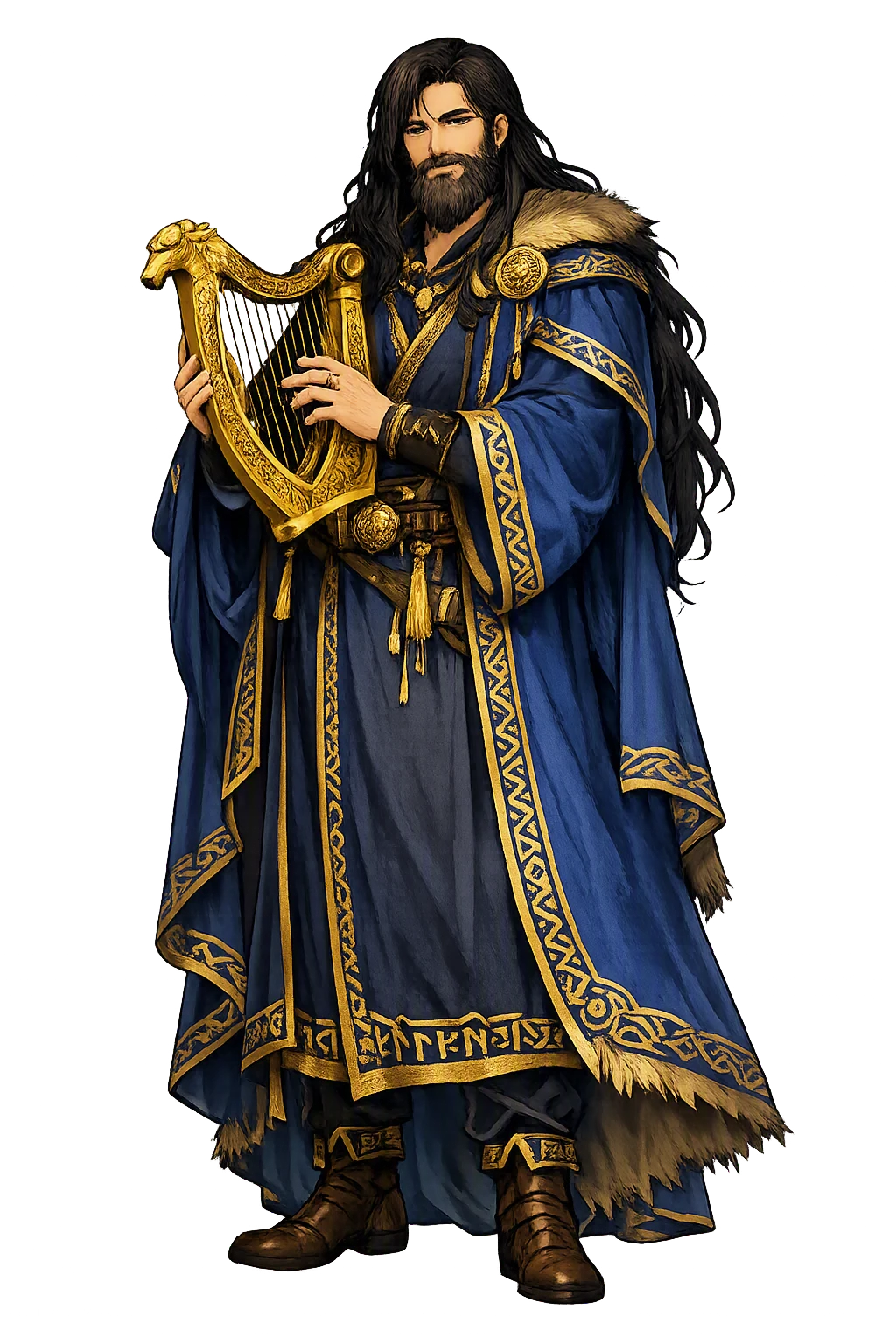
Why Bragi is spelled that way — and what it costs to get it right
There is a version of this name the early internet had to settle for: bragi. This is the file on how Bragi replaced it.
Bragi acts in almost nothing and speaks in everything. His dossier is a voice: the catalogue portrait in Gylfaginning, the storytelling frame of Skáldskaparmál, the first sharp answer to Loki in Lokasenna, and the welcome spoken over dead kings in the court poems. The tradition made the god of poetry out of the thing poetry does.
At a Glance
- Restored name: Bragi
- ASCII form: bragi
- Meaning: "Poet, first"
- Domain of influence: Poetry, Eloquence
- Pantheon: Norse
- Classification: Tier 2
- Original script: ᛒᚱᛅᚴᛁ
- Series: The Restoration Files, No. 68 of 397
The Name Before the Marks
Spoken, the name runs `/ˈbrɑ.ɣi/` — bRAH-ghi — a short open 'ah', and the g softening between vowels to a light voiced fricative, like a gentle 'gh'; stress falls on the first syllable.
The Temple That Stands Now
The restored name is not a plaque; it is an address. The temple of Bragi lives at /sites/bragi/, with its mythology in the lore halls, its peer-reviewed record in the Scholarly Edition, and its place in the pattern atlas on the patterns floor.
The restoration keeps one feature the ASCII form drops. One is enough to matter, and the label says so plainly: Tier-2.
Where the Name Stood First
Bragi is a textual god: no runestone invokes him, no votive deposit names him, and the place-name record offers no secure theophoric site — the silence that leads Simek and Lindow to weigh him as a late literary personification rather than an old cult figure. The runic corpus does know the name, but only as an ordinary human anthroponym: Bragi is well attested as a Viking-Age man's name in Scandinavian inscriptions, which is precisely the problem for cult-hunters, since none of the carvings can be tied to the god. The witnesses are therefore the manuscripts. Lokasenna and Grímnismál survive in the thirteenth-century Codex Regius of the Poetic Edda; Gylfaginning and the Skáldskaparmál frame in the Codex Regius and sister manuscripts of the Prose Edda, with Skáldatal in the Uppsala codex; Hákonarmál rides inside the Heimskringla tradition and Eiríksmál inside Fagrskinna. The famous image of Bragi as an old harper belongs to nineteenth-century art, not to the material record: no medieval carving, pendant, or picture stone shows him. The temple on the web is the newest of these addresses — the first one that fits in a pocket.
The Archetype at Work
The pattern atlas seats this temple in 4 industries, each match argued and weighted: Music, Arts & Performance (patron of skalds — the divine address for every court poet of the North.); Writing, Publishing & Media (the god of poetry — bragr itself is said to descend from his name.); Education, Research & Knowledge (eloquence as divine office — the god who greets dead kings with the right words.). The Resonance File reads those seats through the myths themselves.
In the Sacred Texts
The Norse tradition is not a vibe; it is a library. The Sacred Texts collection holds Poetic Edda and Prose Edda — the primary sources the temple's scholarship is built on. The temple is the argument; the texts are the evidence.
The File Continues
The temple's founding dispatch tells the name's story; its Resonance File reads the myths into the industries; the blog index holds the whole archive.
Continue the series — previous file: Blodeuwedd (read it here) · next file: Brigid (read it here).
The Restoration Files are written from the same canonical record as the temples themselves: the lexicon, the lore catalog, the pattern atlas, and the cited scholarly sources. If a file ever disagrees with its temple, the temple is right — tell us, and the file will be corrected.