
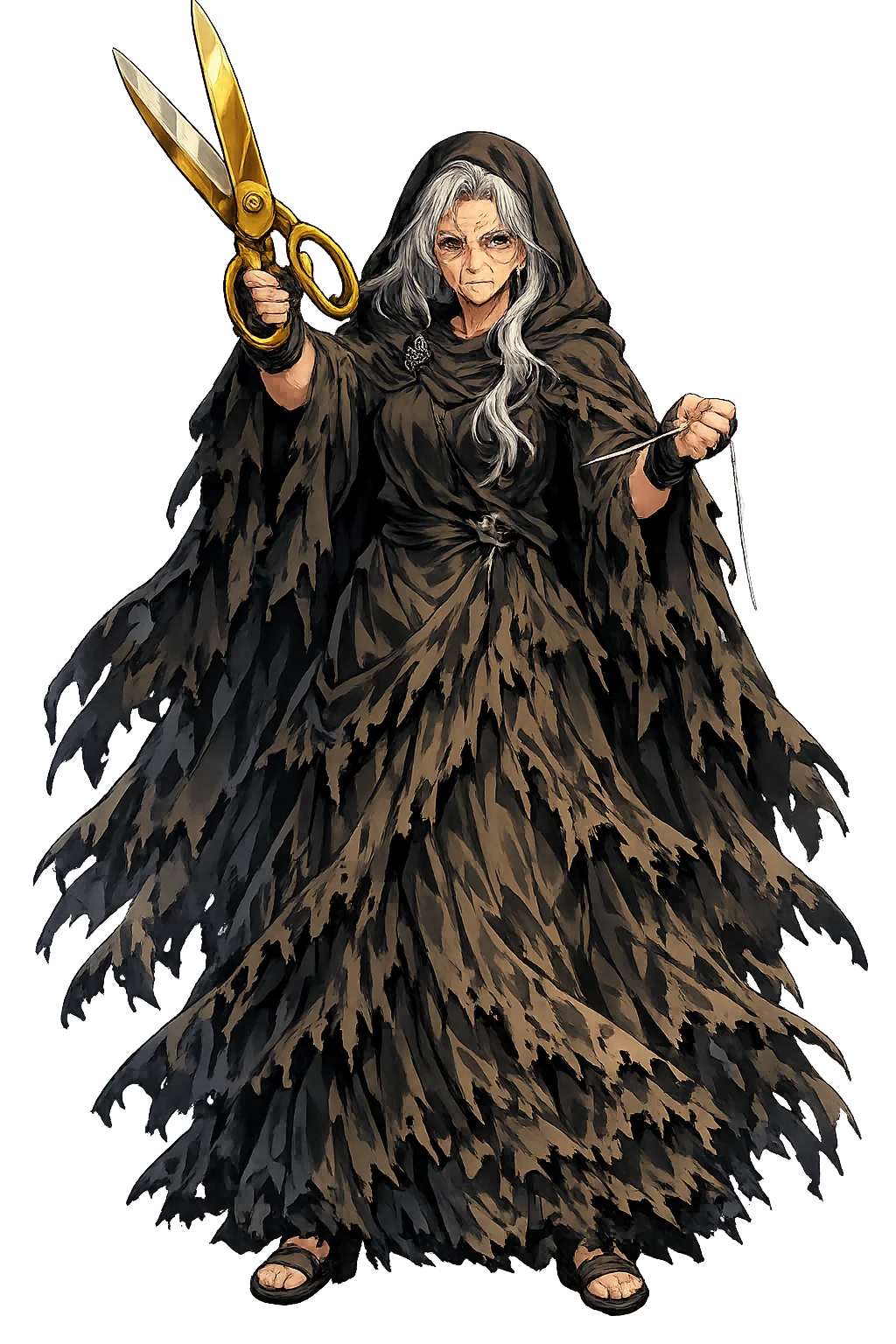
Átropos in 2026: why scholars still care
In 2026, names are treated as data points. Átropos is a reminder that they are also cultural artifacts — and that the difference matters for search engines, AI training corpora, and anyone who types the name of a Greek figure into a browser. Scholars never stopped caring about the difference between atropos and Átropos; the web simply made that care actionable. What follows is the full scholarly picture — name, script, sound, myth, cult, and legacy — followed by the engineering compromise that lets a restored spelling live at a real address. The question is not whether the name is old. It is whether the digital world is old enough to hold it.
At a Glance
- Restored name: Átropos
- ASCII form: atropos
- Meaning: "Inflexible, inevitable"
- Domain of influence: Cutter of Thread
- Pantheon: Greek
- Classification: Tier 2
- Original script: Ἄτροπος (Greek)
- Live domain: átropos.com
Overview
Átropos (atropos) — She Who Cannot Be Turned — belongs to the Greek tradition, where it is catalogued under the domain "Cutter of Thread". The name means "Inflexible, inevitable".
Átropos is the third of the three Moirai: Klōthṓ spins the thread, Láchesis measures it, and Átropos cuts it. Her name is a verdict — "she who cannot be turned aside" — and Greek literature treats her not as a villain but as the grammar of endings itself.
PuniCodex restores the name as Átropos and serves its temple at átropos.com. The original preserves one prosodic feature — stress or vowel length — rather than both, which places the name in Tier 2. The plain ASCII form atropos survives as a modern convenience imposed by the early domain-name system; the restoration, not the fallback, is the form the project defends as philologically complete.
The Name
The name is attested in Greek as Ἄτροπος. Etymologically it means "Inflexible, inevitable".
The ASCII form atropos survives only because the early domain-name system could not carry diacritics; it is a technological compromise, not an ancient spelling. The Unicode restoration Átropos recovers the stress accent of the original directly in the address bar. The original preserves one prosodic feature — stress or vowel length — rather than both, which places the name in Tier 2.
The letter-by-letter transformation runs:
- a → Á — Acute on a
- t → t — t same
- r → r — r same
- o → o — o same
- p → p — p same
- o → o — o same
- s → s — s same
The project holds the domain átropos.com (xn--tropos-ota.com) as the canonical home of this name.
The Original Script
The name is written in Greek as Ἄτροπος. This original script is the form against which the ASCII fallback atropos and the PuniCodex restoration Átropos are measured: the restoration preserves its pitch accent of the written form, so that a reader typing the modern address still speaks the ancient name.
Pronunciation
The reconstructed pronunciation of the name is /á.tro.pos/ — Attic Greek.
For the modern speaker, the closest approximation is: AH-tro-pos, stress on the first syllable; both o vowels short.
Kindred and historical forms of the name:
- Greek — Ἄτροπος
- Latin — Atropos
- Owned form — Átropos
Greek Ἄτροπος carries the recessive accent of a feminine agent-noun on the first syllable — Átropos — from ἀ- ("not") plus τρέπω ("to turn"): the one who cannot be turned. The Latin form Atropos keeps the same stress, which is why the English "atropos" and the goddess sound alike. Latin kept both the word and the weight: Seneca's Atropos stresses the same first syllable as the Greek.
Mythology
Hesiod names her with her sisters in the Theogony: Klōthṓ, Láchesis, and Átropos, "who give mortals good and evil." Of the three, she alone never appears as a character with dialogue — she is the act, not the actor.
Daughters of Night (The Genealogy)
In the Theogony's first account the Moirai are fatherless daughters of Nyx, Night — older than Zeús himself, and in some traditions even the king of gods bows to their decree. A second Hesiodic account makes them daughters of Zeús and Themis, law-givers by birth: the tension between fate above Zeús and fate as his instrument runs through all Greek thought.
Méleagros and the Brand (The Warning)
Seven days after Méleagros' birth the Moirai appeared to his mother Althaia and declared the child would live only until the log then burning on her hearth was consumed. She snatched it from the fire and kept it for years — until, enraged at her son for killing her brothers, she thrust it back into the flames, and Átropos' sentence completed itself at once.
The Future on the Spindle (The Cosmos)
In the Myth of Er that closes Plato's Republic, the souls see the spindle of Anánkē, Necessity, around which all the spheres of heaven turn. Láchesis sings the past, Klōthṓ the present, and Átropos the future — the three sisters holding the music of the planets in their hands.
Symbols & Iconography
The iconography associated with Átropos concentrates in a small set of recurring attributes, each a compressed statement about the name:
- The shears — The instrument of the cut — finality without malice
- The thread — The spun and measured life she completes
- The scroll — In Roman art the Parcae write as well as spin — fate as record
The Moirai enter art late and as a triad: Hellenistic gems and Roman sarcophagi show the three with their instruments — spindle, scroll or measure, and shears — Átropos usually eldest, veiled, holding the cutting tool or the finished thread. On the great Roman sarcophagi (the "Prometheus" and "Meleager" types) they attend the deathbed as the plot's auditors. Medieval and Renaissance art softened them into the "weird women" of tapestry, but the shears stayed with the third sister throughout — the one attribute no tradition ever reassigned.
Epithets & Cult Titles
Átropos' titles are statements of function rather than cult.
- Ἄτροπος — 'she who may not be turned'; the name itself, from ἀ-τρέπω, is her first epithet.
- ἡ πρεσβυτάτη — 'the eldest'; Plato and later tradition make her senior of the three Moirai.
- Μοῖρα — 'the Portion'; the generic title she shares with her sisters, the Apportioners.
- Morta — her Roman name among the Parcae, from mors: the Latin speakers heard death in her directly.
The Greeks gave her almost no cult, and that absence is itself the testimony: what cannot be turned cannot be persuaded, so she received no prayers.
The Homeric Hymns
The Homeric corpus contains no hymn to the Moirai — fate does not receive cult-song in the archaic manner — but the Orphic tradition repaired the omission: Orphic Hymn 59, "To the Fates," invokes Klōthṓ, Láchesis, and Átropos "who dwell in heaven's circling course," begging them to come "gentle, and bring a good end." The hymn is the fullest surviving liturgical address to the triad, and its request — for a good measure rather than a long one — is exactly Átropos' theology. Plato's vision of the three singing sisters at the spindle of Necessity (Republic 617c) is the philosophical counterweight.
Oracle Sites & Sanctuaries
The Moirai's few sanctuaries are revealing. Pausanias records an altar to the Fates beside the sanctuary of Despoina in Arcadia — chance admitted to the holiest mystery cult as a subsidiary power. In Corinth and elsewhere they appear with Zeús Moiragétēs, 'leader of the Fates' — the theology that subordinates them to the sky-god's will. Their truest shrine is the spindle-whorl itself: dedications of spinning tools in temple deposits show that Greek women offered the instruments of the Fates' own craft to the goddesses of craft, Athena and Artemis, in their name.
Archaeology & Evidence
The Moirai rarely received independent cult — Pausanias notes an altar to them beside the sanctuary of Despoina in Arcadia and statues in the temple of Zeús Moiragetēs ("leader of the fates"). Their true monument is funerary: Roman sarcophagi carved the Parcae with spindle, scroll, and shears as standard eschatological furniture, and Hellenistic gems show Átropos with her blades. The famous "Spindle Whorl" dedications of spinning-women's tools in temple deposits tie the goddess's craft to real women's work.
Realm & Domain
Átropos is the third of the three Moirai: Klōthṓ spins the thread, Láchesis measures it, and Átropos cuts it. Her name is a verdict — "she who cannot be turned aside" — and Greek literature treats her not as a villain but as the grammar of endings itself.
The Shears
Her attribute from Hellenistic art onward: the blades that end the measured span.
The Spindle of Necessity
In Plato's Republic she turns the future on the cosmic spindle her mother Anánkē holds.
The Brand of Méleagros
The log whose burning measured a hero's life — her timetable written in firewood.
Atropine
The alkaloid of deadly nightshade, Atropa belladonna, named for the cut she delivers.
Across Cultures
Rome mapped her onto Morta of the Parcae (from mors, death), with Nona and Decuma spinning and measuring — though later poets reshuffled the names. The Latin poets from Catullus to Seneca use the Fates' cut as the fixed boundary of rhetoric itself: even Jove, they repeat, cannot unshear what is sheared.
Modern biology gave her a second immortality: the nightshade genus Atropa and its alkaloid atropine — the poison that stills the heart and the drug that restarts it — carry the name of the Inflexible into every emergency room.
Within the Greek tradition, closely related names in the corpus include [[acheron|Achérōn]], [[achilleus|Achilleús]], [[adamas|Adámas]], [[aer|Aḗr]], [[aither|Aithḗr]], and [[ananke|Anánkē]].
Cultural Legacy
Shakespeare's "thread of life" and every three-weird-sisters scene from Macbeth to modern fantasy descend from her triad. In philosophy she anchors the ancient debate on determinism: Chrysippus and the Stoics built their heimarmenē around the Moirai's decree, and Epicurus invented the atomic swerve partly to break Átropos' loom. Wherever an ending is shown as both just and unalterable, her shears are in the frame.
The Scholarly Record
The account of Átropos given in this edition rests on the witnesses and reference works listed below. Lexica and etymological dictionaries secure the form and meaning of the name; the literary and religious texts supply the narrative evidence.
- Liddell-Scott-Jones Greek-English Lexicon, 9th ed. with 1996 supplement, 1843. Full text
- Hesiod, Theogony, Loeb Classical Library No. 57, 700 BCE. Full text
- Plato, Dialogues, Loeb Classical Library / Oxford Classical Texts, 348 BCE. Full text
- Apollodorus, Bibliotheca, Loeb Classical Library (Frazer), 150.
- Pausanias, Description of Greece, Loeb Classical Library, 180. Full text
- Etymological Dictionary of Greek, 2 vols., Brill, 2010. Full text
A Meditation
Átropos is the least frightening of the Fates once understood: she does not shorten the thread, she only confirms its measure. Every system that ends cleanly — a contract performed, a story resolved, a life fully spent — has passed through her hands. The terror belongs not to the cut but to the tangle.
There is a reason programmers, actuaries, and hospice workers all know her name without knowing it: every system that terminates correctly implements her. The thread that ends on schedule is not a tragedy but a design — the Moirai were never death-dealers but measure-keepers, and she is simply the sister who reads the measurement aloud. A culture that can name its ending honestly, the Greeks understood, is freer than one that cannot: the cut is only cruel when the weaving was dishonest.
So the philosophers made peace with her: the Stoics called her law, Epicurus built his swerve against her, and both schools agreed on the one thing the poets always knew — that the measured life is the only kind there is. The shears do not threaten; they define. What has no end has no shape, and what has no shape cannot be lived, only endured.
The Unicode Restoration
Átropos is classified as Tier 2: the original preserves at least one philological feature that ASCII cannot encode. The ASCII fallback atropos still resolves everywhere, but it is the restored form that carries the name's full information. Across the 7 characters of the name, the restoration adjusts 1: 1 mark of stress (Á). That is the whole thesis of this temple: the marks are the message.
Character by Character
The journey from atropos to Átropos, one character at a time:
- a → Á — Acute on a
- t → t — t same
- r → r — r same
- o → o — o same
- p → p — p same
- o → o — o same
- s → s — s same
The Domain Name
The restored name is live as a working domain: átropos.com, which the DNS carries in punycode form as xn--tropos-ota.com — an ASCII-compatible encoding that lets a non-ASCII name travel the global network without breaking older infrastructure. The visitor sees Átropos; the machines see the encoding. That duality is the engineering compromise on which the entire restoration rests, and it is why a name written the way its own tradition wrote it in Greek can now be typed into any browser on earth.
The Greek Pantheon
Átropos is one of 268 entries the PuniCodex lexicon catalogues under the Greek pantheon. The Pantheon page gathers the tradition's major figures in one place, and the Lexicon lets you filter all 915 restorations by tradition, tier, or script — the fastest way to see where this name sits among its kin.
Frequently Asked Questions
What does Átropos mean? The traditional gloss is "Inflexible, inevitable."
Which tradition does Átropos belong to? Átropos is catalogued in the Greek pantheon of the PuniCodex lexicon.
Why is Átropos classified as Tier 2? Because the original preserves at least one philological feature that ASCII cannot encode — and the marks in the restored spelling preserve exactly that evidence.
Is Átropos a working domain? Yes — átropos.com resolves today and routes to this temple.
What is the punycode for átropos.com? The DNS encoding is xn--tropos-ota.com; browsers perform the translation automatically, so visitors only ever see the restored name.
Typing Átropos
You do not need a special keyboard to use this restoration. The PuniCodex Type Tool converts the ASCII form atropos into Átropos as you type, and the browser extension offers the same conversion inside any text field. Copy the restored form, paste it into the address bar, and the DNS does the rest.
Sister Temples
Other temples in the Greek pantheon include Phlégethōn, Phoíbē, and Phthónos — each with its own restoration story, its own scholarly record, and its own place in the lexicon.
Why This Restoration Matters
In 2026 the stakes are practical. Search indexes, language models, and localization pipelines all inherit whatever spelling the web normalizes — which means every Unicode domain is also a training signal. Átropos teaches the machinery that the restored form exists, that it is used, and that it points to a real place. That is why a project built on philology ends up caring about DNS: the infrastructure decides which names the future sees. This restoration makes sure the future sees the whole name.
Explore Further
This post is one doorway into the temple. The home page carries the full character breakdown and the ambient canvas; the lore page tells the myths in long form; the Scholarly Edition preserves the sources, pronunciation data, and revision history; and the patron wall supports the restoration directly. For the wider map, browse the Lexicon, explore the Pantheon, or return to the PuniCodex blog.
Related Names
Sources
The full scholarly apparatus — every citation, revision, and review — lives in the Scholarly Edition. Key references for this post:
- Hesiod, Theogony / Works and Days / Shield, Loeb Classical Library No. 57, 700 BCE.
- Liddell-Scott-Jones Greek-English Lexicon, 9th ed. with 1996 supplement, 1843.
- Hesiod, Theogony, Loeb Classical Library No. 57, 700 BCE.
- Plato, Dialogues, Loeb Classical Library / Oxford Classical Texts, 348 BCE.
- Pausanias, Description of Greece, Loeb Classical Library, 180.
- Etymological Dictionary of Greek, 2 vols., Brill, 2010.
- Apollodorus, Bibliotheca, Loeb Classical Library (Frazer), 150.
- Plato, Republic 617c; Hesiod, Theogony 217–222, 904–906.
- Pausanias 8.37; on Zeus Moiragetes, see the Attic inscriptions.
- Orphic Hymn 59 (Athanassakis & Wolkow); Plato, Republic 617c.
- Lexicon authorities for this entry: Plato, LSJ.