
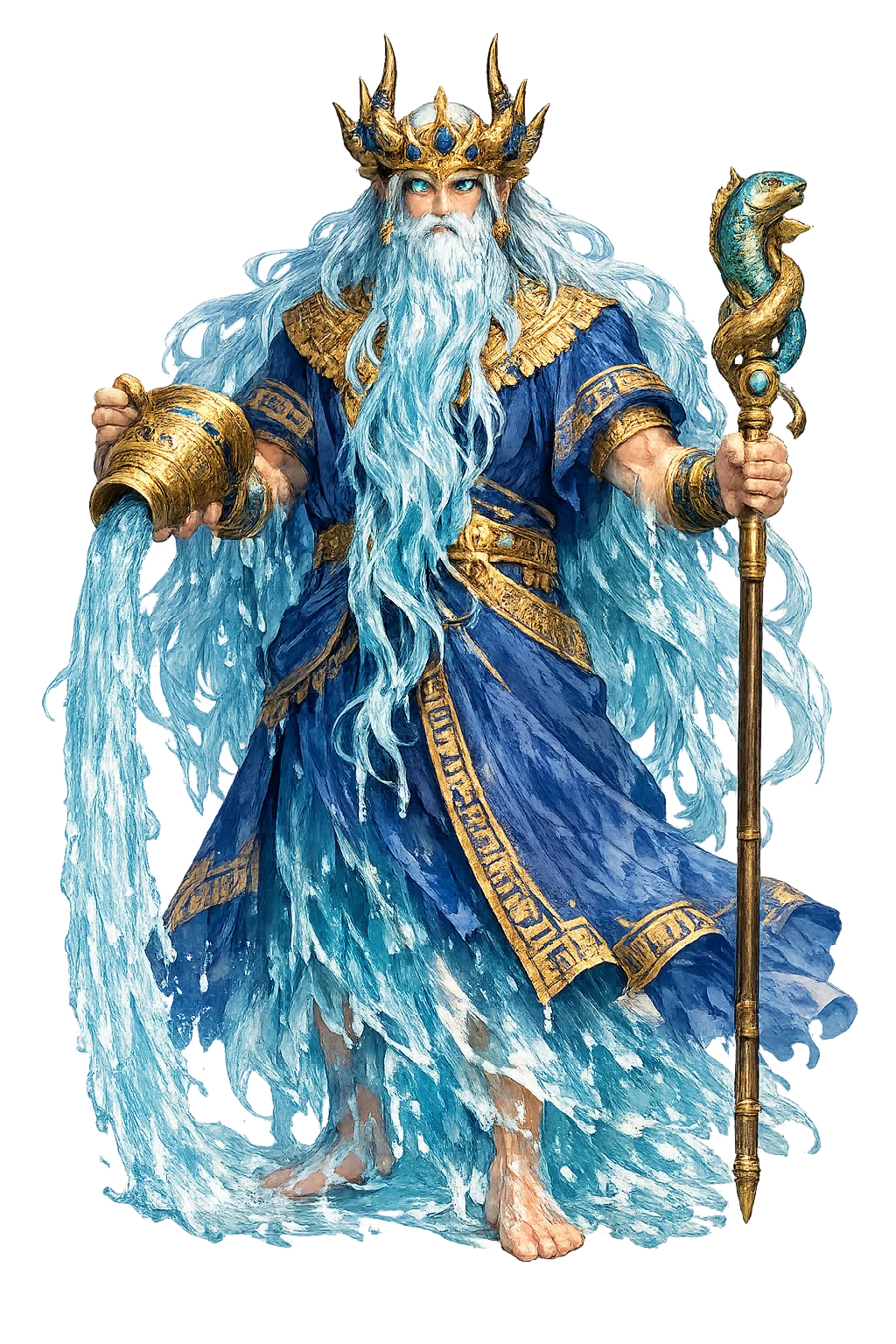
Why Apsû belongs in your address bar
Every address bar is a choice. When you type Apsû, you are not typing a novelty; you are restoring a name that the early DNS, built for English typewriters, could not carry. The plain ASCII form apsu is a leftover of that constraint, not the name itself. This post is the long version of the restoration: where the name comes from, how the Cuneiform tradition wrote it, how it is pronounced, what the myths and the material record preserve, and why its Unicode form now lives as a working domain. The claim throughout is simple — the original spelling is not decoration. It is the name.
At a Glance
- Restored name: Apsû
- ASCII form: apsu
- Meaning: "Reconstruction node for the Mesopotamian abyss Apsu (Sumerian Abzu): the circumflex marks a discussable vowel length, not a canonical spelling claim."
- Domain of influence: Phonological Reconstruction, Fresh Water, Abyss
- Pantheon: Mesopotamian
- Classification: Tier 2
- Original script: 𒀊𒍪 (Cuneiform)
- Live domain: apsû.com
Overview
Apsû (apsu) — Sumerian abzu — is the primordial freshwater ocean beneath the earth of Mesopotamian cosmology: the reservoir that feeds every spring, well, and river, and the deep over which the city of Eridu and its E-abzu temple stood. In the Enuma Elish the Apsû is also a character — the first father, whose mingling with [[tiamat|Tiāmat]], the salt sea, begets the gods, and whose death at the hands of [[ea|Ēa]] turns the deep into the god of wisdom's dwelling. No cult, hymn, or votive text addressed to the Apsû as a personal god is known; the deep is honored, if at all, only through the temples built upon it.
The name is written 𒀊𒍪 (AB.ZU). Standard Assyriology writes Apsu (Akkadian) or abzu (Sumerian); the circumflex on the final vowel of Apsû marks a discussable, reconstructed length — a question kept visible, not a canonical spelling — and places the name in Tier 2.
PuniCodex serves the temple at apsû.com; the plain ASCII apsu is the fallback the early domain system imposed, not the restoration.
The Name
The name is attested in Cuneiform as 𒀊𒍪. Etymologically it means "Reconstruction node for the Mesopotamian abyss Apsu (Sumerian Abzu): the circumflex marks a discussable vowel length, not a canonical spelling claim.".
Standard Assyriology transliterates the primordial freshwater abyss as Apsu (Akkadian) or Abzu (Sumerian 𒀊𒍪). The length of the final vowel in Akkadian Apsû is reconstructed from linguistic convention, not from the cuneiform signs themselves; the circumflex on Apsû is a pedagogical mark that makes that open question visible, not a claim of canonical spelling.
Cognate forms across related languages:
- abzu (AB.ZU) (sumerian) — Sumerian 'abyss, primeval water' (ETCSL, Black-Green)
The ASCII form apsu survives only because the early domain-name system could not carry diacritics; it is a technological compromise, not an ancient spelling. The Unicode restoration Apsû recovers the vowel length of the original directly in the address bar. The original preserves one prosodic feature — stress or vowel length — rather than both, which places the name in Tier 2.
The letter-by-letter transformation runs:
- a → A — Same, capitalized
- p → p — Same
- s → s — Same
- u → û — Circumflex: a visible question mark — the length of Apsu's final vowel is discussable, not certain
Attested and derived spellings of the name:
- Apsu — ASCII form: Standard unmarked Assyriological transliteration
- Abzu — scholarly variant: Sumerian form of the primordial freshwater abyss
The project holds the domain apsû.com (xn--aps-foa.com) as the canonical home of this name.
Etymology & Roots
The recorded derivation reads: Standard Assyriology transliterates the primordial freshwater abyss as Apsu (Akkadian) or Abzu (Sumerian 𒀊𒍪). The length of the final vowel in Akkadian Apsû is reconstructed from linguistic convention, not from the cuneiform signs themselves; the circumflex on Apsû is a pedagogical mark that makes that open question visible, not a claim of canonical spelling.
The root gloss is "primeval freshwater abyss."
The reconstruction is classed as disputed.
Kindred forms recorded in the lexicon:
- abzu (AB.ZU) (sumerian) — Sumerian 'abyss, primeval water' (ETCSL, Black-Green)
The Original Script
The name is preserved in Cuneiform as 𒀊𒍪 — Sumero-Akkadian cuneiform, attested Sumerian / Old Babylonian – Neo-Assyrian, c. 2600–600 BCE, in Mesopotamia. The script is written left-to-right / top-to-bottom.
The scholarly transliteration is Apsû (Sumerian logogram + Akkadian scholarly), giving the normalized reading /ˈap.suː/.
The rendering proceeds step by step:
- The name is written 𒀊𒍪 in cuneiform.
- Sumerian logograms may be read with Akkadian values; the divine determinative 𒀭 marks theonyms.
- Macrons in the Unicode restoration mark long vowels inferred from Akkadian and Sumerian convention.
- The Unicode restoration Apsû is registrable in .com; the cuneiform form is not supported in the .com IDN table.
Pronunciation
The reconstructed pronunciation of the name is /apˈsuː/ — Sumerian/Akkadian Reconstruction.
Phoneme by phoneme:
- Ap- — Open vowel [a] followed by voiceless bilabial stop [p], the sound of water meeting a lip.
- -sû — Voiceless sibilant [s] plus long close back vowel [uː], carrying stress; the circumflex marks length.
For the modern speaker, the closest approximation is: 'ahp-SOO' — stress the second syllable and draw out the final vowel like a deep reservoir.
Kindred and historical forms of the name:
- Sumerian — 𒀊𒍪 (abzu), the primordial freshwater abyss beneath the earth
- Akkadian — apsû, the subterranean freshwater ocean and Ea's dwelling
- Hebrew comparison — tĕhôm, the primordial deep of Genesis 1:2, possibly cognate with Tiamat
Apsû is Tier 2 because the circumflex on the final u does not record a canonical Greek-style stress or a universally agreed long vowel. It is a pedagogical mark: a visible question that invites discussion about how the name was pronounced in Sumerian and Akkadian. Standard Assyriology writes Apsu or Abzu; the Unicode form Apsû belongs to PuniCodex's phonological reconstruction hub.
Mythology
Apsu is the Mesopotamian primordial freshwater abyss — the sweet water that lies beneath the earth and mingles with Tiamat, the salt sea, to bring forth the first generations of gods. In the Enuma Elish, Apsu is not a god of personality but a cosmic place that becomes, through violence and architecture, the foundation of divine kingship.
The Freshwater Abyss (Cosmogony)
Before sky was separated from earth, there was only Apsu, the fresh water, and Tiamat, the salt water. Their waters mingled and produced the oldest gods: Lahmu and Lahamu, then Anshar and Kishar, then Anu, and finally Ea, the wisest. Apsu is thus the original reservoir — not merely a sea but the possibility of form, the liquid matrix from which order emerges.
Apsu and Tiamat (Conflict)
The younger gods disturbed Apsu with their noise and commotion. Apsu, wishing to sleep, resolved to destroy them, but Tiamat refused. Ea learned of the plot, cast a spell on Apsu, and slew him. From Apsu's body Ea built his splendid abode, and there, with his consort Damkina, he begot Marduk, the storm-god who would later defeat Tiamat and create the world from her corpse.
The Slayer Ea (Transformation)
Ea does not simply kill Apsu; he appropriates him. The abyss becomes Ea's house, the source of his wisdom and the place from which he dispenses me, the divine decrees. In Mesopotamian cult, the abzu remains the underground water that feeds wells, rivers, and marshes — the invisible freshwater that makes civilization possible. To possess Apsu is to possess the hidden knowledge beneath the world.
Marduk Born in Apsu (Legacy)
The god Marduk is born in the abzu, the house built upon Apsu's slain body. His birth there binds him to both wisdom and violence: he is the child of Ea's cunning and Apsu's primordial depth. When Tiamat raises an army of monsters, Marduk emerges from the abzu to confront her, armed with winds, floods, and the authority of the deep. Apsu, killed at the beginning, thus fathers the god who orders the cosmos.
Symbols & Iconography
The Apsû has no cult image — it is a place before it is a power — but the tradition gives it a consistent iconography of depth:
- The subterranean water — the invisible freshwater feeding springs, wells, and marshes; the 'pure water' of the incantations rises from it.
- The temple basin — the apsû as an architectural term: the cultic water tank by which Babylonian temples localized the cosmic deep within their own walls.
- The E-abzu of Eridu — the 'House of the Deep', Enki's temple, standing directly over the deep it names.
- The mingled waters — Apsû and [[tiamat|Tiāmat]] intertwined at the opening of the Enuma Elish, the primordial couple from whom the generations of the gods arise.
- Underground water — The invisible freshwater feeding springs, rivers, and wells
- Ea's temple — The abzu as the house of wisdom, built upon the defeated abyss
Archaeology & Evidence
The Apsû survives archaeologically above all as architecture. At Eridu, the E-abzu — among the earliest sacred buildings in southern Mesopotamia — was rebuilt in eighteen superimposed levels from the Ubaid period onward, the physical anchor of the idea of a pure, god-given deep beneath the city. At Babylon, the E-sagil complex held an apsû-basin representing the cosmic freshwater within the temple quarter, and ritual texts prescribe lustral water drawn from such basins for purification.
Textually, the epic that makes the deep a character survives in copies from Nineveh, Sippar, Babylon, and Aššur, its recitation fixed in the Babylonian New Year (akītu) festival, when the story of Apsû's defeat and Marduk's victory rehearsed the annual renewal of cosmic order.
Realm & Domain
The name is written 𒀊𒍪. Standard Assyriology transliterates it as Apsu (Akkadian) or Abzu (Sumerian). But the length of the final vowel in Akkadian Apsû remains an open question — and it is here, in the space between the written sign and the spoken sound, that this temple operates. This node of PuniCodex is dedicated to the phonological reconstruction and didactic grammar of the ancient Near East: vowel length is marked not because it is certain, but because it is discussable — the circumflex is a question mark made visible.
Apsû is nevertheless the sweet-water ocean that lies beneath the world — the cosmic freshwater reservoir from which springs, rivers, and wells draw their life. In Mesopotamian cosmogony, Apsû is both a place and a primordial power, the male depths that mingle with Tiamat's salt sea to beget the gods.
Freshwater Ocean
The subterranean source of all sweet water, the matrix of civilization in Mesopotamia.
Ea's House
After Apsû's defeat, Ea built his splendid abode upon the slain abyss.
Father of Marduk
Marduk was born in the abzu, the house built on Apsû's transformed body.
Cosmic Foundation
Temples and cities were literally and symbolically anchored to the abzu below.
Across Cultures
The abzu travelled far beyond Mesopotamia.
The Unicode form Apsû is a reconstruction node: standard Assyriology writes Apsu or Abzu, while the circumflex makes visible the open question of final-vowel length. In the Hebrew Bible, the primordial tĕhôm ('deep') of Genesis 1:2 is linguistically cognate with [[tiamat|Tiāmat]], while the 'fountains of the great deep' (Genesis 7:11) that rise to flood the world presuppose exactly the subterranean freshwater ocean the Mesopotamians called the Apsû. Greek sources knew Mesopotamian cosmology through Berossus, whose Babyloniaca described Oannes emerging from the Erythraean Sea, an avatar of the apkallu sage associated with the abzu. In later esoteric traditions, the abyss became a symbol of hidden knowledge and the unconscious. The abzu is thus one of the ancient Near East's most influential geographical ideas: a freshwater deep beneath the world, the source of both physical fertility and divine wisdom.
Within the Mesopotamian tradition, closely related names in the corpus include [[anu|Anû]], [[ashur|Aššur]], [[ea|Ēa]], [[enlil|Enlīl]], [[ishtar|Ištar]], and [[shamash|Šamaš]].
Cultural Legacy
The idea of a watery abyss beneath the earth has never disappeared.
It survives in the biblical 'fountains of the great deep' (Genesis 7:11), in medieval maps showing subterranean rivers, and in modern geology's aquifers and groundwater systems. Science fiction and fantasy continue to imagine hidden freshwater seas beneath the crust. The name Apsû itself has been revived in games, novels, and occult cosmologies as a primordial power. PuniCodex keeps the circumflex not as a settled fact but as an invitation: every visitor is invited into the philological conversation. What began as a Mesopotamian explanation of wells and springs became one of the West's foundational images of depth, origin, and the unconscious.
The Scholarly Record
The account of Apsû given in this edition rests on the witnesses and reference works listed below. Lexica and etymological dictionaries secure the form and meaning of the name; the literary and religious texts supply the narrative evidence.
- Enuma Elish: The Babylonian Epic of Creation, Standard Babylonian version, 1200 BCE. Full text
- CAD (Chicago Assyrian Dictionary).
- ETCSL (Electronic Text Corpus of Sumerian Literature).
- Jacobsen, The Treasures of Darkness.
- Epic of Gilgamesh, Tablet XI (Standard Babylonian version: Utnapištim recounts Ea's counsel from the Apsû).
- Atrahasis (Akkadian Flood Story: Ea dwells in the Apsû and warns Atraḫasis of the deluge).
- Enki and Ninhursag (Sumerian myth of the abzu and the paradise of Dilmun).
- Enki and the World Order (Sumerian hymn: Enki assigns the me from the Apsû).
A Meditation
The Apsû asks a small, precise question: what lies under the world? The Mesopotamian answer was a freshwater ocean — the deep that makes wells rise and marshes live, hidden but indispensable. Every temple that housed a cult basin rehearsed the belief: the building rests on, and draws purity from, a water it cannot see.
The circumflex on Apsû rehearses the same lesson at the level of the letter. The final vowel's length lies beneath the written surface, inferred rather than inscribed. Reading the name with its mark intact is an exercise in holding a depth in view without claiming to have sounded it.
The Unicode Restoration
Apsû is classified as Tier 2: the original preserves at least one philological feature that ASCII cannot encode. The ASCII fallback apsu still resolves everywhere, but it is the restored form that carries the name's full information. Across the 4 characters of the name, the restoration adjusts 1: 1 mark of length (û). That is the whole thesis of this temple: the marks are the message.
Name Variations
The lexicon records 2 additional forms of the name:
- Apsu (ascii) — Standard unmarked Assyriological transliteration
- Abzu (alt) — Sumerian form of the primordial freshwater abyss
The temple uses Apsû as the primary form: it is the spelling that best balances philological accuracy with the practical limits of DNS.
Character by Character
The journey from apsu to Apsû, one character at a time:
- a → A — Same, capitalized
- p → p — Same
- s → s — Same
- u → û — Circumflex: a visible question mark — the length of Apsu's final vowel is discussable, not certain
The Domain Name
The restored name is live as a working domain: apsû.com, which the DNS carries in punycode form as xn--aps-foa.com — an ASCII-compatible encoding that lets a non-ASCII name travel the global network without breaking older infrastructure. The visitor sees Apsû; the machines see the encoding. That duality is the engineering compromise on which the entire restoration rests, and it is why a name written the way its own tradition wrote it in Cuneiform can now be typed into any browser on earth.
Why This Restoration Matters
Restoring Apsû is part of a larger effort to make the web multilingual by default. The PuniCodex project does not ask users to learn a new alphabet; it asks the infrastructure to respect the alphabets that already exist. Every section of this post — the script, the sound, the myths, the evidence — converges on the same point: the marks in Apsû are information, and information deserves an address of its own. A single Unicode domain is a small proof, but it is a proof that scales: every name restored makes the next one easier, and every visit to apsû.com is a vote for the restored form.
Explore Further
This post is one doorway into the temple. The home page carries the full character breakdown and the ambient canvas; the lore page tells the myths in long form; the Scholarly Edition preserves the sources, pronunciation data, and revision history; and the patron wall supports the restoration directly. For the wider map, browse the Lexicon, explore the Pantheon, or return to the PuniCodex blog.
Related Names
Sources
The full scholarly apparatus — every citation, revision, and review — lives in the Scholarly Edition. Key references for this post:
- Enuma Elish: The Babylonian Epic of Creation, Standard Babylonian version, 1200 BCE.
- Electronic Text Corpus of Sumerian Literature, Oxford Oriental Institute.
- CAD (Chicago Assyrian Dictionary).
- ETCSL (Electronic Text Corpus of Sumerian Literature).
- The Assyrian Dictionary of the Oriental Institute of the University of Chicago (CAD), s.v. apsû.
- Safar, Mustafa & Lloyd, Eridu (Republic of Iraq, Ministry of Culture and Information, 1981).
- Lexicon authorities for this entry: Enuma Elish, Black-Green.