
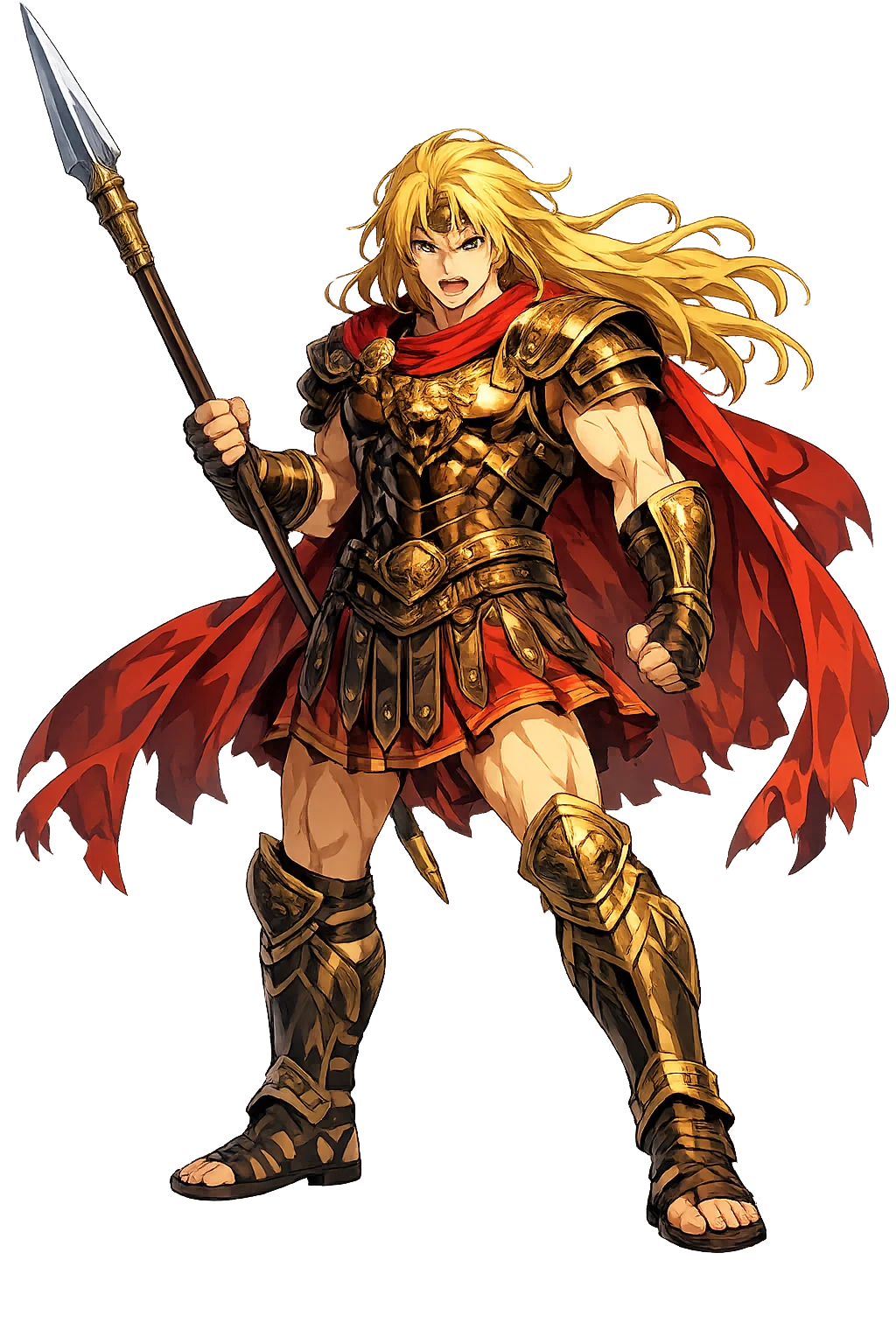
The hidden history behind Achilleús
Behind the modern ASCII form achilleus hides a much longer story. Achilleús reaches back through manuscripts, inscriptions, and oral tradition long before it ever touched a keyboard, and every mark in the restored spelling is a receipt from that journey. In what follows we trace the name from its Greek attestations through its mythology, its cult, its symbols, and its afterlife in other cultures — and we show how the PuniCodex project turned that philological record into a Unicode domain that resolves today. The history was never lost. It was only waiting for the infrastructure to catch up.
At a Glance
- Restored name: Achilleús
- ASCII form: achilleus
- Meaning: "Possibly 'grief of the people' (from ἄχος + λαός), or a pre-Greek name"
- Domain of influence: War, Glory, Rage
- Pantheon: Greek
- Classification: Tier 1
- Original script: Ἀχιλλεύς (Greek)
- Live domain: achilleús.com
Overview
Achilleús (achilleus) — The Wrath and the Heel — belongs to the Greek tradition, where it is catalogued under the domain "War, Glory, Rage". The name means "Possibly 'grief of the people' (from ἄχος + λαός), or a pre-Greek name".
Achilleús is the hero the Iliad is named around: the man who chose a short life with imperishable fame (kleos aphthiton) over a long life in obscurity. His wrath is the poem's first word — mēnin — and his heel is the world's oldest named weakness.
PuniCodex restores the name as Achilleús and serves its temple at achilleús.com. The original carries both stress and vowel length, and exactly one historically valid Unicode restoration exists, which places the name in Tier 1. The plain ASCII form achilleus survives as a modern convenience imposed by the early domain-name system; the restoration, not the fallback, is the form the project defends as philologically complete.
The Name
The name is attested in Greek as Ἀχιλλεύς. Etymologically it means "Possibly 'grief of the people' (from ἄχος + λαός), or a pre-Greek name".
The ASCII form achilleus survives only because the early domain-name system could not carry diacritics; it is a technological compromise, not an ancient spelling. The Unicode restoration Achilleús recovers the stress accent of the original directly in the address bar. The original carries both stress and vowel length, and exactly one historically valid Unicode restoration exists, which places the name in Tier 1.
The letter-by-letter transformation runs:
- a → A — Same letter
- c → c — Same letter
- h → h — Same letter
- i → i — Same letter
- l → l — Same letter
- l → l — Same letter
- e → e — Same letter
- u → ú — Stress mark (acute/tone)
- s → s — Same letter
The project holds the domain achilleús.com (xn--achilles-u5a.com) as the canonical home of this name.
The Original Script
The name is written in Greek as Ἀχιλλεύς. This original script is the form against which the ASCII fallback achilleus and the PuniCodex restoration Achilleús are measured: the restoration preserves its pitch accent of the written form, so that a reader typing the modern address still speaks the ancient name.
Pronunciation
The reconstructed pronunciation of the name is /a.kʰil.leús/ — Attic Greek.
For the modern speaker, the closest approximation is: ah-khil-LEWS, stress on the final syllable.
Kindred and historical forms of the name:
- Greek — Ἀχιλλεύς
- Latin — Achilleus
- English — Achilles
- Owned form — Achilleús
Homeric Greek Ἀχιλλεύς scans with a short i and a stressed final syllable; the geminate λλ is attested in the best manuscripts beside the single-λ variant Ἀχιλεύς. The restoration Achilleús keeps the acute on the final syllable exactly where the Greek puts it. In the epic hexameter the name scans as three long syllables — a weight the English "Achilles" entirely loses.
Mythology
Son of the mortal Pēleús and the sea-goddess Thetis, Achilleús stands exactly between god and man: the strongest argument the Greeks ever made that excellence cannot cancel mortality.
Two Fates (The Choice)
His mother Thetis told him he carried two fates: stay at Troy and win glory that never dies, or sail home to a long life forgotten. In Iliad 9 he weighs them aloud — the first hero in Western literature to choose knowingly, and to choose the flame over the ember.
The Death of Pátroklos (The Rage)
When Hektōr killed Pátroklos, who wore Achilleús' own armour into battle, grief converted the hero's anger from his king to his enemy. He returned to war knowing it sealed his death, killed Hektōr before the walls of Troy, and dragged the body behind his chariot — until Priam's night visit taught him pity again.
Paris' Arrow (The Wound)
Later tradition gives the death the Iliad only foreshadows: an arrow from Paris, guided by Apóllōn, finding the one vulnerable heel. The Roman-era Achilleid of Statius tells how Thetis dipped the infant in the Styx, holding him by that heel — the water made him deathless everywhere her hand did not cover.
The White Island (The Afterlife)
Greek sailors of the Black Sea believed Achilleús lived on as a daimōn of Leuke, the White Island, with Helen or Medea as consort. Arrian and Pausanias report the cult; sailors anchored there to leave offerings well into the Roman period — a hero-cult with a real address.
Symbols & Iconography
The iconography associated with Achilleús concentrates in a small set of recurring attributes, each a compressed statement about the name:
- The ash spear — The Pelian spear only he could wield — strength that cannot be inherited
- The heel — The mortal point in the immortal frame; vulnerability as destiny
- The lyre — He sang of heroes' fame in his tent — the warrior who is also a poet
- The Scamander — The river that rose against him when his killing choked its waters
Achilleús is among the most painted figures of Greek art. The François Vase (ca. 570 BCE) shows his pursuit of Troilos in full narrative band; Exekias' amphora of Achilleús and Ajax playing dice (Vatican) is the canonical image of epic downtime; the ransom scene — Priam kneeling before him — fills dozens of red-figure cups. Roman sarcophagi favored the Skyros episode (the hero discovered among the daughters), and Pompeian wall-painting kept the Briseis handover. His heel, tellingly, is rarely shown: the iconography prefers the rage and the grief to the wound.
Epithets & Cult Titles
Homer frames him with a small, fixed set of formulae that every listener knew.
- Ποδώκης (Podṓkēs) — 'swift-footed'; his most constant epithet, used even at the moment of his death.
- Πηλεΐδης (Pēleïdēs) — 'son of Pēleús'; the patronymic that ties him to the mortal line.
- Αἰακίδης (Aiakídēs) — 'descendant of Aiakos'; the grander lineage-name, reaching back to Zeús.
- θεοῖς ἐπιείκελος (theoîs epiéikelos) — 'like the gods'; the comparison the poem grants and withdraws.
- δῖος (dîos) — 'brilliant, godlike'; the generic heroic epithet he shares with Odysseus alone.
The formulae are not ornament: in oral verse they are the meter's building blocks, and Achilleús owns more of them than any hero of the cycle.
The Homeric Hymns
No Homeric Hymn addresses Achilleús — the corpus is for gods, and he is the great counter-example of the hero who is not one. His hymnic afterlife runs through the Epic Cycle instead: the Aethiopis (his death and Thetis' removal of his body to the White Island) and the Little Iliad, surviving in Proclus' summaries and a handful of fragments. The Iliad itself functions as his hymn: its first word, μῆνιν, is his, and the poem's invocations keep returning to his choice. The Homeric Hymn to Demeter's brief notice of the hero's afterlife (480–482) is the corpus' nearest bow to him.
Oracle Sites & Sanctuaries
Achilleús received hero-cult at two remarkable addresses. In the Troad, his tomb-tumulus (Sivri Tepe) was a pilgrimage goal: Alexander sacrificed there, and Roman emperors followed. More famous was Leukē, the White Island at the Danube's mouth, where Arrian reports a temple, a statue, and offerings left by sailors who believed the hero still feasted there with Helen. Games were held in his honour, and the island's snakes were kept as his sacred animals. At Phthiā in Thessaly, his homeland kept his memory as the local hero par excellence, and Sparta's Amyklai later claimed a share of his cult.
Archaeology & Evidence
A hero-cult of Achilleús is documented at his tomb in the Troad (the tumulus at Sivri Tepe) and, most vividly, on the island of Leuke off the Danube delta, where Arrian reports a temple, votive offerings, and the hero appearing to sailors. Vase painting made him one of the most depicted figures in Greek art: the François Vase shows his pursuit of Troilos, and the Achilles-and-Ajax dice game survives in dozens of black-figure cups, including Exekias' masterpiece. Roman-era stamps and lamps from Olbia confirm the Black Sea cult lasted centuries.
Realm & Domain
Achilleús is the hero the Iliad is named around: the man who chose a short life with imperishable fame (kleos aphthiton) over a long life in obscurity. His wrath is the poem's first word — mēnin — and his heel is the world's oldest named weakness.
The Wrath
The Iliad opens on his mēnis — a rage that costs the Achaeans thousands of lives and remakes epic poetry.
The Heel
The single unarmoured point of an otherwise deathless fighter; the West's shorthand for a fatal flaw.
Kleos Aphthiton
Imperishable fame — the bargain every brand strikes: burn briefly and be remembered forever.
Leuke the White Isle
His afterlife island in the Black Sea, where sailors left offerings to the hero for a thousand years.
Across Cultures
Rome read him through the Aeneid's mirror: Achilles is what Aeneas must not be — brilliant, doomed, and defiant of fate. Alexander the Great slept with the Iliad under his pillow and raced around Achilleús' supposed tomb at Troy, consciously modelling his own short bright career on the hero's choice.
In late antiquity and Byzantium he survived as a romance figure; in the Renaissance he returned as the measure of martial virtue. Modern Greece claims him as a national ancestor whose very untranslatability — rage, grief, honour — defines the epic imagination.
Within the Greek tradition, closely related names in the corpus include [[acheron|Achérōn]], [[adamas|Adámas]], [[aer|Aḗr]], [[aither|Aithḗr]], [[ananke|Anánkē]], and [[andromeda|Andromedē]].
Cultural Legacy
His name seeded two everyday terms: the Achilles heel (a single fatal weakness) and the Achilles tendon, named by the anatomist Verheyen in 1693 for the tendon nearest the mythic wound. "The wrath of Achilles" remains the standard translation exercise for every student of Greek, the μῆνιν ἄειδε θεά that begins Western literature.
Psychology borrowed him too: the "Achilles complex" names self-destructive rage, and every sport that sells invincibility borrows his silhouette — until the heel reminds the audience how the story ends.
The Scholarly Record
The account of Achilleús given in this edition rests on the witnesses and reference works listed below. Lexica and etymological dictionaries secure the form and meaning of the name; the literary and religious texts supply the narrative evidence.
- Liddell-Scott-Jones Greek-English Lexicon, 9th ed. with 1996 supplement, 1843. Full text
- Homer, Iliad, Oxford Classical Texts (Monro & Allen); Loeb, 750 BCE. Full text
- Etymological Dictionary of Greek, 2 vols., Brill, 2010. Full text
- Pindar, Victory Odes (Olympian, Pythian, Nemean, Isthmian), Loeb Classical Library, 438 BCE. Full text
- Apollodorus, Bibliotheca, Loeb Classical Library (Frazer), 150.
- Pausanias, Description of Greece, Loeb Classical Library, 180. Full text
- Cambridge Ancient History, Multiple volumes, 1970. Full text
A Meditation
Achilleús is the god of the deadline. He knows the exact price of brilliance and pays it anyway, and his story asks the reader which currency they are spending: years, or light. To hold his name is to hold the oldest question in the Western canon — whether a life is measured by its length or by what survives it.
The Unicode Restoration
Achilleús is classified as Tier 1: the original carries both stress and length, and only one valid Unicode restoration exists. The ASCII fallback achilleus still resolves everywhere, but it is the restored form that carries the name's full information. Across the 9 characters of the name, the restoration adjusts 1: 1 mark of stress (ú). That is the whole thesis of this temple: the marks are the message.
Character by Character
The journey from achilleus to Achilleús, one character at a time:
- a → A — Same letter
- c → c — Same letter
- h → h — Same letter
- i → i — Same letter
- l → l — Same letter
- l → l — Same letter
- e → e — Same letter
- u → ú — Stress mark (acute/tone)
- s → s — Same letter
The Domain Name
The restored name is live as a working domain: achilleús.com, which the DNS carries in punycode form as xn--achilles-u5a.com — an ASCII-compatible encoding that lets a non-ASCII name travel the global network without breaking older infrastructure. The visitor sees Achilleús; the machines see the encoding. That duality is the engineering compromise on which the entire restoration rests, and it is why a name written the way its own tradition wrote it in Greek can now be typed into any browser on earth.
The Greek Pantheon
Achilleús is one of 268 entries the PuniCodex lexicon catalogues under the Greek pantheon. The Pantheon page gathers the tradition's major figures in one place, and the Lexicon lets you filter all 915 restorations by tradition, tier, or script — the fastest way to see where this name sits among its kin.
Frequently Asked Questions
What does Achilleús mean? The traditional gloss is "Possibly 'grief of the people' (from ἄχος + λαός), or a pre-Greek name."
Which tradition does Achilleús belong to? Achilleús is catalogued in the Greek pantheon of the PuniCodex lexicon.
Why is Achilleús classified as Tier 1? Because the original carries both stress and length, and only one valid Unicode restoration exists — and the marks in the restored spelling preserve exactly that evidence.
Is Achilleús a working domain? Yes — achilleús.com resolves today and routes to this temple.
What is the punycode for achilleús.com? The DNS encoding is xn--achilles-u5a.com; browsers perform the translation automatically, so visitors only ever see the restored name.
Typing Achilleús
You do not need a special keyboard to use this restoration. The PuniCodex Type Tool converts the ASCII form achilleus into Achilleús as you type, and the browser extension offers the same conversion inside any text field. Copy the restored form, paste it into the address bar, and the DNS does the rest.
Sister Temples
Other temples in the Greek pantheon include Epimētheus, Epistḗmē, and Erátō — each with its own restoration story, its own scholarly record, and its own place in the lexicon.
Why This Restoration Matters
The story of Achilleús did not end in antiquity; it changed medium. Names that survive for millennia do so because each generation finds a new carrier for them — clay, papyrus, print, and now DNS. The PuniCodex restoration simply makes the carrier honest: the spelling that resolves is the spelling the evidence supports. If this post showed anything, it is that achilleus and Achilleús are not the same name with different styling. They are a summary and the text it summarizes. The web can now serve the text.
Explore Further
This post is one doorway into the temple. The home page carries the full character breakdown and the ambient canvas; the lore page tells the myths in long form; the Scholarly Edition preserves the sources, pronunciation data, and revision history; and the patron wall supports the restoration directly. For the wider map, browse the Lexicon, explore the Pantheon, or return to the PuniCodex blog.
Related Names
Sources
The full scholarly apparatus — every citation, revision, and review — lives in the Scholarly Edition. Key references for this post:
- Homer, Iliad, Oxford Classical Texts (Monro & Allen); Loeb, 750 BCE.
- Liddell-Scott-Jones Greek-English Lexicon, 9th ed. with 1996 supplement, 1843.
- Etymological Dictionary of Greek, 2 vols., Brill, 2010.
- Pausanias, Description of Greece, Loeb Classical Library, 180.
- Pindar, Victory Odes (Olympian, Pythian, Nemean, Isthmian), Loeb Classical Library, 438 BCE.
- Cambridge Ancient History, Multiple volumes, 1970.
- Apollodorus, Bibliotheca, Loeb Classical Library (Frazer), 150.
- Homer, Iliad, passim (Milman Parry, L'épithète traditionnelle).
- Arrian, Periplus of the Euxine Sea 21–23; Pausanias 3.19.
- Proclus, Chrestomathy (Aethiopis summary); Homeric Hymn to Demeter 480–482.
- Lexicon authorities for this entry: LSJ, Iliad, Beekes.