
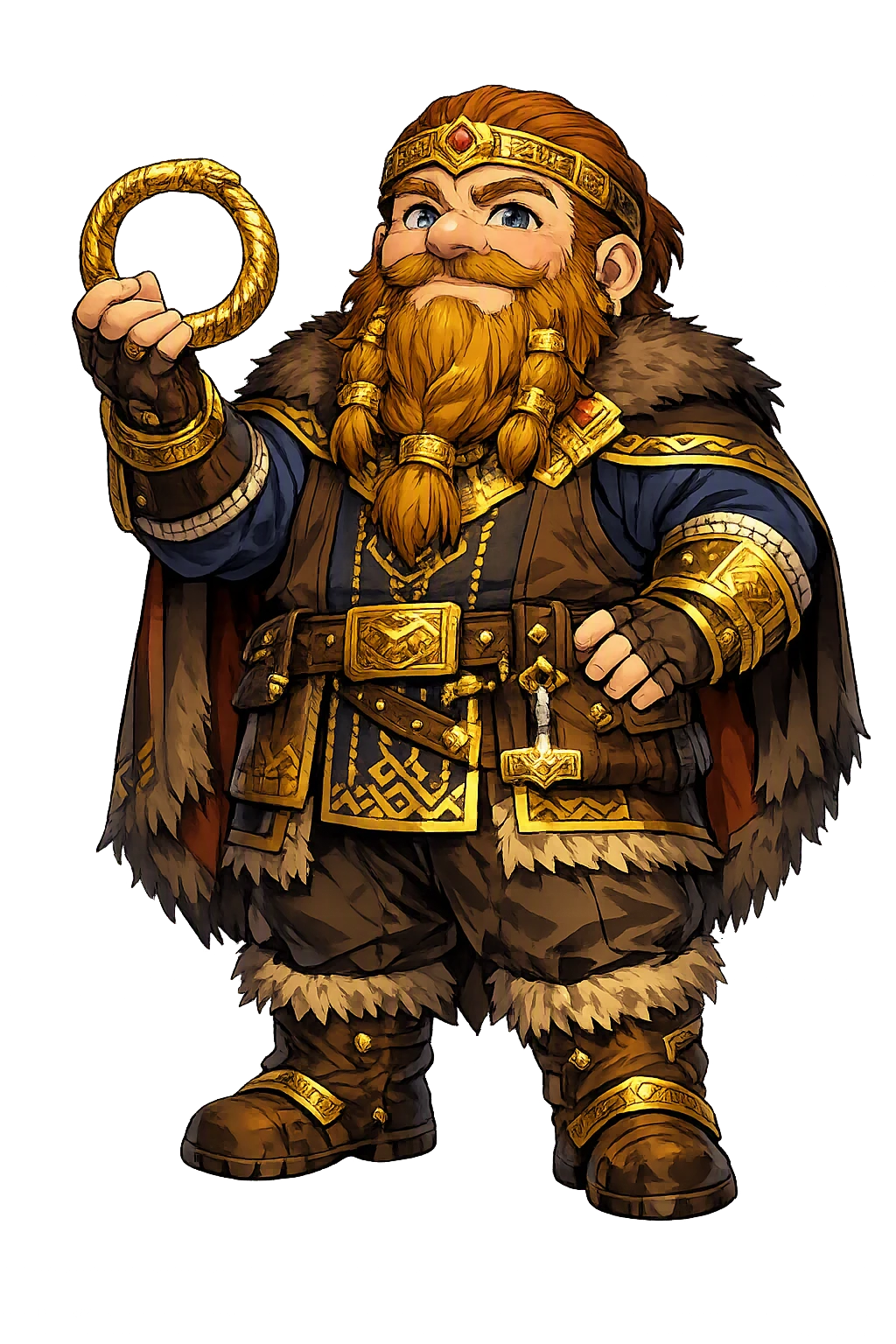
How Sindri was rebuilt, mark by mark
Bench notes, Sindri: what we found, what we rejected, and what we finally set down. Kept in the open, because a restoration you cannot audit is just a spelling with confidence.
What We Found
The attestation runs through the tradition's own sources: ᛋᛁᚾᛏᚱᛁ. Meaning: "Sparkling".
The figure behind the name: Sindri's dossier is one long scene in Snorri and one stanza in Völuspá — a forge and a hall.
What the Name Carried In
The Wager of the Head. It begins with a crime: Loki, for mischief, cuts off all the hair of Sif, Þórr's wife. Þórr seizes him and would break every bone, and Loki swears to get the svartálfar to make hair of gold for Sif that will grow like living hair.
Three Castings, Three Stings. Sindri lays a pigskin in the forge and tells Brokkr to blow and never cease. A fly settles on Brokkr's hand and stings, but the bellows do not stop: out comes a boar with bristles of gold, Gullinbursti.
A spelling that has to carry stories like these is not a label. It is equipment.
Where It Stood Before Us
Sindri is a wholly textual dwarf: no runestone invokes him, no votive deposit names him, and no image can be securely identified with him. His attestation hangs on the manuscript witnesses — the Codex Regius and related codices of Snorri's Edda for Skáldskaparmál 35 (with the Codex Upsaliensis tradition reading the brother's name as Eitri), and the Codex Regius of the Poetic Edda for Völuspá's golden hall at Niðavellir. The material context is nonetheless richer for him than for most dwarfs, because his products are findable. Thor's-hammer pendants — Mjǫllnir in miniature — are the commonest amulets of the late Viking Age, known by the hundred from tenth-century graves, hoards, and settlement sites across Scandinavia and the diaspora: the forge's most famous casting, worn at the neck of the converted and unconverted alike. Gold arm-rings of Draupnir's type fill the hoards. And the corpus's visual language of the smithy survives on the Gotland picture stones — Ardre VIII shows a smithy scene with tools and a headless body, usually read as Vǫlundr — proof that the smith at his forge was a carved subject in the Viking-Age north, though no carving names Sindri himself. The bench inherits all of it — the web temple is the newest site, not the first.
What We Rejected
Any form invented for availability. The rule on the bench: if the evidence does not carry it, the domain does not get it — whatever the registrar has in stock.
What We Set Down
Sindri — One decisive feature survives — a single, honest mark — which places the restoration in Tier-2: exact, and exactly labeled.
For the voice: 'SIN-dri' — two short beats, the weight on the first, the d clicked crisply between the n and the r as in 'laundry' said fast, both vowels clipped.
The temple stands at /sindri/ — the notes above are public in its Scholarly Edition, sources and all.
At a Glance
- Restored name: Sindri
- ASCII form: sindri
- Meaning: "Sparkling"
- Domain of influence: Dwarf Smith
- Pantheon: Norse
- Classification: Tier 2
- Original script: ᛋᛁᚾᛏᚱᛁ
- Series: The Restoration Files, No. 450 of 548
The File Continues
The temple's founding dispatch tells the name's story; its Resonance File reads the myths into the industries; the blog index holds the whole archive.
Continue the series — previous file: Simargl (read it here) · next file: Sītā (read it here).
The Restoration Files are written from the same canonical record as the temples themselves: the lexicon, the lore catalog, the pattern atlas, and the cited scholarly sources. If a file ever disagrees with its temple, the temple is right — tell us, and the file will be corrected.