PuniCodex

Extended Lore

ᛋᛁᚾᛏᚱᛁ Sindri

Etymology · Phonology · Orthography · Cultural Legacy · Primary Sources

Tier 2 Sindri
Sindri — Dwarf Smith
01

Quick Facts

Essential information about Sindri, Dwarf Smith

Original Scriptᛋᛁᚾᛏᚱᛁ
Unicode RestorationSindri
Reconstructed Pronunciation/ˈsin.dri/
PantheonNorse
DomainDwarf Smith
MeaningSparkling
ClassificationTier 2
Primary DomainSindri
Sacred SymbolsThe bellows, The fly that stung, Draupnir, Mjǫllnir's short handle, The golden hall at Niðavellir
02

Etymology & Word Family

From original script to Unicode restoration

Original Script ᛋᛁᚾᛏᚱᛁ Sindri — "Sparkling"
Unicode Restoration Sindri Restored stress, length, and script
Modern ASCII sindri Plain-ASCII fallback

Sindri is Tier 2 by the mechanical rule: the normalized Old Norse form is already plain ASCII — no diacritic, no distinctive letter for the ASCII alphabet to lose. The smith whose name means 'sparkling' leaves his mark in meaning, not in orthography; only the capital distinguishes the restored form from the input.

03

Unicode Character Breakdown

Character-by-character philological analysis

CharacterUnicodeNameBlockPhonetic Role
SU+0053Latin Capital Letter SBasic LatinSame, capitalized
iU+0069Latin Small Letter IBasic LatinSame
nU+006ELatin Small Letter NBasic LatinSame
dU+0064Latin Small Letter DBasic LatinSame
rU+0072Latin Small Letter RBasic LatinSame
iU+0069Latin Small Letter IBasic LatinSame

The Tier 2 classification reflects how much of the original phonology this restoration preserves — stress and vowel length for Greek names, distinctive letters and diacritics for every other tradition.

04

Cultural Significance

From ancient cult to modern Unicode

Ancient Domain

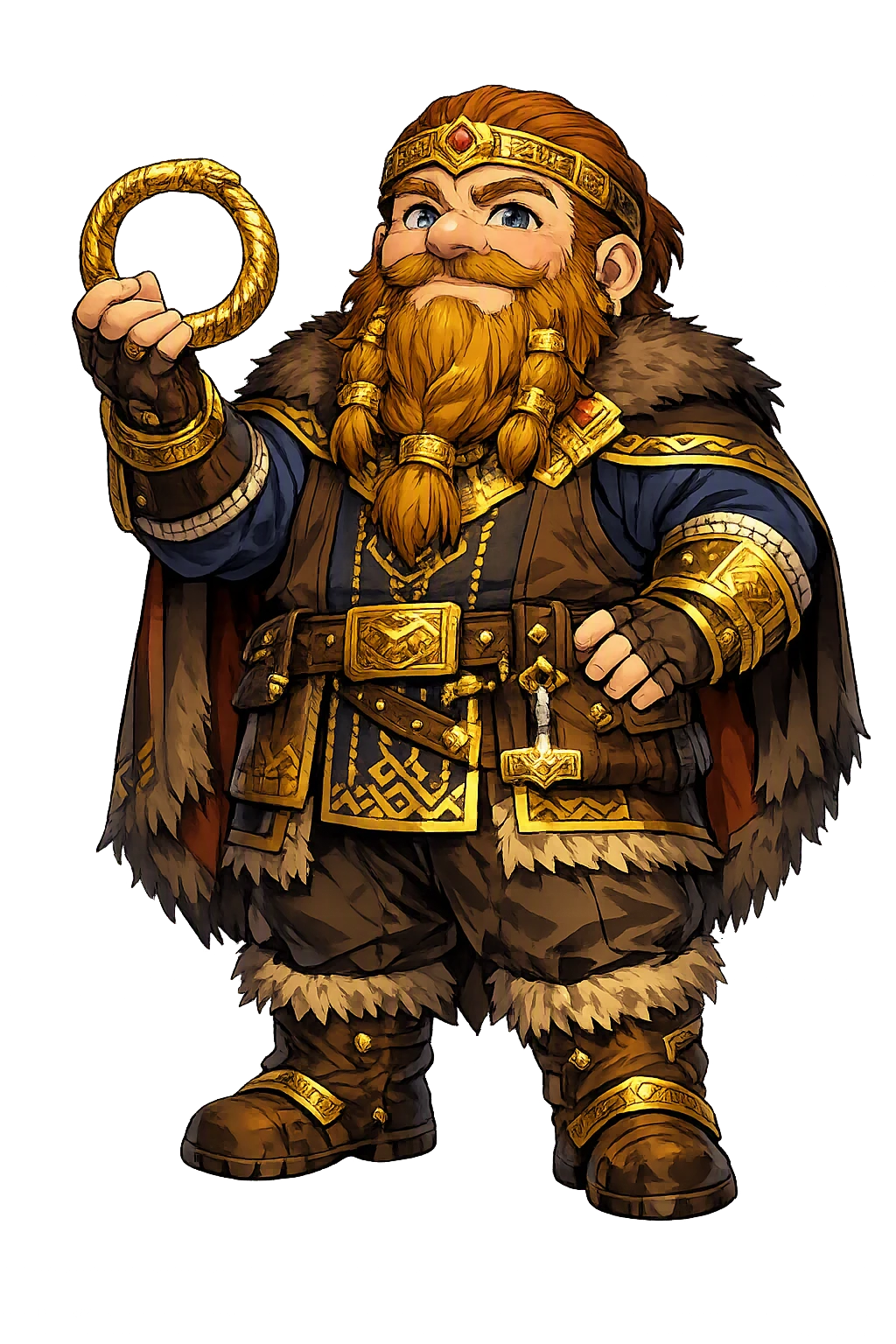
Sindri is the dwarf at the anvil while his brother [[brokkr|Brokkr]] works the bellows: the smith who took Loki's wager and cast, in three heats, the golden-bristled boar Gullinbursti for Freyr, the ring Draupnir for Óðinn, and the hammer Mjǫllnir for Þórr — the greatest single afternoon's work in the northern corpus, done to win a bet staked on a trickster's head. His name is his trade: sindra, 'to sparkle', the forge-word for metal throwing off sparks. And Völuspá gives him a second life beyond Snorri's forge-scene: north on Niðavellir stands a hall of gold belonging to the kindred of Sindri, a dwarf chieftain of the verse tradition whose family owns the golden house.

Sindri in Later Traditions

Sindri's closest kin are inside the corpus itself. His brother [[brokkr|Brokkr]] is the other half of one workshop — the two are never separated in the sources, bellows and anvil, and Snorri names the forge by the pair. [[andvari|Andvari]] is the corpus's other great dwarf of the gold, but inverted: Andvari's hoard is won by robbery and carries a curse, Sindri's gold is made in three heats and carries only a wager. Vǫlundr of Vǫlundarkviða, 'prince of elves', is the verse tradition's other smith narrative — the smith wronged who takes revenge, where Sindri is the smith wagered against who wins. Cross-culturally the comparisons are structural, not borrowed: Hephaistos, the Greek smith who forges the gods' masterworks and is himself marred; Ilmarinen of the Kalevala, who forges the Sampo under a bargain's pressure; Goibniu of the Irish Tuatha Dé Danann, whose smith-work arms the gods for their last battle. The pattern is old — the divine weapon must come from an other-than-divine hand — but Sindri's version is the only one where the masterpiece's flaw is timed to a single held breath of the bellows.

Modern Legacy

Sindri's afterlife is the afterlife of his three treasures: every retelling of Norse myth that reaches the forging of Mjǫllnir keeps his one afternoon and its three stings, from the Victorian handbooks onward — the short handle is the detail no adapter has ever dared to cut, because it is the story. The smith himself has had a quieter reception than his work, and much of it flows under his manuscript double: the variant name Eitri carries the same dwarf-smith into a robust modern afterlife in games and film, where the forge that made the hammer is restaged for new audiences — the inventions are modern, but the forge, the brother, and the interrupted casting are Skáldskaparmál's own. The sturdiest legacy is the name: Sindri never died out in Iceland and remains a living male given name, borne today by men who inherit the forge's spark in its plainest form.

Unicode Restoration as Cultural Act

Restoring Sindri in a domain name is more than orthographic accuracy. It is a statement that the internet should recognize the full range of human writing — not only the ASCII keyboard.

05

Frequently Asked Questions

Common questions about Sindri, Dwarf Smith, and Unicode restoration

01How do you pronounce Sindri?

In reconstructed pronunciation, Sindri is /ˈsin.dri/ — approximately 'SIN-dri' — two short beats, the weight on the first, the d clicked crisply between the n and the r as in 'laundry' said fast, both vowels clipped..

02What does Sindri mean?

Sindri means Sparkling in the norse tradition.

03What are the symbols of Sindri?

Sindri is associated with The bellows (The wager's condition and the forge's heartbeat — the one tool whose failure, for a single instant, marks the hammer forever), The fly that stung (Loki's sabotage in miniature — the god who cannot win the contest fairly trying to spoil the work, and succeeding only at the handle), Draupnir (The ring that drips eight rings every ninth night — wealth that renews itself, the forge's answer to Andvari's cursed gold), Mjǫllnir's short handle (The flaw in perfection — the Æsir's best defense carries the permanent mark of the moment the work was broken), The golden hall at Niðavellir (Völuspá's witness — the house of gold of Sindri's kindred in the dwarf-fields, a chieftain's seat beyond Snorri's forge-scene).

04Why restore Sindri in Unicode?

Plain ASCII sindri strips the stress, length, and script that make the name specific. Unicode restoration returns the name to its original written dignity.

05What is the most important myth about Sindri?

It begins with a crime: Loki, for mischief, cuts off all the hair of Sif, Þórr's wife. Þórr seizes him and would break every bone, and Loki swears to get the svartálfar to make hair of gold for Sif that will grow like living hair. He goes first to the sons of Ívaldi, who make the golden hair and two more treasures — the ship Skíðblaðnir for Freyr and the spear Gungnir for Óðinn. Then, flushed with success, Loki goes to the dwarf Brokkr and wagers his own head that Brokkr's brother Sindri cannot make three treasures just as good.The bet is the whole engine of the chapter: a trickster's tongue staked against a smith's hands. Brokkr accepts, and the brothers go to the forge with the terms set — Sindri lays the metal, Brokkr works the bellows, and the bellows must not stop blowing until the work comes out of the fire.

06

Scholarly Sources

The philological foundations of this restoration

Every claim on this page is grounded in established scholarship. The orthographic restorations follow disciplinary convention. The etymological chain follows the best available reference works. This is not invention — it is resurrection through scholarship.

Lexicography & Philology

  • Prose Edda
  • Cleasby-Vigfusson

Primary Texts

  • Snorri Sturluson, Prose Edda: Skáldskaparmál 35 (the cutting of Sif's hair; the sons of Ívaldi's three treasures; the wager of Loki's head; Sindri at the forge and Brokkr at the bellows; Gullinbursti, Draupnir, and the short-handled Mjǫllnir; the judgment of the Æsir; the sewing of Loki's lips with Vartari); Skáldskaparmál þulur (dwarf heiti)
  • Poetic Edda: Völuspá 37 (the hall of gold of Sindri's kindred, standing north on Niðavellir); Grímnismál 43 (Ívaldi's sons and the making of Skíðblaðnir)
  • Snorri Sturluson, Prose Edda: Gylfaginning (the svartálfar and their world; Draupnir laid on Baldr's pyre and sent back from Hel by Hermóðr's errand)
  • de Vries, Altnordisches etymologisches Wörterbuch, s.v. sindra, Sindri (the forge-word and its cognates: Old English sinder, modern English cinder)

Archaeology & Art History

  • Material evidence — iconography, inscriptions, and temple archaeology — for Sindri and related cults.
  • Sindri is a wholly textual dwarf: no runestone invokes him, no votive deposit names him, and no image can be securely identified with him. His attestation hangs on the manuscript witnesses — the Codex Regius and related codices of Snorri's Edda for Skáldskaparmál 35 (with the Codex Upsaliensis tradition reading the brother's name as Eitri), and the Codex Regius of the Poetic Edda for Völuspá's golden hall at Niðavellir. The material context is nonetheless richer for him than for most dwarfs, because his products are findable. Thor's-hammer pendants — Mjǫllnir in miniature — are the commonest amulets of the late Viking Age, known by the hundred from tenth-century graves, hoards, and settlement sites across Scandinavia and the diaspora: the forge's most famous casting, worn at the neck of the converted and unconverted alike. Gold arm-rings of Draupnir's type fill the hoards. And the corpus's visual language of the smithy survives on the Gotland picture stones — Ardre VIII shows a smithy scene with tools and a headless body, usually read as Vǫlundr — proof that the smith at his forge was a carved subject in the Viking-Age north, though no carving names Sindri himself.

Religious Studies

  • Cleasby–Vigfusson, An Icelandic-English Dictionary, s.v. sindr ('forge-slag, sparks'), sindra ('to sparkle'), Sindri, Eitri, Brokkr, Draupnir, Mjǫllnir, Gullinbursti; Zoëga, A Concise Dictionary of Old Icelandic, s.v. Sindri, draupnir, mjǫllnir
  • Simek, Dictionary of Northern Mythology; Orchard, Dictionary of Norse Myth and Legend; Lindow, Norse Mythology: A Guide — s.v. Sindri, Eitri, Brokkr, Mjǫllnir (attestation; the Sindri/Eitri manuscript equation; dwarf-lore and the smith motif)
Return

The Surface Awaits

You have traced the name from its earliest attestation to its Unicode restoration. Now return to the myth. The story is where the name lives.

Back to Lore
Sindri mascot