
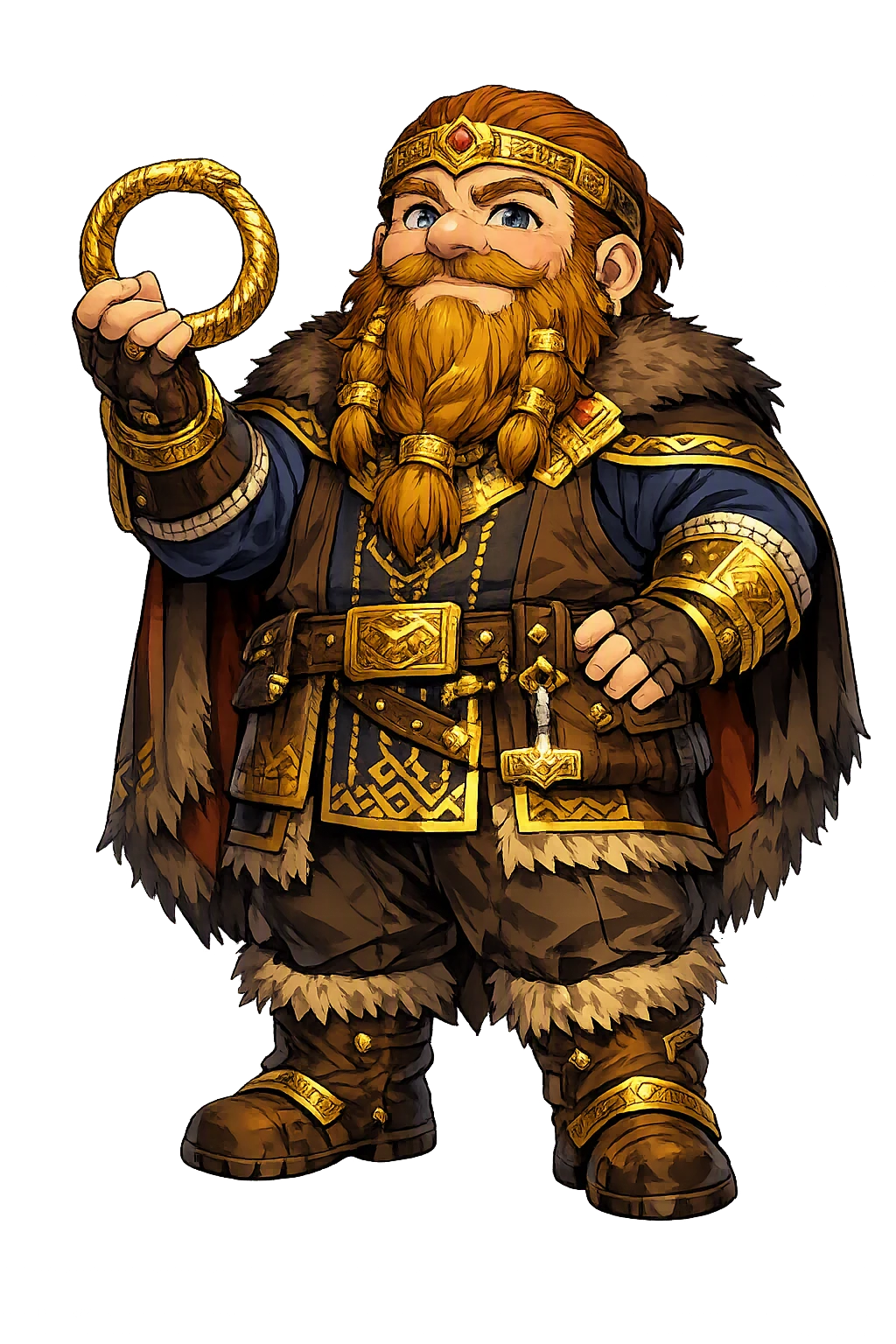
Pronouncing Sindri: a guide for the curious
Saying Sindri aloud is harder than reading it on a screen, and more rewarding. The restored spelling is a compressed pronunciation guide: every accent and macron is an instruction. This post unpacks those instructions — the reconstructed sound, the phoneme-by-phoneme record, the kindred forms in neighboring languages — and then zooms out to the full record around the name: its Younger Futhark writing, its mythology, its cult, and its modern life as a Unicode domain. Whether you arrive as a linguist, a reader of myth, or a domainer, you will leave able to say the name the way the evidence suggests it was said — and able to type it the way it was written.
At a Glance
- Restored name: Sindri
- ASCII form: sindri
- Meaning: "Sparkling"
- Domain of influence: Dwarf Smith
- Pantheon: Norse
- Classification: Tier 2
- Original script: ᛋᛁᚾᛏᚱᛁ (Younger Futhark)
Overview
Sindri (sindri) — Dwarf Smith · Sparkling — is the dwarf at the anvil in the Prose Edda's great forge-scene: brother of Brokkr, who works the bellows while Sindri works the fire, and maker of the gods' three greatest treasures — the golden-bristled boar Gullinbursti for Freyr, the ring Draupnir for Óðinn, and the short-handled hammer Mjǫllnir for Þórr — cast in three heats to win Loki's wagered head. The verse tradition knows a grander figure: Völuspá counts a hall of gold standing north on Niðavellir, belonging to the kindred of Sindri — a dwarf chieftain with a family and a golden house, not merely a wagered-against craftsman.
The name is the trade. Old Norse sindra means 'to sparkle, throw off sparks', and sindr is the slag and spark of the forge — cognate with Old English sinder and the modern English 'cinder'. The smith is named for what his fire throws off. Part of the manuscript tradition of Skáldskaparmál names Brokkr's brother Eitri rather than Sindri, and the handbooks treat the two as one smith under two forge-names.
PuniCodex restores the name as Sindri — identical to the ASCII input, because normalized Old Norse writes no diacritic in this name. The mechanical rule therefore places the name in Tier 2: nothing distinctive is lost in transit, a statement about orthography and never about the smith. The temple is domain-less: the plain-ASCII sindri.com is registered to a third party outside the collection and is watched for release.
The Name
The name is attested in Old Norse as Sindri — the dwarf's name, and in modern times an unbroken Icelandic male given name. Its etymology is among the most transparent in the northern onomasticon: it is built on the forge-word sindra, 'to sparkle, to throw off sparks', with the noun sindr, 'slag, sparks from the smith's fire', beside it. The smith is the sparkler — named for the bright debris of his own work. The Germanic cognates run straight into English: Old English sinder, 'slag, dross of metal', is the same word, and modern English 'cinder' is its descendant — the cooled spark of the forge surviving in every fireplace.
The ASCII form is not a fallback here but the form itself: normalized Old Norse writes six plain Latin letters and a capital. The Unicode restoration Sindri therefore preserves nothing the ASCII alphabet loses, and the mechanical rule classifies the name Tier 2 — an orthographic fact, not a judgment on the smith.
The letter-by-letter transformation runs:
- s → S — Same, capitalized
- i → i — Same
- n → n — Same
- d → d — Same
- r → r — Same
- i → i — Same
The project holds no domain for this name. The plain-ASCII sindri.com is registered to a third party outside the collection and is watched for release; this temple claims nothing it does not hold.
The Original Script
The name is preserved in medieval Icelandic manuscripts in the Latin alphabet as Sindri — Old Norse (North Germanic), attested 13th c. CE in the Codex Regius of the Prose Edda and related codices, recording material centuries older. Before the Latin bookhand, Old Norse names were carved in the Younger Futhark; no runic attestation of this theonym survives, so the manuscript form is the primary witness. The runic rendering is ᛋᛁᚾᛏᚱᛁ (s-i-n-t-r-i), a normalized phonetic reconstruction.
The scholarly rendering proceeds step by step:
- The name is a simplex, not a compound: six letters, two syllables, built on the forge-word sindra, 'to sparkle'.
- The n-d-r cluster of the Latin spelling reflects an epenthetic stop grown between nasal and r; the Younger Futhark's undifferentiated stop rune ᛏ writes the cluster without distinguishing the voicing.
- Old Norse orthography needs no diacritic here: both vowels are short i, and no distinctive letter (þ, ð, æ, ǫ) occurs in the name.
- The Unicode restoration Sindri is therefore identical to the ASCII form — the restoration is a matter of canonical reference, not rescued orthography.
- The name's etymology — sindra, 'to sparkle, throw off sparks', beside sindr, 'forge-slag', cognate with Old English sinder and modern English cinder — is registered in the lexica, and unlike most northern names it is not disputed.
Pronunciation
The reconstructed pronunciation of the name is /ˈsin.dri/ — Old Norse Reconstruction.
Phoneme by phoneme:
- Si- — Voiceless alveolar sibilant [s] and short close front unrounded [i], stressed on the first syllable as in every Old Norse word
- -ndri — Nasal [n] plus the epenthetic stop [d] that Old Norse grew between n and r, then trilled or tapped [r], and a final short [i], fully sounded rather than reduced to schwa
For the modern speaker, the closest approximation is: 'SIN-dri' — two short beats, the weight on the first, the d clicked crisply between the n and the r as in 'laundry' said fast.
Kindred and historical forms of the name:
- Old Norse — Sindri, brother of Brokkr, maker of Gullinbursti, Draupnir, and Mjǫllnir
- Younger Futhark — ᛋᛁᚾᛏᚱᛁ (s-i-n-t-r-i), the Viking-Age runic rendering
- Manuscript variant — Eitri, the name part of the Skáldskaparmál tradition gives the same smith
- Modern Icelandic — Sindri, an unbroken living male given name
Sindri is Tier 2 because the restoration preserves nothing the ASCII form loses: no diacritic, no distinctive letter, no vowel length. English and Old Norse write the name identically.
Mythology
Sindri's mythology is one long scene in Snorri and one stanza in Völuspá — a forge and a hall.
The Wager of the Head (Skáldskaparmál 35)
It begins with a crime: Loki, for mischief, cuts off all the hair of Sif, Þórr's wife. Under Þórr's hands Loki swears to get the svartálfar to make hair of gold that will grow like living hair, and he goes first to the sons of Ívaldi, who make the golden hair and two more treasures — the ship Skíðblaðnir and the spear Gungnir. Then, flushed with success, Loki goes to the dwarf Brokkr and wagers his own head that Brokkr's brother Sindri cannot make three treasures just as good. The bet is the engine of the chapter: a trickster's tongue staked against a smith's hands.
Three Castings, Three Stings (Skáldskaparmál 35)
Sindri lays a pigskin in the forge and tells Brokkr to blow and never cease; a fly stings Brokkr's hand, but out comes Gullinbursti, the boar with bristles of gold. Next gold goes into the fire; the fly stings Brokkr's neck, harder, but out comes the ring Draupnir. Last, iron — and now Sindri himself fears the work will fail if the blowing falters. The fly settles between Brokkr's eyes and stings until the blood blinds him; Brokkr sweeps it away, the bellows fall silent for one instant, and the hammer that comes out has a handle short by a finger's breadth. The fly is Loki, who cannot win fairly: the sabotage succeeds exactly as far as the handle and no farther.
The Judgment and the Sewn Lips (Skáldskaparmál 35)
The Æsir judge the six treasures with Óðinn, Þórr, and Freyr as assessors. The boar runs through air and sea and lights the night; the ring drips eight rings every ninth night; the hammer never misses, never breaks, always returns to the hand, and shrinks small enough to carry inside the shirt — its one fault the short handle. The judgment is unanimous: Mjǫllnir is the best of all the treasures, and the brothers have won. Loki offers ransom, flees on his sky-shoes, is caught, and pleads his last legalism — the head was staked, but not the neck. Brokkr takes an awl instead and sews Loki's lips together; the thread is called Vartari.
The Golden Hall at Niðavellir (Völuspá 37)
The verse tradition knows a grander Sindri. Völuspá counts a hall that stands north on Niðavellir, made of gold, belonging to the kindred of Sindri — beside the giant Brimir's beer-hall at Ókólnir. Here Sindri is no lone craftsman but a dwarf chieftain, the head of a family rich enough to roof its house in the metal his name throws off as sparks. The dwarf þulur preserved with Skáldskaparmál keep the name in the catalogues of dwarf heiti, and the manuscript tradition splits on the forge-scene itself: where part of the tradition names Brokkr's brother Sindri, another part calls him Eitri — one smith under two forge-names.
Symbols & Iconography
The iconography of Sindri is narrative rather than cultic — the corpus gives him no temple regalia, but fixed around his one forge-scene and one eddic stanza a set of objects no retelling can omit:
- The bellows — the wager's condition and the forge's heartbeat: the one tool whose failure, for a single instant, marks the hammer forever
- The fly that stung — Loki's sabotage in miniature: the god who cannot win fairly trying to spoil the work, and succeeding only at the handle
- Draupnir — the ring that drips eight rings of equal weight every ninth night: wealth that renews itself, later laid on Baldr's pyre and sent back from Hel
- Mjǫllnir's short handle — the flaw in perfection: the Æsir's surest defense carrying the permanent mark of the interrupted bellows-stroke
- The golden hall at Niðavellir — Völuspá's witness: the house of gold of Sindri's kindred in the dwarf-fields
Archaeology & Evidence
Sindri is a wholly textual dwarf: no runestone invokes him, no votive deposit names him, and no image can be securely identified with him. His attestation hangs on the manuscript witnesses — the Codex Regius and related codices of Snorri's Edda for Skáldskaparmál 35, with the Codex Upsaliensis tradition reading the brother's name as Eitri, and the Codex Regius of the Poetic Edda for Völuspá's golden hall at Niðavellir.
The material context is nonetheless richer for him than for most dwarfs, because his products are findable. Thor's-hammer pendants — Mjǫllnir in miniature — are the commonest amulets of the late Viking Age, known by the hundred from tenth-century graves, hoards, and settlement sites across Scandinavia and the diaspora: the forge's most famous casting, worn at the neck of the converted and unconverted alike. Gold arm-rings of Draupnir's type fill the hoards. And the corpus's visual language of the smithy survives on the Gotland picture stones — Ardre VIII shows a smithy scene with tools and a headless body, usually read as Vǫlundr — proof that the smith at his forge was a carved subject in the Viking-Age north, though no carving names Sindri himself.
Realm & Domain
Sindri is catalogued under Dwarf Smith — and the gloss is exact: the sources give him one office, one scene, and one product line, and all three are the forge.
The Anvil
Sindri's station in Skáldskaparmál 35 is the forge itself: he lays the metal, chooses the heats, and takes the work out of the fire, while his brother Brokkr holds the bellows. The chapter names the forge by the pair, but the craft by the smith alone — 'Sindri feared the work would fail' is the story's one glance into a craftsman's mind.
The Three Treasures
Gullinbursti for Freyr, Draupnir for Óðinn, Mjǫllnir for Þórr: one afternoon's output, and the Æsir's judgment that the marred third piece is the finest treasure ever made. Everything the gods trust at Ragnarǫk came off his anvil.
The Wager
The forge-scene is staked on Loki's head, and Sindri's victory ends with the trickster's lips sewn shut with the awl-thread Vartari — the smith who cannot take his stake taking the voice that staked it.
The Golden Hall
Völuspá adds what Snorri withholds: a hall of gold north on Niðavellir belonging to Sindri's kindred — the craftsman of the prose tradition revealed as a chieftain of the verse one.
Across Cultures
Sindri's closest kin are inside the corpus itself. His brother Brokkr is the other half of one workshop — bellows and anvil, never separated in the sources. Andvari is the corpus's other great dwarf of the gold, but inverted: Andvari's hoard is won by robbery and carries a curse, while Sindri's gold is made in three heats and carries only a wager. Vǫlundr of Vǫlundarkviða, 'prince of elves', is the verse tradition's other smith narrative — the smith wronged who takes revenge, where Sindri is the smith wagered against who wins.
Cross-culturally the comparisons are structural, not borrowed: Hephaistos, the Greek smith who forges the gods' masterworks and is himself marred; Ilmarinen of the Kalevala, who forges the Sampo under a bargain's pressure; Goibniu of the Irish Tuatha Dé Danann, whose smith-work arms the gods for their last battle. The pattern is old — the divine weapon must come from an other-than-divine hand — but Sindri's version is the only one where the masterpiece's flaw is timed to a single held breath of the bellows.
Cultural Legacy
Sindri's afterlife is the afterlife of his three treasures: every retelling of Norse myth that reaches the forging of Mjǫllnir keeps his one afternoon and its three stings — the short handle is the detail no adapter has ever dared to cut, because it is the story. The smith himself has had a quieter reception than his work, and much of it flows under his manuscript double: the variant name Eitri carries the same dwarf-smith into a robust modern afterlife in games and film, where the forge that made the hammer is restaged for new audiences — the inventions are modern, but the forge, the brother, and the interrupted casting are Skáldskaparmál's own.
The sturdiest legacy is the name: Sindri never died out in Iceland and remains a living male given name, borne today by men who inherit the forge's spark in its plainest form.
The Scholarly Record
The account of Sindri given in this edition rests on the witnesses and reference works listed below. Skáldskaparmál 35 supplies the forge-scene and the wager; Gylfaginning 49 the ring's later history; Völuspá and Grímnismál the eddic frame; Cleasby–Vigfusson, Zoëga, and de Vries the forge-word behind the name, with Simek, Orchard, and Lindow arbitrating attestation and the Sindri/Eitri equation.
- Snorri Sturluson, Edda, Skáldskaparmál 35 (the cutting of Sif's hair; the sons of Ívaldi; the wager; Sindri at the forge and Brokkr at the bellows; Gullinbursti, Draupnir, and the short-handled Mjǫllnir; the judgment; Vartari), ed. and trans. Anthony Faulkes (London: Everyman, 1987).
- Snorri Sturluson, Edda, Gylfaginning 49 (Draupnir laid on Baldr's pyre; Baldr sends it back from Hel), trans. Faulkes (1987).
- The Poetic Edda, trans. Carolyne Larrington, 2nd ed. (Oxford: Oxford University Press, 2014): Völuspá 37 (the hall of gold of Sindri's kindred, north on Niðavellir); Grímnismál 43 (Ívaldi's sons and Skíðblaðnir).
- Snorri Sturluson, Edda, Skáldskaparmál, þulur (dverga heiti), trans. Anthony Faulkes (London: Viking Society for Northern Research, 1998).
- Vǫlundarkviða (Poetic Edda), trans. Larrington (2014) — the corpus's other great smith narrative.
- Cleasby, Richard, and Guðbrandur Vigfússon, An Icelandic-English Dictionary, 2nd ed. (Oxford: Clarendon Press, 1957), s.v. sindr, sindra, Sindri, Eitri, Brokkr, Draupnir, Mjǫllnir, Gullinbursti.
- Zoëga, Geir T., A Concise Dictionary of Old Icelandic (Oxford: Clarendon Press, 1910), s.v. Sindri, draupnir, mjǫllnir.
- de Vries, Jan, Altnordisches etymologisches Wörterbuch, 2nd ed. (Leiden: Brill, 1962), s.v. sindra, Sindri (the forge-word; cognates Old English sinder, English cinder).
- Simek, Rudolf, Dictionary of Northern Mythology, trans. Angela Hall (Cambridge: D. S. Brewer, 1993), s.v. Sindri, Eitri, Brokkr, Mjǫllnir (attestation; the Sindri/Eitri manuscript equation).
- Orchard, Andy, Dictionary of Norse Myth and Legend (London: Cassell, 1997), s.v. Sindri, dwarfs.
- Lindow, John, Norse Mythology: A Guide to the Gods, Heroes, Rituals, and Beliefs (Oxford: Oxford University Press, 2001), s.v. Sindri, Brokkr, dwarfs, Mjǫllnir.
- Davidson, Hilda R. Ellis, 'Thor's Hammer', Folklore 76 (1965): 1–15 (the archaeological record of hammer amulets).
A Meditation
Sindri is the Edda's shortest sermon on how perfection fails. The gods' three greatest treasures are made in one afternoon by a smith whose name is a forge-word for sparks, and two of them are flawless. The third — the best, the one the Æsir will trust in the last battle — is marred by a single instant: a fly, an eyelid, a held breath of the bellows, and the handle is short forever.
The tradition does not call the hammer ruined; it calls it the finest thing ever forged, short handle and all. That is the forge's verdict and the story's mercy: the masterpiece is not the work that never faltered but the work that survived its interruption. Loki wins the sting and loses the wager. Sindri wins everything except the head he was promised — and takes the trickster's voice instead, one stitch at a time, with an awl.
The Unicode Restoration
Sindri is classified as Tier 2: the restoration needs no distinctive letters or diacritics its ASCII form would lose. The ASCII fallback sindri still resolves everywhere, but it is the restored form that carries the name's full information. That is the whole thesis of this temple: the marks are the message.
Why This Restoration Matters
Pronunciation turns out to be the heart of the matter. The marks in Sindri are instructions for the voice, and a web that strips them is a web that mispronounces the past at scale. The restoration hands the instructions back: say it as the evidence suggests, type it as the tradition wrote it, and let the punycode machinery do the quiet translation in between. That is all the PuniCodex project asks of the infrastructure — and everything it asks of you, the reader, is to use the whole name.
Explore Further
This post is one doorway into the temple. The home page carries the full character breakdown and the ambient canvas; the lore page tells the myths in long form; the Scholarly Edition preserves the sources, pronunciation data, and revision history; and the patron wall supports the restoration directly. For the wider map, browse the Lexicon, explore the Pantheon, or return to the PuniCodex blog.
Related Names
Sources
The full scholarly apparatus — every citation, revision, and review — lives in the Scholarly Edition. Key references for this post:
- Snorri Sturluson, Edda, Skáldskaparmál 35, ed. and trans. Anthony Faulkes (London: Everyman, 1987).
- Völuspá 37 (Poetic Edda), trans. Carolyne Larrington, The Poetic Edda, 2nd ed. (Oxford: Oxford University Press, 2014).
- Cleasby, Richard, and Guðbrandur Vigfússon, An Icelandic-English Dictionary, 2nd ed. (Oxford: Clarendon Press, 1957), s.v. sindr, sindra, Sindri.
- de Vries, Jan, Altnordisches etymologisches Wörterbuch, 2nd ed. (Leiden: Brill, 1962), s.v. sindra, Sindri.
- Lexicon authorities for this entry: Prose Edda, Cleasby-Vigfusson.