Stories of Šw
Shu's mythology is cosmogony in motion. He is not a hero who goes on quests; he is the first differentiation of the creator, the void that becomes space, the breath that makes the world inhabitable. Without him, Nut and Geb would remain locked together and no life could arise.
In the oldest Egyptian creation account we possess — Pyramid Text Utterance 600, inscribed in the royal pyramids of the late Old Kingdom — the creator Atum stands alone on the primeval hill in the waters of Nun and, without companion, brings forth the first two gods: he sneezes Shu and spits Tefnut, the sacred text says, and the wordplay is the theology. Shu's very name (šw) echoes the sneeze, Tefnut's the spittle; the world begins with the creator's own body discharging itself into differentiation. The Coffin Texts (spells 75–80) expand the scene: Atum, alone in Nun, says he was not built by any builder, and then — 'I sneezed Shu, I spat Tefnut'. Whether by sneeze, spittle, or exhalation, Shu is the moment creation becomes conscious: the first breath the universe ever takes. The myth's joke is profound — the cosmos as a sneeze — and its claim deeper: life begins not with matter but with air, the lightest thing that exists, without which no god, king, or field can live.
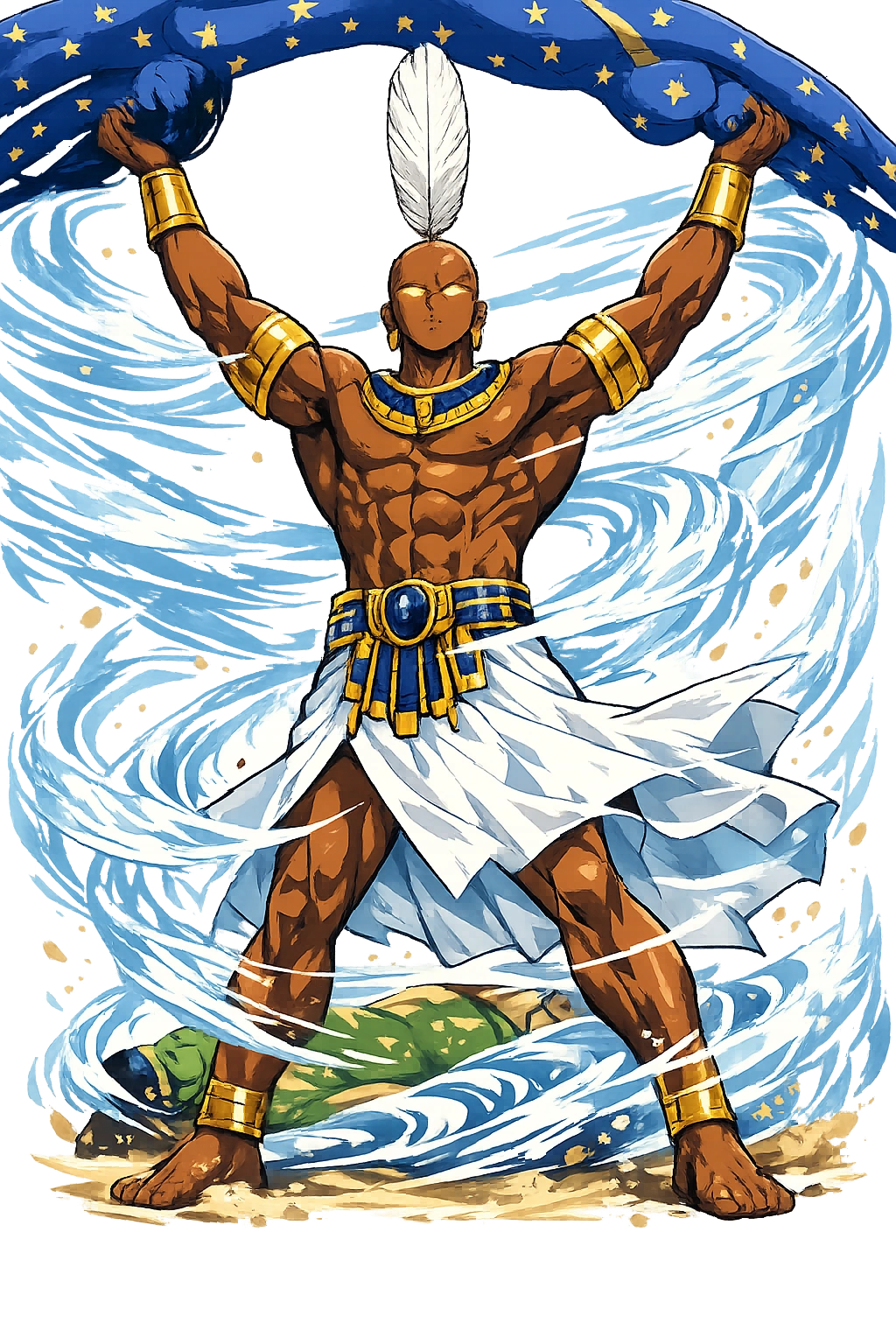
Shu and Tefnut beget the twins Geb (earth) and Nut (sky), but the children are locked in an embrace that leaves no room for life. Shu places himself in the interval and raises Nut above his head, arching her body into the starry vault — the posture the Egyptians gave him forever: kneeling or standing, arms lifted, the cosmic pillar. The image saturates Egyptian religion. It fills royal tombs from the Book of the Dead papyrus of the scribe Nakht (TT52) to the burial chamber of Horemheb (KV57); the Late Period Book of Nut diagrams it as an astronomical treatise; and every temple doorway flanked by heh-pillars and every palace façade propped by figures with raised arms is a frozen Shu. The Ennead of Heliopolis is thus not only a genealogy but a physics: Atum's first act of self-differentiation, perpetually maintained by his firstborn son. Order is not a state but a held pose — and the sky stays up only because someone never puts his arms down.
A late myth tells how Tefnut quarrelled with Shu and departed south to Nubia, taking the form of a lioness — or, in the Demotic telling, of a cat travelling with her companion baboon. The land dried behind her; the south wind brought no relief. Shu sent Thoth, master of words, disguised as a baboon, to talk her home; his flood of eloquence — stories, flattery, argument, and embedded animal fables — accomplished what force could not. The Demotic Myth of the Sun's Eye (Papyrus Leiden I 384) and the Ptolemaic Papyrus Jumilhac preserve the journey, and the returning eye is welcomed in festival. The myth explains the dry wind from the south and the coming of moisture, but its deeper subject is the first marriage: Shu is air, Tefnut moisture, and dry air alone is desolation. It also quietly honors its own medium — the world is saved by eloquence, not arms. In Egypt's most literate civilization, even the weather is talked home.
Funerary texts make Shu the atmosphere of salvation. The dead are promised they will not thirst because of Shu and will not hunger because of Tefnut; the ascension utterances of the Pyramid Texts give the king a ladder and a wind, and the Coffin Texts teach that to become an akh — an effective, transfigured spirit — is to breathe Shu again. In the Book of the Dead the justified sail the sky in Re's barque through the very air Shu is, and spell 15 greets the solar retinue in which he stands at the prow of the night voyage. Breath is the thread on which Egyptian immortality is strung: the heart must be light, the name must live, and the lungs must fill — in the Duat as in Memphis. The afterlife was not imagined as ghostly ether but as weather: a climate maintained by the same god who first separated sky from ground. To die was to change skies, not to stop breathing.
Egypt's king-lists did not begin with men. The Turin Royal Canon, compiled in the Ramesside age, records the gods themselves as Egypt's first rulers — Re, then Shu, then Geb, Osiris, Seth, Horus — reigning for tens of thousands of years before the human dynasties begin. Shu thus appears not only as a cosmological principle but as a precedent for pharaonic office: the god of air once wore the crown and governed the Two Lands. The tradition explains the throne's succession as the Ennead's own — power descending from creator to breath to earth to the murdered and avenged Osiris — giving every later king a genealogy that was also a cosmology. No narrative survives of what Shu did in his reign; the canon gives years, not deeds, and the entry alone testifies. But its placement is the point: between the creator and the earth stands the god of the interval, and kingship, like air, is what fills the space between heaven and ground.
Air · Wind · Lions
Šw is the air that separates earth from sky, the breath that brings consciousness, the light that makes visibility possible. In Heliopolitan theology he is the first being to emerge from the creator Atum — not by procreation alone, but by breath, spittle, or sneeze. His eternal labour is to hold the sky-goddess Nut above the earth-god Geb, so that the space of life can exist between them.
Shu is the atmosphere itself — invisible, life-giving, and inseparable from consciousness.
With arms raised, Shu lifts Nut away from Geb, creating the interval in which all life dwells.
The rays of the sun are called the 'Shu-forms of Re'; Shu makes seeing possible by making space luminous.
Shu sometimes takes leonine form as a fighter and defender, paired with Tefnut's lioness form.
From the original script to the living URL
𓄑
The name in its original Egyptian form. Šw (𓄑) is attested in the source tradition — “Emptiness, he who rises up”. Its original diacritics and script distinctions carry the full phonetic and orthographic weight of the source tradition.
shu
Reduced to plain shu, the name loses everything that made it specific: original diacritics and script distinctions. What remains is an ASCII string that machines can parse but that no longer speaks with its original voice.
Šw
The Unicode restoration recovers what ASCII flattened. Šw restores original diacritics and script distinctions, returning the name to its original written dignity. The domain encodes to Punycode, but the browser displays the truth.
Šw.com → xn--w-4ma.com
The non-ASCII characters in Šw are encoded while the ASCII remains visible. To the DNS, it is Punycode. To humanity, it is Šw.
Owned, ideal, and ASCII forms of Šw
Šw
Restores 𓄑. The live temple domain — šw.com.
shu
Flattens 𓄑. The plain ASCII fallback — what DNS and legacy systems see.
How Šw was spoken
How Šw travels from ancient script to the modern URL
Egyptian šw; the original vocalisation is unknown. The name is related to šw “dry, emptiness" or to the verb “to rise up".
Air, Wind, Lions
The Unicode restoration Šw uses Egyptological characters registrable in .com; hieroglyphs are outside the .com IDN table.
The lore you have read is the living myth. Extended Lore opens the scholarly vault beneath it: the cult and its material remains, a history of the image, the name after antiquity, a meditation on what the name still means, and the full scholarly apparatus — etymology, orthography, sources.
Enter Extended Lore