PuniCodex

Extended Lore

𓄑 Šw

Etymology · Orthography · Cult · Iconography · Reception · Sources

Tier 1 Šw.com
Šw — Air, Wind, Lions
01

Quick Facts

Essential information about Šw, Air, Wind, Lions

Original Script𓄑
Unicode RestorationŠw
Reconstructed Pronunciation/ʃuː/
PantheonEgyptian
DomainAir, Wind, Lions
MeaningEmptiness, he who rises up
ClassificationTier 1
Primary DomainŠw.com
Sacred SymbolsOstrich feather, Raised arms, Lion, Ankh, Four supports / Ogdoad
02

Etymology & Word Family

From original script to Unicode restoration

Original Script 𓄑 Šw — "Emptiness, he who rises up"
Unicode Restoration Šw Restored stress, length, and script
Modern ASCII shu Plain-ASCII fallback

From Egyptian šw, associated with emptiness/dryness and the rising of light/air; the name denotes the god of wind and sunlight.

03

Unicode Character Breakdown

Character-by-character philological analysis

CharacterUnicodeNameBlockPhonetic Role
ŠU+0160Latin Capital Letter S with CaronLatin Extended-AShin
—N/ADropped characterEgyptian orthographyNot written
wU+0077Latin Small Letter WBasic LatinW

The Tier 1 classification reflects how much of the original phonology this restoration preserves — stress and vowel length for Greek names, distinctive letters and diacritics for every other tradition.

04

Cult & Worship

How the sacred was kept — rites, sanctuaries, remains

The Cult

Shu never had a town. No temple dedicated to him alone is known anywhere in Egypt, and no priesthood of Shu, no festival calendar, no votive hoard bears his name; his was a cult without a headquarters, befitting a god who is everywhere and owns nothing. His worship ran instead through the great shared liturgies: the Pyramid Texts make him the breath that transfigures the king, the Coffin Texts promise the dead they shall not thirst because of Shu, and temple cosmology seats him among the Heliopolitan Ennead in every sanctuary that raised the sky on heh-pillars. What the devout left behind is small, fitting, and portable: ostrich-feather amulets of faience and stone set on the throats and breasts of Late Period mummies, and the feather of lightness that crowns his images from the New Kingdom onward. The later solar theology adds a leonine pair — Shu with Tefnut as lion and lioness — but even there he remains the atmosphere of other gods' cults rather than master of his own.

In the Earth

Shu raising Nut above Geb is painted in the burial chamber of Horemheb (KV57) and on the Book of the Dead papyrus of the scribe Nakht (TT52, Metropolitan Museum). His ostrich feathers crown bronze and stone statuettes from the New Kingdom onward, and the 'Shu-pose' of raised arms develops into the heh-pillars that flank temple doorways. Reliefs at Karnak and in the Osireion at Abydos show him within the Heliopolitan ennead, and faience and stone feathers from his headgear appear among funerary amulets. The motif crosses media with ease — painted, carved, cast — because it is Egyptian cosmology's most portable sentence: someone holds up the sky.

05

Iconography

How Šw was imaged across the ages

The Image

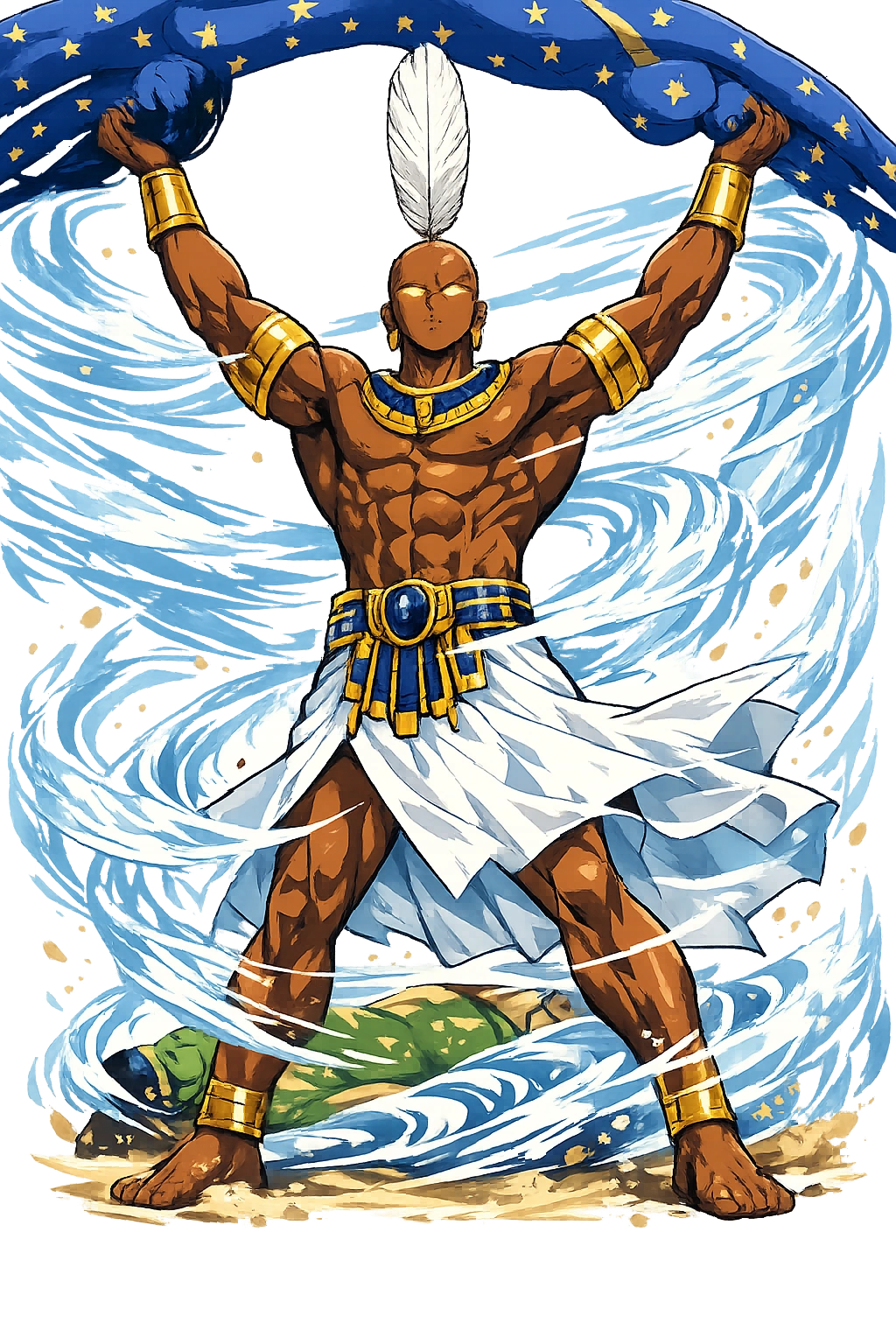
Look for the raised arms and the feather. Shu is imaged as a man — occasionally leonine in the late tradition — standing or kneeling with both arms lifted overhead to hold the arched body of Nut above the recumbent Geb, one or more tall ostrich feathers rising from his head. The type is old, but its great survivals are New Kingdom and later: the painted separation of sky and earth in the burial chamber of Horemheb (KV57) and the vignette of the Book of the Dead of the scribe Ani (British Museum), where Shu kneels beneath Nut's star-spangled vault, arms braced upward. The Late Period miniaturizes him: bronze statuettes, and the feather-amulet that reduces his whole figure to a single plume worn at the throat. The pose proved endlessly portable — heh-figures with lifted arms flank temple gateways, and palace façades were propped on the same frozen labour: the most widely copied sentence in Egyptian cosmology.

06

Reception & Transformation

The name after its own age — transmission, translation, survival

Afterlives

For a thousand years Shu existed only as a riddle in late-antique Greek compilations; his Egyptian texts returned with decipherment. Champollion's breakthrough (1822) opened the inscriptions; Maspero's publication of the Pyramid Texts in the 1880s and 1890s restored the sneeze of Utterance 600 to the world, and the Bremner-Rhind priestly compendium, published at the turn of the century, preserved the Late Period cosmogonies entire. Twentieth-century theology then found the deep structure: Henri Frankfort's classic studies of Egyptian religion and Jan Assmann's anatomy of mediation read Shu as the god of the space that makes difference possible. Within Egypt his image had one last afterlife: under Akhenaten the rays of the Aten end in hands — the lifted arms of the sky-bearer reborn as sunlight, a visual echo scholars have long noted. The Copts, meanwhile, kept the word itself: ϣⲟⲩ (šou), 'air, wind' — the last form of a name first breathed at creation.

Identifications Across Traditions

The Greeks associated Shu with Atlas, the Titan who holds up the celestial sphere — a comparison of function, not of name, since no Greek rendering of šw is attested; modern scholars repeat the comparison on the same grounds. In Egyptian theology Shu could merge with Re (as the rays of sunlight) and with Onuris, the warrior god. Later solar theology made Shu the son of Re as well as of Atum, smoothing local variants into a single cosmic scheme. The image of a figure supporting the heavens passed from Egypt into Hellenistic and medieval cosmography, influencing depictions of the celestial spheres.

Modern Legacy

Shu survives wherever we say 'atmosphere' and mean more than weather. The Greeks, meeting the image of a figure bearing heaven, supplied the parallel of Atlas — a comparison every Egyptology handbook repeats — and the sky-bearer motif migrated through Hellenistic and medieval art into the atlantes of Renaissance architecture, carved men holding up what cannot be held. Modern science gave his domain a name and a fragility: the atmosphere is now known to be thin, held, and breakable — Shu's arms, imaged by satellites. Breath-work, meditation, and singing traditions treat every inhalation as a microcosm of his labour: to breathe is to separate inside from outside and to hold, for a moment, the space in which life happens. Few gods have aged so well into metaphor without losing their physics.

07

The Meditation

What Šw means — beyond the dictionary

Shu is the god of the interval. He is what happens between earth and sky, between inhalation and exhalation, between the word and its meaning. We rarely notice him because he is what we move through; he is the invisible precondition of every visible thing. To become conscious of Shu is to realise that emptiness is not nothing. The space between bodies, between stars, between sounds — these intervals are as real as the things they separate.

In an age of clutter and noise, Shu asks us to respect the void. The sky is not a blue screen but a held breath. The silence between notes is not absence but architecture. The pause before speaking is where intention gathers. Shu teaches that separation is a form of love: by holding Nut away from Geb, he creates the room in which all living things can breathe. To name him Šw is to hear, in two letters, the rush of that creating distance.

08

Frequently Asked Questions

Common questions about Šw, Air, Wind, Lions, and Unicode restoration

01How do you pronounce Šw?

In reconstructed pronunciation, Šw is /ʃuː/ — approximately 'SHOO' — drawn out, breathy, like the sound of wind passing through a corridor.

02What does Šw mean?

Šw means Emptiness, he who rises up in the egyptian tradition.

03What are the symbols of Šw?

Šw is associated with Ostrich feather (Lightness, air, and truth; Shu wears one or more feathers on his head), Raised arms (The posture of Shu supporting the sky; the hieroglyph for ka-arms also echoes his life-giving embrace), Lion (Shu's fighting aspect; the dry, parching wind of the desert), Ankh (The breath of life that Shu carries into every nostril), Four supports / Ogdoad (The eight Heh-gods who assist Shu in holding up the heavens).

04Why restore Šw in Unicode?

Plain ASCII shu strips the stress, length, and script that make the name specific. Unicode restoration returns the name to its original written dignity.

05What is the most important myth about Šw?

“Born from Atum” — the The First Breath story that anchors the mythology of Šw, told in full on the lore page.

09

Scholarly Sources

The philological foundations of this restoration

Every claim on this page is grounded in established scholarship. The orthographic restorations follow disciplinary convention. The etymological chain follows the best available reference works. This is not invention — it is resurrection through scholarship.

◈

Lexicography & Philology

  • Faulkner, R. O. A Concise Dictionary of Middle Egyptian. Oxford: Griffith Institute, 1962.
  • Wb
◎

Primary Texts

  • Faulkner, The Ancient Egyptian Pyramid Texts (Utterance 600)
  • Faulkner, The Ancient Egyptian Coffin Texts (spells 75–80)
  • Book of the Dead (spell 15; Nakht papyrus, TT52)
  • Papyrus Jumilhac
◉

Archaeology & Art History

  • Material evidence — iconography, inscriptions, and temple archaeology — for Šw and related cults.
✦

Religious Studies

  • Book of Nut
  • Papyrus Leiden I 384 (Demotic Myth of the Sun's Eye)
  • Turin Royal Canon
Return

The Surface Awaits

You have traced the name from its earliest attestation to its Unicode restoration. Now return to the myth. The story is where the name lives.

Back to Lore
Šw mascot