The Living Myth
Destruction, Transformation, Dance · The Auspicious Destroyer
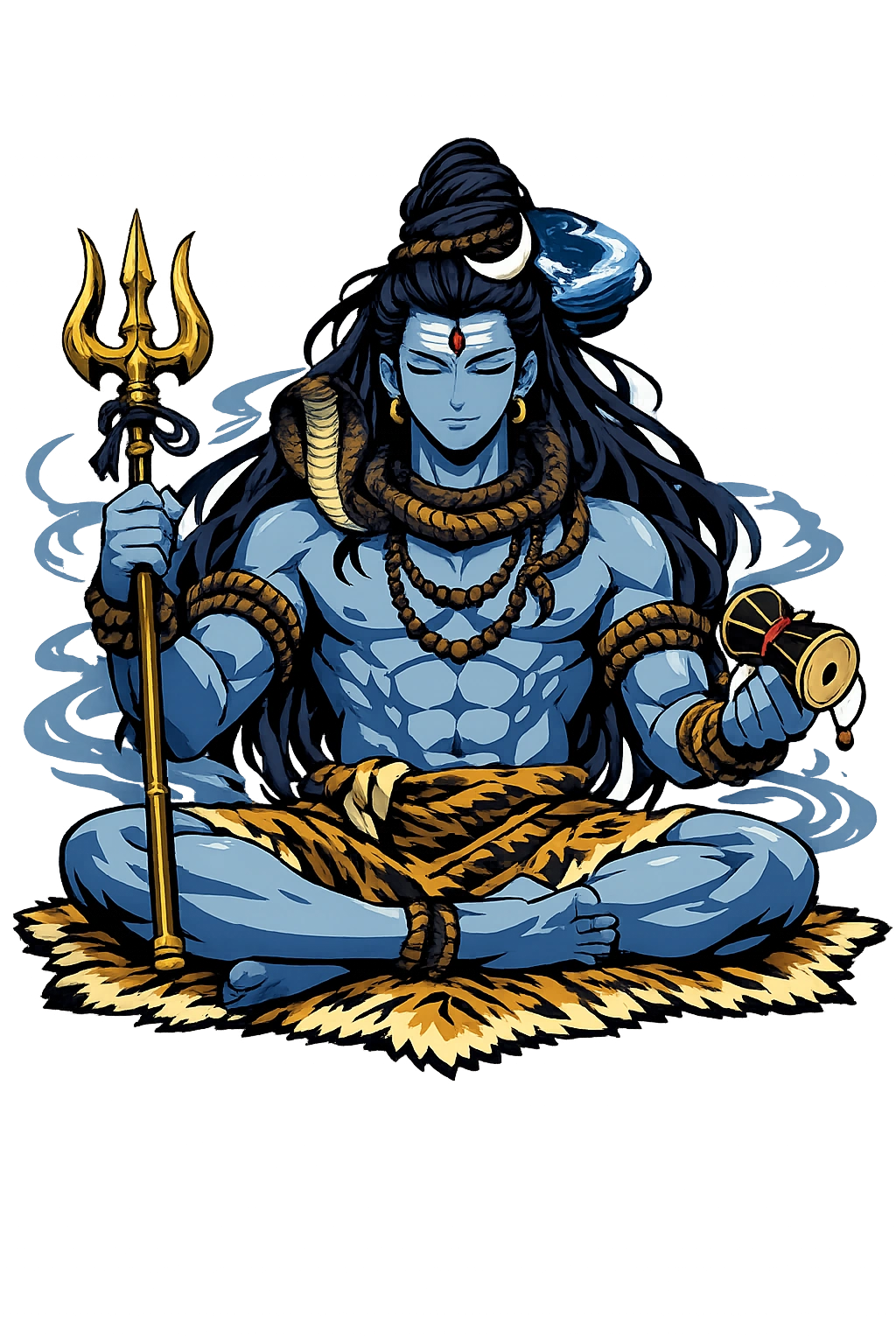
Stories of Śiva
Śiva's mythology is a philosophy told as story: poison drunk for the world, cities burned to restore the gods' dignity, a river caught in matted hair, a marriage won by tapas. He moves between cremation ground and bridal chamber, teaching that renunciation and engagement are one path.
When the gods and demons churned the cosmic ocean in search of amṛta, the elixir of immortality, the first thing to rise was not nectar but Halāhala, a poison black enough to scorch every world. Creation began to suffocate. The gods fled to Śiva, who sat motionless on Kailāsa. Without hesitation he took the poison into his palm and drank it. Pārvatī pressed her hands against his throat to keep the toxin from descending, and it burned there forever, turning his neck blue. From that day he has been called Nīlakaṇṭha, the Blue-Throated One, the god who absorbs destruction so that life may continue. Pārvatī's grip is the detail theology loves: salvation is not solitary — the god drinks, but love holds the line that keeps the draught from reaching the heart.
The three demon cities of Tripura — golden, silver, and iron — rolled through heaven, earth, and the underworld, protected by a single shared moment of vulnerability. Their tyrant inhabitants mocked the gods and upset the order of the worlds. Śiva agreed to destroy them, but only after the gods had first earned the merit to deserve such an intervention. He climbed his chariot, made of the earth itself, with Brahmā as driver and Mount Mandara as bow. He bent the bowstring until it touched his ear, then released a single arrow at the exact conjunction when all three cities aligned. The missile flashed like a smile and the cities burned, restoring cosmic balance. The gods had first to assemble the shot — bow, arrow, chariot and charioteer gathered from the substances of the world — so that the destroyer fires, but creation supplies the bow.
After the death of his first wife Satī, Śiva withdrew into severe asceticism on the mountain, draped in ash and serpents, indifferent to the world. The gods grew anxious: without a wife he would have no son to lead them against the demon Tāraka. The Himalayan princess Pārvatī, Satī reborn, resolved to win him through her own ascetic power. She fasted, stood in snow, and repeated his name until the mountain itself shuddered. One morning Śiva appeared before her disguised as an old Brahmin, testing her devotion with harsh words. Pārvatī did not waver. He revealed himself, accepted her, and their wedding became the model of every sacred marriage in the Hindu imagination — the union of stillness and energy, ascetic and king. Their sons Skanda and Gaṇeśa — war and wisdom — complete the household: the ascetic’s energies turned to family without ceasing to be ascetic.
When King Bhagīratha sought to bring the celestial Gangā down to purify the ashes of his ancestors, the river's descent was so violent it threatened to shatter the earth. Bhagīratha prayed to Śiva, who caught the falling torrent in his matted locks and released it in measured streams. This act of controlled descent revealed Śiva as the one who receives cosmic force without being overwhelmed, turning destructive flood into life-giving river. Pilgrims have honored him as Gangādhara ever since. The measured release — seven streams from seven locks — is the theological point: grace is force with a throttle, and Bhagīratha’s generations of debt are washed away by a river whose descent only stillness could survive. Every liṅga washed with water each morning re-enacts the caught torrent: the force that could shatter the earth, received and released as blessing.
The domain of Śiva
Śiva holds Hinduism's hardest paradox: the god named 'auspicious' whose dance dissolves the cosmos, the supreme ascetic who is also the model husband and father. Destruction is not the opposite of his grace but one of its forms — the still point around which creation and dissolution turn as one rhythm.
As Lord of the Dance, Śiva's cosmic tāṇḍava destroys a weary universe and prepares the ground for rebirth.
He drank the Halāhala poison to save creation, and Pārvatī held it in his throat, turning it blue forever.
He destroyed the three demon cities with a single arrow at the moment of their shared vulnerability.
He caught the falling Ganges in his matted locks and released her gently to purify the earth.
From the original script to the living URL
शिव
The name in its original Sanskrit form. Śiva (शिव) is attested in the source tradition — “The auspicious one; the deity of destruction, transformation, and regeneration, the third member of the Hindu Trimūrti alongside Brahmā and Viṣṇu.”. Its original diacritics and script distinctions carry the full phonetic and orthographic weight of the source tradition.
shiva
Reduced to plain shiva, the name loses everything that made it specific: original diacritics and script distinctions. What remains is an ASCII string that machines can parse but that no longer speaks with its original voice.
Śiva
The Unicode restoration recovers what ASCII flattened. Śiva restores original diacritics and script distinctions, returning the name to its original written dignity. The domain encodes to Punycode, but the browser displays the truth.
Śiva.com → xn--iva-bza.com
The non-ASCII characters in Śiva are encoded while the ASCII remains visible. To the DNS, it is Punycode. To humanity, it is Śiva.
Owned, ideal, and ASCII forms of Śiva
Śiva
Restores शिव. The live temple domain — śiva.com.
shiva
Flattens शिव. The plain ASCII fallback — what DNS and legacy systems see.
How Śiva was spoken
How Śiva travels from ancient script to the modern URL
From Sanskrit śiva- 'auspicious, gracious, benevolent'. Related to the Vedic Rudra-Śiva complex.
Supreme deity (Trimurti as destroyer/regenerator), ascetic, lord of yoga, and cosmic dancer.
The IAST form Śiva uses the acute on S (U+015A) and macron on i, registrable in .com. The Devanagari form is not used as a domain because Indic scripts are not supported in the .com IDN table.
The lore you have read is the living myth. Extended Lore opens the scholarly vault beneath it: the cult and its material remains, a history of the image, the name after antiquity, a meditation on what the name still means, and the full scholarly apparatus — etymology, orthography, sources.
Enter Extended Lore