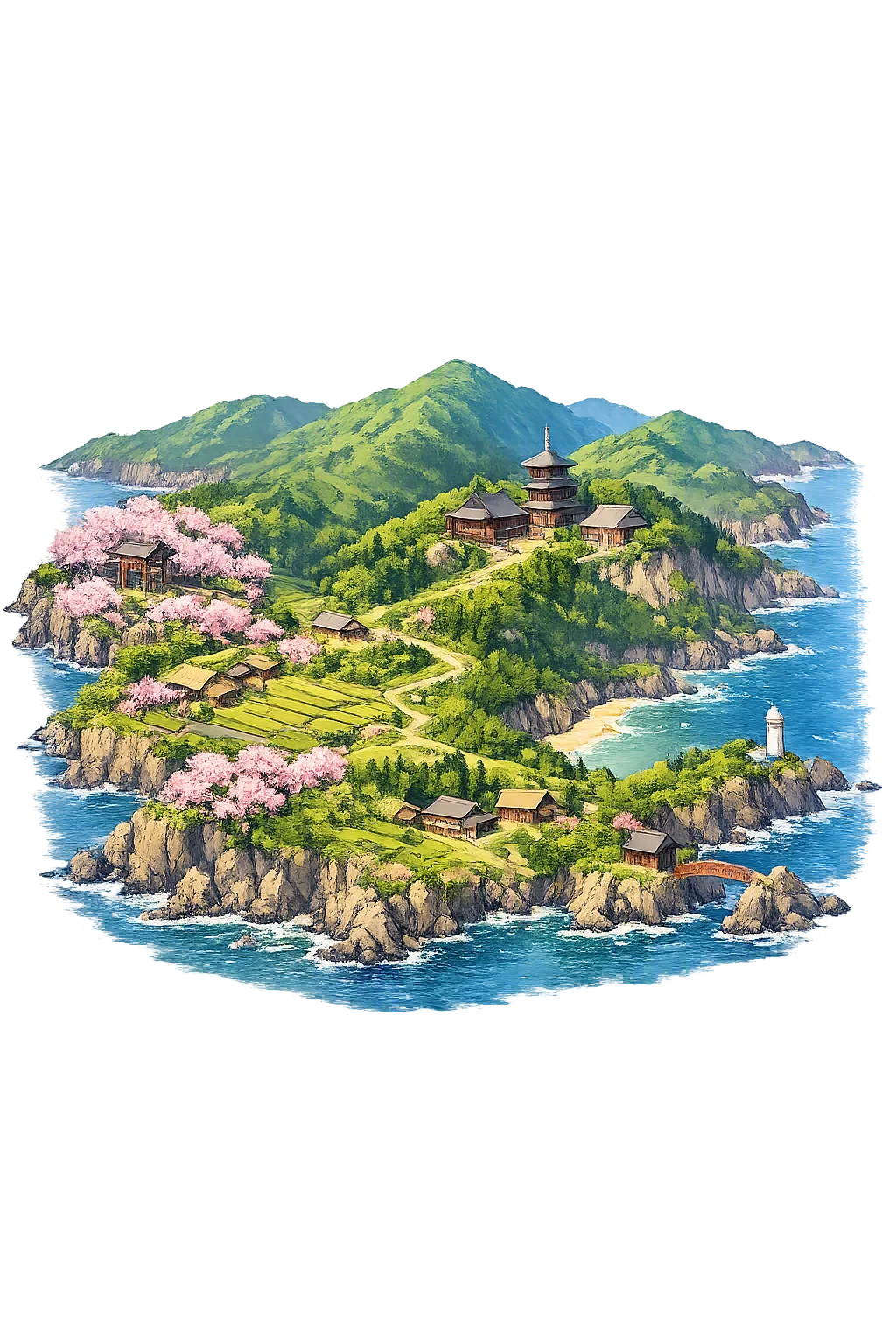
Stories of Shikoku
Shikoku's mythology is the mythology of Kūkai and the Buddhist pilgrimage that bears his memory — documented history, medieval hagiography, and mountain legend fused into a single sacred geography that thousands of pilgrims in white still walk each year, temple by temple, around the island.
Kūkai (774–835), later venerated as Kōbō Daishi, was born in the village of Byōbugaura in Sanuki province — present-day Zentsū-ji city, where temple 75 still marks the family home. The medieval biographies wrap his life in marvel: as a youth he was sent by a despairing kinsman into the mountain wilderness, and there, tradition says, the esoteric teachings came to him in visionary form. The documentary core is solid: in 804 he sailed to Tang China, studied Sanskrit and esoteric Buddhism at the Qinglong monastery in Chang'an under the Indian master Huiguo, returned in 806 laden with scriptures and ritual implements, founded the Shingon school, and in 816 received imperial leave to open a mountain monastery on Kōya-san. His own early writings — the Sango Shiiki of 797 and the Shōrai Mokuroku of 806 — are among the founding documents of Japanese Buddhist literature. When he died on Kōya-san in 835, tradition refused the word: the master had entered eternal samādhi in the Okunoin and would sit there until the coming of the future Buddha. The hagiography makes the point the pilgrims still act on: on Shikoku, Kūkai never left.
The Shikoku Henro links 88 temples in a circuit of some 1,200 kilometres, and the number is itself theology: in Shingon numerology there are eighty-eight bonnō, the delusions that bind the heart, and each temple is understood to release one. The circuit as pilgrims walk it took shape in the Edo period, when temple associations, printed guidebooks such as the Shikoku Reijōki, and the island-wide institution of osettai — free food and lodging offered to walkers — made the henro a mass practice. Pilgrims wear the white byakue and sugegasa hat and carry a kongō-zue staff whose metal rings announce the dead traveling with them, and they address the Daishi not as a memory but as a companion: the walk's first principle is dōgyō ninin, 'two traveling together' — yourself and Kūkai. Walking tales insist the Daishi appears along the road as a child, a beggar, or a stranger who vanishes around the bend. The circuit turns a whole island into one ritual body: to walk Shikoku is to walk through Kūkai's biography, one delusion at a time.
Long before the eighty-eight temples were numbered, Shikoku's mountains were training grounds. The great peak Ishizuchi-san (1,982 m) in Ehime is a principal center of Shugendō, the mountain-ascetic tradition, and its founding legend belongs to En no Gyōja — the seventh-century wonder-working ascetic whom the court exiled and who, tradition says, flew over the capital and tamed demons into Buddhism. Shugendō communities hold that En trained on Ishizuchi and sealed its mountain spirits; the summit still keeps a shrine to the Tengu, the red-faced spirit who tested and then served him, and ascetic rites continue there in season. Several henro temples preserve the same mountain character — none more than Yokomine-ji, temple 60, which clings to a ridge at seven hundred metres and was rebuilt from near-abandonment in the 1970s by its yamabushi community. The island's sacred geography thus runs on two engines: Kūkai's circuit below and En's peaks above, the walking pilgrimage and the climbing one.
Shikoku — literally 'four countries' — is an island the ancient state made: the ritsuryō provincial reforms of the seventh century carved it into Awa, Tosa, Iyo, and Sanuki, the four kuni that gave the island its name and that the pilgrimage later stitched back into a single sacred circuit. For most of its history the island was a maritime world of fishing ports, steep fields, and castle towns — Tokushima, Kōchi, Matsuyama, Takamatsu — reachable from the mainland only by sea. In the nineteenth century one Shikoku son helped end the age he was born into: Sakamoto Ryōma (1836–1867), a low-ranking samurai of the Tosa domain, brokered the secret alliance of Satsuma and Chōshū against the shōgunate and sketched a Japan governed by councils of daimyō and court nobles rather than by a military dictator — a vision he lived just long enough to see begun. The island's modern identity holds both halves at once: the henro's slow walking world, and the Tosa-born revolutionary who could not wait for it.
Pilgrimage, Rural Japan, and the Cult of Kūkai
Shikoku is Japan's smallest main island, a place of mountains, coast, and rural quiet. For more than a thousand years it has been walked by pilgrims on the henro, the 88-temple circuit associated with Kūkai, the founder of Shingon Buddhism. Shikoku means 'four provinces,' and its identity is inseparable from the spiritual geography of the pilgrimage.
The 88-temple pilgrimage circuit honoring Kūkai; in Shingon numerology the 88 stands for the bonnō, the delusions each temple is walked to release.
The birthplace and spiritual home of the Shingon founder, born at Zentsū-ji in Sanuki in 774.
Ishizuchi-san and ridges like Yokomine-ji (temple 60) preserve the Shugendō layer beneath the Buddhist circuit.
Awa, Tosa, Iyo, and Sanuki — the ancient kuni that gave the island its name and that the pilgrimage stitches into one body.
From the original script to the living URL
四国
The name in its original Japanese form. Shikoku (四国) is attested in the source tradition — “Four provinces”. Its original diacritics and script distinctions carry the full phonetic and orthographic weight of the source tradition.
shikoku
The plain shikoku form is identical to the Unicode restoration. Because this name is already written in Latin letters, no diacritics, stress, or script information were lost — only capitalization differs.
Shikoku
The Unicode restoration does not need to recover lost marks for Shikoku. Its value is canonical spelling and consistent cataloguing, not the reconstruction of erased orthography. The domain is readable as-is to both DNS and humanity.
Shikoku.com
This restoration is written entirely in ASCII letters — no Punycode encoding stands between Shikoku and the DNS. The domain reads identically to machines and to human eyes.
Owned, ideal, and ASCII forms of Shikoku
Shikoku
Restores 四国. The full Unicode restoration. shikoku.com is not in the PuniCodex collection — it is watched for release; if it drops, this temple upgrades to an owned flagship.
How Shikoku was spoken
How Shikoku is preserved in writing
A bespoke provenance study for Shikoku is being prepared by the PUNICODEX scholarly team.
Contribute scholarly provenance →The lore you have read is the living myth. Extended Lore opens the scholarly vault beneath it: the cult and its material remains, a history of the image, the name after antiquity, a meditation on what the name still means, and the full scholarly apparatus — etymology, orthography, sources.
Enter Extended Lore