
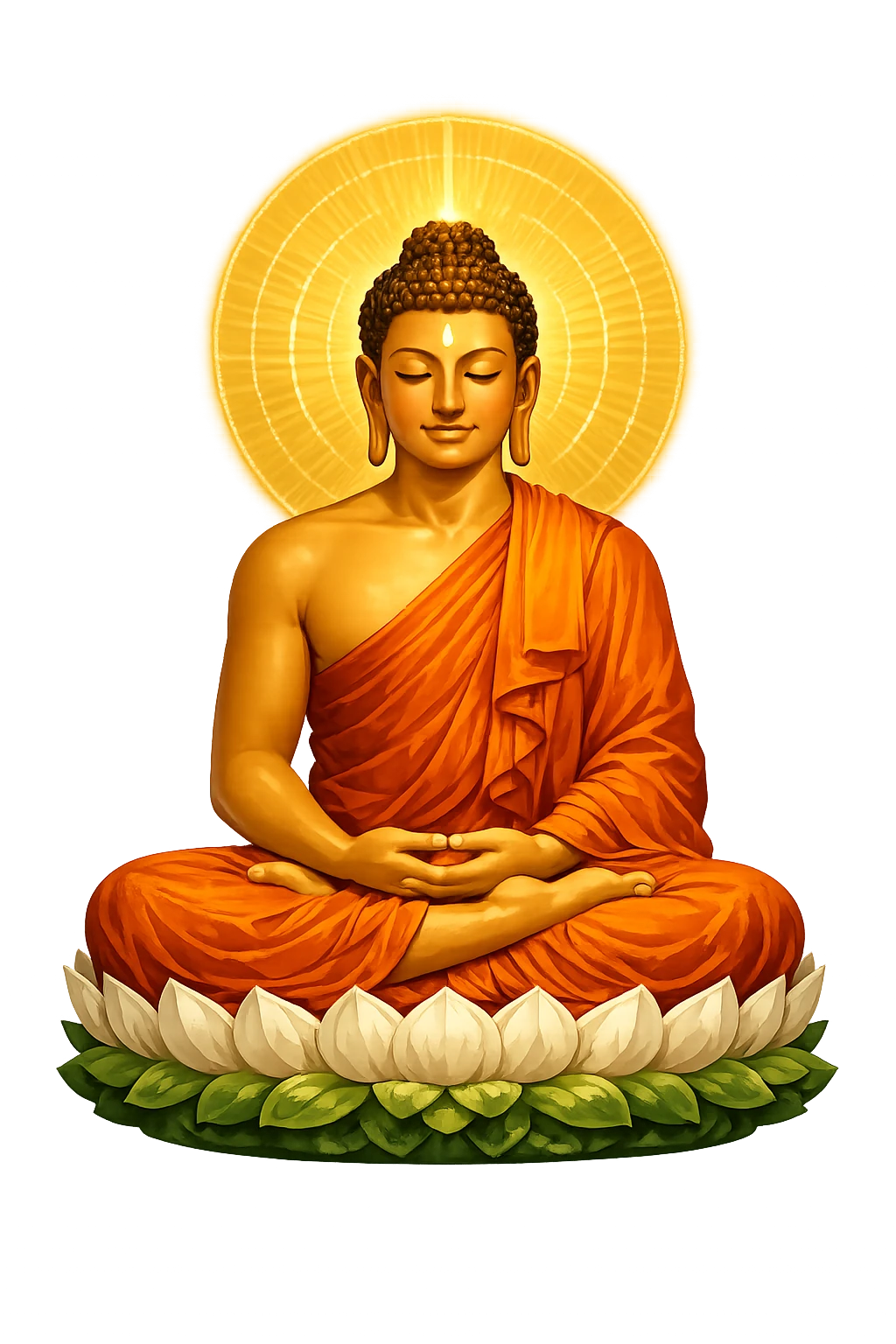
Śākyamuni in 2026: why scholars still care
In 2026, names are treated as data points. Śākyamuni is a reminder that they are also cultural artifacts — and that the difference matters for search engines, AI training corpora, and anyone who types the name of a Buddhist figure into a browser. Scholars never stopped caring about the difference between shakyamuni and Śākyamuni; the web simply made that care actionable. What follows is the full scholarly picture — name, script, sound, myth, cult, and legacy — followed by the engineering compromise that lets a restored spelling live at a real address. The question is not whether the name is old. It is whether the digital world is old enough to hold it.
At a Glance
- Restored name: Śākyamuni
- ASCII form: shakyamuni
- Meaning: "‘sage of the Śākya clan’, epithet of the historical Buddha Siddhārtha Gautama, MW."
- Domain of influence: Enlightenment, Teaching, Historical Buddha
- Pantheon: Buddhist
- Classification: Tier 1
- Original script: शाक्यमुनि (Devanagari)
- Live domain: śākyamuni.com
Overview
Śākyamuni (shakyamuni) — Enlightenment, Teaching, Historical Buddha · Sage of the Śākyas, the Awakened One — is the honorific by which the Buddhist traditions name the historical Buddha: Siddhārtha Gautama of the Śākya clan, who awakened under the Bodhi tree and taught the Dharma for forty-five years before his parinirvāṇa at Kuśinagara.
The name means exactly what it says: muni, ‘sage, silent one’, of the Śākyas — the small aristocratic republic of Kapilavastu at the Himalayan foothills into which he was born, in the usual scholarly dating, in the fifth century BCE. The title does the tradition's most important historical work: it anchors Buddhism not in a cosmic principle but in a person — a man of a named clan, a named town, and a remembered life — even as the Mahāyāna would later surround that person with innumerable other Buddhas.
PuniCodex restores the name as Śākyamuni and serves its temple at śākyamuni.com. The restoration keeps the palatal ś and the long ā of the Sanskrit; the plain ASCII shakyamuni is a modern convenience of the early domain-name system, not an attested ancient spelling.
The Name
The name is attested in Devanagari as शाक्यमुनि (IAST śākyamuni; Pāli Sakyamuni). It is a genitive tatpuruṣa compound: śākya, ‘of the Śākya (clan)’, + muni, ‘sage, silent sage’ — ‘the Sage of the Śākyas’. Monier-Williams records the compound as the standard epithet of the historical Buddha; Edgerton documents its currency in Buddhist Hybrid Sanskrit texts. His other principal titles — Tathāgata (‘Thus-gone’), Bhagavān (‘the Blessed One’), Sugata (‘Well-gone’) — supplement rather than replace it; Śākyamuni is the one that carries the clan.
The ASCII form shakyamuni survives only because the early domain-name system could not carry diacritics; it is a technological compromise, not an ancient spelling, and it smuggles an English digraph (sh) into a Sanskrit name. The Unicode restoration Śākyamuni recovers the palatal sibilant ś and the long ā directly in the address bar. Because the restoration preserves distinctive letters and vowel length the ASCII form loses, the name is classified Tier 1.
The letter-by-letter transformation runs:
- s → Ś — Ś: voiceless palatal sibilant /ɕ/
- h → — — Part of the ś digraph
- a → ā — Macron: long /aː/
- k → k — Same
- y → y — Same
- a → a — Same
- m → m — Same
- u → u — Same
- n → n — Same
- i → i — Same
The project holds the domain śākyamuni.com (xn--kyamuni-r3a32f.com) as the canonical home of this name.
The Original Script
The name is preserved in Devanagari as शाक्यमुनि — Brahmic abugida, attested Buddhist Hybrid Sanskrit and Classical Sanskrit, in the manuscript traditions of India, Nepal, and Tibet; the script is written left-to-right.
The scholarly transliteration is Śākyamuni (IAST), giving the normalized reading /ˈɕaː.kjə.mu.ni/.
The rendering proceeds step by step:
- Sanskrit Śākyamuni is written शाक्यमुनि in Devanagari: शा (śā) + क्य (kya) + मु (mu) + नि (ni); the conjunct क्य writes the palatalized cluster.
- The compound is śākya (‘of the Śākya clan’) + muni (‘sage’), a genitive tatpuruṣa.
- IAST writes the voiceless palatal sibilant as ś (distinguished from retroflex ṣ and dental s) and vowel length with the macron (ā).
- The Unicode restoration Śākyamuni is registrable in .com; the Devanagari form is not supported in the .com IDN table.
Pronunciation
The reconstructed pronunciation of the name is /ˈɕaː.kjə.mu.ni/ — Sanskrit Reconstruction.
Phoneme by phoneme:
- Śā- — Voiceless palatal sibilant [ɕ] (softer than English ‘sh’) with long open [aː]; the clan-name Śākya, stressed
- -kya- — Voiceless velar [k] with palatal glide [j] and short [ə]
- -mu- — Voiced bilabial nasal [m] with short [u]
- -ni — Voiced dental nasal [n] with short [i]
For the modern speaker, the closest approximation is: ‘SHAA-kyuh-moo-nih’ — the first vowel long, the ś hushed rather than hissed.
Kindred and historical forms of the name:
- Sanskrit — शाक्यमुनि (śākyamuni), ‘Sage of the Śākyas’
- Pāli — Sakyamuni
- Chinese — 釋迦牟尼 (Shìjiāmóuní)
- Japanese — Shakamuni; Tibetan — Śākya thub-pa (Shakya Thubpa, ‘Śākya Sage’)
Śākyamuni is Tier 1 because the palatal ś and the long ā are both lost in ASCII. The name's first syllable carries the whole clan; the digraph ‘sh’ is an English guess at a Sanskrit phoneme.
Mythology
The life of Śākyamuni is the master-narrative of Buddhism, told with increasing splendour from the spare early suttas to the Sanskrit epics Lalitavistara and Aśvaghoṣa's Buddhacarita.
Birth and Renunciation
Born to the Śākya nobility at Lumbinī — the Aśokan pillar there still reads ‘here the Buddha Śākyamuni was born’ — the child Siddhārtha was raised in Kapilavastu, married, and fathered a son. At twenty-nine, the four encounters — an old man, a sick man, a corpse, and a wandering ascetic — unmade his world; he left the palace by night in the Great Renunciation. Six years of teachers and austerities followed, ending at the verge of death by starvation, when he accepted a girl's gift of milk-rice and remembered the middle way.
The Awakening
Seated beneath the Bodhi tree at Uruvelā (Bodhgayā), he withstood Māra's assault — desire, fear, and death's own armies — touched the earth as his witness, and in the night of the full moon saw his past lives, the working of karma, and the chain of dependent origination. He became the Buddha, the Awakened, and the tradition dates the world's religion from that night.
The Teaching
At the Deer Park of Sarnath he set the wheel turning for five ascetics with the sermon on the middle way and the four noble truths (SN 56.11). Forty-five years of walking ministry followed: the founding of the Saṅgha, the great discourses, the conversion of kings and killers, the admission of women to the order.
The Parinirvāṇa
At eighty, lying between twin sāla trees at Kuśinagara, he took his last meal, gave his last instruction — ‘all compounded things decay; strive on with diligence’ — and passed beyond return. The Mahāparinibbāna Sutta's account of the cremation and the division of the relics is Buddhism's foundation document of mourning and pilgrimage alike.
The Birth at Lumbinī (Nidānakathā / Lalitavistara)
Queen Māyā, traveling to her father's house, gave birth standing in the grove at Lumbinī, holding the branch of a sāla tree; the child took seven steps and declared this his last birth. The legends multiplied — the shower of blossoms, the two streams of water, the prophecy of the sage Asita — but the place is fixed in stone: Aśoka's pillar at Rummindei, raised in his twentieth regnal year, reads in plain Prakrit, hida budhe jāte sakyamuni — "here the Buddha Śākyamuni was born." It is the only birthplace of a world teacher certified by a contemporary emperor.
The Four Sights and the Going Forth (Ariyapariyesanā Sutta)
Sheltered in three palaces, the young Śākyan saw what his father had fenced out: an old man, a sick man, a corpse, and a wandering ascetic — the four sights the later tradition makes the hinge of his life. In the Majjhima Nikāya's Ariyapariyesanā Sutta (MN 26) he tells it himself: he shaved his hair, put on the ochre robe, and went forth from home into homelessness while still young, in the prime of life, with his parents weeping. The great renunciation — the night ride on Kaṇṭhaka with the groom Channa — became Buddhist art's first epic scene.
The Awakening and the First Turning (SN 56.11)
Six years of austerities on the Nairañjanā brought him to the edge of death and the discovery of the middle way; seated under the Bodhi tree at Uruvelā he withstood Māra's assault, touched the earth as his witness, and by dawn saw the four noble truths and the chain of dependent arising. Weeks later, in the deer park at Ṛṣipatana near Benares — Sarnath — he taught the five ascetics the Dhammacakkappavattana Sutta (SN 56.11), the setting-in-motion of the wheel: suffering, its origin, its cessation, and the eightfold path. The sermon is preserved in every Buddhist canon; the wheel he turned has not stopped.
Symbols & Iconography
The iconography of Śākyamuni is the grammar by which all Buddhist art learned to speak:
- The Bodhi tree — The ficus under which he awoke at Bodhgayā; in the earliest aniconic art the empty throne and tree stand for the Buddha himself
- The wheel (dharmacakra) — The first sermon at Sarnath ‘set rolling’ the wheel of Dharma; flanked by two deer it marks the Deer Park
- The begging bowl — The monk's bowl, emblem of renunciation and of the middle way between indulgence and starvation
- The mudrās — Bhūmisparśa (earth-touching, the victory over Māra), dhyāna (meditation), abhaya (fearlessness), dharmacakra-pravartana (teaching): the four gestures that tell the whole life
- The lion's roar — His teaching is called the lion's roar (sīhanāda), fearless and sovereign; the Sarnath lion capital became India's national emblem
Archaeology & Evidence
No figure of the ancient world has a better monumental biography. The Aśokan pillars mark the itinerary: at Lumbinī the inscribed pillar (3rd c. BCE) reads in Brahmi ‘here the Buddha Śākyamuni was born’, and the emperor remitted the village's taxes for the honour; at Bodhgayā Aśoka's pilgrimage began the shrine that became the Mahābodhi temple; at Sarnath his lion capital crowned the column by the Deer Park, now the emblem of the Indian republic; and at Kuśinagara the parinirvāṇa temple enshrines the great reclining image.
The relic geography continues the biography: the Aśokan tradition of 84,000 stūpas seeded the subcontinent with his remains, and the Piprahwa reliquary inscription (1898; its reading and authenticity long debated) claims the bone relics of the Śākyas' own share. Gandhāra and Mathura gave him his first human images in the early centuries CE, fixing the type — ushnisha, urna, monastic robe — that Buddhist art still follows.
Realm & Domain
Śākyamuni is the Awakened One of this age: the teacher whose life is the charter of Buddhism — birth, renunciation, awakening, teaching, and the final passing that taught the last lesson.
Awakening
Under the Bodhi tree at Bodhgayā he became Buddha — ‘the Awakened’ — having seen through Māra's last assault to the end of becoming.
Teaching
For forty-five years he walked the Gangetic plain teaching the middle way: the four noble truths, the eightfold path, dependent origination.
The Historical Anchor
Of this age's Buddhas he is the remembered one: a clan, a town, a death-date — the person through whom the Dharma entered human history.
The Refuge
First of the Three Jewels: Buddhists ‘go for refuge’ to the Buddha — the teacher before the teaching.
Across Cultures
The Mahāyāna recontextualized the man without dethroning him: surrounded by countless Buddhas — Amitābha of the west, Akṣobhya of the east, Vairocana of the cosmos itself — Śākyamuni remains the Buddha of this world, the one who chose to awaken in a degenerate age. The trikāya doctrine read his biography at three depths: the historical person as nirmāṇakāya (emanation body), his glorified aspect as saṃbhogakāya, and the truth he realized as dharmakāya.
East Asia nativized him utterly: Chinese Shìjiāmóuní, Japanese Shakamuni, Tibetan Śākya thub-pa — every canon pronounces the same Śākya sage in its own phonology. The interpretatio graeca of the early centuries made him a subject of wonder as far as the Mediterranean, where the Barlaam and Josaphat romance carried a transfigured version of his life into Christian hagiography.
Cultural Legacy
Śākyamuni is, by any count, among the most consequential human beings who ever lived: the tradition he founded now spans every inhabited continent, and his festival — Vesak, the full-moon day of his birth, awakening, and passing — is a United Nations observance.
His image set the course of Asian art from Gandhāra's Greco-Buddhist Buddhas to the colossi of Bamiyan and the Great Buddhas of Nara and Kamakura; his life supplied the template of the renunciant ideal across Indian civilization; and his words — the Kalama Sutta's counsel to test teachings in experience, the Dhammapada's aphorisms — circulate today far beyond formal Buddhism, in mindfulness practice, ethics curricula, and the global literature of awakening.
The Scholarly Record
The account of Śākyamuni given in this edition rests on the witnesses and reference works listed below. The Pāli canon supplies the earliest narrative strata; the Sanskrit biographies the classical form; the lexica the name; the epigraphy the ground.
- Dīgha Nikāya 14 (Mahāpadāna Sutta) and 16 (Mahāparinibbāna Sutta), trans. Maurice Walshe, The Long Discourses of the Buddha (Boston: Wisdom, 1995).
- Majjhima Nikāya 26 (Ariyapariyesanā Sutta), trans. Ñāṇamoli & Bodhi, The Middle Length Discourses of the Buddha (Boston: Wisdom, 1995).
- Saṃyutta Nikāya 56.11 (Dhammacakkappavattana Sutta); Sutta Nipāta 3.2 (Padhāna Sutta).
- Aśvaghoṣa, Buddhacarita, ed. and trans. E. H. Johnston (Oxford, 1936); Lalitavistara Sūtra.
- Kern, H., trans., Saddharma-Puṇḍarīka, or The Lotus of the True Law, Sacred Books of the East 21 (Oxford: Clarendon Press, 1884), esp. ch. 16.
- Monier-Williams, Monier, A Sanskrit-English Dictionary (Oxford: Clarendon Press, 1899), s.v. śākya, muni.
- Edgerton, Franklin, Buddhist Hybrid Sanskrit Grammar and Dictionary, vol. 2 (New Haven: Yale University Press, 1953), s.v. Śākyamuni.
- Thapar, Romila, Aśoka and the Decline of the Mauryas, 2nd ed. (Delhi: Oxford University Press, 1997).
- Buswell, Robert E., ed., Encyclopedia of Buddhism (New York: Macmillan Reference, 2004).
- Lopez, Donald S., ed., Buddhism in Practice (Princeton: Princeton University Press, 1995).
A Meditation
The name Śākyamuni is a quiet rebuke to every grandiose account of religion. Not ‘Lord of the Universe’, not ‘Eternal Light’ — Sage of the Śākyas. A man of one small clan, whose method was to sit down under a tree and refuse to move until he saw clearly, and whose last recorded instruction was that everything compounded decays: strive on.
The tradition surrounded him later with cosmic Buddhas and measures of measureless light, and kept him anyway at the centre — because his promise is the smallest and the largest at once: that a human being, without special revelation, can wake up. The name on this temple is the reminder that awakening has an address: a clan, a tree, a plain in the Gangetic north.
The Unicode Restoration
Śākyamuni is classified as Tier 1: the restoration preserves at least one distinctive feature — a diacritic or a distinctive letter — that the ASCII form loses. The ASCII fallback shakyamuni still resolves everywhere, but it is the restored form that carries the name's full information. Across the 10 characters of the name, the restoration adjusts 3: 1 mark of length (ā); 2 further adjustments (Ś, h). That is the whole thesis of this temple: the marks are the message.
The Domain Name
The restored name is live as a working domain: śākyamuni.com, which the DNS carries in punycode form as xn--kyamuni-r3a32f.com — an ASCII-compatible encoding that lets a non-ASCII name travel the global network without breaking older infrastructure. The visitor sees Śākyamuni; the machines see the encoding. That duality is the engineering compromise on which the entire restoration rests, and it is why a name written the way its own tradition wrote it in Devanagari can now be typed into any browser on earth.
Why This Restoration Matters
In 2026 the stakes are practical. Search indexes, language models, and localization pipelines all inherit whatever spelling the web normalizes — which means every Unicode domain is also a training signal. Śākyamuni teaches the machinery that the restored form exists, that it is used, and that it points to a real place. That is why a project built on philology ends up caring about DNS: the infrastructure decides which names the future sees. This restoration makes sure the future sees the whole name.
Explore Further
This post is one doorway into the temple. The home page carries the full character breakdown and the ambient canvas; the lore page tells the myths in long form; the Scholarly Edition preserves the sources, pronunciation data, and revision history; and the patron wall supports the restoration directly. For the wider map, browse the Lexicon, explore the Pantheon, or return to the PuniCodex blog.
Related Names
Sources
The full scholarly apparatus — every citation, revision, and review — lives in the Scholarly Edition. Key references for this post:
- Buswell, Robert E., ed., Encyclopedia of Buddhism (New York: Macmillan Reference, 2004), s.v. ‘Buddha, Life of the’.
- Monier-Williams, Monier, A Sanskrit-English Dictionary (Oxford: Clarendon Press, 1899), s.v. śākya, muni.
- Edgerton, Franklin, Buddhist Hybrid Sanskrit Grammar and Dictionary, vol. 2 (New Haven: Yale University Press, 1953), s.v. Śākyamuni.
- Monier-Williams, Monier, A Sanskrit-English Dictionary (Clarendon Press, 1899), s.v. śākya, muni.
- Lexicon authorities for this entry: MW, Buddhist texts.