
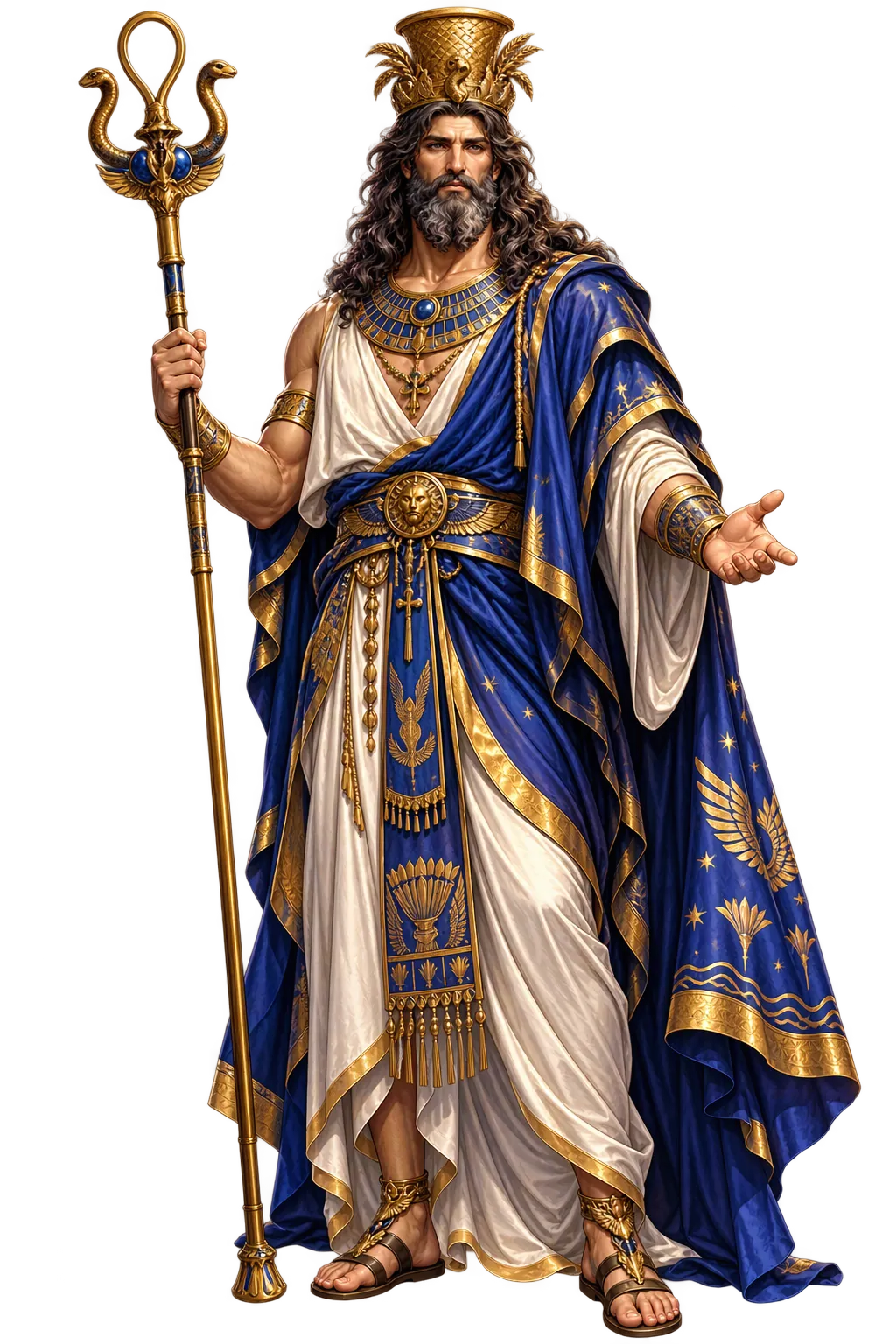
Why Serapis is spelled that way — and what it costs to get it right
There is a version of this name the early internet had to settle for: serapis. This is the file on how Serapis replaced it.
Serapis has no native myths of his own — he was assembled, not born. His ‘mythology’ is the history of a political-theological project: the Ptolemaic state needed one god Greeks and Egyptians could share, and the priests of Memphis supplied the old, deep name — Osiris-Apis — while the court supplied the face, the cult, and the capital.
At a Glance
- Restored name: Serapis
- ASCII form: serapis
- Meaning: "Composite of Osiris and Apis"
- Domain of influence: Syncretic God, Underworld
- Pantheon: Egyptian
- Restoration: ASCII-equivalent form
- Original script: 𓊨𓁹𓀭𓎛𓐑𓊪𓃒
- Series: The Restoration Files, No. 469 of 597
The Name Before the Marks
Spoken, the name runs `/ˈsɛrəpɪs/ (conventional)` — “SAIR-uh-piss”
The Temple That Stands Now
The restored name is not a plaque; it is an address. The temple of Serapis lives at /serapis/, with its mythology in the lore halls, its peer-reviewed record in the Scholarly Edition, and its place in the pattern atlas on the patterns floor.
aSCII-equivalent form
Where the Name Stood First
The Saqqara Serapeum’s bull galleries — rediscovered by Mariette — are among the strangest monuments of Egypt: cathedral-scale tunnels of granite sarcophagi, each once holding a mummified Apis. Alexandria’s Serapeum survives only in the ‘Pompey’s Pillar’ precinct and papyrus, but its daughter-temples across the Mediterranean stand in Delos, Ephesus and Roman Ostia. The temple on the web is the newest of these addresses — the first one that fits in a pocket.
The Archetype at Work
The pattern atlas seats this temple in 3 industries, each match argued and weighted: Global Pantheon Brands (the Ptolemies' deliberately engineered pan-Mediterranean deity — the ancient world's most successful brand launch.); Faith & Spiritual Organizations (the Ptolemaic synthesis-god — state-built religion as organizational engineering.); Food & Hospitality (the modius of grain crowned him — the granary of the Mediterranean as hospitality's warrant.). The Resonance File reads those seats through the myths themselves.
In the Sacred Texts
The Egyptian tradition is not a vibe; it is a library. The Sacred Texts collection holds The Book of the Dead — the primary sources the temple's scholarship is built on. The temple is the argument; the texts are the evidence.
The File Continues
The temple's founding dispatch tells the name's story; its Resonance File reads the myths into the industries; the blog index holds the whole archive.
Continue the series — previous file: Seonangshin (read it here) · next file: Srqt (read it here).
The Restoration Files are written from the same canonical record as the temples themselves: the lexicon, the lore catalog, the pattern atlas, and the cited scholarly sources. If a file ever disagrees with its temple, the temple is right — tell us, and the file will be corrected.