PuniCodex

Extended Lore

𓊨𓁹𓀭𓎛𓐑𓊪𓃒 Serapis

Etymology · Orthography · Cult · Iconography · Reception · Sources

ASCII-equivalent form Serapis
Serapis — Syncretic God, Underworld
01

Quick Facts

Essential information about Serapis, Syncretic God, Underworld

Original Script𓊨𓁹𓀭𓎛𓐑𓊪𓃒
Unicode RestorationSerapis
Reconstructed Pronunciation/ˈsɛrəpɪs/ (conventional)
PantheonEgyptian
DomainSyncretic God, Underworld
MeaningComposite of Osiris and Apis
ClassificationASCII-equivalent form
Primary DomainSerapis
Sacred SymbolsOsiris-Apis, Lord of Alexandria, God of Fertility and Grain, The Mystery God
02

Etymology & Word Family

From original script to Unicode restoration

Original Script 𓊨𓁹𓀭𓎛𓐑𓊪𓃒 Serapis — "Composite of Osiris and Apis"
Unicode Restoration Serapis Canonical scholarly spelling — ASCII-identical
Modern ASCII serapis Plain-ASCII fallback

The name Serapis reaches the modern world through scholarly transliteration of the egyptian tradition. Because the conventional spelling uses only Latin letters, its Unicode and ASCII forms coincide — the tradition it carries is in the name itself, not in diacritics.

03

Unicode Character Breakdown

Character-by-character philological analysis

CharacterUnicodeNameBlockPhonetic Role
SU+0053Latin Capital Letter SBasic LatinSame, capitalized
eU+0065Latin Small Letter EBasic LatinSame
rU+0072Latin Small Letter RBasic LatinSame
aU+0061Latin Small Letter ABasic LatinSame
pU+0070Latin Small Letter PBasic LatinSame
iU+0069Latin Small Letter IBasic LatinSame
sU+0073Latin Small Letter SBasic LatinSame

This restoration reflects fidelity to the attested tradition, not recovered diacritics: every character of Serapis already survives in ASCII. What the restoration preserves is the canonical spelling itself — the form scholarship standardised.

04

Cult & Worship

How the sacred was kept — rites, sanctuaries, remains

The Cult

His cult followed the Greek model — priests, processions, initiation — while keeping Egyptian priestly control at Memphis and Canopus. The annual procession of the god’s image through Alexandria was one of antiquity’s great public spectacles; Hadrian built him a villa-temple at Tivoli as the Empire’s house-god.

In the Earth

The Saqqara Serapeum’s bull galleries — rediscovered by Mariette — are among the strangest monuments of Egypt: cathedral-scale tunnels of granite sarcophagi, each once holding a mummified Apis. Alexandria’s Serapeum survives only in the ‘Pompey’s Pillar’ precinct and papyrus, but its daughter-temples across the Mediterranean stand in Delos, Ephesus and Roman Ostia.

05

Iconography

How Serapis was imaged across the ages

The Image

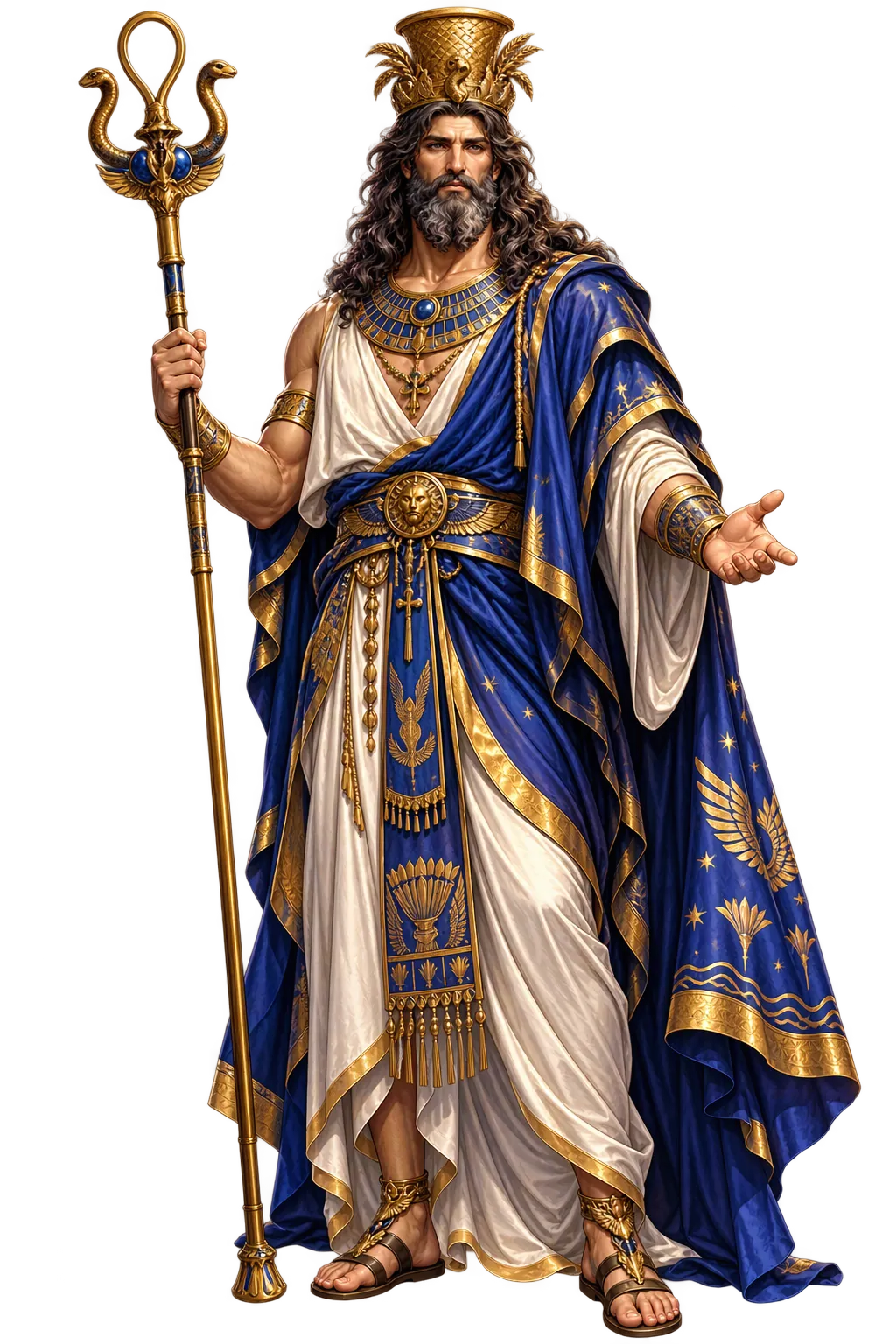
A majestic bearded man in Greek style, enthroned with Cerberus at his feet, a modius (grain-measure) on his head as crown. The type is Zeus for the upper half, Hades for the lower, and the modius marks the granary of the world — three gods in one silhouette.

06

Reception & Transformation

The name after its own age — transmission, translation, survival

Afterlives

For the Church Fathers Serapis was the archetype of pagan Alexandria — his fall in 391 was celebrated as the triumph of the cross. For modern scholarship he remains the paradigmatic ‘political god’, and the debate over whether he was Ptolemaic invention or Memphite survival still frames every study of cultural translation in the Hellenistic world.

Identifications Across Traditions

Serapis IS syncretism — a god whose entire existence is the identification of Osiris, Apis, Zeus, Hades, Dionysus and Asclepius in one image. His standard type deliberately quotes the Olympian Zeus for authority and the underworld Hades for function; the modius of grain and the Cerberus at his feet keep the chthonic half visible.

Modern Legacy

He is the case-study of religious engineering: how a state builds a god. His cult outlasted the dynasty that made him by four centuries, and the destruction of his Alexandria Serapeum in 391 CE is conventionally marked as the end of classical paganism’s public life in the city that had defined it.

07

The Meditation

What Serapis means — beyond the dictionary

A name assembled from two older names — wsjr and ḥp — Serapis is proof that the Egyptian habit of joining gods was still alive when Greek letters took over the job. Restored in Latin letters, he carries his whole biography in his spelling: an Egyptian core, a Greek middle, a Roman afterlife.

08

Frequently Asked Questions

Common questions about Serapis, Syncretic God, Underworld, and Unicode restoration

01How do you pronounce Serapis?

In reconstructed pronunciation, Serapis is /ˈsɛrəpɪs/ (conventional) — approximately “SAIR-uh-piss”.

02What does Serapis mean?

Serapis means Composite of Osiris and Apis in the egyptian tradition.

03What are the symbols of Serapis?

Serapis is associated with Osiris-Apis (The fusion of the dead Osiris with the Apis bull of Memphis — afterlife power in bovine form.), Lord of Alexandria (His great Serapeum towered over the harbour city; its library annexe made him a god of learning.), God of Fertility and Grain (Patron of the Nile’s harvest and the grain fleets; his modius of grain crowns his head.), The Mystery God (His cult carried Egyptian afterlife promises in Greek initiatory form — a blueprint for later mystery religions.).

04Why restore Serapis in Unicode?

Serapis is written entirely in ASCII letters, so its restoration is about canonical fidelity rather than recovered diacritics: the temple fixes the name in its scholarly standard spelling, attested in the source tradition, instead of leaving it to drift.

05What is the most important myth about Serapis?

“The Dream of Ptolemy I” — the Ptolemaic Foundation story that anchors the mythology of Serapis, told in full on the lore page.

09

Scholarly Sources

The philological foundations of this restoration

Every claim on this page is grounded in established scholarship. The orthographic restorations follow disciplinary convention. The etymological chain follows the best available reference works. This is not invention — it is resurrection through scholarship.

◈

Lexicography & Philology

  • Faulkner, R. O. A Concise Dictionary of Middle Egyptian. Oxford: Griffith Institute, 1962.
  • Wb
◎

Primary Texts

  • Plutarch, De Iside et Osiride (foundation legend)
◉

Archaeology & Art History

  • Material evidence — iconography, inscriptions, and temple archaeology — for Serapis and related cults.
✦

Religious Studies

  • Tacitus, Histories 4.83–84 (the Sinope statue)
  • Serapeum stelae and Apis embalmment records (Saqqara)
  • Fraser, Ptolemaic Alexandria (cult history)
  • Borgeaud & Volokhine, “La formation de la légende de Sarapis”
Return

The Surface Awaits

You have traced the name from its earliest attestation to its Unicode restoration. Now return to the myth. The story is where the name lives.

Back to Lore
Serapis mascot