PuniCodex

Extended Lore

𓃭 Sḫmt

Etymology · Orthography · Cult · Iconography · Reception · Sources

Tier 1 Sḫmt.com
Sḫmt — War, Vengeance, Healing
01

Quick Facts

Essential information about Sḫmt, War, Vengeance, Healing

Original Script𓃭
Unicode RestorationSḫmt
Reconstructed Pronunciation/saxˈmaːt/
PantheonEgyptian
DomainWar, Vengeance, Healing
MeaningThe Powerful One (Egyptian sḫmt)
ClassificationTier 1
Primary DomainSḫmt.com
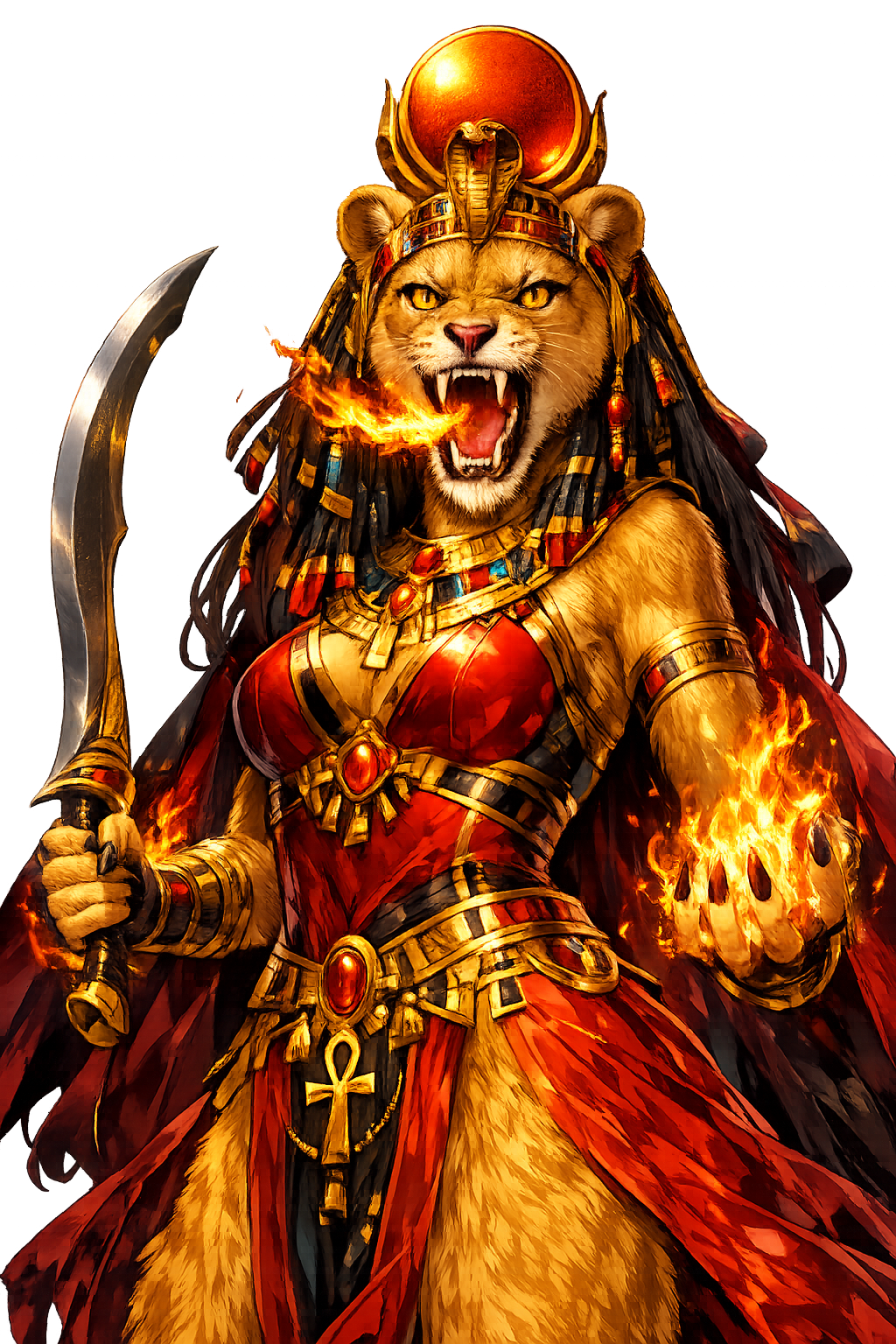
Sacred SymbolsLioness, Sun disk and uraeus, Ankh, Red beer, Arrow
02

Etymology & Word Family

From original script to Unicode restoration

Original Script 𓃭 Sḫmt — "The Powerful One (Egyptian sḫmt)"
Unicode Restoration Sḫmt Restored stress, length, and script
Modern ASCII sekhmet Plain-ASCII fallback

The name Sḫmt carries the orthographic signature of the egyptian tradition: 𓃭. Unicode restoration recovers what ASCII flattens.

03

Unicode Character Breakdown

Character-by-character philological analysis

CharacterUnicodeNameBlockPhonetic Role
SU+0053Latin Capital Letter SBasic LatinSame
ḫU+1E2BLatin Small Letter H with Breve BelowUnknownH-with-breve: voiceless velar fricative
—N/ADropped characterEgyptian orthographyDropped: merged into ḫ
mU+006DLatin Small Letter MBasic LatinSame
—N/ADropped characterEgyptian orthographyDropped: vowel not written
tU+0074Latin Small Letter TBasic LatinSame

The Tier 1 classification reflects how much of the original phonology this restoration preserves — stress and vowel length for Greek names, distinctive letters and diacritics for every other tradition.

04

Cult & Worship

How the sacred was kept — rites, sanctuaries, remains

The Cult

Sekhmet was not worshipped so much as maintained. Her images stood in ranks — above all in the Mut precinct at Thebes — and before them the daily cult laid food, drink, and the rattle of the sistrum that soothed the solar eye, for a goddess of plague is honored by routine, not by risk. Temple calendars of the late temples mark the turn of the year with her appeasement: the dangerous days when the year's heat opens, ritually calmed with litanies of her mercy-names.

Her priesthoods were also practical. At Memphis she stood beside Ptah's creative word as its executive power, and in royal ritual she embodied the king's own ferocity — Amenhotep III set her statues before his sed-festival jubilees so that renewal would be guarded by force. Healing belonged to the same economy: the fever she sent, her devotees reasonably assumed, she alone could reliably revoke.

In the Earth

The most striking material witnesses are the hundreds of granite statues of Sekhmet from the Mut precinct at Karnak, many now in museums worldwide, including the British Museum and the Louvre, with further examples from the Luxor cache. Bronze amulets, votive ears, and healing stelae come from Saqqara, Memphis, and Deir el-Medina. The Book of the Heavenly Cow survives on the walls of the tomb of Tutankhamun (KV62), Seti I (KV17), and Ramesses VI (KV9), preserving the Destruction of Mankind narrative in royal burial contexts. Amenhotep III's statue program is documented by its own inscriptions and by the Amenhotep III colossi at the temple's entrance.

05

Iconography

How Sḫmt was imaged across the ages

The Image

Know her by the mane. Sekhmet is a lioness-headed woman crowned with the sun disk and uraeus, seated or striding, holding the ankh of life and often a papyrus scepter — power that creates as easily as it kills. Her name is written with the seated-lioness determinative: the hieroglyphs insist the goddess is the animal.

She is named already in the Pyramid Texts, and her image is among Egypt's most conservative: by the Old Kingdom the type existed, and three thousand years later it had barely moved — lioness head, solar crown, red linen dressing her statues, for red is the color of the desert wind and of blood. Amenhotep III's granite hundreds fixed the canon in monumental form, many now in the British Museum and the Louvre, and Late Period bronze amulets carried the same face into the hands of the poor. No other Egyptian goddess survives in so many monumental images.

06

Reception & Transformation

The name after its own age — transmission, translation, survival

Afterlives

Sekhmet's afterlife is a museum story first. Her statues poured into Europe through the consular collections of the 1820s — Henry Salt's for the British Museum, Bernardino Drovetti's for the Louvre — and the lioness face, more expressive than the serene ideal, became one of the most reproduced images of Egypt on postcards and in guidebooks.

The textual transmission ran in parallel: the funerary texts, translated by Wallis Budge's generation for an occult-hungry readership, made her the Egyptians' dark goddess in the Victorian imagination, and twentieth-century Egyptology rebuilt the theology beneath the myth — the solar-eye cycle published from the royal tombs, the great Karnak statue corpus catalogued piece by piece. Where antiquity ended she passed through Coptic memory as Sakhmi, a name-ghost without a cult. She is studied today more coolly than she is ever invoked: the goddess of plague survives chiefly as evidence — of how a society ritualizes the diseases it cannot cure.

Identifications Across Traditions

Sekhmet and Hathor are two sides of the same solar eye: the destroyer and the lover, the lioness and the cow. In Thebes she fuses with Mut; in Memphis with Bastet and Wadjet as protective forces. The Greeks sometimes compared her to Athena for her martial aspect, but the comparison is inexact: Athena is strategist, Sekhmet is conflagration. Later magical texts from Roman Egypt invoke her under Greek names and with syncretic attributes, blending her lion-roar with the names of Jewish and Greek angels. In modern goddess spirituality she has become the archetype of the angry, healing feminine.

Modern Legacy

Sekhmet strides through modern culture as the archetype of righteous rage: lioness-warrior in games and fantasy novels, patroness of a fury that protects rather than wounds, invoked in wellness and feminist spirituality as the power women are still told to suppress. Scholars of ancient medicine study her priesthood as an early case of temple healing and of ritual epidemic management — her distributed garrison of statues reads today like an ancient public-health program. Artists return to her granite faces in museum storerooms and find the most human expression in Egyptian art: not serene like the gods, but barely restrained. In a culture still negotiating whether female anger is pathology or immunity, Sekhmet offers the older answer — it is the immune system of the cosmos: dangerous, necessary, and owed daily offerings.

07

The Meditation

What Sḫmt means — beyond the dictionary

Sekhmet teaches that the same fire that burns also sterilizes. She is not a goddess of controlled, domesticated warmth; she is the wild heat that purifies by destroying what cannot survive it. In that sense she is a frightening model of justice: not patient deliberation but swift, blazing consequence.

Yet her story turns on mercy. The beer that dyes the sand red is a divine joke, but it is also a profound insight: rage can be transformed, not by force, but by intoxication, festival, and the refusal to keep feeding it. Sekhmet wakes us from the fantasy that anger must either be denied or obeyed. It can be honored, poured out, and allowed to fall asleep in the lap of Hathor.

08

Frequently Asked Questions

Common questions about Sḫmt, War, Vengeance, Healing, and Unicode restoration

01How do you pronounce Sḫmt?

In reconstructed pronunciation, Sḫmt is /saxˈmaːt/ — approximately 'sakh-MAHT' — 'sakh' as in 'Bach' with an s, then 'maht' with a long 'ah' and a crisp or silent final t.

02What does Sḫmt mean?

Sḫmt means The Powerful One (Egyptian sḫmt) in the egyptian tradition.

03What are the symbols of Sḫmt?

Sḫmt is associated with Lioness (Her primary form and the animal embodiment of solar ferocity), Sun disk and uraeus (Her identity as the eye of Re, the burning emanation of the sun), Ankh (The life she can grant after she has taken it), Red beer (The pacifying drink that turned her rage into festival), Arrow (The plague and punishment she sends as Re's messenger).

04Why restore Sḫmt in Unicode?

Plain ASCII sekhmet strips the stress, length, and script that make the name specific. Unicode restoration returns the name to its original written dignity.

05What is the most important myth about Sḫmt?

“The Day the Eye Did Not Stop” — the Destruction story that anchors the mythology of Sḫmt, told in full on the lore page.

09

Scholarly Sources

The philological foundations of this restoration

Every claim on this page is grounded in established scholarship. The orthographic restorations follow disciplinary convention. The etymological chain follows the best available reference works. This is not invention — it is resurrection through scholarship.

◈

Lexicography & Philology

  • Faulkner, R. O. A Concise Dictionary of Middle Egyptian. Oxford: Griffith Institute, 1962.
  • Wb
◎

Primary Texts

◉

Archaeology & Art History

  • Material evidence — iconography, inscriptions, and temple archaeology — for Sḫmt and related cults.
✦

Religious Studies

  • Allen, Middle Egyptian (2014)
  • Book of the Heavenly Cow (KV62, KV17, KV9)
  • Lichtheim, Ancient Egyptian Literature, vol. 2
  • Borghouts, Ancient Egyptian Magical Texts
  • Kozloff and Bryan, Egypt's Dazzling Sun: Amenhotep III and His World (1992)
  • Robins, Women in Ancient Egypt
Return

The Surface Awaits

You have traced the name from its earliest attestation to its Unicode restoration. Now return to the myth. The story is where the name lives.

Back to Lore
Sḫmt mascot