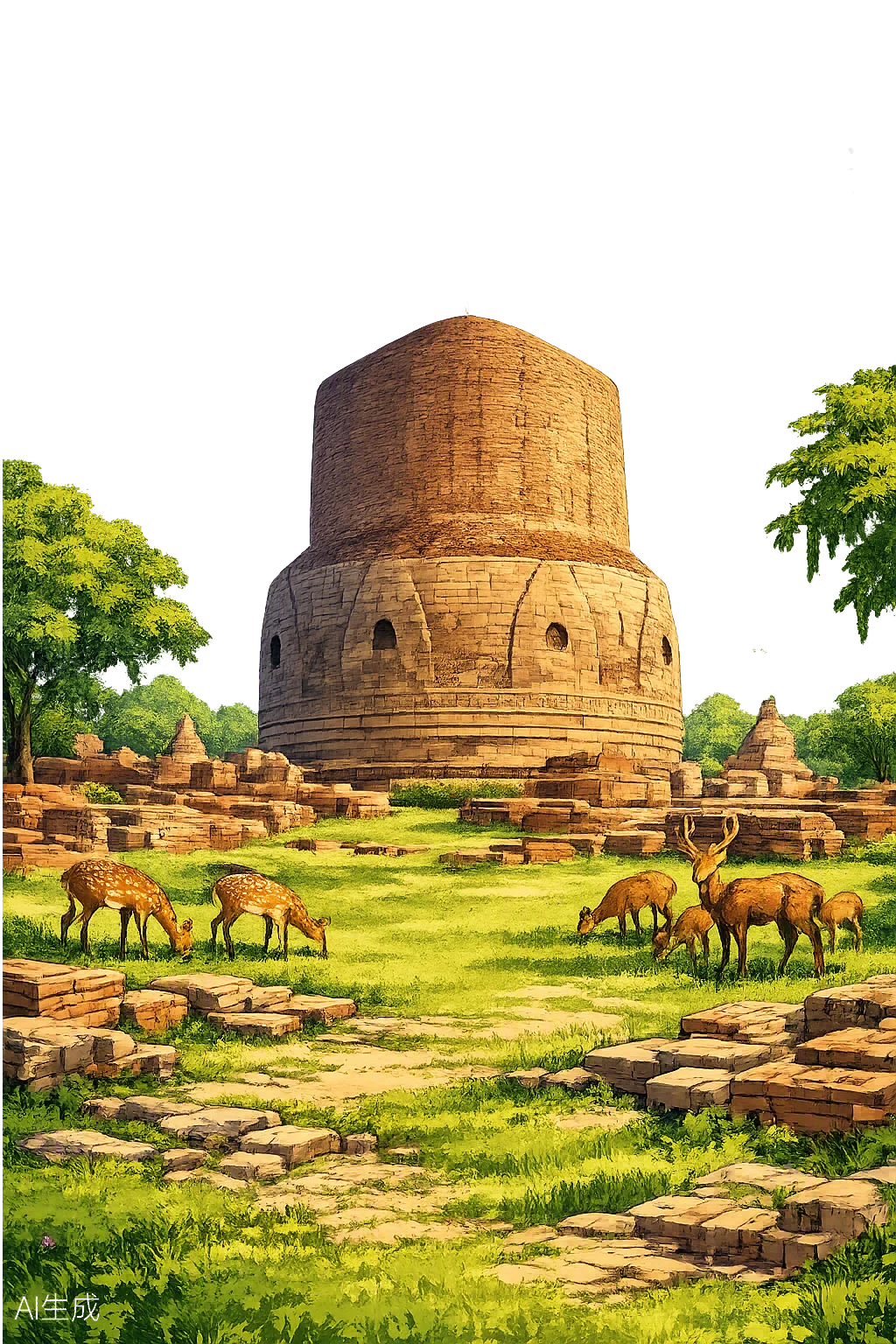
Stories of Sarnath
Sarnath is not a mythic battlefield but a sacred geography of events: here, tradition holds, the Buddha gave his first sermon, turned the Wheel of Dhamma, and founded the Sangha. Its lore weaves scripture, Jātaka story, and the long historical afterlife of Indian Buddhism into a single landscape.
After the awakening beneath the Bodhi tree at Bodh Gayā, the tradition recorded in the Mahāvagga of the Vinaya says the Buddha hesitated to teach: the Dhamma he had seen was subtle, peaceable, beyond the net of opinion, and beings were pleasure-bent. The god Brahmā Sahampati descended from his heaven to beg him to open the doors of the Deathless, and the Buddha surveyed the world with the awakened eye and saw beings 'with little dust in their eyes' — enough to warrant the effort. He walked from Gayā to the deer park of Ṛṣipatana outside Benares, where the five ascetics who had attended him — Koṇḍañña, Vappa, Bhaddiya, Mahānāma, and Assaji — had sworn to shun him for abandoning severe austerity, yet rose to receive him. To them he preached the Dhammacakkappavattana Sutta (SN 56.11): the two extremes to avoid, the middle way, the four noble truths, and the three turnings of the wheel in their twelve modes. Koṇḍañña's mind opened with the dustless, stainless eye of Dhamma — 'whatever is subject to arising is subject to cessation' — and the gods of ten thousand world-systems cried that the unsurpassed wheel had been set rolling. In a single sermon in a deer park, a private awakening became a public teaching and a solitary sage became the head of a community: that is Sarnath's primacy.
The commentarial tradition explains the ancient name Ṛṣipatana — Pali Isipatana, 'the place where the sages fell (rained down)' — with a legend: five hundred paccekabuddhas, solitary enlightened beings, foresaw that a fully awakened Buddha would arise and preach upon that very ground. At the appointed hour they rose into the air, flew through the sky, and descended in the deer park; having paid homage to the ground and circled it, they passed into final nirvāṇa together. Hence the ground where they 'fell' was called Ṛṣipatana. Whether read as legend or as etiological tale, the story fixes Sarnath's identity in Buddhist memory: not merely a pleasant grove outside Benares but a pre-appointed stage, reserved across cosmic time for the one sermon that would matter most. Modern philology reads the name more soberly — the 'fall' may mark where sages descended to attain the ground, or simply where a hermitage stood — but the tradition itself tells the grander version, and it is the tradition that drew pilgrims for two thousand years.
The deer park's gentleness had a model in the Jātakas, the vast corpus of the Buddha's former lives. The Nigrodhamiga Jātaka (no. 12) tells of a time when the Bodhisatta was born as the golden king of a deer herd in a royal park at Benares. The king's kitchen daily took one deer; the Bodhisatta persuaded him to draw lots instead, so that herds and families would not be broken indiscriminately. When the lot at last fell on a pregnant doe, the deer king stepped forward in her place — and the king, struck that a beast would give its life for another's unborn, granted safety to all deer, then to every creature of his realm. A deer park is thus, in Buddhist imagination, the one landscape where the law of the stronger is lawfully suspended. The tradition attached this ideal to Sarnath's Mṛgadāva: the park where deer grazed unafraid was the fitting auditorium for a teaching that would extend the Bodhisatta's self-replacement to all beings — and the pair of deer flanking the wheel on Aśoka's own art is that Jātaka's ethic in stone.
Sarnath's second flowering was imperial. Aśoka — the Mauryan emperor who embraced the Dhamma after Kalinga — raised the great brick stupa over the sermon ground, erected a polished sandstone pillar crowned by four lions, and endowed monasteries; tradition adds that he redistributed relics and patronized the order there. Through the Gupta centuries the site grew into a wealthy monastic university-city, its monuments faced with carved stone and its monks copying and commenting on the canon. When the Chinese pilgrim Xuanzang visited around 640 CE, he counted some thirty monasteries with over three thousand monks and described the colossal pillar, the Ashokan foundations, and the great vihāra where the Abhidharma was still taught; the earlier pilgrim Faxian had left a similar report a century before. Then the silence: the monasteries were abandoned in the twelfth and thirteenth centuries as institutional Buddhism faded from northern India, and the site lay buried under its own brick until British archaeologists reopened it in the nineteenth century. The rise, maturity, and silence of Sarnath trace almost exactly the whole career of Indian Buddhism itself.
First Sermon
Sarnath is the deer park outside ancient Benares where, weeks after his awakening at Bodh Gayā, the Buddha delivered the first sermon and set the Wheel of Dhamma turning. Sacred to the Buddhist tradition, it marks the founding moment of the teaching and of the Sangha itself.
Here the Buddha taught the Dhammacakkappavattana Sutta — the middle way and the four noble truths — to the five ascetics, and the Sangha was born.
The grove called Ṛṣipatana, 'fall of the sages', and Mṛgadāva, 'deer park' — a landscape of gentleness, spared the hunt, chosen for the first teaching.
The eight-spoked wheel 'first turned' at Sarnath; Buddhist art across Asia pairs it with two deer, the site's signature image.
Aśoka's polished pillar, crowned by four addorsed lions, stood here; its capital is now the state emblem of India.
From the original script to the living URL
सर्नथ्
The name in its original Buddhist form. Sarnath (सर्नथ्) is attested in the source tradition — “Lord of the deer”. Its original diacritics and script distinctions carry the full phonetic and orthographic weight of the source tradition.
sarnath
The plain sarnath form is identical to the Unicode restoration. Because this name is already written in Latin letters, no diacritics, stress, or script information were lost — only capitalization differs.
Sarnath
The Unicode restoration does not need to recover lost marks for Sarnath. Its value is canonical spelling and consistent cataloguing, not the reconstruction of erased orthography. The domain is readable as-is to both DNS and humanity.
Sarnath.com
This restoration is written entirely in ASCII letters — no Punycode encoding stands between Sarnath and the DNS. The domain reads identically to machines and to human eyes.
Owned, ideal, and ASCII forms of Sarnath
Sarnath
Restores सर्नथ्. The full Unicode restoration. sarnath.com is not in the PuniCodex collection — it is watched for release; if it drops, this temple upgrades to an owned flagship.
How Sarnath was spoken
How Sarnath travels from ancient script to the modern URL
The lore you have read is the living myth. Extended Lore opens the scholarly vault beneath it: the cult and its material remains, a history of the image, the name after antiquity, a meditation on what the name still means, and the full scholarly apparatus — etymology, orthography, sources.
Enter Extended Lore