PuniCodex

Extended Lore

सर्नथ् Sarnath

Etymology · Orthography · Cult · Iconography · Reception · Sources

Tier 2 Sarnath
Sarnath — First Sermon, Deer Park
01

Quick Facts

Essential information about Sarnath, First Sermon, Deer Park

Original Scriptसर्नथ्
Unicode RestorationSarnath
Reconstructed Pronunciation/sarnath/
PantheonBuddhist
DomainFirst Sermon, Deer Park
MeaningLord of the deer
ClassificationTier 2
Primary DomainSarnath
Sacred SymbolsDharmachakra, Pair of deer, Dhamek stupa, Lion capital, Cankamana
02

Etymology & Word Family

From original script to Unicode restoration

Original Script सर्नथ् Sarnath — "Lord of the deer"
Unicode Restoration Sarnath Canonical scholarly spelling — ASCII-identical
Modern ASCII sarnath Plain-ASCII fallback

The name Sarnath reaches the modern world through scholarly transliteration of the buddhist tradition. Because the conventional spelling uses only Latin letters, its Unicode and ASCII forms coincide — the tradition it carries is in the name itself, not in diacritics.

03

Unicode Character Breakdown

Character-by-character philological analysis

CharacterUnicodeNameBlockPhonetic Role
SU+0053Latin Capital Letter SBasic LatinSame, capitalized
aU+0061Latin Small Letter ABasic LatinSame
rU+0072Latin Small Letter RBasic LatinSame
nU+006ELatin Small Letter NBasic LatinSame
aU+0061Latin Small Letter ABasic LatinSame
tU+0074Latin Small Letter TBasic LatinSame
hU+0068Latin Small Letter HBasic LatinSame

The Tier 2 classification here reflects fidelity to the attested tradition, not recovered diacritics: every character of Sarnath already survives in ASCII. What the restoration preserves is the canonical spelling itself — the form scholarship standardised.

04

Cult & Worship

How the sacred was kept — rites, sanctuaries, remains

The Cult

Sarnath has never had a deity to worship — its cult is the cult of an event. The grammar was set early: Aśoka raised a pillar and a relic stūpa, the Dharmarajika, in the third century BCE, making the deer park a monument to the first sermon, and tradition fixed the Mulagandhakuti as the hut where the Buddha passed his first rains — so the circuit of stūpa, shrine, and pillar defined practice: circumambulation, relic veneration, and the recitation of the Dhammacakkappavattana Sutta that continues at the Dhamek stūpa on full-moon days. By the fifth century CE Faxian, and later Xuanzang, found a functioning monastic city with monks in the thousands and shrines studding its foundations; the deer grazed on as living emblems of the founding mercy. Pilgrims still walk the same path. The ‘cult’ is simply remembering, on the spot, that the wheel was first turned here.

In the Earth

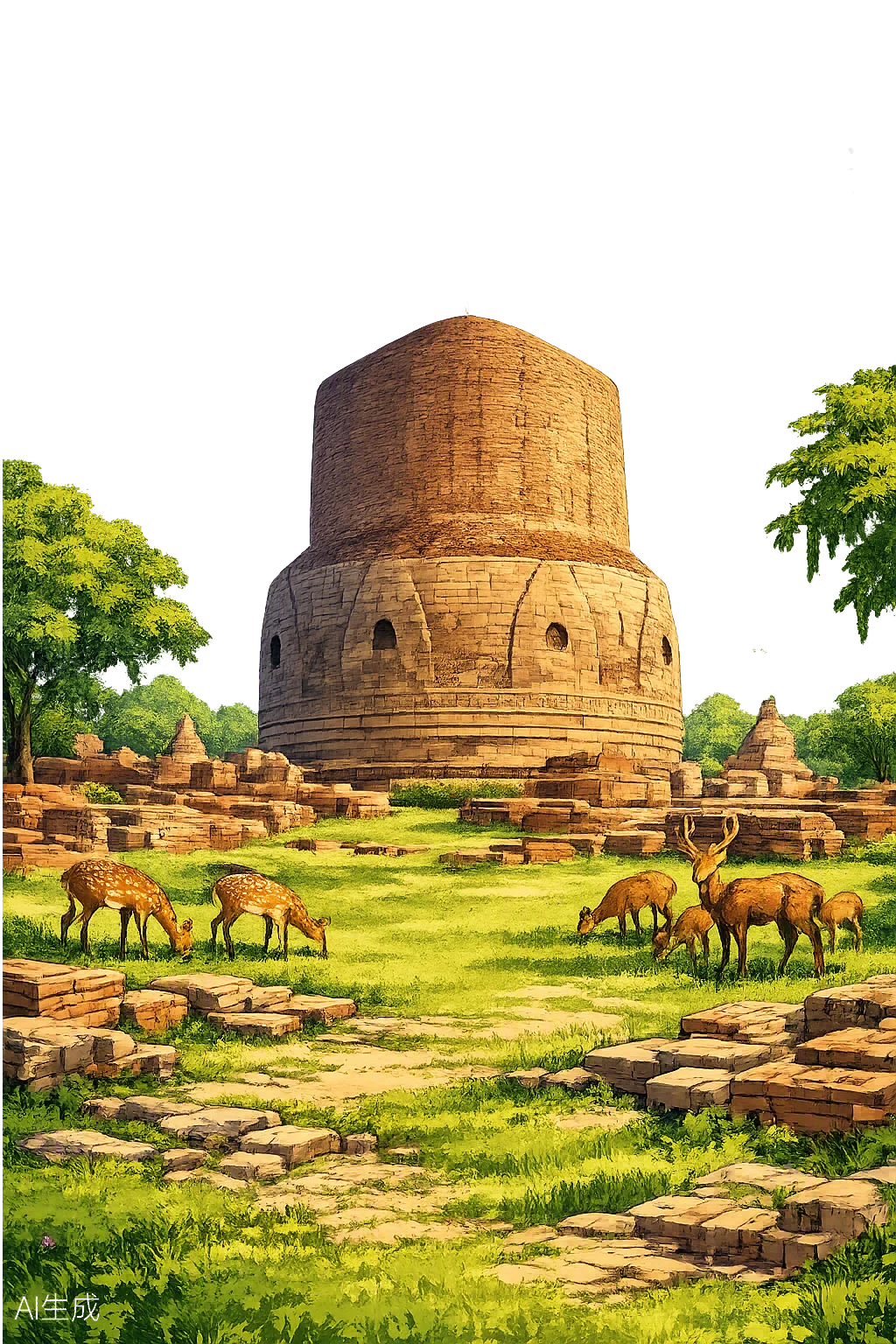
Sarnath preserves one of India's great excavation landscapes. The Dhamek stupa, a massive cylindrical brick monument with a Mauryan core, was enlarged through the Gupta period, when its lower courses were faced with carved stone panels of flowers, swastikas, and honeysuckle. Beside it stand the foundations of the Dharmarajika stupa — Aśoka's original relic monument — and the Mulagandhakuti, the main shrine where the Buddha was believed to have spent his first rainy season. Aśoka's polished sandstone pillar, erected c. 250 BCE, bore his edicts and was crowned by four addorsed lions carrying a dharma wheel; the capital is now displayed in the Sarnath Museum. Systematic excavation began with Alexander Cunningham's surveys of the 1830s–60s and culminated under Sir John Marshall's campaign of 1904–05, which cleared the great monastery and mapped the Ashokan remains.

05

Iconography

How Sarnath was imaged across the ages

The Image

Sarnath’s iconography is the most reproduced in Buddhism: a wheel between two deer. The earliest version is an absence — at Bharhut and Sāñcī (second–first century BCE) the first sermon is shown by an empty throne beneath the wheel, the Buddha never pictured, the deer flanking the seat as the park’s emblem. Aśoka’s lion capital (c. 250 BCE, now in the Sarnath Museum) crowned the scene with four addorsed lions carrying the wheel — the image India later raised to its state seal. Under the Guptas the site produced the type that taught the world to picture the Buddha preaching: the seated Sarnath Buddha, hands in the dhammacakka mudrā, eyes downcast, the wheel-turning made flesh; the museum’s standing and seated Gupta figures are the canonical exemplars. Every ‘Turning the Wheel’ image in Tibet, China, and Japan descends from this grammar.

06

Reception & Transformation

The name after its own age — transmission, translation, survival

Afterlives

Sarnath’s modern reception began as forgetting undone. The site went silent after the twelfth century, its stūpas sinking into mounds, until Alexander Cunningham’s surveys of the 1830s–60s read the buried brick and the Archaeological Survey’s campaign of 1904–05 cleared the great monastery and recovered the lion capital — archaeology literally re-founding the tradition it uncovered. The sermon itself travelled by manuscript: the Pali canon survived in Sri Lanka, reached print through Turnour’s Ceylon editions of the 1830s, and entered English through the Pali Text Society’s translations, Warren’s Buddhism in Translations (1896) carrying the deer-park scene to generations of Western readers; Edwin Arnold’s Light of Asia (1879) had already made the first sermon a Victorian set piece. The wheel-and-deer image followed the scholarship, from Cunningham’s plates to the front matter of every Buddhist studies primer. The site’s modern afterlife runs through three institutions: the museum, the printed canon, and the republic that took its seal from the pillar.

Identifications Across Traditions

Sarnath is a site of pan-Buddhist, not merely Indian, devotion. The wheel flanked by two deer — carved on early Indian reliefs such as those at Bharhut and Sāñcī — became the international emblem of Buddhism, carried with the tradition to Sri Lanka, Central and Southeast Asia, China, Korea, and Japan, so that Sarnath's founding image adorns temples from Anuradhapura to Nara. The modern revival owes much to Anagārika Dharmapāla, whose Mahā Bodhi Society raised the Mulagandhakuti shrine in 1931 beside the excavated foundations. Diplomatic Buddhism now meets at Sarnath: Japanese, Thai, and Sri Lankan temples share the grounds with the Indian stupas, making the deer park a quiet concord of the tradition's nations — a concord entirely in the spirit of the first sermon, which was addressed to five skeptics and opened its doors to everyone.

Modern Legacy

For the Buddhist world Sarnath is a first-rank pilgrimage site, paired with Bodh Gayā, Kusinārā, and Lumbinī in the circuit of the four principal sacred places. Aśvaghoṣa already celebrated the first sermon in the Buddhacarita, and the Chinese pilgrims Faxian and Xuanzang recorded the monuments when the monasteries still functioned. After twelve centuries of silence, excavation returned the site to memory: the lion capital of Aśoka's pillar now serves as the Republic of India's state emblem, an extraordinary afterlife for a Buddhist monument in a modern secular state. The site's sculpture is divided between the Sarnath Museum and Kolkata; the Dhammacakkappavattana Sutta is still recited at the Dhamek stupa on full-moon days, two and a half millennia after the wheel was first turned. Few places on Earth can claim so long a continuous memory of a single afternoon.

07

The Meditation

What Sarnath means — beyond the dictionary

Sarnath teaches a distinction easy to miss: between the event and the announcement. The enlightenment at Bodh Gayā was the event — solitary, silent, complete. Sarnath was the announcement, and the tradition insists the second was nearly withheld. The Buddha's hesitation in the Vinaya account is one of the most human moments in scripture: a teacher who doubts that anyone will understand him, persuaded finally by a god's plea and by the few beings 'with little dust in their eyes.' The first sermon is therefore not merely the Buddhist Genesis; it is the founding act of communication — the decision that an insight kept private would die, while an insight spoken aloud, even clumsily, even to five skeptics, could turn the wheel of a world. The deer-park setting is the doctrine in landscape form: gentleness, creatures unafraid of the hunter, as the precondition of truth-telling. Every later sermon, commentary, and sangha stands in the footprint of that afternoon.

08

Frequently Asked Questions

Common questions about Sarnath, First Sermon, Deer Park, and Unicode restoration

01How do you pronounce Sarnath?

In reconstructed pronunciation, Sarnath is /sarnath/ — approximately SAR-nath — two even beats, the weight on the first, the final "th" pronounced with breath as in "path.".

02What does Sarnath mean?

Sarnath means Lord of the deer in the buddhist tradition.

03What are the symbols of Sarnath?

Sarnath is associated with Dharmachakra (The eight-spoked wheel of Dhamma 'first turned' at Sarnath; the earliest art shows it flanked by two deer.), Pair of deer (The gazelle pair flanking the wheel on Aśokan and later reliefs — the Deer Park's residents, traditionally spared the hunt by the Buddha's example.), Dhamek stupa (The great cylindrical brick-and-stone stupa raised over the sermon ground, its lower courses faced with Gupta floral carving.), Lion capital (Four addorsed Asiatic lions on Aśoka's pillar (c. 250 BCE) carrying a dharma wheel — adopted as the emblem of the Republic of India.), Cankamana (The raised promenade where the Buddha walked in meditation after the first sermon, marked by votive stupas.).

04Why restore Sarnath in Unicode?

Sarnath is written entirely in ASCII letters, so its restoration is about canonical fidelity rather than recovered diacritics: the temple fixes the name in its scholarly standard spelling, attested in the source tradition, instead of leaving it to drift.

05What is the most important myth about Sarnath?

“Setting the Wheel in Motion” — the The First Sermon story that anchors the mythology of Sarnath, told in full on the lore page.

09

Scholarly Sources

The philological foundations of this restoration

Every claim on this page is grounded in established scholarship. The orthographic restorations follow disciplinary convention. The etymological chain follows the best available reference works. This is not invention — it is resurrection through scholarship.

◈

Lexicography & Philology

  • Buddhist texts
  • MW
◎

Primary Texts

  • The Larger Sukhāvatī-vyūha Sūtra; the Smaller Sukhāvatī-vyūha Sūtra; the Amitāyurdhyāna Sūtra; the Lotus Sūtra.
◉

Archaeology & Art History

  • Material evidence — iconography, inscriptions, and temple archaeology — for Sarnath and related cults.
✦

Religious Studies

  • Dhammacakkappavattana Sutta, SN 56.11
  • Mahāvagga I, Vinaya Piṭaka
  • Nigrodhamiga Jātaka (Jātaka no. 12)
  • Aśvaghoṣa, Buddhacarita 17–18
  • Xuanzang, Great Tang Records on the Western Regions
  • Marshall, John, A Guide to Sarnath (1918); Cunningham, Archaeological Survey of India reports (1861–65)
Return

The Surface Awaits

You have traced the name from its earliest attestation to its Unicode restoration. Now return to the myth. The story is where the name lives.

Back to Lore
Sarnath mascot