The Living Myth
Knowledge, Music, Arts, Speech · The River of Eloquence
Stories of Sarasvatī
Sarasvatī's double biography — river first, word second — is the oldest story of how a landscape becomes a mind. The Ṛgveda knows her as a mighty stream of the heartland and, in the same breath, as Vāk, Speech itself. Between those two identities lies three thousand years of Indian civilization, which kept the name and forgot the water.
The Ṛgveda hymns her as a river of superlatives: 'purest in her course from the mountains to the sea,' whose might surpasses all other waters (RV 7.95; Nadīstuti, RV 10.75). The Nadīstuti hymn to the rivers sets her between the Yamunā and the Śutudrī — the heartland stream of the Vedic people — and names her 'best of mothers, best of rivers, best of goddesses' in a single breath, collapsing geography, fertility, and devotion into one current. She flows 'from the mountain to the sea' purifying as she goes, invoked for wealth, descendants, and wisdom alike. Every later doctrine of the sacred word in India flows from this identification: if the greatest river is a goddess, and the goddess is speech, then speech itself is the mightiest stream — the source on which civilization draws. The myth means that language was India's first river: before the Ganges was holy, the word was.
Ṛgveda 10.125 is unique in the Veda: a hymn spoken by the goddess herself. 'I move with the Rudras, with the Vasus, with the Ādityas; I uphold Mitra and Varuṇa, Indra and Agni, and the two Aśvins... I am the queen, the gatherer of riches, the knowing one; the gods set me in many places, and many homes hold me. I breathe through all that breathes.' Vāk narrates her own supremacy: the gods perform their functions through her; the seer hymns her 'beyond those who see far'; the very Ṛgveda being chanted is, by her account, her body. It is the earliest self-referential text in Sanskrit — the scripture aware of itself. The myth means that in the Vedic imagination speech is not a tool of the gods but their substance: to praise is to participate in the goddess, and every hymn is Vāk praising herself through a human throat.
The Vedic Sarasvatī was no gentle muse. Ṛgveda 6.61 remembers her as a warrior stream of the Bharata clans: she 'destroyed the Pārāvatas' for her devotees and aided them in battle, while her turbulent floods smashed bridge and bank and bore off the poet's enemies (RV 6.61). The same hymn joins her name to Indra and to the twin Aśvins as a power to be summoned at the tribe's crisis. This is the goddess before her gentrification: a river of the frontier, flood-strong, partisan, dangerous to cross and dangerous to invoke carelessly. The Vedic people trusted her the way river peoples always trust their river — with their lives, not merely their verses. The myth means that the word was armed before it was chaste: speech protected the tribe before it purified the mind, and the same current that carries a poem can carry a people to war.
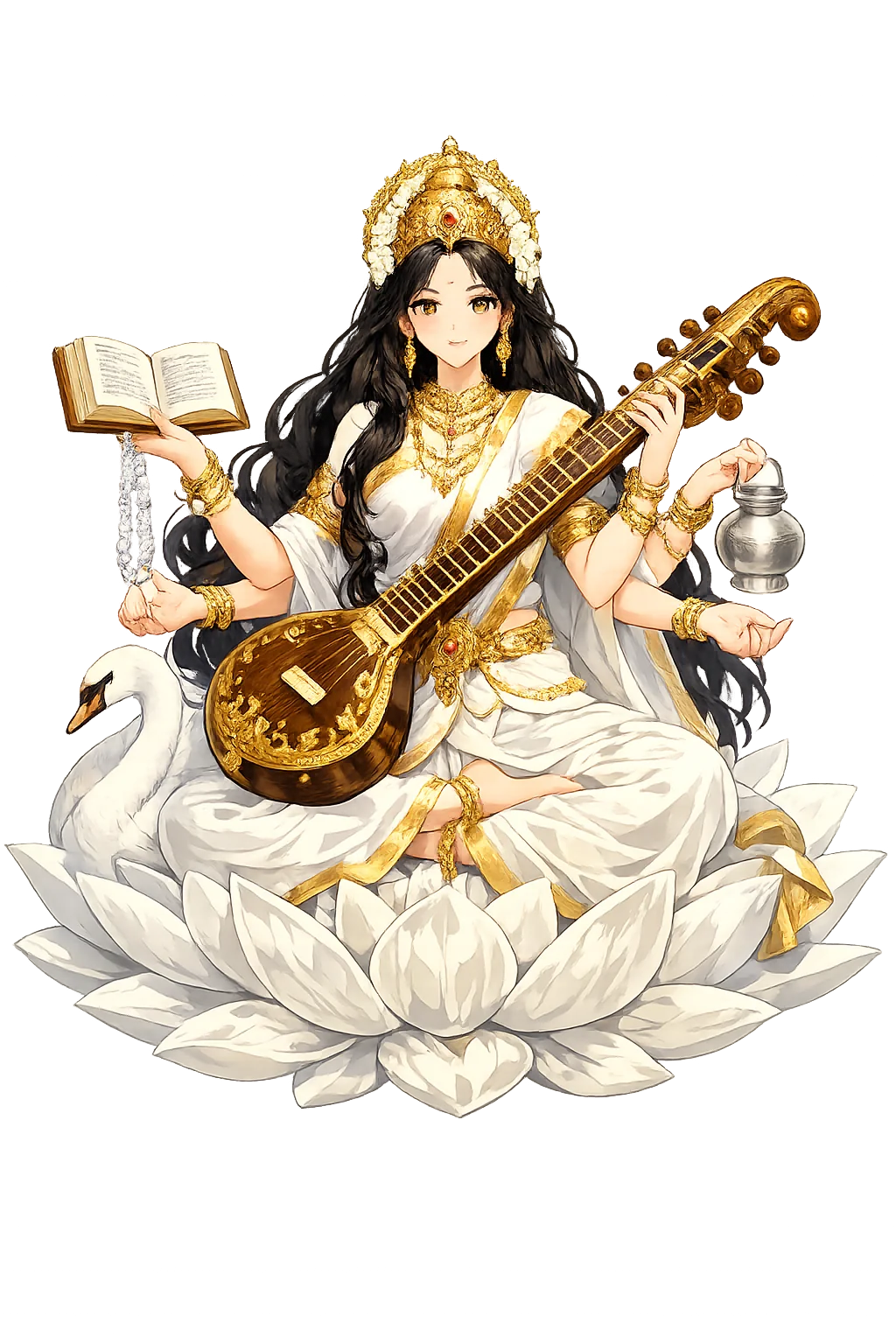
Later tradition makes her Brahmā's consort and śakti — the power by which the creator speaks the world into being. When Brahmā's four faces recited the four Vedas, Sarasvatī was their voice; when he formed beings, she was the formative energy itself. The iconography settles into its final, unchanging form: white-robed as milk and swan-down, the vīṇā across her lap, a palm-leaf book and prayer-beads in two of her four hands, riding the discerning haṃsa. Mythically the marriage is awkward — the same Purāṇic cycle that makes her Brahmā's power also punishes Brahmā's desire for a daughter of his own making — and the marriage is mostly iconographic rather than narrative. The myth means that creation without speech is dumb: the maker of the universe needs the goddess of the word as his voice, his instrument, and his restraint.
The Mahābhārata already knows a diminished Sarasvatī: she 'loses herself' in the desert, appearing and vanishing at named fords — Vinaśana, 'the place of disappearance,' among them — and the epic's tīrtha lists (Vana parvan) follow her ghost eastward. Later hydrography reads the myth as memory: the great river of the hymns dried as the Yamunā shifted east and the Sutlej west, its channels captured by the Ganges and Indus systems, leaving the Ghaggar-Hakra paleochannels for the Thar to swallow. The word outlived the water. Modern archaeology — Landsat imagery of buried channels, drills by the Geological Survey of India, Harappan sites dense along the dry bed — has turned the goddess's vanishing into a research program, and a political one: the 'Sarasvatī River' question is India's most contested meeting of hymn and hydrology. The myth means that a name can be more durable than its referent — the river died, and the civilization she watered simply began to drink from the word.
Speech, Learning, Music, and the Flowing Word
Sarasvatī is the only goddess the Ṛgveda hymns as both river and word: the mightiest stream of the Vedic heartland, and Vāk, Speech itself — the current on which all knowledge, music, and scripture flows. Her hymns are the oldest poetry in any Indo-European language addressed to a goddess. Where she moves, rivers run and verses sing.
The Vedic Sarasvatī — greater than the Indus, the hymns say — whose drying shaped a civilization's memory and fuels a modern river debate.
Her instrument: the stringed lute whose seven notes order all music, as her speech orders all thought.
The swan that separates milk from water — the emblem of discernment, learning's first virtue.
Speech personified: the Ṛgveda's own word for the goddess of the word, hymned in RV 10.125.
From the original script to the living URL
सरस्वती
The name in its original Sanskrit form. Sarasvatī (सरस्वती) is attested in the source tradition — “The goddess of eloquence and learning — river of sacred speech (saras 'flowing water' + vatī 'possessing')”. Its macron-length vowels carry the full phonetic and orthographic weight of the source tradition.
saraswati
Reduced to plain saraswati, the name loses everything that made it specific: macron-length vowels. What remains is an ASCII string that machines can parse but that no longer speaks with its original voice.
Sarasvatī
The Unicode restoration recovers what ASCII flattened. Sarasvatī restores macron-length vowels, returning the name to its original written dignity. The domain encodes to Punycode, but the browser displays the truth.
Sarasvatī.com → xn--sarasvat-hjb.com
The non-ASCII characters in Sarasvatī are encoded while the ASCII remains visible. To the DNS, it is Punycode. To humanity, it is Sarasvatī.
Owned, ideal, and ASCII forms of Sarasvatī
Sarasvatī
Restores सरस्वती. The live temple domain — sarasvatī.com.
saraswati
Flattens सरस्वती. The plain ASCII fallback — what DNS and legacy systems see.
How Sarasvatī was spoken
How Sarasvatī travels from ancient script to the modern URL
The lore you have read is the living myth. Extended Lore opens the scholarly vault beneath it: the cult and its material remains, a history of the image, the name after antiquity, a meditation on what the name still means, and the full scholarly apparatus — etymology, orthography, sources.
Enter Extended Lore