PuniCodex

Extended Lore

सरस्वती Sarasvatī

Etymology · Orthography · Cult · Iconography · Reception · Sources

Tier 1 Sarasvatī.com
Sarasvatī — Knowledge, Music, Arts, Speech
01

Quick Facts

Essential information about Sarasvatī, Knowledge, Music, Arts, Speech

Original Scriptसरस्वती
Unicode RestorationSarasvatī
Reconstructed Pronunciation/sarasvatˈiː/
PantheonSanskrit
DomainKnowledge, Music, Arts, Speech
MeaningThe goddess of eloquence and learning — river of sacred speech (saras 'flowing water' + vatī 'possessing')
ClassificationTier 1
Primary DomainSarasvatī.com
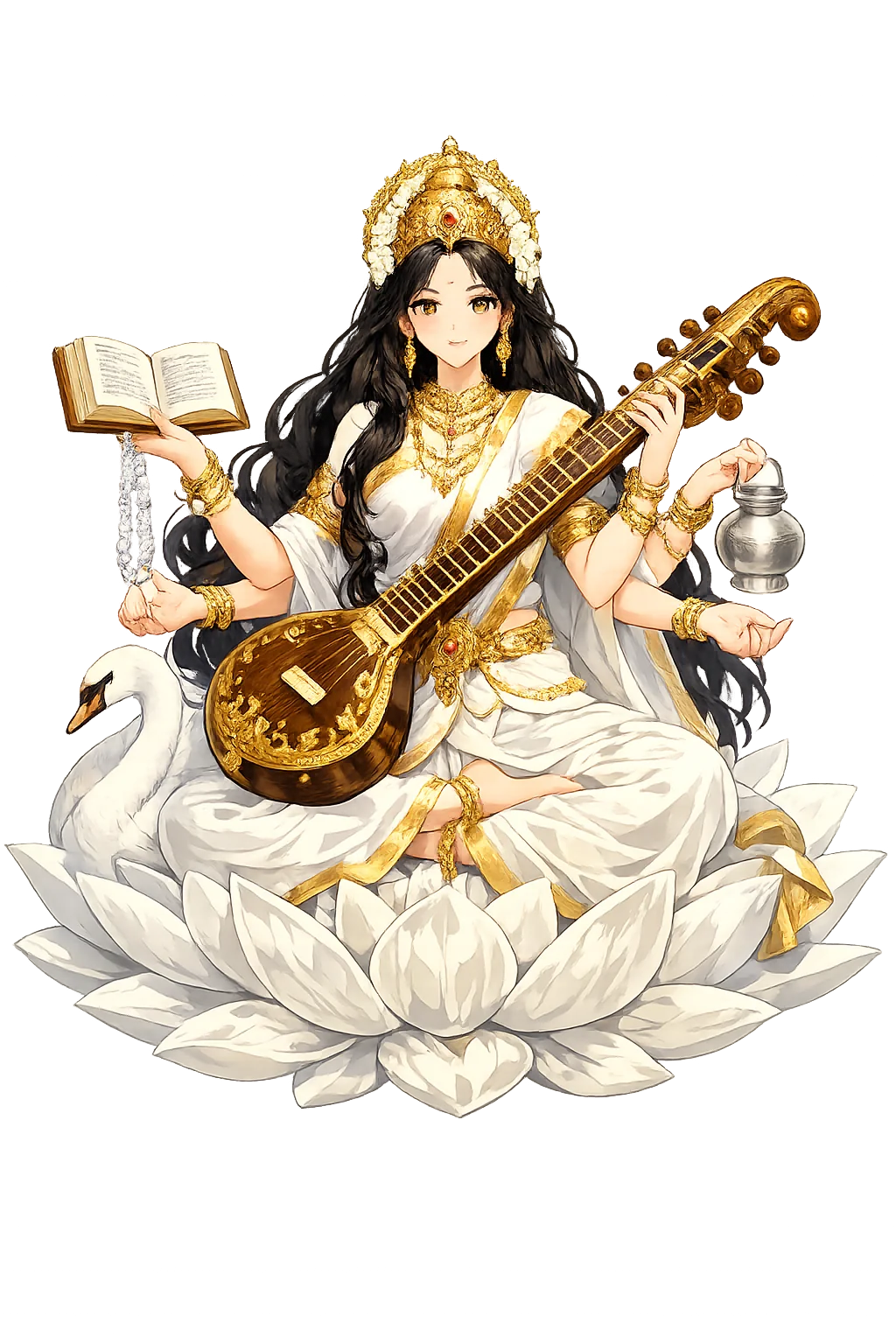
Sacred SymbolsThe white lotus, The vīṇā, The haṃsa (swan), The palm-leaf book, The dried riverbed
02

Etymology & Word Family

From original script to Unicode restoration

Original Script सरस्वती Sarasvatī — "The goddess of eloquence and learning — river of sacred speech (saras 'flowing water' + vatī 'possessing')"
Unicode Restoration Sarasvatī Restored stress, length, and script
Modern ASCII saraswati Plain-ASCII fallback

The name Sarasvatī carries the orthographic signature of the sanskrit tradition: सरस्वती. Unicode restoration recovers what ASCII flattens.

03

Unicode Character Breakdown

Character-by-character philological analysis

CharacterUnicodeNameBlockPhonetic Role
SU+0053Latin Capital Letter SBasic LatinSame
aU+0061Latin Small Letter ABasic LatinShort /a/
rU+0072Latin Small Letter RBasic LatinSame
aU+0061Latin Small Letter ABasic LatinShort /a/
sU+0073Latin Small Letter SBasic LatinSame
vU+0076Latin Small Letter VBasic LatinV: labiodental fricative
aU+0061Latin Small Letter ABasic LatinShort /a/
tU+0074Latin Small Letter TBasic LatinSame
īU+012BLatin Small Letter I with MacronLatin Extended-AMacron: long /iː/

The Tier 1 classification reflects how much of the original phonology this restoration preserves — stress and vowel length for Greek names, distinctive letters and diacritics for every other tradition.

04

Cult & Worship

How the sacred was kept — rites, sanctuaries, remains

The Cult

Sarasvatī's oldest temple was the voice. In Vedic ritual she was worshipped at the morning pressing of soma, where the deities of the prātaḥsavana were the Aśvins, Sarasvatī, and Indra, and the hymns of Ṛgveda 6.61 and 7.95 were themselves cult recitations, sung where her river was met at its ford. With Ilā and Bhāratī she formed the triad of goddesses who received the triple offering into the three sacred fires — geography, poetry, and altar fused in a single oblation.

When the river vanished the worship did not: it migrated to the threshold of learning. Her rites are rites of speech — the purification of syllables, the first tracing of the alphabet by a child's hand, the consecration of books and instruments before her image. Temple worship at Basara, Sringeri, and the ruined Śāradā seat of Kashmir is real but secondary; the schoolroom is her lasting sanctuary, and the recitation of her hymns, three millennia unbroken, is her true daily cult.

In the Earth

The Ghaggar-Hakra dry channels between the Yamunā and the Indus — traced by satellite imagery of buried paleochannels and drilled by the Geological Survey of India — are the standard candidates for the Vedic river; Harappan sites (Kalibangan, Banawali, Ganweriwala) line its banks in densities the Indus itself cannot match, so the goddess's lost river is now the most studied dry bed in Asia. Her temples are comparatively few for so great a goddess — the Sharada Peeth in Kashmir (now across the LoC), Sringeri's Sharadamba, Basara's Gnana Saraswati in Telangana, and Pushkar's shrine — because her true temple has always been the school and the library. In the east her migration is architectural: the Benzaiten shrines of Enoshima and Chikubushima, and Bali's Padmasana shrines, mark the goddess's path from river to word to island.

05

Iconography

How Sarasvatī was imaged across the ages

The Image

No Vedic image of Sarasvatī exists — the hymns worship a river and a voice — and her first certain images belong to the early centuries CE, when sculptors gave the learned goddess a body: standing or seated, serene, already carrying the instrument. The canon settled slowly and then froze — white garments, four arms, the vīṇā across her lap, a palm-leaf manuscript and a rosary in the free hands, the white swan for a mount, every element a doctrine of discernment made visible.

Medieval temples of the Deccan gave her monumental stone form, and in the Rajput and Pahari schools she became one of the most-painted of goddesses, enthroned with her lute in jewel-like miniatures. But the image that conquered India is a print: Raja Ravi Varma's oleographs of the 1890s — the lotus-seated goddess, veena in hand, swan at her side — fixed the modern icon as firmly as any canonical text.

06

Reception & Transformation

The name after its own age — transmission, translation, survival

Afterlives

The tradition carried Sarasvatī on two currents at once: the unbroken recitation of her hymns — Vedic students chanting the river-speech verbatim for three thousand years — and the commentarial ascent that made her the goddess of grammar itself, every Sanskrit commentary opening with a bow toward the word she embodies.

Europe met her through the philological revolution. The Asiatic Society's translations opened the Veda to the West; Wilson's and Max Müller's nineteenth-century Rig-Veda versions carried the battle-river into every university library, and Whitney's grammar taught her name in the lecture hall. In 1893 the geologist R. D. Oldham identified the lost Sarasvatī with the Ghaggar's dry bed, turning a hymn into a research question that survey and satellite still pursue. In art her afterlife ran from Pahari miniatures to Ravi Varma's printing press — the first mass-media goddess of India. The word, as ever, outran the water.

Identifications Across Traditions

Her eastward journey is one of Asia's great religious migrations: as Benzaiten in Japan she became one of the Seven Gods of Fortune, goddess of music, water, and wealth, with island shrines at Enoshima and Chikubushima; in Tibet she is Yangchenma, 'goddess of melody'; in Bali she is the island's tutelary of learning, with her own festival, Saraswati Day, when no one may touch a book. Burmese and Thai traditions keep her as Thurathadi and Suratsawadi, and the Buddhist Prajñāpāramitā literature absorbed her into the perfection-of-wisdom lineage — the river of speech becoming the ocean of insight. In every case the migration kept the grammar: a flowing medium (river, speech, music) that purifies whatever it carries.

Modern Legacy

She is the most actively worshipped scholar-deity on earth: Basant Panchami each spring sees hundreds of millions in yellow dress honor her with books, instruments, and the first letters children ever write (vidyā-ārambha, the 'beginning of learning' ceremony, places a stylus in a toddler's hand before her image). Her name brands India's largest educational networks, universities, and the national digital library's heritage portal. The lost river named for her drives modern archaeology and politics alike: the Ghaggar-Hakra paleochannel debate over the 'Sarasvatī River' is India's most contested meeting of hymn and hydrology, with court cases, ministries, and satellite surveys all enlisted. No other goddess is so regularly invoked by people who have never seen a temple of hers: her temple is the school, and her festival is the first day of term.

07

The Meditation

What Sarasvatī means — beyond the dictionary

Sarasvatī is the proof that attention is a kind of water: it flows, it gathers, it carves channels in the mind that outlast the floods that made them. The river dried and the goddess did not — the word learned to flow without banks. She asks the student's oldest question: not what do you know, but what current carries it — and where, in the dry season of distraction, will you dig for the buried stream?

In an age when speech flows more abundantly and means less than ever, Sarasvatī is the discipline of the current: eloquence as responsibility, learning as purification. The swan on her banner does the work most education now skips — it separates. To study with her is to accept that most of what pours through us is water, and that the milk must be taken out.

08

Frequently Asked Questions

Common questions about Sarasvatī, Knowledge, Music, Arts, Speech, and Unicode restoration

01How do you pronounce Sarasvatī?

In reconstructed pronunciation, Sarasvatī is /sarasvatˈiː/ — approximately sah-RAH-swah-tee — the final ī long, the v soft as in verse.

02What does Sarasvatī mean?

Sarasvatī means The goddess of eloquence and learning — river of sacred speech (saras 'flowing water' + vatī 'possessing') in the sanskrit tradition.

03What are the symbols of Sarasvatī?

Sarasvatī is associated with The white lotus (Purity of mind; knowledge unsullied by the muddy water it rises from), The vīṇā (Music as cosmic order — Nāda Brahman, the sound that is the absolute), The haṃsa (swan) (Viveka, discernment — the power to take the true and leave the rest), The palm-leaf book (The written word she guards as goddess of libraries and letters), The dried riverbed (Not an image but an evocation: the Ghaggar-Hakra channels, her material ghost — the scholarship of geology serving the memory of a hymn).

04Why restore Sarasvatī in Unicode?

Plain ASCII saraswati strips the stress, length, and script that make the name specific. Unicode restoration returns the name to its original written dignity.

05What is the most important myth about Sarasvatī?

“Mightiest of Streams” — the The River story that anchors the mythology of Sarasvatī, told in full on the lore page.

09

Scholarly Sources

The philological foundations of this restoration

Every claim on this page is grounded in established scholarship. The orthographic restorations follow disciplinary convention. The etymological chain follows the best available reference works. This is not invention — it is resurrection through scholarship.

◈

Lexicography & Philology

  • MW
  • KEWA
◎

Primary Texts

  • Ṛgveda Saṃhitā 6.61 (the battle river); 7.95 (the mightiest stream)
  • Ṛgveda Saṃhitā 10.75 (Nadīstuti, hymn to the rivers); 10.125 (Vāk)
  • Vendidad 1 (Avestan Haraxvaitī, the Iranian cognate of her name)
◉

Archaeology & Art History

  • Material evidence — iconography, inscriptions, and temple archaeology — for Sarasvatī and related cults.
✦

Religious Studies

  • Mahābhārata, Vana parvan (Vinaśana and the tīrtha of the vanishing river)
  • Monier-Williams, Sanskrit-English Dictionary; Mayrhofer, EWAia s.v. sarasvatī
  • Gonda, Vedic Literature (the river hymns)
Return

The Surface Awaits

You have traced the name from its earliest attestation to its Unicode restoration. Now return to the myth. The story is where the name lives.

Back to Lore
Sarasvatī mascot