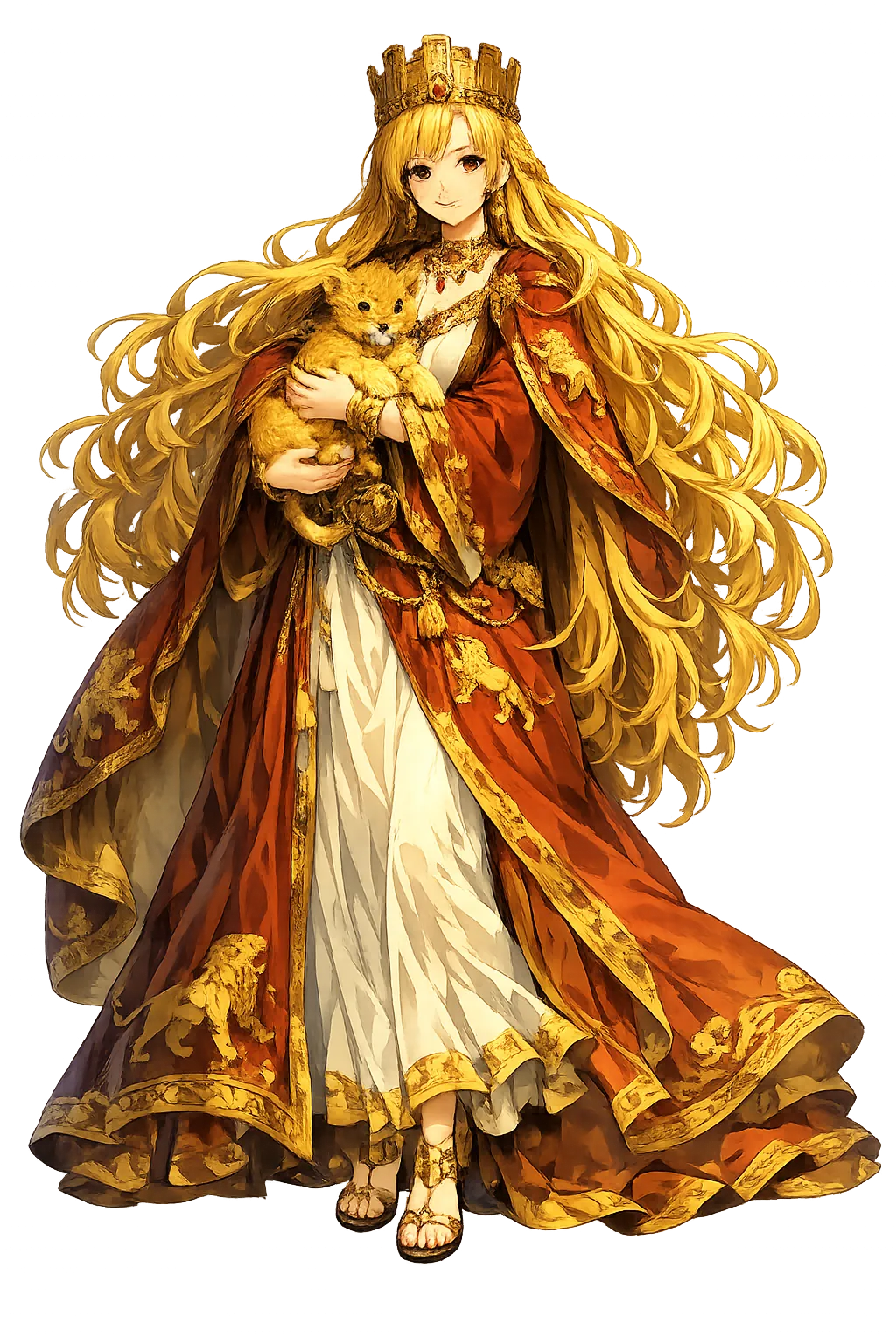
Stories of Rhéā
Rhéā's myth is the hinge between Titanic and Olympian rule. She endures Kronos's violence, then engineers the survival of the son who will overthrow him — the story of how the Olympians were born twice: once in her womb, and once out of a trick.
Rhéā's marriage was a maternity under siege. Wedded to her brother Kronos, she bore him Hestía, Deméter, Hēra, Hádēs, and Poseidôn — and each infant, ‘as soon as each was born from the holy womb’, Kronos gulped down whole, for he had learned from Gaia and starry Ouranós that it was fated for him to be overthrown by his own son, though he was mighty, and he kept ever watchful, waiting for it (Theogony 453–467). Rhéā's grief is one of the quietest devastations in Greek poetry — Hesiod records no cry, no protest, only the fact that she bore children into a father who was also a mouth. The myth means that her story begins in the oldest nightmare of motherhood: the body that nourishes and the body that consumes are the same. Her later cunning is forged in this silence.
When Rhéā was pregnant with Zeus, she finally turned from grieving mother to strategist. She went to her own parents, Gaia and Ouranós, and they sent her to Crete, to Lyktos, where she bore the great Zeus in a hidden cave — ‘in the land of Crete, in a rich and secret place’ (Theogony 468–474). Gaia took the child into her arms and hid him in a cave deep within the divine earth, in the dense woods of Mount Aigaion; Rhéā meanwhile wrapped a great stone in swaddling bands and gave it to Kronos, who took it in his hands and gulped it down, the fool, not knowing that the stone, instead of a son, lay in his stone-like belly (Theogony 475–491). Later tradition displayed the stone at Delphi, where Pausanias saw it, anointed with oil (10.16.3). The myth means that the world's navel began as a decoy: the center of the cosmos was once a mother's lie, and it saved everything.
A god hidden in a cave is a god whose cry must be masked — and Rhéā's Cretan attendants turned concealment into cult. Callimachus, in his Hymn to Zeus (42–53), imagines the infant's dangerous noise and the remedy: ‘for if you were to see the pipe and the puffed-out dance of the Kouretes... you would say: “The war-gear of the Kouretes is the invention of war-mad Ares; no, Rhea bore you, goddess of many names, she bore you, lion-mouthed”’ — the Curetes beat their shields and stamped their dancing feet so that the child's wailing would not reach his father. Diodorus (5.70) preserves the Cretan tradition that Rhea entrusted the babe to these armed guardians. The cave itself the sources cannot agree on — Ida or Dikte — and the disagreement fed rival Cretan sanctities for centuries. The myth means that the birth of Zeus is also the birth of ritual: the clashing shield, the ecstatic dance, the mystery that hides the god by noise — Cretan religion claimed to reenact the rescue of heaven's king every time it danced.
In later, Orphic-flavored tradition Rhéā's maternity extends to the other twice-born god. Diodorus (3.73), reporting the Orphic account, tells that after the Titans' attack on the infant Dionysos — the first death of the god — the child was restored, and the rites that surrounded him were those of the Mother: the tympanon, the cymbal, the ecstatic dance, the lion-drawn chariot. Nonnus, in the Dionysiaca (9), has Rhea receive the newborn Dionysos into her wild mountain company, nursing him among the nymphs of the forests. The Greeks had long since identified their Rhéā with the Phrygian Mother of the Gods — Pausanias (7.17) treats the Mother's myth as Rhea's own — so the fosterage of Dionysos by the mountain mother closes a circle: the goddess who saved Zeus from a father also shelters Dionysos from the Titans. The myth means that Rhéā's role outlived the Titanomachy: she is the permanent refuge of the young god against the devouring old order.
Fertility, Mountain, Maternal Cunning
Rhéā is the Titaness who gave birth to the Olympian gods and saved the youngest, Zeus, from being swallowed by his father Kronos. She is the mountain mother, the fertile earth, and the cunning protector of divine succession — the hinge between the old gods and the new.
By Kronos she bore Hestia, Demeter, Hera, Hades, Poseidon, and Zeus — the entire next divine generation.
She hid the infant Zeus in a Cretan cave and gave Kronos a stone in swaddling clothes — the first trick in Greek mythology.
Worshipped on Crete's peaks and in Phrygia; the Greeks identified her with the wild Mother of the mountains.
Her possible link to rhéō, 'to flow', ties her to springs, milk, and the unceasing abundance of the living earth.
From the original script to the living URL
Ῥέα
The name in its original Greek form. Rhéā (Ῥέα) is attested in the source tradition — “Flow, ease (from ῥέω)”. Its acute accents carry the full phonetic and orthographic weight of the source tradition.
rhea
Reduced to plain rhea, the name loses everything that made it specific: acute accents. What remains is an ASCII string that machines can parse but that no longer speaks with its original voice.
Rhéā
The Unicode restoration recovers what ASCII flattened. Rhéā restores acute accents, returning the name to its original written dignity. The domain encodes to Punycode, but the browser displays the truth.
Rhéā.com → xn--rh-cja0h.com
The non-ASCII characters in Rhéā are encoded while the ASCII remains visible. To the DNS, it is Punycode. To humanity, it is Rhéā.
Owned, ideal, and ASCII forms of Rhéā
Rhéā
Restores Ῥέα. The live temple domain — rhéā.com.
rhea
Flattens Ῥέα. The plain ASCII fallback — what DNS and legacy systems see.
How Rhéā was spoken
How Rhéā is preserved in writing
A bespoke provenance study for Rhéā is being prepared by the PUNICODEX scholarly team.
Contribute scholarly provenance →The lore you have read is the living myth. Extended Lore opens the scholarly vault beneath it: the cult and its material remains, a history of the image, the name after antiquity, a meditation on what the name still means, and the full scholarly apparatus — etymology, orthography, sources.
Enter Extended Lore