
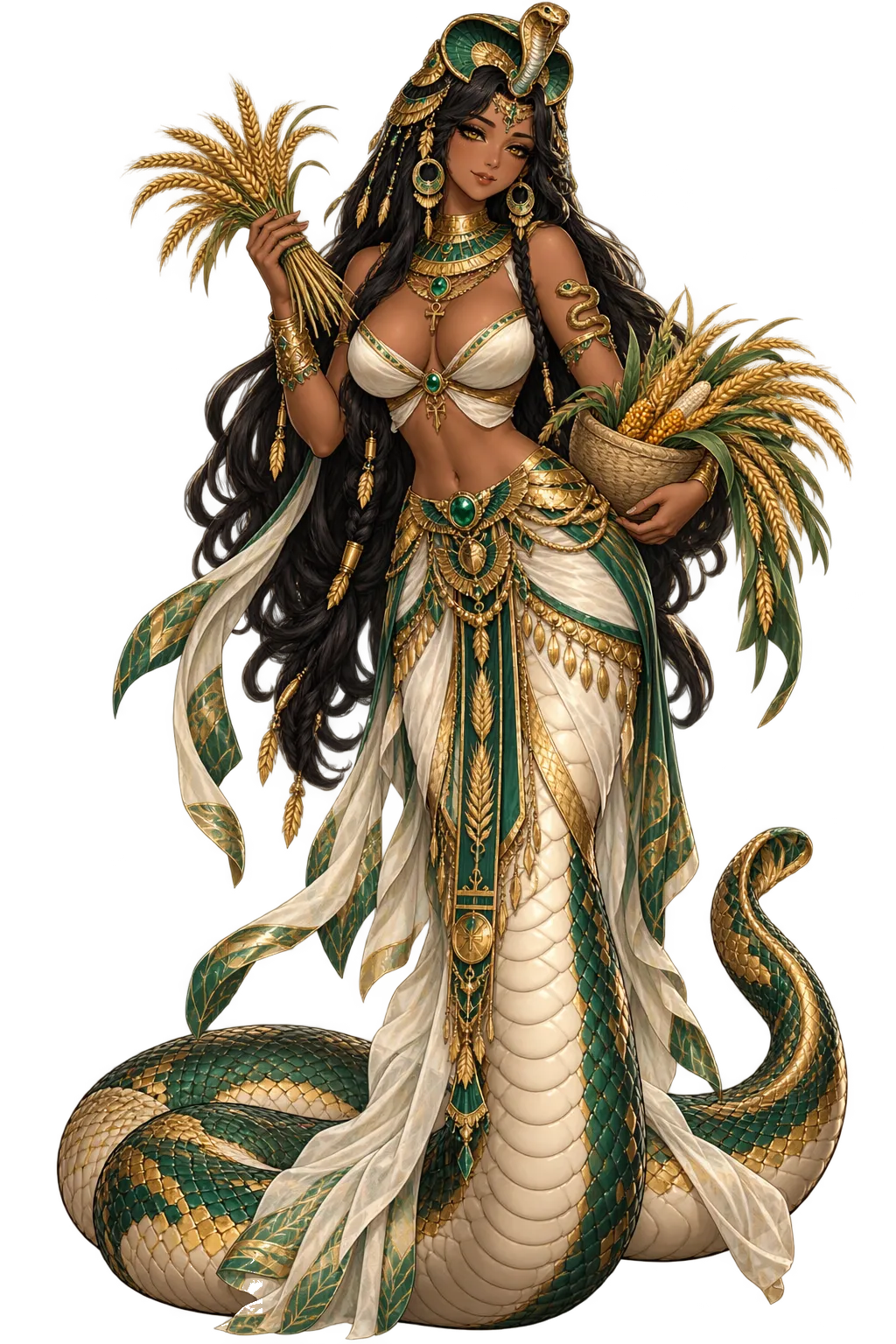
The hidden history behind Rnnwtt
Behind the modern ASCII form renenutet hides a much longer story. Rnnwtt reaches back through manuscripts, inscriptions, and oral tradition long before it ever touched a keyboard, and every mark in the restored spelling is a receipt from that journey. In what follows we trace the name from its Hieroglyphs attestations through its mythology, its cult, its symbols, and its afterlife in other cultures — and we show how the PuniCodex project turned that philological record into a Unicode domain that resolves today. The history was never lost. It was only waiting for the infrastructure to catch up.
At a Glance
- Restored name: Rnnwtt
- ASCII form: renenutet
- Meaning: "The nursing snake"
- Domain of influence: Nursing, Harvest
- Pantheon: Egyptian
- Restoration: ASCII-equivalent form
- Original script: 𓂋𓈖𓈖𓅱𓏏𓏏𓆗 (Hieroglyphs)
Overview
Rnnwtt (renenutet) — The Harvest, the Nursing Cobra · The nursing snake — belongs to the Egyptian tradition, where it is catalogued under the domain "Nursing, Harvest". The name means "The nursing snake".
Rnnwtt — Renenutet — is the harvest as maternity: the cobra who coils in the last standing sheaf and nurses the grain to ripeness. Every Egyptian granary was her temple in miniature; every nurse suckling a child repeated her oldest work. She is the goddess in whom food and motherhood are the same fact.
PuniCodex restores the name as Rnnwtt and serves its temple at its temple. The restoration aSCII-equivalent form — a description computed from the displayed form itself. The plain ASCII form renenutet survives as a modern convenience imposed by the early domain-name system; the restoration, not the fallback, is the form the project defends as philologically complete.
The Name
The name is attested in Hieroglyphs as 𓂋𓈖𓈖𓅱𓏏𓏏𓆗. Etymologically it means "The nursing snake".
The ASCII form renenutet survives only because the early domain-name system could not carry diacritics; it is a technological compromise, not an ancient spelling. The Unicode restoration Rnnwtt recovers the full diacritic detail of the scholarly transliteration directly in the address bar. The restoration aSCII-equivalent form — a description computed from the displayed form itself.
The letter-by-letter transformation runs:
- r → R — Same, capitalized
- e → n — Special phonetic character
- n → n — Same
- e → w — Special phonetic character
- n → t — Special phonetic character
- u → t — Special phonetic character
- t → — — Dropped: vowel not written
- e → — — Dropped: vowel not written
- t → — — Dropped: vowel not written
The Original Script
The name is preserved in Hieroglyphs as 𓂋𓈖𓈖𓅱𓏏𓏏𓆗 — Egyptian hieroglyphs, attested Egyptian hieroglyphic, c. 3200 BCE – 4th century CE, in Nile Valley, Egypt. The script is written right-to-left / top-to-bottom / multidirectional.
The scholarly transliteration is Rnnwtt (Egyptological transliteration), giving the normalized reading Original vocalisation unknown; Egyptological /rɛ.nɛˈnuː.tɛt/..
The rendering proceeds step by step:
- Hieroglyphic spelling 𓂋𓈖𓈖𓅱𓏏𓏏𓆗 generated from MdC r:n:n-w-t:t-I12
- Read in scholarly transliteration as Rnnwtt
- The nursing snake
Pronunciation
The reconstructed pronunciation of the name is /rəˌnɛnuːˈtɛt/ (conventional) — Conventional reading — Egyptian vocalisation not attested.
Phoneme by phoneme:
- Rnnwtt — Written rnn.t or rnnwtt; conventionally vocalised “Renenutet”. The root rnn means “to nurse, suckle”.
- ** — The cobra-goddess of the harvest and of nursing, lady of the granary.
For the modern speaker, the closest approximation is: “reh-nuh-NOO-tet”
Kindred and historical forms of the name:
- Greek — Τηρνοῦθις (Tērnoûthis); fused with Thermouthis in the Greco-Roman period
Her name is the participle “she who nurses” — the harvest that feeds is her milk.
Mythology
Renenutet’s mythology is the theology of food security in a subsistence economy: the goddess who turns sunlight into grain and grain into children’s milk. She has no great narrative cycle because she needed none — every harvest was her epiphany, every famine her absence, every granary her chapel.
The Cobra in the Last Sheaf (Harvest Theology)
Egyptian reapers left the last sheaf standing and addressed it as Renenutet: the goddess still resident in the field. To cut it was to release her into the granary for the year’s safekeeping. The custom — attested from the Old Kingdom harvest scenes onward — made every field’s end a small theological drama.
Mother of the Vineyard (Fayum & Dendera)
In the Fayum and at Dendera she presided over the wine-press as over the threshing-floor; the wine-jar docket ‘Renenutet’s portion’ marked the divine tithe of the vintage. With Sobek as her consort in the Fayum she mothered the crop-cycle whole — grain, grape, and the flood that feeds both.
Nurse of the King (Royal Nurture)
The king’s titulary calls him ‘the nursling of Renenutet’: the harvest feeds the state as the breast feeds the child, and both are her body. Royal birth-scenes show her cobra rearing behind the throne of the nursing mother, transferring the goddess’ own milk into the legitimate succession.
Thermouthis (Greco-Roman Age)
Under the Ptolemies she was worshipped as Thermouthis — ‘the harvest-serpent’ in Greek dress — with a cult that joined her to Isis the nurse. The equation made her an international goddess of provisioning, and her images spread with the grain trade she embodied.
Symbols & Iconography
The iconography associated with Rnnwtt concentrates in a small set of recurring attributes, each a compressed statement about the name:
- The Harvest Cobra — A rearing cobra crowned with the harvest’s plumes; the last sheaf of the field is her shrine.
- Lady of the Granary — Every storehouse and threshing floor fell under her protection — and her audit.
- The Nursing Goddess — Her name means “she who nurses”; the pharaoh himself was her nursling.
- Goddess of the Vineyard — Wine-presses and wine-jars carried her name; the vintage was her second harvest.
Archaeology & Evidence
The material record for Rnnwtt survives in a small number of securely identified remains, catalogued below; the corpus is thin but unambiguous, and each site is tied to the name by ancient testimony.
Her finest surviving monument is the temple of Dendera’s granary quarter; the Fayum’s Tebtunis papyri preserve her vineyard accounts. Serpent-cult objects from the harvest festivals — plumed cobra figurines — fill the Late Period strata of sites across the valley.
Realm & Domain
Rnnwtt — Renenutet — is the harvest as maternity: the cobra who coils in the last standing sheaf and nurses the grain to ripeness. Every Egyptian granary was her temple in miniature; every nurse suckling a child repeated her oldest work. She is the goddess in whom food and motherhood are the same fact.
The Harvest Cobra
A rearing cobra crowned with the harvest’s plumes; the last sheaf of the field is her shrine.
Lady of the Granary
Every storehouse and threshing floor fell under her protection — and her audit.
The Nursing Goddess
Her name means “she who nurses”; the pharaoh himself was her nursling.
Goddess of the Vineyard
Wine-presses and wine-jars carried her name; the vintage was her second harvest.
Across Cultures
Renenutet merged early with Wadjet, the cobra of Lower Egypt — both are the rearing uraeus — and with Meretseger of the Theban necropolis in her serpent aspect. As Thermouthis she was equated with Isis and Demeter, the two great maternal goddesses of the classical world; the triangulation made her the most exported of Egypt’s agricultural deities.
Within the Egyptian tradition, closely related names in the corpus include Ꜣb, Ꜣḫ, Ꜣmun, ꜥnḫ, ꜣnpw, and ꜥꜣpp.
Cultural Legacy
The ‘last sheaf’ custom survived in Egyptian folk practice into the modern era, one of the longest-lived ritual continuities on earth. Her name, in the Greek dress of Thermouthis, entered the magical papyri and the romance-literature of the ancient novel; and every study of Egyptian food-economy begins with her shrines at the granary door.
The Scholarly Record
The account of Rnnwtt given in this edition rests on the witnesses and reference works listed below. Lexica and etymological dictionaries secure the form and meaning of the name; the literary and religious texts supply the narrative evidence.
- Harvest and vintage scenes, Old Kingdom tombs.
- Fayum temple hymns (Renenutet-Sobek theology).
- Dendera granary dockets and wine tithes.
- Greco-Roman Thermouthis cult inscriptions.
A Meditation
Rnnwtt: the name suckles. Its restoration in plain letters is a granary-stela — six consonants standing like six full jars in a row, each one sealed, each one feeding the next. No diacritic could improve a name that means milk.
The Unicode Restoration
Rnnwtt aSCII-equivalent form. The ASCII fallback renenutet still resolves everywhere, but it is the restored form that carries the name's full information. Across the 9 characters of the name, the restoration adjusts 7: 7 further adjustments (n, w, t, t, t, e, t). That is the whole thesis of this temple: the marks are the message.
Character by Character
The journey from renenutet to Rnnwtt, one character at a time:
- r → R — Same, capitalized
- e → n — Special phonetic character
- n → n — Same
- e → w — Special phonetic character
- n → t — Special phonetic character
- u → t — Special phonetic character
- t → t — Dropped: vowel not written
- e → e — Dropped: vowel not written
- t → t — Dropped: vowel not written
The Egyptian Pantheon
Rnnwtt is one of 66 entries the PuniCodex lexicon catalogues under the Egyptian pantheon. The Pantheon page gathers the tradition's major figures in one place, and the Lexicon lets you filter all 983 restorations by tradition or script — the fastest way to see where this name sits among its kin.
Frequently Asked Questions
What does Rnnwtt mean? The traditional gloss is "The nursing snake."
Which tradition does Rnnwtt belong to? Rnnwtt is catalogued in the Egyptian pantheon of the PuniCodex lexicon.
What does Rnnwtt preserve that ASCII cannot show? The form itself answers: Rnnwtt aSCII-equivalent form — and the marks in the restored spelling are exactly that evidence.
Can I use Rnnwtt in a normal browser? Yes. The DNS resolves the punycode form automatically, and the type tool on this site converts renenutet to Rnnwtt for copying and pasting.
Where does the scholarly information come from? The entry is built from lexica, inscriptional evidence, and reviewed scholarly sources listed in the Scholarly Edition. Every claim is traceable to a canonical source.
Typing Rnnwtt
You do not need a special keyboard to use this restoration. The PuniCodex Type Tool converts the ASCII form renenutet into Rnnwtt as you type, and the browser extension offers the same conversion inside any text field. Copy the restored form, paste it into the address bar, and the DNS does the rest.
Sister Temples
Other temples in the Egyptian pantheon include Mnw, Nbtḥwt, and Onuris — each with its own restoration story, its own scholarly record, and its own place in the lexicon.
Why This Restoration Matters
The story of Rnnwtt did not end in antiquity; it changed medium. Names that survive for millennia do so because each generation finds a new carrier for them — clay, papyrus, print, and now DNS. The PuniCodex restoration simply makes the carrier honest: the spelling that resolves is the spelling the evidence supports. If this post showed anything, it is that renenutet and Rnnwtt are not the same name with different styling. They are a summary and the text it summarizes. The web can now serve the text.
Explore Further
This post is one doorway into the temple. The home page carries the full character breakdown and the ambient canvas; the lore page tells the myths in long form; the Scholarly Edition preserves the sources, pronunciation data, and revision history; and the patron wall supports the restoration directly. For the wider map, browse the Lexicon, explore the Pantheon, or return to the PuniCodex blog.
A Closer Look at the Marks
A restored name is a small map. In Rnnwtt, the journey from the ASCII fallback renenutet to the Unicode form can be read letter by letter, and each letter tells a story. Of the 9 characters, 2 remain unchanged; they anchor the name to its modern shape. The remaining adjustments recover marks the source tradition used to distinguish this name from every other word built from the same letters.
The r stays as it is — Same, capitalized.
The e becomes n — Special phonetic character.
The n stays as it is — Same.
The e becomes w — Special phonetic character.
The n becomes t — Special phonetic character.
The u becomes t — Special phonetic character.
The t becomes t — Dropped: vowel not written.
The e becomes e — Dropped: vowel not written.
The t becomes t — Dropped: vowel not written.
Together these changes are not decoration. They are the minimum set of marks needed to keep the name legible in its own tradition. Remove them and you still have a string of letters; you no longer have the name as it was written.
Rnnwtt in Its Tradition
Rnnwtt does not stand alone. It belongs to the Egyptian tradition, where it is counted among 66 names in the PuniCodex lexicon. Its sphere — Nursing, Harvest — places it beside other figures who govern similar aspects of experience. The restored spelling is therefore not only a philological decision; it is a way of keeping the name in the company of its kin. When the address bar shows Rnnwtt, it marks the boundary between a generic search term and a named entry in a living catalog of myth. That catalog is the point of the project. Every restored name is a vote for specificity: the web should know the difference between a figure and a keyword, between a tradition and a trend. Rnnwtt is one such vote.
What You Will Find in the Temple
The temple page for Rnnwtt is more than a landing page. The home tab presents the character breakdown, the pronunciation guide, and the live domain status in a single view. The lore tab gathers the myths and narratives that give the name its depth. The Scholarly Edition tab publishes the sources, variant forms, and review history that justify the restoration. Industry patterns show where the name appears in modern commerce and culture, while the gallery and creatives tabs collect visual and sponsor material. The patron wall lets visitors support the restoration directly. Each tab is generated from the same canonical sources, so the domain, the blog, the scholars page, and the search index all agree. The result is a single source of truth about a name, delivered through several doors.
The Restoration on the Live Web
A domain name is a kind of publication. When Rnnwtt resolves, it proves that the restored spelling is not a theoretical exercise; it is a working address on the public internet. Search engines can index it, language models can encounter it, and anyone who copies it from a manuscript can paste it into a browser. That practical reality changes the status of the restoration. Before Unicode domains, a scholar could write the name correctly in an article while the public web flattened it to renenutet. Now the public web can carry the correct form end to end. The punycode translation happens silently, so the infrastructure remains compatible while the visible name keeps its marks. That compromise — human-readable restoration, machine-readable encoding — is the foundation of every PuniCodex temple.
Restoration Notes
Restoring a name is not a single decision; it is a sequence of smaller decisions, each backed by a different kind of evidence. For Rnnwtt, the chain begins with the attested form in Hieroglyphs, continues through the standard scholarly romanizations, and ends with the DNS-compatible Unicode spelling used by this temple. The meaning "The nursing snake" anchors the name in its semantic field; without that anchor, the marks would float free of the figure they name. Of the 9 characters in the ASCII form, 7 carry adjusted marks: e becomes n (Special phonetic character), e becomes w (Special phonetic character), n becomes t (Special phonetic character), u becomes t (Special phonetic character), t becomes t (Dropped: vowel not written), e becomes e (Dropped: vowel not written), t becomes t (Dropped: vowel not written). Those adjustments are not arbitrary styling. They follow the restoration logic the displayed form wears openly: Rnnwtt aSCII-equivalent form. The rule is mechanical, not editorial, which means the same standard applies to every entry in the lexicon. A visitor who disagrees with the classification can at least see exactly which evidence produced it, because every step is recorded in the Scholarly Edition. That transparency is the difference between a restoration project and a branding exercise. The name is being put back, not invented.
Related Names
Sources
The full scholarly apparatus — every citation, revision, and review — lives in the Scholarly Edition. Key references for this post:
- James P. Allen, Middle Egyptian: An Introduction to the Language and Culture of Hieroglyphs, Cambridge University Press, 2000.
- Harvest and vintage scenes, Old Kingdom tombs.
- Fayum temple hymns (Renenutet-Sobek theology).
- Dendera granary dockets and wine tithes.
- Faulkner, A Concise Dictionary of Middle Egyptian.
- Lexicon authorities for this entry: Faulkner, Wb.