The Living Myth
Nursing, Harvest · The Harvest, the Nursing Cobra · The nursing snake
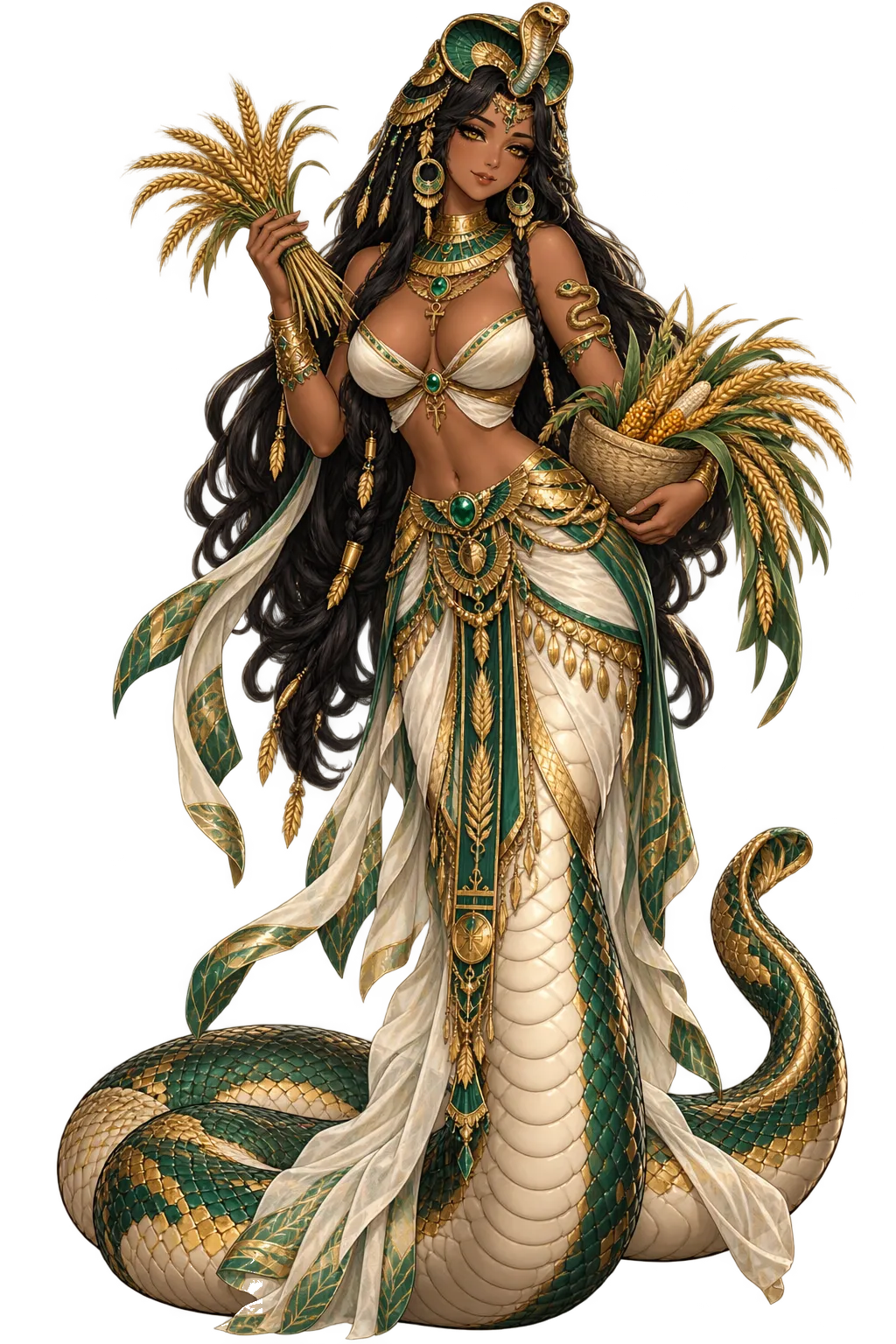
Stories of Rnnwtt
Renenutet’s mythology is the theology of food security in a subsistence economy: the goddess who turns sunlight into grain and grain into children’s milk. She has no great narrative cycle because she needed none — every harvest was her epiphany, every famine her absence, every granary her chapel.
Egyptian reapers left the last sheaf standing and addressed it as Renenutet: the goddess still resident in the field. To cut it was to release her into the granary for the year’s safekeeping. The custom — attested from the Old Kingdom harvest scenes onward — made every field’s end a small theological drama.
In the Fayum and at Dendera she presided over the wine-press as over the threshing-floor; the wine-jar docket ‘Renenutet’s portion’ marked the divine tithe of the vintage. With Sobek as her consort in the Fayum she mothered the crop-cycle whole — grain, grape, and the flood that feeds both.
The king’s titulary calls him ‘the nursling of Renenutet’: the harvest feeds the state as the breast feeds the child, and both are her body. Royal birth-scenes show her cobra rearing behind the throne of the nursing mother, transferring the goddess’ own milk into the legitimate succession.
Under the Ptolemies she was worshipped as Thermouthis — ‘the harvest-serpent’ in Greek dress — with a cult that joined her to Isis the nurse. The equation made her an international goddess of provisioning, and her images spread with the grain trade she embodied.
Lady of the Granary, Mother of the Field
Rnnwtt — Renenutet — is the harvest as maternity: the cobra who coils in the last standing sheaf and nurses the grain to ripeness. Every Egyptian granary was her temple in miniature; every nurse suckling a child repeated her oldest work. She is the goddess in whom food and motherhood are the same fact.
A rearing cobra crowned with the harvest’s plumes; the last sheaf of the field is her shrine.
Every storehouse and threshing floor fell under her protection — and her audit.
Her name means “she who nurses”; the pharaoh himself was her nursling.
Wine-presses and wine-jars carried her name; the vintage was her second harvest.
From the original script to the living URL
𓂋𓈖𓈖𓅱𓏏𓏏𓆗
The name in its original Egyptian form. Rnnwtt (𓂋𓈖𓈖𓅱𓏏𓏏𓆗) is attested in the source tradition — “The nursing snake”. Its original diacritics and script distinctions carry the full phonetic and orthographic weight of the source tradition.
renenutet
The plain renenutet form is identical to the Unicode restoration. Because this name is already written in Latin letters, no diacritics, stress, or script information were lost — only capitalization differs.
Rnnwtt
The Unicode restoration does not need to recover lost marks for Rnnwtt. Its value is canonical spelling and consistent cataloguing, not the reconstruction of erased orthography. The domain is readable as-is to both DNS and humanity.
Rnnwtt.com
This restoration is written entirely in ASCII letters — no Punycode encoding stands between Rnnwtt and the DNS. The domain reads identically to machines and to human eyes.
The attested spelling family of Rnnwtt
Rnnwtt
Restores 𓂋𓈖𓈖𓅱𓏏𓏏𓆗. The full Unicode restoration. rnnwtt.com is not in the PuniCodex collection — it is watched for release; if it drops, this temple upgrades to an owned flagship. Attested by Faulkner, Wb.
How Rnnwtt was spoken
How Rnnwtt travels from ancient script to the modern URL
Egyptian Rnnwtt; the original vocalisation is unknown. The name means “the nursing snake", a harvest-goddess.
The lore you have read is the living myth. Extended Lore opens the scholarly vault beneath it: the cult and its material remains, a history of the image, the name after antiquity, a meditation on what the name still means, and the full scholarly apparatus — etymology, orthography, sources.
Enter Extended Lore