PuniCodex

Extended Lore

रत्नसम्भव Ratnasambhava

Etymology · Orthography · Cult · Iconography · Reception · Sources

Tier 2 Ratnasambhava
Ratnasambhava — Jewel-Born, South
01

Quick Facts

Essential information about Ratnasambhava, Jewel-Born, South

Original Scriptरत्नसम्भव
Unicode RestorationRatnasambhava
Reconstructed Pronunciation/rɐt.nɐ.sɐm.bʱɐ.ʋɐ/
PantheonBuddhist
DomainJewel-Born, South
Meaning'Born of the Jewel' — the Dhyānibuddha of the southern jewel family
ClassificationTier 2
Primary DomainRatnasambhava
Sacred SymbolsThe wish-fulfilling jewel (cintāmaṇi), Gold and ochre, The varada mudrā, The horse, Māmakī, his consort
02

Etymology & Word Family

From original script to Unicode restoration

Original Script रत्नसम्भव Ratnasambhava — "'Born of the Jewel' — the Dhyānibuddha of the southern jewel family"
Unicode Restoration Ratnasambhava Canonical scholarly spelling — ASCII-identical
Modern ASCII ratnasambhava Plain-ASCII fallback

The name Ratnasambhava reaches the modern world through scholarly transliteration of the buddhist tradition. Because the conventional spelling uses only Latin letters, its Unicode and ASCII forms coincide — the tradition it carries is in the name itself, not in diacritics.

03

Unicode Character Breakdown

Character-by-character philological analysis

CharacterUnicodeNameBlockPhonetic Role
RU+0052Latin Capital Letter RBasic LatinSame, capitalized
aU+0061Latin Small Letter ABasic LatinSame
tU+0074Latin Small Letter TBasic LatinSame
nU+006ELatin Small Letter NBasic LatinSame
aU+0061Latin Small Letter ABasic LatinSame
sU+0073Latin Small Letter SBasic LatinSame
aU+0061Latin Small Letter ABasic LatinSame
mU+006DLatin Small Letter MBasic LatinSame
bU+0062Latin Small Letter BBasic LatinSame
hU+0068Latin Small Letter HBasic LatinSame
aU+0061Latin Small Letter ABasic LatinSame
vU+0076Latin Small Letter VBasic LatinSame
aU+0061Latin Small Letter ABasic LatinSame

The Tier 2 classification here reflects fidelity to the attested tradition, not recovered diacritics: every character of Ratnasambhava already survives in ASCII. What the restoration preserves is the canonical spelling itself — the form scholarship standardised.

04

Cult & Worship

How the sacred was kept — rites, sanctuaries, remains

The Cult

Ratnasambhava is worshipped the way all Dhyani Buddhas are: inside a maṇḍala. The core rite is abhiṣeka, initiation, in which the master consecrates the disciple at the southern gate of the five-Buddha diagram; the daily practice is his visualization from the yoga-tantra manuals descended from the Sarvatathāgatatattvasaṃgraha — gold body, open hand, jewel-born, radiating equality. Amoghavajra’s mid-eighth-century translations installed the rite in Tang China, and from there Japanese Shingon still constructs his southern court in sand and silk. For laypeople the cult is simpler: his gilt face on every Kathmandu Valley stūpa receives the morning’s water-offerings at the south side, and his mantra with the seed-syllable Trāṃ is recited for the ripening of generosity. No single great monastery was ever ‘his’ — the maṇḍala is his only cathedral.

In the Earth

The five-Dhyani-Buddha scheme is stamped across medieval Asian sacred geography. At Borobudur in Java (8th–9th century) the galleries distribute the five Buddhas with their characteristic mudrās. In the western Himalaya, the 11th-century temples of Alchi and Tabo preserve five-Buddha wall cycles in which the southern, golden figure displays the gift-bestowing hand. Pala-period (8th–12th century) bronze workshops of the Nālandā region exported small gilt images of the southern Buddha along the monastic routes into Tibet, and Newar craftsmen made the gilt-copper pañca-dhyāni set a fixture of every Kathmandu Valley stūpa — the crowning faces of Swayambhū and Boudhanath still include him. Tang and Japanese maṇḍala paintings preserved at Tō-ji, Shōgo-in, and the repositories of Mount Kōya fix his iconography in silk.

05

Iconography

How Ratnasambhava was imaged across the ages

The Image

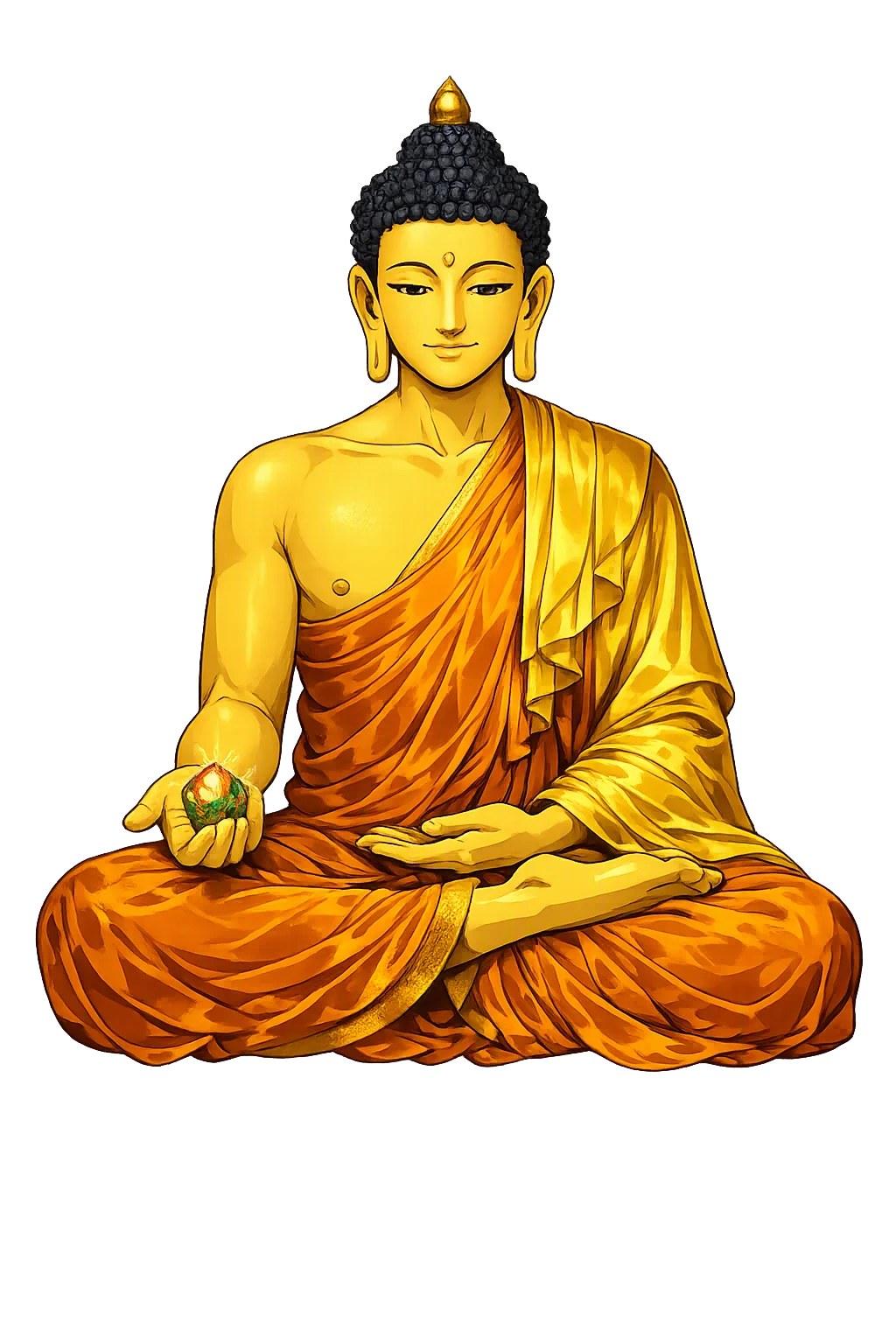
Recognize Ratnasambhava by his open hand. Gold in color, seated in meditation at the south of the maṇḍala, right hand lowered in the varadā mudrā — the gesture of giving — he is the only one of the five Dhyani Buddhas whose hand opens outward in generosity, and his throne stands on horses, the fleet emblem of his family. The tantras give him his consort Māmakī and his sign, the wish-fulfilling jewel from which he is born. His earliest monumental images are the great statues of Borobudur (c. 800), where the southern Buddha’s gift-bestowing hand is carved in living stone, and the portable Pala bronzes of the Nālandā workshops carried the type along the monastic roads into Tibet. For a thousand years his iconography has been the most stable in Buddhism: change the mudrā and he is no longer himself.

06

Reception & Transformation

The name after its own age — transmission, translation, survival

Afterlives

Ratnasambhava’s journey is the journey of the five-Buddha maṇḍala itself. Born in the esoteric canon of early medieval India — the Sarvatathāgatatattvasaṃgraha assembles his theology — he crossed to Tang China in Amoghavajra’s eighth-century translations, then to Japan with Kūkai, whose paired Womb- and Diamond-Realm maṇḍalas enshrine his southern court at Tō-ji to this day. Tibet received him by the late eighth century, and Newar craftsmen made his gilt face a permanent fixture of every Kathmandu stūpa. Europe met him through Brian Hodgson, the British Resident in Nepal whose 1830s essays introduced the five Dhyani Buddhas to Western scholarship; Burnouf’s Introduction (1844) gave the system its scholarly architecture, and the maṇḍala took its place — sometimes as theology, sometimes as art history — in the modern study of Buddhism from Snellgrove to the Princeton Dictionary. The jewel-born one travelled by translation: Sanskrit to Chinese, Chinese to Japanese, image to Tibet, catalogue to the West.

Identifications Across Traditions

In China the Tang esoteric masters rendered him as Baosheng Rulai 寶生如來, 'Jewel-Arising Tathāgata', and his southern court survives in both Womb- and Diamond-Realm maṇḍalas transmitted to Japan, where Shingon knows him as Hōshō Nyorai. In Tibet he is Rin chen 'byung, central to the initiation maṇḍalas of all four classes of tantra. The Newars of the Kathmandu Valley absorbed the five Buddhas so completely that every stūpa carries his gilt image facing south — Buddhist architecture turned into a permanent five-direction liturgy. In the modern West he has been reinterpreted through Jungian psychology, the gold of the south read as the individuated self — a reading that tells us more about the interpreters than about the maṇḍala, but which keeps his image circulating far beyond any monastery.

Modern Legacy

Ratnasambhava's cult never had a single great pilgrimage centre; it lives wherever the five-Buddha maṇḍala is painted — on the toranas of Nepalese stūpas, in the assembly halls of Ladakhi and Tibetan monasteries, in the Tang maṇḍalas preserved at Tō-ji and the thousand-year rites of Mount Kōya. His gift-gesture made him a patron of abundance, addressed by farmers and merchants alike. In contemporary Buddhist practice, meditations on his golden light and equality-wisdom are taught in Tibetan lineages, while museums from the Met to the British Museum display the Pala-period bronzes through which his image once travelled the monastic world. In Southeast Asia the five-Buddha scheme crowns the stūpas of the old Khmer and Javanese empires, so that Borobudur itself is, among other things, a monument to the jewel-born Buddha of the south.

07

The Meditation

What Ratnasambhava means — beyond the dictionary

Ratnasambhava is the Buddha who asks what wealth is for. Born of the jewel, he does not hoard it: his hand is open, palm outward — the only mudrā among the five Dhyani Buddhas that gives rather than reassures, subdues, meditates, or protects. His teaching is that avarice is equality denied: the delusion that my gem and yours are rival claims on a finite world. To meditate on the south-facing Buddha is to imagine a richness that increases precisely by being given away. In an age built on scarcity mechanics and attention economies, the jewel-born one is quietly heretical: he promises that the wish-fulfilling gem was never a commodity, and that the hand which opens is itself the treasure.

08

Frequently Asked Questions

Common questions about Ratnasambhava, Jewel-Born, South, and Unicode restoration

01How do you pronounce Ratnasambhava?

In reconstructed pronunciation, Ratnasambhava is /rɐt.nɐ.sɐm.bʱɐ.ʋɐ/ — approximately 'ruht-nuh-SUHM-bhuh-vuh' — five even syllables, no hard stress; aim the breathy 'bh' in the middle of the word.

02What does Ratnasambhava mean?

Ratnasambhava means 'Born of the Jewel' — the Dhyānibuddha of the southern jewel family in the buddhist tradition.

03What are the symbols of Ratnasambhava?

Ratnasambhava is associated with The wish-fulfilling jewel (cintāmaṇi) (The ratna that grants every need — his family's emblem and the 'jewel' from which he is born.), Gold and ochre (His body-color: the southern light of ripening crops, wealth, and generosity made visible.), The varada mudrā (Palm turned outward at the knee — the gesture of giving that unties the knot of miserliness and pride.), The horse (His vāhana or throne-mount — as Akṣobhya has the elephant and Amitābha the peacock, the south rides on energy.), Māmakī, his consort (In the five-family maṇḍala his consort is Māmakī, the stainless one — wisdom of equality in female form.).

04Why restore Ratnasambhava in Unicode?

Ratnasambhava is written entirely in ASCII letters, so its restoration is about canonical fidelity rather than recovered diacritics: the temple fixes the name in its scholarly standard spelling, attested in the source tradition, instead of leaving it to drift.

05What is the most important myth about Ratnasambhava?

“Born of the Jewel in Akaniṣṭha” — the The Vow story that anchors the mythology of Ratnasambhava, told in full on the lore page.

09

Scholarly Sources

The philological foundations of this restoration

Every claim on this page is grounded in established scholarship. The orthographic restorations follow disciplinary convention. The etymological chain follows the best available reference works. This is not invention — it is resurrection through scholarship.

◈

Lexicography & Philology

  • Vajrayana texts
  • Buddhist texts
◎

Primary Texts

  • The Larger Sukhāvatī-vyūha Sūtra; the Smaller Sukhāvatī-vyūha Sūtra; the Amitāyurdhyāna Sūtra; the Lotus Sūtra.
◉

Archaeology & Art History

  • Material evidence — iconography, inscriptions, and temple archaeology — for Ratnasambhava and related cults.
✦

Religious Studies

  • Sarvatathāgatatattvasaṃgraha (Compendium of the Truth of All Tathāgatas), yoga-tantra canon of the five-Buddha maṇḍala
  • Conze, Edward, Buddhist Texts Through the Ages (1954)
  • Snellgrove, David, Indo-Tibetan Buddhism (1987)
  • Williams, Paul, Mahāyāna Buddhism: The Doctrinal Foundations, 2nd ed. (2009)
  • Buswell, Robert E., and Donald S. Lopez Jr., The Princeton Dictionary of Buddhism (2014), s.v. Ratnasambhava
Return

The Surface Awaits

You have traced the name from its earliest attestation to its Unicode restoration. Now return to the myth. The story is where the name lives.

Back to Lore
Ratnasambhava mascot