PuniCodex

Extended Lore

ᚱᛅᚴᚾᛅᚱᚢᚴ Ragnarǫk

Etymology · Orthography · Cultural Legacy · Reception · Primary Sources

Tier 1 Ragnarǫk.com
Ragnarǫk — Doom of the Gods
01

Quick Facts

Essential information about Ragnarǫk, Doom of the Gods

Original Scriptᚱᛅᚴᚾᛅᚱᚢᚴ
Unicode RestorationRagnarǫk
Reconstructed Pronunciation/ˈraɣ.naˌrɔk/
PantheonNorse
DomainDoom of the Gods
MeaningTwilight of the gods (from ragna + rǫk)
ClassificationTier 1
Primary DomainRagnarǫk.com
Sacred SymbolsGjallarhorn, Fenrir's jaws, Mjöllnir and the World-Serpent, World-ash in flames, Dawn of the new sun
02

Etymology & Word Family

From original script to Unicode restoration

Proto-indo-european *ragna + *rōk- gods + twilight, destiny
Original Script ᚱᛅᚴᚾᛅᚱᚢᚴ Ragnarǫk — "Twilight of the gods (from ragna + rǫk)"
Unicode Restoration Ragnarǫk Restored stress, length, and script
Modern ASCII ragnarok Plain-ASCII fallback

Old Norse ragnarǫk "twilight of the gods". The final battle and renewal of the world.

03

Unicode Character Breakdown

Character-by-character philological analysis

CharacterUnicodeNameBlockPhonetic Role
RU+0052Latin Capital Letter RBasic LatinSame
aU+0061Latin Small Letter ABasic LatinSame
gU+0067Latin Small Letter GBasic LatinSame
nU+006ELatin Small Letter NBasic LatinSame
aU+0061Latin Small Letter ABasic LatinSame
rU+0072Latin Small Letter RBasic LatinSame
ǫU+01EBLatin Small Letter O with OgonekLatin Extended-BO-hook: short /ɔ/ vowel
kU+006BLatin Small Letter KBasic LatinSame

The Tier 1 classification reflects how much of the original phonology this restoration preserves — stress and vowel length for Greek names, distinctive letters and diacritics for every other tradition.

04

Cultural Significance

From ancient cult to modern memory

Ragnarǫk in Later Traditions

Scholars have long debated how much of Ragnarǫk is native Germanic doom and how much was colored by Christian apocalypse, since every surviving account was written down in Christian Iceland — the renewal, the returning judge-god Baldr, and the righteous few sheltered through the fire have obvious New Testament echoes, and Snorri's matter-of-fact narration reads like sacred history. The name itself is a medieval crux: ragnarǫk means 'doom of the powers', while the later variant ragnarøkkr, 'twilight of the gods' (Lokasenna 39), produced Wagner's Götterdämmerung and the modern English 'twilight of the gods.' Saxo Grammaticus gives the euhemerized version in Gesta Danorum, where the last battle of Hotherus and Balderus is fought with human armies. Whatever its layers, the myth's skeleton — winter, wolves, fire, and a green return — is anchored in northern experience in a way no borrowed apocalypse could be.

Modern Legacy

The name lives on in modern fantasy, Neopagan practice, Scandinavian heritage, and the global reception of Viking-Age literature. Restoring Ragnarǫk in Unicode preserves the name's cultural specificity against the flattening force of plain ASCII. Ragnarǫk has become shorthand for any apocalyptic scenario, from environmental collapse to nuclear war; the Old Norse form, with its technical spelling, reminds us that the myth was also a theology of renewal, not merely an end. Wagner made the twilight an opera, Tolkien borrowed its dragons and its eucatastrophe, and modern climate discourse has adopted the word for the horizon of our own fimbulvetr — usually forgetting, as the seeress did not, what comes after the fire.

In the Earth

The end-time myth is carved on the Gosforth Cross in Cumbria, where a bound figure, the serpent, and cosmic combat appear together. The Rök runestone (Ög 136) names Baldr's death and the doom of the gods, while the Ledberg stone in Östergötland has been read as Óðinn devoured by Fenrir. These monuments show eschatology circulating in Christianizing Scandinavia.

05

The Meditation

What Ragnarǫk means — beyond the dictionary

Ragnarǫk is the myth that takes mortality seriously at the scale of the cosmos. Other traditions end the world to punish it; the Norse end it because everything made can be unmade — the wolf grows, the chain stretches, the winter comes back. What gives the myth its terrible dignity is that the gods know, and fight anyway. Óðinn gathers the einherjar for a war whose outcome the seeress has already recited to his face.

And yet the poem refuses to end in ash. The earth rises green, the dice are found in the grass, and children who hid under a tree walk out into morning dew. Ragnarǫk thus holds two truths at once: everything you build will burn, and burning is not the last thing that happens. It is a theology for people who live with winter — those who knew that spring is not a promise, only a habit the world has not yet broken.

06

Screen & Culture

Where Ragnarǫk echoes through film, television, and games — and how

07

Frequently Asked Questions

Common questions about Ragnarǫk, Doom of the Gods, and Unicode restoration

01How do you pronounce Ragnarǫk?

In reconstructed pronunciation, Ragnarǫk is /ˈraɣ.naˌrɔk/ — approximately 'RAGH-na-rok' — the middle consonant is a throaty 'gh', and the final vowel is a short, rounded 'o' like 'hot'.

02What does Ragnarǫk mean?

Ragnarǫk means Twilight of the gods (from ragna + rǫk) in the norse tradition.

03What are the symbols of Ragnarǫk?

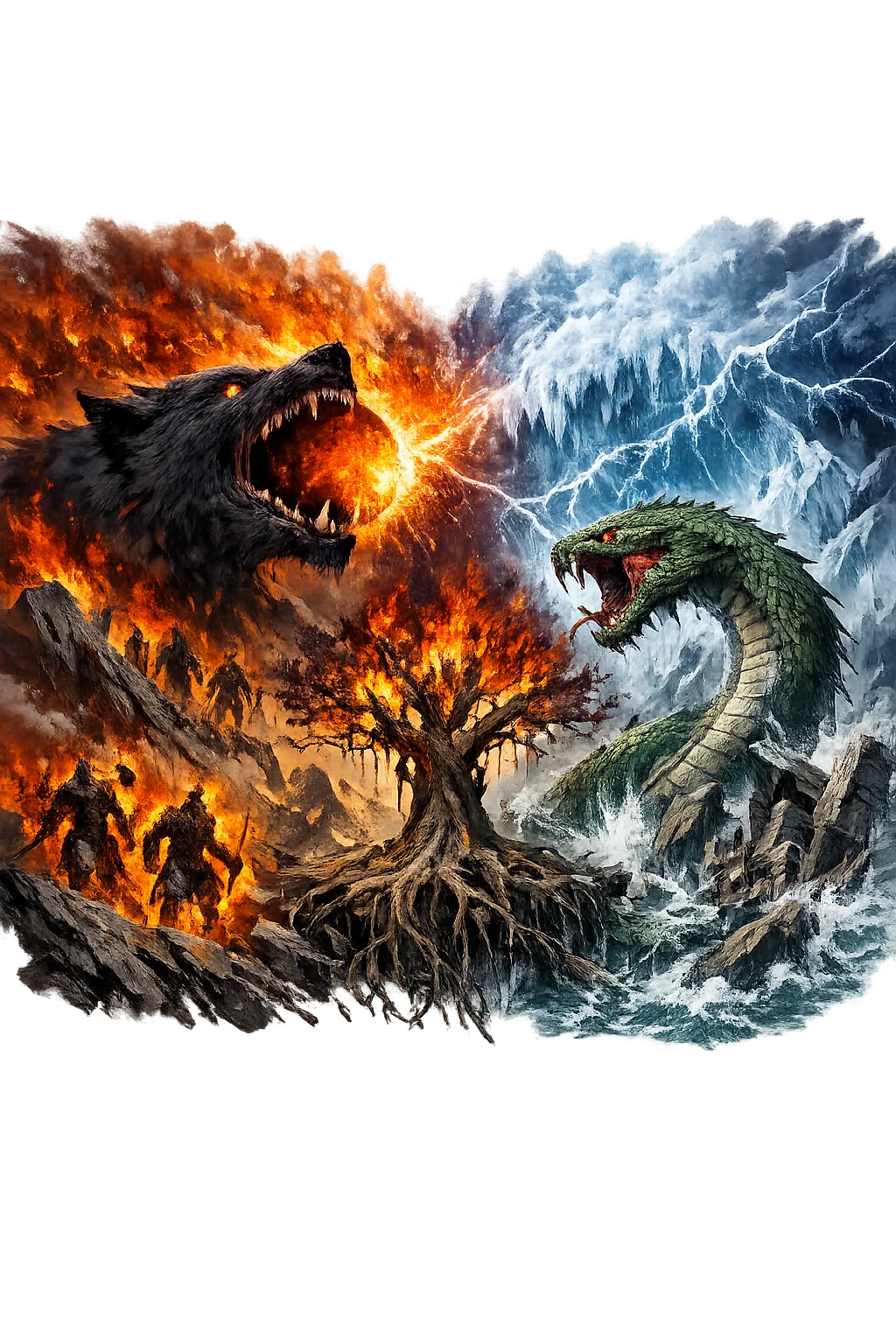
Ragnarǫk is associated with Gjallarhorn (Heimdallr's horn whose blast announces the beginning of the end), Fenrir's jaws (The bound wolf that breaks free and devours Odin), Mjöllnir and the World-Serpent (The final blows exchanged by Þórr and Miðgarðsormr), World-ash in flames (Yggdrasill shaken and burned as the cosmos collapses), Dawn of the new sun (The reborn world rising after the flood and fire have passed).

04Why restore Ragnarǫk in Unicode?

Plain ASCII ragnarok strips the stress, length, and script that make the name specific. Unicode restoration returns the name to its original written dignity.

05What is the most important myth about Ragnarǫk?

“Fimbulvetr: Three Winters Without a Summer” — Ragnarǫk is the end of the Norse cosmos and its secret rebirth. Foretold by the seeress of Völuspá and narrated by Snorri, it runs from fimbulvetr — three winters with no summer — through the breaking of every bond to the last battle on Vígríðr, and ends not in ash but in green grass. The full telling lives on the lore page.

08

Scholarly Sources

The philological foundations of this restoration

Every claim on this page is grounded in established scholarship. The orthographic restorations follow disciplinary convention. The etymological chain follows the best available reference works. This is not invention — it is resurrection through scholarship.

Lexicography & Philology

  • Cleasby-Vigfusson
  • Zoëga

Primary Texts

  • Poetic Edda, Völuspá 26–66 (fimbulvetr, the battle, the fire, the renewal)
  • Snorri Sturluson, Prose Edda, Gylfaginning 50–53
  • Poetic Edda, Lokasenna 39–42 (the name ragnarøkkr and the binding)
  • Poetic Edda, Vafþrúðnismál 50–51 (the fated ending)
  • Saxo Grammaticus, Gesta Danorum (the euhemerized last battle)
  • Rök runestone, Ög 136 (Baldr's death and the doom of the divine powers)

Archaeology & Art History

  • Material evidence — iconography, inscriptions, and temple archaeology — for Ragnarǫk and related cults.

Religious Studies

  • Comparative studies of norse religion and the place of Ragnarǫk within it.
Return

The Surface Awaits

You have traced the name from its earliest attestation to its Unicode restoration. Now return to the myth. The story is where the name lives.

Back to Lore
Ragnarǫk mascot