The Living Myth
Divine Love, Consort of Krishna · The Beloved of Vraja · Krishna's Eternal Heart
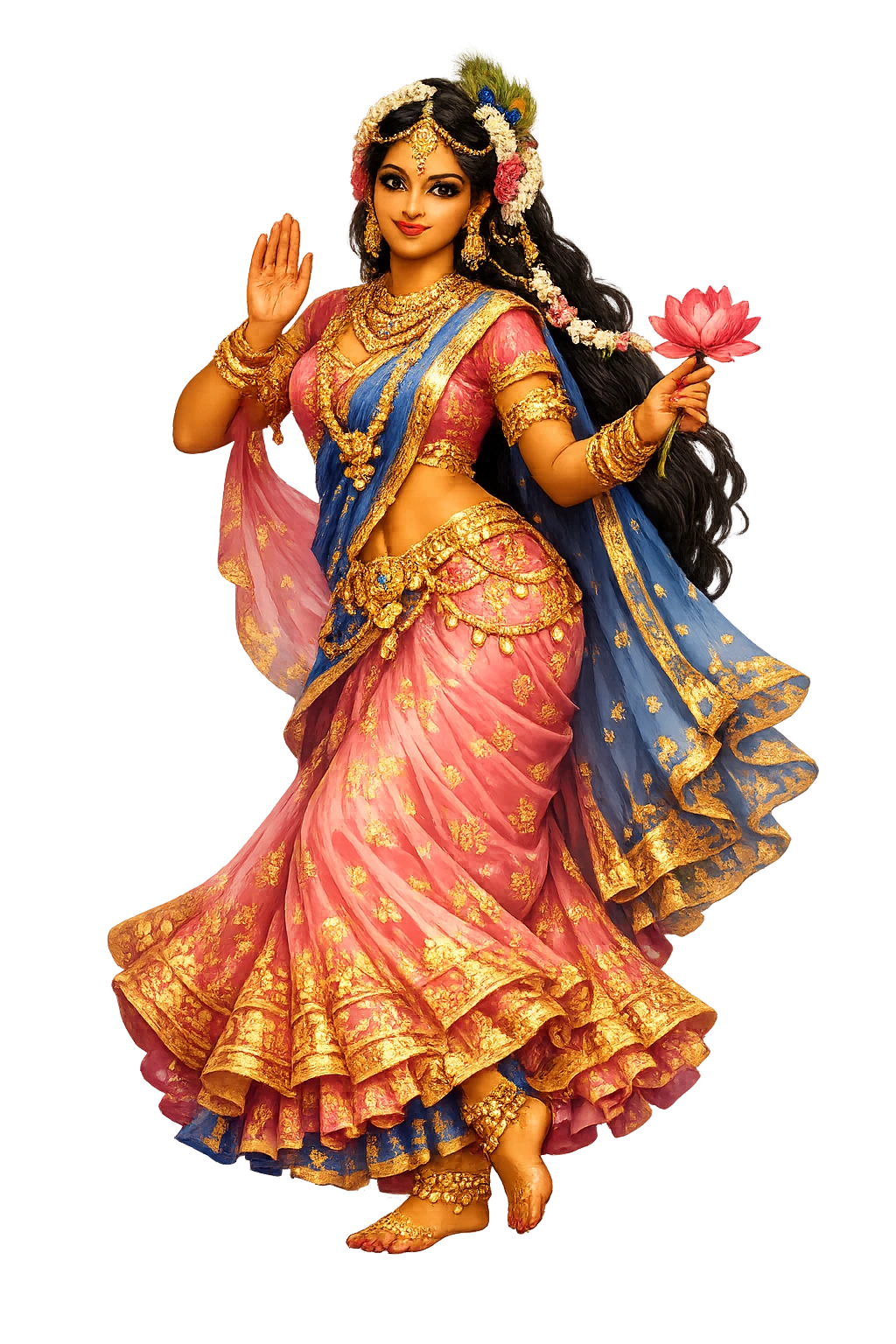
Stories of Rādhā
Rādhā's mythology is the rarest kind: a figure the early texts leave unnamed, whom poetry and devotion then build, line by line, into the measure of divine love itself. No epic gives her a birth or a quest; her story is the story of her name — from a hidden verb in the Bhāgavata to the first word of the Braj greeting.
The Bhāgavata Purāṇa tells the rāsa-līlā across five chapters of its tenth book — the autumn full-moon night on the Yamunā's bank, Krishna's flute emptying the village, the dance in which he multiplies himself among the gopīs — and never once speaks her name. Yet one verse (10.30.28) says of one gopī, anayārādhito nūnaṃ bhagavān hariḥ: "surely the Lord was perfectly worshipped by her." The great commentators hear the name hidden in the verb: ārādhitaḥ, worshipped — Rādhā. Her devotees have ever since read the whole book as her portrait, unsigned. The five chapters move from flute to forest to dance, through jealousy and separation and restoration, and at the center of them all stands the one the text will not name. The omission is itself the mythology: she is the beloved so central that the text can assume everyone knows, and so intimate that the text will not say.
In the twelfth century Jayadeva wrote the Gītagovinda, and the unsigned portrait got its signature. His aṣṭapadīs — songs in eights — stage the whole drama of separation and union: the go-between urging Rādhā through the spring night to the tryst, Krishna begging her foot on his head, the refrain rādhā-mādhavayor jayati yamunā-kūle raḥaḥ-kelayaḥ — "the secret love-play of Rādhā and Mādhava triumphs on the Yamunā's bank." The poem was taken into temple liturgy — it is sung before Jagannātha at Puri to this day — and Rādhā's name became inseparable from the god's. What scripture left anonymous, poetry made canonical: the Gītagovinda did not record her worship, it founded it. No two centuries have agreed on the poem's date or its author's exact shrine, but every century since has sung it — the aṣṭapadīs are among the most-set texts in the history of Indian music.
The later purāṇas complete the ascent. The Brahma-vaivarta Purāṇa makes Rādhā the prakṛti itself — the primal nature from whom all goddesses proceed, Krishna's own other half, without whom he is not merely lonely but incomplete. What the Bhāgavata hinted and Jayadeva sang, the sectarian texts systematized: the cowherd girl of Vraja is the very power by which the divine loves, and being loved is shown to be a divine attribute, not a divine accident. The theology is radical in the strict sense: it returns to the root question of what God is, and answers that God without Rādhā is power without love. The same purāṇa makes her the source from whom Lakṣmī, Sarasvatī, and Durgā proceed — the mother of goddesses as much as the beloved of the god.
The Gauḍīya theologians gave the ascent its final form: Rādhā is Krishna's hlādinī-śakti, his bliss-potency, and her love is the one thing in existence he does not already possess. Kṛṣṇadāsa Kavirāja's Caitanya-caritāmṛta explains the Golden Avatar by her: Krishna, curious what she feels in loving him, takes her mood and her golden complexion and is born as Caitanya. Devotion does not merely reach God here; God is defined by the reach of devotion. Her festival, Rādhāṣṭamī, falls on the eighth of Bhādrapada's bright fortnight, fifteen days after his birthday — her own day, in her own right. The myth's last movement is the most startling: the god borrows the devotee's heart, and finds it larger than heaven. And the theologians drew the corollary: to approach Krishna without Rādhā is to approach power without its own heart — which is why, in her temples, her name is spoken first.
The Rāsa Dance, the Gītagovinda, and the Theology of Longing
Rādhā is the chief of the gopīs and the supreme beloved of Krishna: the village girl of Vraja whom the poets and the theologians raised, century by century, until she stood as goddess beside — and, for her devotees, above — the god she loves.
The autumn full-moon dance of the Bhāgavata's tenth book — Krishna multiplied among the gopīs.
Jayadeva's twelfth-century song-cycle — the poem that taught India to sing her name beside Mādhava's.
Her bathing-pool below Govardhan — for the Gauḍīyas the most sacred water on earth.
Her village on the ridge — the hilltop temples where Holi is played in her honor every spring.
From the original script to the living URL
राधा
The name in its original Sanskrit form. Rādhā (राधा) is attested in the source tradition — “The beloved of Kṛṣṇa, chief of the gopīs (from √rādh, 'to succeed, accomplish')”. Its macron-length vowels carry the full phonetic and orthographic weight of the source tradition.
radha
Reduced to plain radha, the name loses everything that made it specific: macron-length vowels. What remains is an ASCII string that machines can parse but that no longer speaks with its original voice.
Rādhā
The Unicode restoration recovers what ASCII flattened. Rādhā restores macron-length vowels, returning the name to its original written dignity. The domain encodes to Punycode, but the browser displays the truth.
Rādhā.com → xn--rdh-1oac.com
The non-ASCII characters in Rādhā are encoded while the ASCII remains visible. To the DNS, it is Punycode. To humanity, it is Rādhā.
Owned, ideal, and ASCII forms of Rādhā
Rādhā
Restores राधा. The live temple domain — rādhā.com.
radha
Flattens राधा. The plain ASCII fallback — what DNS and legacy systems see.
How Rādhā was spoken
How Rādhā travels from ancient script to the modern URL
The lore you have read is the living myth. Extended Lore opens the scholarly vault beneath it: the cult and its material remains, a history of the image, the name after antiquity, a meditation on what the name still means, and the full scholarly apparatus — etymology, orthography, sources.
Enter Extended Lore