PuniCodex

Extended Lore

राधा Rādhā

Etymology · Orthography · Cult · Iconography · Reception · Sources

Tier 1 Rādhā.com
Rādhā — Divine Love, Consort of Krishna
01

Quick Facts

Essential information about Rādhā, Divine Love, Consort of Krishna

Original Scriptराधा
Unicode RestorationRādhā
Reconstructed Pronunciation/ˈrɑː.d̪ʱɑː/
PantheonSanskrit
DomainDivine Love, Consort of Krishna
MeaningThe beloved of Kṛṣṇa, chief of the gopīs (from √rādh, 'to succeed, accomplish')
ClassificationTier 1
Primary DomainRādhā.com
Sacred SymbolsThe golden lotus, The kadamba tryst-tree, The cry "Rādhe"
02

Etymology & Word Family

From original script to Unicode restoration

Original Script राधा Rādhā — "The beloved of Kṛṣṇa, chief of the gopīs (from √rādh, 'to succeed, accomplish')"
Unicode Restoration Rādhā Restored stress, length, and script
Modern ASCII radha Plain-ASCII fallback

The name Rādhā carries the orthographic signature of the sanskrit tradition: राधा. Unicode restoration recovers what ASCII flattens.

03

Unicode Character Breakdown

Character-by-character philological analysis

CharacterUnicodeNameBlockPhonetic Role
RU+0052Latin Capital Letter RBasic LatinSame, capitalized
āU+0101Latin Small Letter A with MacronLatin Extended-ALong vowel
dU+0064Latin Small Letter DBasic LatinSame
hU+0068Latin Small Letter HBasic LatinSame
āU+0101Latin Small Letter A with MacronLatin Extended-ALong vowel

The Tier 1 classification reflects how much of the original phonology this restoration preserves — stress and vowel length for Greek names, distinctive letters and diacritics for every other tradition.

04

Cult & Worship

How the sacred was kept — rites, sanctuaries, remains

The Cult

Rādhā is worshipped above all in the sacred geography of Braj: Vrindavan, Varṣāṇā, and Rādhā-kuṇḍa are her living shrines, and the Gauḍīya, Rādhāvallabha, and Rādhāramaṇa sampradayas keep daily liturgies of song, food-offering, the loving service of her images, prayer, and circumambulation. Her annual birthday, Rādhāṣṭamī, and the spring festival of Holi draw pilgrims who re-enact the rāsa-līlā. The cult is intensely emotional and musical; kīrtan, sevā, and the recitation of Jayadeva’s Gītagovinda are themselves forms of worship.

In the Earth

Her monuments are the sacred geography of Braj: Varṣāṇā (Barsana), her village, crowned by the Lārlījī temple on its ridge; Govardhan hill, around which pilgrims still circle barefoot; and Rādhā-kuṇḍa, her bathing-pool, restored and excavated in the sixteenth century under Raghunātha dāsa Gosvāmin and venerated by the Gauḍīyas as the holiest water in existence. The Rādhāvallabha temple in Vrindavan anchors her own sampradāya, and the illustrated Gītagovinda manuscripts — palm-leaf and paper, from Odisha to the Punjab Hills — are among the glories of Indian painting.

05

Iconography

How Rādhā was imaged across the ages

The Image

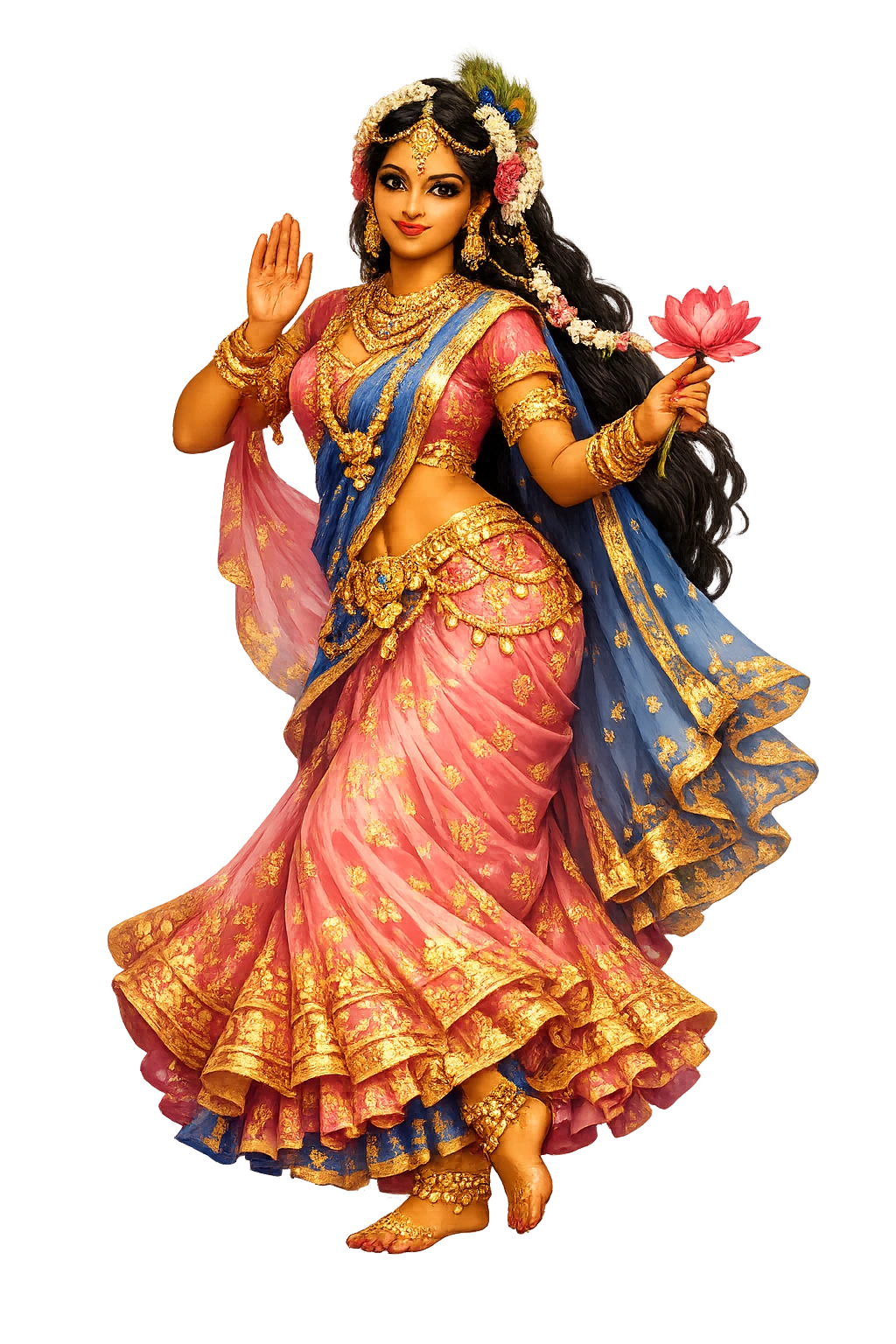
She appears in illustrated manuscripts of the Gītagovinda as the dark or fair gopī dancing with Kṛṣṇa in the moonlit groves of Vrindavan. Pahari, Rajput, Mughal, and Pushtimarg painters produced thousands of rāsa-līlā images organized around the nayikā types, while Chaitanya iconography shows her as the hidden consort within the divine couple. Temple sculptures, modern calendar art, and ISKCON imagery continue the same visual grammar: the bowed head, the raised arm, the jeweled girdle, the lotus foot, and the longing glance.

06

Reception & Transformation

The name after its own age — transmission, translation, survival

Afterlives

Rādhā is barely visible in early sources; she emerges fully in the Bhāgavata Purāṇa and achieves classical form in Jayadeva’s twelfth-century Gītagovinda. Gauḍīya theologians, especially Caitanya and the Six Gosvāmīs, elevated her as the supreme hlādinī-śakti, while Braj-bhāṣā and Bengali Vaiṣṇava poets such as Sūrdās and Vidyāpati made her the voice of vernacular devotion. Colonial Orientalists debated her historical origins, and the twentieth century saw both the global spread of ISKCON and Western yoga culture and feminist critiques of her subordinate role. In the twenty-first century her image circulates in Bollywood cinema, devotional memes, and global kirtan festivals, ensuring that the medieval gopī remains a contemporary figure of longing and divine love. Her afterlife is therefore theological, poetic, and contested, moving from Sanskrit canon to world music, visual art, and contemporary Hindu identity.

Identifications Across Traditions

Her worship organizes whole sampradāyas: the Nimbārkas adore the yugala, the divine couple, as one; the Rādhā-vallabhīs of Hita Harivaṃśa's line put her name first and her temple at the center of Vrindavan; the Gauḍīyas approach Krishna through her maidservants. Comparatists have set the Gītagovinda beside the Song of Songs as bridal mysticism's two great poems, and the parallel holds better than most: both traditions insist that longing is a form of knowledge. Monier-Williams records her homonym in the sky — the nakshatra Viśākhā bears the name Rādhā — as if the calendar itself had enrolled her.

Modern Legacy

Rādhā is one of the most-spoken divine names on earth: "Rādhe Rādhe" is the everyday greeting of Braj, her Rādhāṣṭamī fills Varṣāṇā's lanes, and the spring Holi of Barsana — the Lāthmār Holi where the women playfully beat the men of Krishna's village — is broadcast worldwide. Kangra and Pahari painters made her longing the face of Indian miniature art; Sūrdās and the bhakti poets sang her in every northern tongue. She gave the tradition its most radical sentence: the devotee, not the deity, is the measure of the divine.

07

The Meditation

What Rādhā means — beyond the dictionary

Rādhā is the proof that devotion is not a means but an end: she does not worship in order to obtain, she loves — and the tradition watched that love until it concluded that God must be made of the same substance. Every act of care done without calculation walks in her rāsa circle. Her question to the powerful is her question to Krishna: what is all your power for, if not this?

08

Frequently Asked Questions

Common questions about Rādhā, Divine Love, Consort of Krishna, and Unicode restoration

01How do you pronounce Rādhā?

In reconstructed pronunciation, Rādhā is /ˈrɑː.d̪ʱɑː/ — approximately RAH-dhah — both a's are long; the dh is a single aspirated sound, not two letters.

02What does Rādhā mean?

Rādhā means The beloved of Kṛṣṇa, chief of the gopīs (from √rādh, 'to succeed, accomplish') in the sanskrit tradition.

03What are the symbols of Rādhā?

Rādhā is associated with The golden lotus (Her complexion and her purity: gaurī, the golden one, the lotus of the Yamunā's bank), The kadamba tryst-tree (The meeting-tree of the riverbank, witness of the appointed nights), The cry "Rādhe" (The vocative that outranks every title: in Braj her name is itself a blessing).

04Why restore Rādhā in Unicode?

Plain ASCII radha strips the stress, length, and script that make the name specific. Unicode restoration returns the name to its original written dignity.

05What is the most important myth about Rādhā?

“The Unnamed Beloved” — the Bhāgavata Purāṇa story that anchors the mythology of Rādhā, told in full on the lore page.

09

Scholarly Sources

The philological foundations of this restoration

Every claim on this page is grounded in established scholarship. The orthographic restorations follow disciplinary convention. The etymological chain follows the best available reference works. This is not invention — it is resurrection through scholarship.

◈

Lexicography & Philology

  • MW
  • Bhagavata
◎

Primary Texts

  • Bhāgavata Purāṇa 10.29–33 (rāsa-līlā); 10.30.28 (anayārādhito nūnaṃ)
◉

Archaeology & Art History

  • Material evidence — iconography, inscriptions, and temple archaeology — for Rādhā and related cults.
✦

Religious Studies

  • Gītagovinda of Jayadeva (12th c.), aṣṭapadī cycle
  • Brahma-vaivarta Purāṇa (Rādhā as prakṛti)
  • Kṛṣṇadāsa Kavirāja, Caitanya-caritāmṛta (hlādinī-śakti doctrine)
  • Sūrdās, Sūrsāgar (Rādhā in Brajbhāṣā lyric)
  • Monier-Williams, A Sanskrit-English Dictionary, s.v. rādhā
Return

The Surface Awaits

You have traced the name from its earliest attestation to its Unicode restoration. Now return to the myth. The story is where the name lives.

Back to Lore
Rādhā mascot