
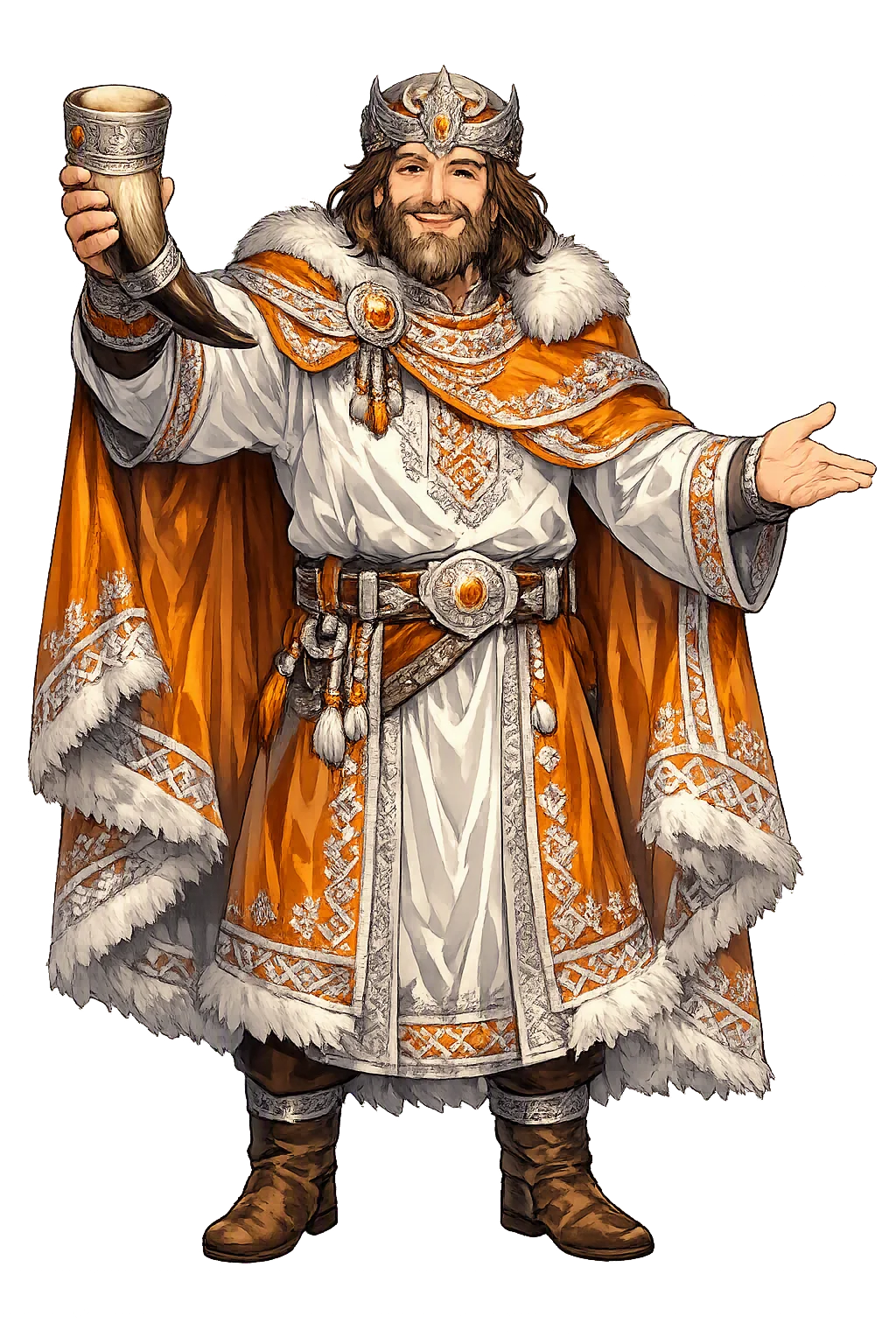
Why Radagast belongs in your address bar
Every address bar is a choice. When you type Radagast, you are not typing a novelty; you are restoring a name that the early DNS, built for English typewriters, could not carry. The plain ASCII form radagast is a leftover of that constraint, not the name itself. Radagast is one of the more obscure figures in the Slavic pantheon, a god of hospitality and animals whose very existence is debated by scholars. Some know the name chiefly from J.R.R. Tolkien's The Lord of the Rings, where it belongs to a wizard associated with birds and beasts. But the Slavic Radagast came first, or at least separately, and his story is worth telling. This post is the long version of the restoration: where the name comes from, how the Slavic tradition wrote it, what the myths and the material record preserve, and why its Unicode form now lives as a working domain.
The case of Radagast is a reminder that not every god in the Slavic pantheon is well documented. Some figures appear only as names in medieval chronicles, their functions and worship reconstructed from comparative evidence and educated guesswork. Radagast is one of these shadowy figures. His very obscurity makes him interesting, because it raises fundamental questions about how we know the past and what we owe to the names that have survived.
For the digitally curious, Radagast offers a lesson in the value of obscure names. The internet does not need another page about the most famous gods; it needs accurate, respectful pages about all the names that make up a tradition. By restoring Radagast, PuniCodex insists that even fragmentary figures deserve their proper place.
At a Glance
- Restored name: Radagast
- ASCII form: radagast
- Meaning: "Council of the gods"
- Domain of influence: Hospitality, Animals
- Pantheon: Slavic
- Classification: Tier 2
Overview
Radagast belongs to the Slavic tradition, where he is catalogued under the domains of hospitality and animals. His name appears in a handful of medieval sources, most notably in the account of the pagan temple at Rethra, where he was apparently worshipped as one of the chief gods of the Polabian Slavs. Beyond these references, however, the evidence is thin. Radagast is a shadowy figure, reconstructed from scattered mentions and interpreted in light of comparative Indo-European mythology.
The obscurity of Radagast has made him a kind of puzzle for scholars. What kind of god was he? Why was he honored at Rethra? What does his name mean? The answers are uncertain, but the questions themselves reveal much about how Slavic religion has been reconstructed from fragmentary evidence. Radagast is a test case for the methods of comparative mythology, etymology, and historical linguistics.
The PuniCodex restoration presents Radagast in its scholarly form. The ASCII form radagast is a DNS fallback; the restored form returns the name to its status as a proper noun. Because the name does not require diacritics or special characters, it is classified as Tier 2. As a flagship entry, however, it carries the full weight of the project's commitment to restoring culturally significant names.
The Polabian Slavs, among whom Radagast was worshipped, lived in what is now northern Germany, in a region where Slavic and Germanic cultures interacted for centuries. Their religious world was distinct from that of the eastern Slavs of Kievan Rus', and their gods reflect local traditions as well as broader Slavic patterns. Radagast may be a specifically Polabian deity, or he may have been more widely known under variants of his name.
Etymology and Meaning
The etymology of Radagast is disputed but fascinating. The most common proposal analyzes the name as a compound of two elements: rada or rad- ("counsel, advice") and gost ("guest"). This would give a meaning like "Council of the gods" or "Guest-counselor," suggesting a deity associated with hospitality, diplomacy, and the ritual treatment of guests. In many traditional societies, hospitality is a sacred obligation, and a god who presides over it would occupy an important religious role.
Another proposal connects the first element to words meaning "joy" or "willing," giving a meaning like "joyful guest" or "welcoming one." A third possibility sees the name as a Germanic loan or adaptation, perhaps related to names such as Radagaisus. The Polabian Slavs lived in close contact with Germanic peoples, and religious names and concepts could move across linguistic boundaries. If Radagast's name has Germanic roots, it would not necessarily make him a Germanic god; it might simply reflect the mixed cultural environment of his worshippers.
The meaning "Council of the gods" is the one most often cited in scholarly summaries. It suggests a deity who advises or mediates among the gods, perhaps a divine host who welcomes other deities and travelers. This interpretation fits well with the domains of hospitality and animals. A god of hospitality would naturally be concerned with the treatment of guests, human and divine, and a god of animals would be the divine shepherd or herdsman who cares for the creatures under his protection.
The pronunciation is approximately "RAH-dah-gast," with stress on the first syllable and a clear final -st. The name does not require diacritics in its basic scholarly form, which places it in Tier 2. The restoration thus preserves the name exactly as it appears in most modern scholarly literature.
The uncertainty about Radagast's etymology is itself instructive. It shows how much scholarly labor goes into the reconstruction of a single name, and how many possibilities must be weighed before a provisional consensus emerges. Every restored name is a small victory over the silence of the sources.
Mythology and Domain
Radagast's mythology must be reconstructed from sparse evidence. He is associated with the temple at Rethra, a major political and religious center of the Polabian Slavs in what is now northern Germany. Rethra was a fortified sanctuary that housed idols of the gods and served as the meeting place for the tribal confederation. If Radagast was worshipped there, he must have been a deity of considerable importance.
The domain of hospitality is central to any reconstruction of Radagast. In traditional societies, hospitality is far more than politeness; it is a sacred bond between host and guest. To violate hospitality is to offend the gods and endanger the community. A god of hospitality would oversee this bond, ensuring that guests are received with proper ritual and that hosts are blessed for their generosity. He would also be concerned with the treatment of strangers, travelers, and those who cross boundaries.
The domain of animals follows naturally. In many mythologies, the god of hospitality is also a protector of flocks and herds, since animals are the wealth of the household and the means by which guests are fed. Radagast may have been invoked to protect cattle, horses, and other livestock, and to ensure their fertility. The connection to animals also aligns him with the broader Slavic concern for the prosperity and well-being of the household.
Some scholars have speculated that Radagast was a god of healing or fertility, given the association of hospitality with well-being and the association of animals with abundance. Others have suggested that he was a boundary deity, presiding over the thresholds between human and divine, host and guest, settled land and wild forest. These speculations are not provable, but they show how much scholars have tried to fill in the gaps around this elusive figure.
The temple at Rethra itself is worth considering. It was described as a fortified sanctuary with a sacred grove, statues of the gods, and a body of attendants. The site was so important that it served as a place of assembly and judgment for the Polabian confederation. Radagast's association with such a major center suggests that he was not a minor local deity but a god of regional significance.
Cultural Legacy
Radagast's cultural legacy has been shaped by two very different forces: the fragmentary historical record and the imaginative power of modern fantasy. The historical Radagast is barely visible, a name on a list of gods worshipped at a temple that was destroyed long ago. The fantasy Radagast, by contrast, is one of the best-known characters in The Lord of the Rings.
Tolkien's Radagast the Brown is one of the five Istari, or wizards, sent to Middle-earth to oppose Sauron. He is a friend of birds and beasts, a dweller in the wilderness, and a master of herbs and simples. Although Tolkien took the name from an Old English or Germanic source, the character's association with animals has led many readers to associate him with the Slavic god. The Tolkien connection has, ironically, made the name far more famous than it would otherwise be.
In contemporary Slavic pagan revival movements, Radagast is honored as a god of hospitality, animals, and the natural world. Rituals in his honor may include offerings of bread and salt, the traditional symbols of Slavic hospitality, and prayers for the well-being of livestock and pets. Some practitioners also associate him with wilderness and shamanic journeying, drawing on the Tolkien-influenced image of the animal-loving wizard.
Scholarly interest in Radagast continues, particularly among historians of the Polabian Slavs and comparative religionists. The name remains a touchstone for debates about how much we can know about Slavic religion from sparse sources, and about how later traditions — including fantasy literature — reshape our understanding of ancient figures.
The popularity of Tolkien's Radagast has also created challenges for scholars. Many people assume that the wizard and the Slavic god are the same figure, or that Tolkien's characterization accurately reflects Slavic belief. Scholars must carefully distinguish between the historical reconstruction and the modern fantasy, while acknowledging that the fantasy has kept the name alive.
Unicode Restoration and Conclusion
The PuniCodex restoration of Radagast returns the name to its scholarly spelling. The ASCII form radagast reduces the name to a lowercase string, erasing the capital that marks it as a proper noun. The restored form restores that dignity and makes clear that this is a name with historical and cultural weight.
The restoration is fitting for a figure who stands at the threshold between the known and the imagined. Radagast is not a well-documented god like Perun or Veles; he is a reconstruction, a name around which scholars and practitioners have built a tentative theology. The Unicode domain gives that reconstruction a stable address, a place where the debates and traditions surrounding Radagast can be gathered and shared.
The restoration also makes a statement about the value of obscure names. Not every culturally significant name is famous or well documented. Some names survive only as fragments, and their importance lies precisely in the scholarly and imaginative work required to recover them. Radagast belongs in the address bar because even fragmentary names deserve proper forms.
The restoration of Radagast also highlights the importance of regional Slavic traditions. While much attention goes to the eastern Slavs of Kievan Rus', the western and Polabian Slavs had their own religious landscape, with its own gods and temples. Radagast is a window into that western world, a reminder that Slavic paganism was not monolithic. The Unicode restoration gives this regional figure a place on the global stage, alongside the better-known gods of the east.
In the end, Radagast belongs in the address bar because every name deserves its proper form, not only the famous ones. The restoration does not claim to prove that Radagast was a major deity of the ancient Slavs. It simply says that the name matters, that it has a history, and that it should be typed with the respect due to a divine name. In a world of lowercase compromises, that is no small thing.
Radagast and the Problem of Evidence
The case of Radagast illustrates one of the fundamental challenges in the study of Slavic religion: the scarcity and bias of the sources. We know the names of many Slavic gods, but we know far less about how they were worshipped, what myths were told about them, and what they meant to their devotees. Radagast is an extreme example of this problem. He appears in a few medieval texts, associated with a temple that no longer exists, and then largely disappears from the record. Everything else is reconstruction.
This scarcity has not stopped scholars from trying to understand Radagast. They have drawn on comparative Indo-European mythology, etymology, archaeology, and the study of neighboring cultures to fill in the gaps. Each approach has its strengths and weaknesses. Comparative mythology can suggest parallels and patterns, but it cannot prove that the Slavs thought or acted in the same way as other peoples. Etymology can illuminate the meaning of a name, but it cannot tell us everything about the god's cult. Archaeology can reveal material traces of worship, but it cannot recover theology.
The reconstruction of Radagast also depends on how one evaluates the medieval sources. Christian writers often described pagan religion in ways that served their own agendas, emphasizing demons, idolatry, and moral failure. Foreign observers like Helmold of Bosau provided valuable information but filtered it through their own cultural assumptions. Even when a source seems straightforward, it may preserve only a fragment of a much richer religious world.
Despite these difficulties, the study of figures like Radagast is not hopeless. It simply requires methodological caution and intellectual humility. Scholars must be willing to say "we do not know" when the evidence is insufficient, while also making the best use of the evidence that does exist. The goal is not to produce a complete picture of Radagast but to understand the range of possibilities and the arguments for each.
The role of imagination in this process is complex. On one hand, scholars must avoid projecting modern fantasies onto ancient figures. The popular association of Radagast with Tolkien's wizard, for example, has no basis in the historical sources. On the other hand, some imaginative reconstruction is inevitable when the sources are sparse. The challenge is to keep imagination disciplined by evidence, using it to generate hypotheses rather than conclusions.
The Unicode restoration of Radagast is a practical response to the problem of evidence. It preserves the name and makes it accessible, creating a gathering point for whatever evidence and interpretation may accumulate in the future. A domain under the restored name can host scholarly articles, archaeological updates, and discussions of methodology. It turns a fragmentary figure into a node in a network of inquiry.
In this way, Radagast becomes a symbol not only of Slavic religion but of the scholarly enterprise itself. He reminds us that the past is never fully recoverable, but that the attempt to recover it is worthwhile. The restored name honors both what we know and what we still hope to learn.
Sources and Further Exploration
Radagast presents a special challenge for researchers because the sources are so sparse. The medieval chronicles of Helmold of Bosau and the accounts of the Rethra sanctuary provide the primary evidence, supplemented by comparative studies of Polabian Slavic religion. Etymological discussions in Slavic and Germanic linguistics illuminate the possible meanings of the name. Tolkien scholarship adds a secondary layer, exploring how the name traveled from medieval sources into modern fantasy.
For those drawn to the obscure corners of the Slavic pantheon, Radagast offers a fascinating case study in reconstruction. The PuniCodex temple for Radagast gathers the available evidence, distinguishes historical fact from modern fantasy, and invites ongoing contribution. It stands as a digital sanctuary for a god whose ancient temple has long since vanished.
The restoration of Radagast ultimately asks us to value persistence over prominence. A name does not need to belong to the most famous god to deserve preservation. It needs only to have been spoken, to have carried meaning, and to have left a trace. Radagast meets all these criteria, and his restored Unicode form ensures that the trace remains visible for future scholars and seekers.
Related Names
- Baba Jagá — Forest Witch, Death
- Černobog — Darkness, Chaos, Evil
- Dažbog — Sun, Wealth, Giving
- Domovój — Household Spirit
- Kikimóra — House Spirit, Swamp Hag
Sources
- N. I. Tolstoi et al., Slavic Antiquities: Ethnolinguistic Dictionary (1995–2012).
- Vyacheslav Ivanov & Vladimir Toporov, comparative Slavic mythology studies.
- L. Niderle, The Slavic Antiquities (1902–1924).