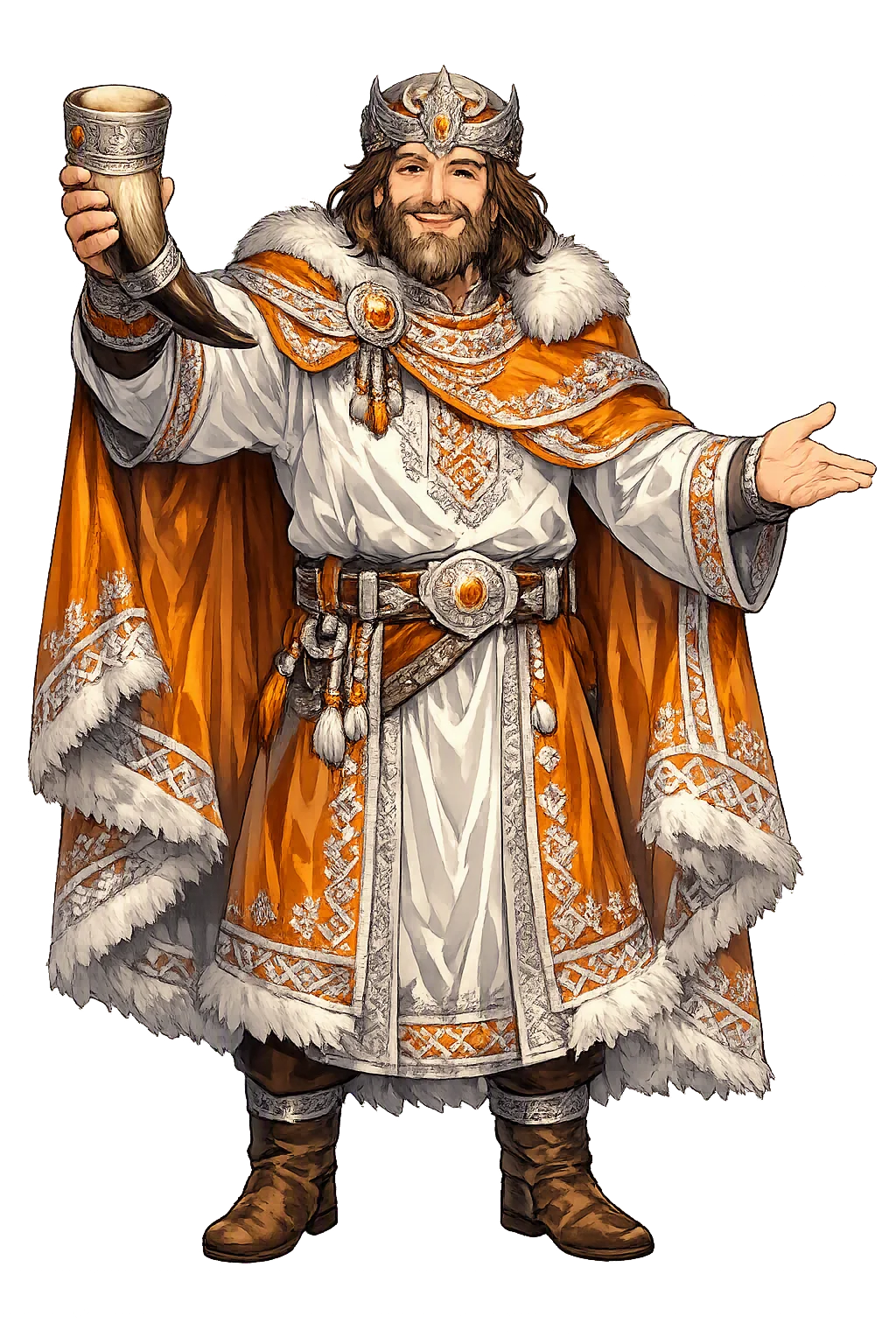
Stories of Radagast
Radagast is known almost entirely from three medieval chroniclers — Thietmar of Merseburg, Adam of Bremen, and Helmold of Bosau — writing two to four centuries after the god's heyday. No Slavic myth of him survives in his own language; what follows are the historical episodes that medieval writers themselves treated as his legend.
Our earliest witness is an enemy. Thietmar of Merseburg, bishop and chronicler, wrote in book VI of his Chronicon (c. 1012–1018) about Riedegost — the Germans called it Radgosc — the chief seat of the Redarii, a Slavic people between the Elbe and the Oder. There stood a vast wooden temple, heaped with the offerings of many tribes, and in it the image of the god who gave the city his name: Radigost. Thietmar wrote with open contempt — he was a soldier of the Church that wanted this cult destroyed — which is precisely why his testimony matters: a propagandist does not invent the power of what he attacks. Radgosc was not a village shrine but a confederate sanctuary, the religious capital of the Elbe Slavs, where tribes that quarreled in peacetime met in the god's shadow. The myth Radagast never got to tell survives as architecture: a god whose legend is a great wooden hall, and whose worship was the politics of a people.
Adam of Bremen, writing his history of the Hamburg church some sixty years later (Gesta Hammaburgensis II.18, c. 1075), adds what Thietmar omits: the oracle. Radgosc, Adam says, was consulted by all the Slavic peoples; the god answered, and the answers were carved and carried home to govern war and settlement alike. His temple had bronze doors and walls hung with weapons — an arsenal of vows. Helmold of Bosau (Chronica Slavorum I.2, c. 1170) supplies the scandalous coda: even Christian Saxons consulted the oracle, crossing the religious frontier the Church was drawing. An oracle crosses borders because necessity does — the god of a single tribe can be refused, but a god who answers the questions everyone must ask cannot. Radagast's carved judgments made him the judge of peoples who shared no language but his: in the eleventh-century north, a Slavic god sat for a while on the throne of uncertainty where every nation seeks counsel.
The chronicle of the god's end is brief. Adam of Bremen records that the temple of Radgosc burned — around 1068, in the Saxon margraves' wars against the Elbe Slavs, as the empire pushed its frontier eastward with sword and baptism. With the hall went the oracle, the standard, and whatever priesthood kept the god's house. No Slavic lament for Radagast survives — no Slavic chronicle survives at all — so the burning is known only from the winning side, in the flat tone with which victors note a difficulty removed. Yet the destruction was the making of the god's legend: a cult that had concentrated the wealth and allegiance of a confederation went up in a single campaign, and what could not be burned was the name. Read backwards through the smoke, the fire is Radagast's passion — the moment when hospitality's door was nailed shut, and the god became a guest in other people's stories.
The god's second life began in a library. Jacob Grimm carried the name Radagost into European scholarship in his Teutonic Mythology (1835), and J. R. R. Tolkien — who knew his Grimm — borrowed it for a wizard. In The Hobbit (1937) Radagast the Brown is the master of shapes and changes of hue, the friend of beasts and birds, the lover of herbs; and Tolkien later observed that he had taken the name from an old Slavic deity, liking its legendary sound. The borrowing was truer than invention could have been: Tolkien's hermit of the wild, who forgets councils of war to tend wounded animals, is a portrait of the god the etymologists reconstruct — radъ, glad; gostь, guest — the one who gladly receives. More people today know Radagast as a wizard than ever knew him as a god; the burned temple survives, improbably, as a footnote in a children's tale, and the god of hospitality lives on as the friendliest face in Middle-earth.
Hospitality
Radagast — medieval Radigost — was the chief god of the Redarii, a Slavic people between the Elbe and the Oder, worshipped in a great wooden temple-city called Radgosc. His name ties him to the guest and the glad welcome: he is the god of hospitality, of the open door, of beasts, and of the trust between strangers.
Thietmar of Merseburg describes the god's vast wooden temple-city, the religious capital of the Elbe Slavs (Chronicon VI.23–25).
His name — Proto-Slavic *radъ-gostь, 'glad guest' or 'he who gladly receives' — makes hospitality itself a divine office.
Adam of Bremen reports that Radgosc gave answers to all the Slavic peoples — and even to Christian Saxons.
The temple burned around 1068; what survives of Radagast is the witness of three chroniclers and a borrowed wizard.
From the original script to the living URL
Radagast
The name survives in scholarly transliteration. Radagast is the standard Slavic romanisation, documented in academic sources — “Council of the gods”. Because the spelling uses only Latin letters, the form is the same in both ASCII and Unicode.
No indigenous writing system is securely attested for individual slavic names. The form shown is a modern scholarly transliteration.
radagast
The plain radagast form is identical to the Unicode restoration. Because this name is already written in Latin letters, no diacritics, stress, or script information were lost — only capitalization differs.
Radagast
The Unicode restoration does not need to recover lost marks for Radagast. Its value is canonical spelling and consistent cataloguing, not the reconstruction of erased orthography. The domain is readable as-is to both DNS and humanity.
Radagast.com
This restoration is written entirely in ASCII letters — no Punycode encoding stands between Radagast and the DNS. The domain reads identically to machines and to human eyes.
Owned, ideal, and ASCII forms of Radagast
Radagast
The full Unicode restoration. radagast.com is not in the PuniCodex collection — it is watched for release; if it drops, this temple upgrades to an owned flagship.
How Radagast was spoken
How Radagast is preserved in writing
No indigenous writing system is securely attested for individual slavic names. The form shown is a modern scholarly transliteration.
Contribute scholarly provenance →The lore you have read is the living myth. Extended Lore opens the scholarly vault beneath it: the cult and its material remains, a history of the image, the name after antiquity, a meditation on what the name still means, and the full scholarly apparatus — etymology, orthography, sources.
Enter Extended Lore