
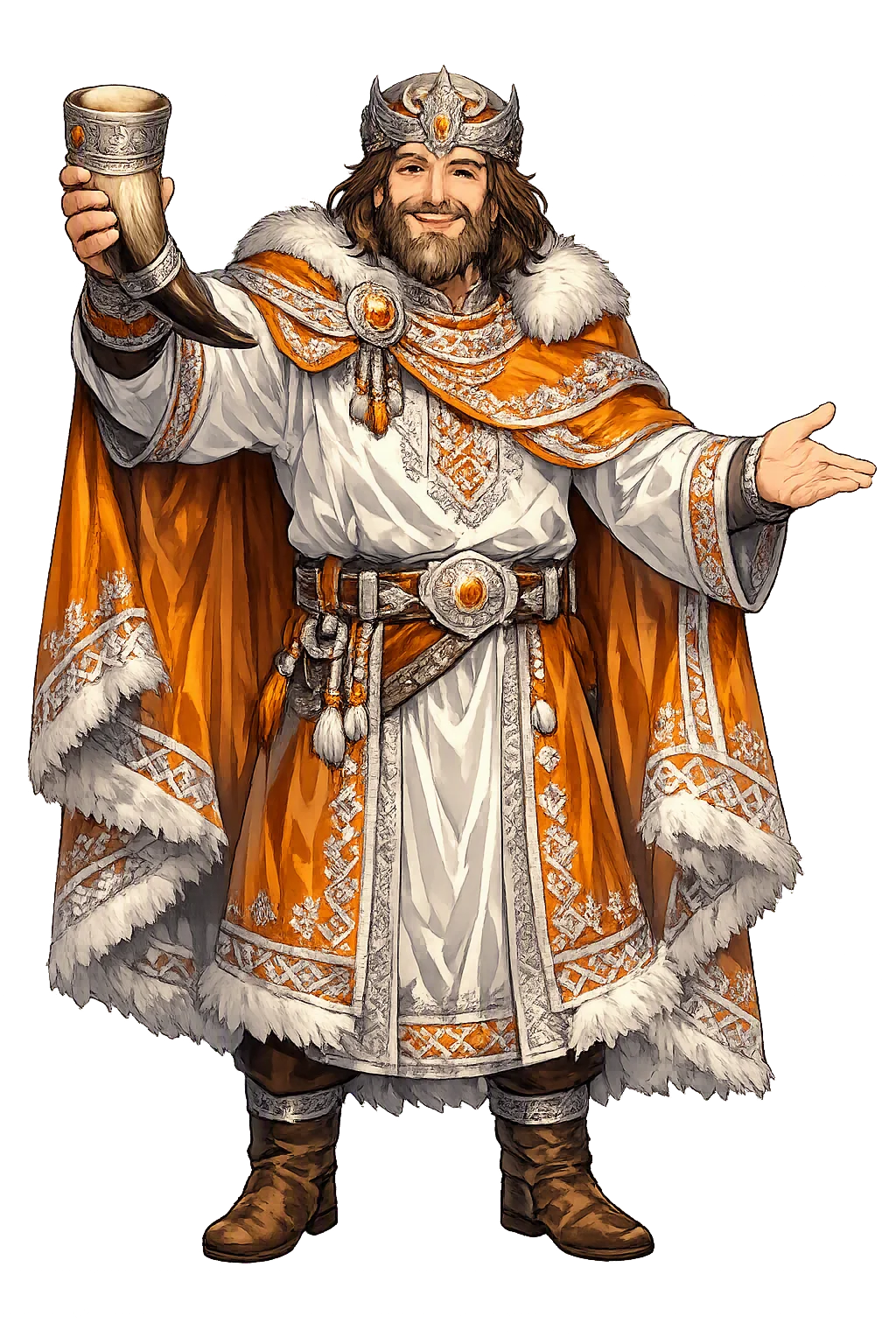
The Cult
Radagast's cult is documented entirely by enemies. Thietmar of Merseburg (Chronicon VI.23–25, c. 1012–1018) describes the god's seat Riedegost as the gathering-place of the Redarii and their allied tribes, where the tribes that quarreled in peacetime met in the god's shadow and the tribal standard was kept under his guardianship. Adam of Bremen (Gesta II.18, c. 1075) supplies the working machinery: a wooden temple with bronze doors, walls hung with dedicated shields and spears, and an oracle whose carved answers were carried home by all the Slavic peoples — and, scandalously, by Christian Saxons, as Helmold of Bosau still remembered (Chronica Slavorum I.2, c. 1170). What cannot be recovered is the liturgy itself: no priesthood, festival, or calendar is recorded, and no votive deposit can be securely tied to the god, since no site of Radgosc has ever been proven. Modern Slavic neopagan groups now honor Radogost as a god of hospitality — a revival, honestly labeled, resting on three hostile Latin witnesses.