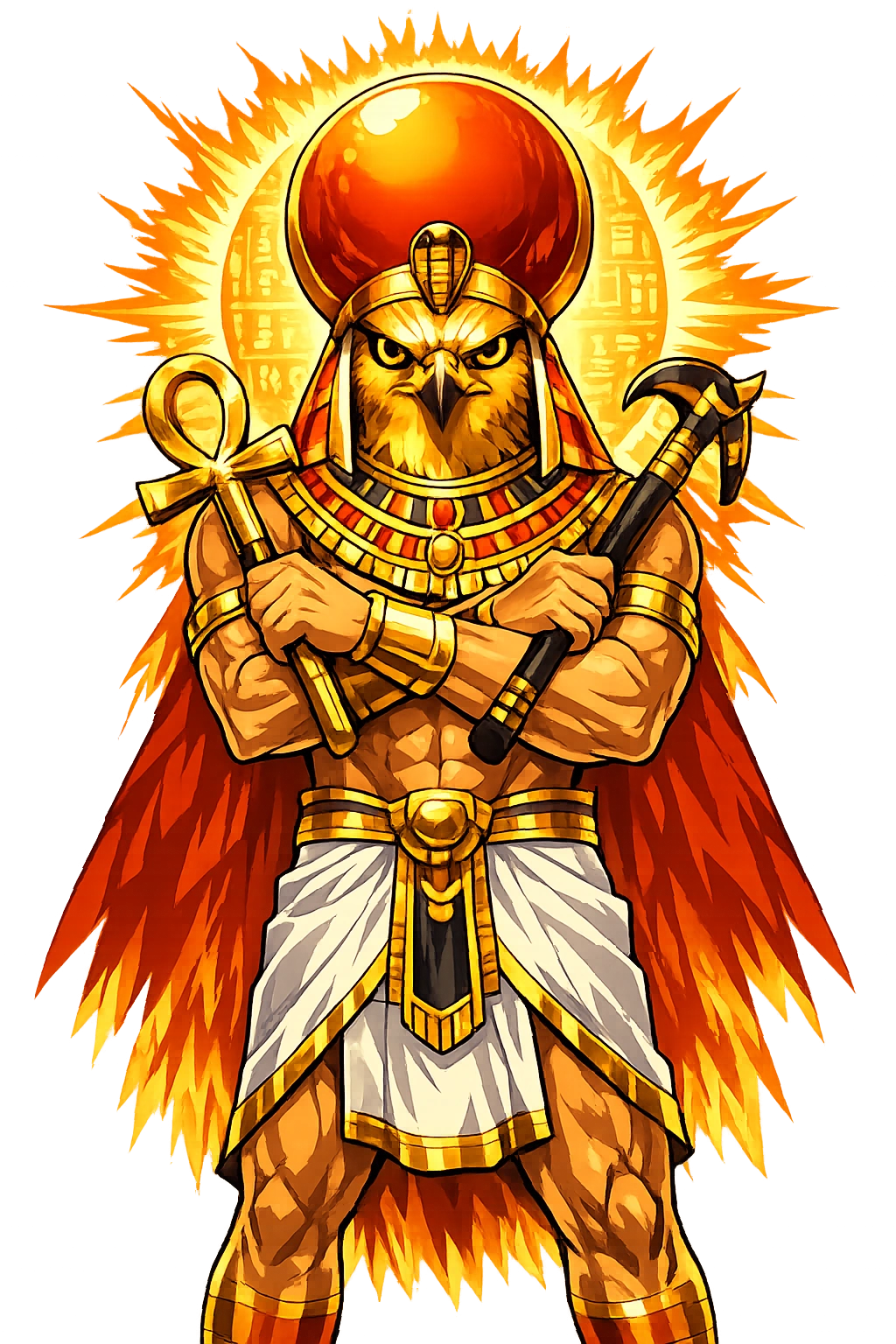
Stories of Rꜥ
Rꜥ's theology is Egypt's most complete vision of order (maat): the sun's daily circuit is a voyage, a kingship and a war. Each dawn the god is born in the east; each night he dies and must be defended; every royal tomb and solar temple re-stages that victory on earth.
The central image of Rꜥ theology is the barque called Mandjet, 'Boat of Millions of Years', in which the god sails the sky by day, and the Mesektet, in which he crosses the underworld by night. The underworld books — the Amduat and the Book of Gates — map the twelve hours of darkness: at each gate Rꜥ must pass guardians, recite their names, and survive the waiting ambush of Apopis, the serpent of chaos who rises from the primordial waters to swallow the sun. Other gods row; the souls of the justified dead join his crew; and at the twelfth hour the scarab Khepri rolls the renewed sun up from the eastern horizon (Book of the Dead, spell 15; Book of Gates). The theology makes every sunrise a contested event: light is not a fact but a nightly victory, re-won while humanity sleeps.
In the myth called 'The Destruction of Mankind', preserved in royal tombs of the Nineteenth–Twentieth Dynasties and on the gilded shrine of Tutankhamun (the 'Book of the Heavenly Cow'), humankind plots rebellion against Rꜥ — who, he says, has grown old, 'his bones silver, his flesh gold, his hair true lapis'. He sends his Eye against them as a raging lioness, the goddess Sekhmet, who slaughters until the gods fear nothing human will survive. Rꜥ halts her by stratagem: seven thousand jars of beer are dyed red with ochre and flooded across the field; Sekhmet drinks, believing it blood, and wakes gentle as Hathor — the returning Eye that becomes the uraeus coiled on the king's brow. The myth is a theology of measured wrath: the same solar power that nearly annihilates the world is tricked into mercy and worn thereafter as protection. Divine anger, Egyptian theology insists, must be outwitted into becoming grace.
Rꜥ ruled by a hidden name — in Egyptian belief the seat of a god's power. Isis, 'a woman excellent of counsel', fashioned a serpent from the god's own spittle fallen to the earth and set it to bite him. No physic of any god could ease the agony, for the wound was made of Rꜥ's own essence. Isis alone could heal him — and would not, until he told her his true name. Rꜥ offered titles one by one: 'I am Khepri at dawn, Rꜥ at noon...' But Isis held out for the hidden name, and in the end the great god whispered it into her bosom and withdrew it from her, 'so that she passed it on to her son Horus' — and thereby, the tale adds, she became mistress of the gods (Leiden Papyrus J 395, c. 1200 BCE). The myth concedes the limits of solar omnipotence: even the sun is subject to time, venom and the older magic of a goddess — and sovereignty, it turns out, is finally something that can be told.
Rꜥ once cursed the sky-goddess Nut so that she could bear no child 'in any year, on any day' — jealousy of the generations she would mother. Nut wept to Thoth, lord of the moon's reckonings, who played draughts with the moon-goddess and won a seventy-second part of her light — enough to make five new days, which lie outside the 360-day year. On these epagomenal days Nut bore five children: Osiris, Horus the Elder, Seth, Isis and Nephthys — the generation whose feud fills the whole of Egyptian myth (Plutarch, De Iside et Osiride 12; the tale also stands behind the Cairo Calendar). The story turns calendrical necessity into cosmogony: the five days outside time are exactly where the drama of time's rulers could begin, and Rꜥ's jealous prohibition becomes the loophole through which salvation enters the world.
The Old Kingdom Pyramid Texts, cut inside the tombs of kings from Unas onward, turn Rꜥ's voyage into the king's itinerary: 'You shall ascend to the sky... you shall stand upon the smoke-cloud... you shall go up to where your father is.' The dead king is bathed, robed and ferried to join Rꜥ's crew — 'rower of Rꜥ, ferryman of the god who is in the sky' — while spells make him Rꜥ's son and other, darker hymns boast he will assimilate the gods' powers to himself (Pyramid Texts, Unas and Teti pyramids; Faulkner's translation). Solar eschatology begins here: heaven is not a place but a posting, a seat in the barque of millions earned by the office of kingship. Egypt's entire political theology flows from the metaphor — to rule is to crew the sun — and three thousand years of pharaonic titulary never abandoned it.
The domain of Rꜥ
Rꜥ is the sun as sovereignty: creator of the ordered world each dawn, father of the king who rules in his name, and nightly conqueror of the serpent of chaos. Egyptian theology unfolded him in three acts — Khepri the scarab at dawn, Rꜥ reigning at noon, Atum the aged creator at dusk — one god in three phases.
Ra sails the Mandjet by day and the Mesektet through the underworld, defeating Apophis each night (Book of the Dead, spell 15).
He is the scarab at dawn, the reigning sun at noon, and the weary creator at evening — one solar life in three bodies.
His eye, embodied as Sekhmet or Hathor, punishes rebellion and returns as the protective uraeus on his brow (Book of the Heavenly Cow).
The pharaoh rules as Ra's son — the royal titulary names him heir of Ra — and every obelisk is a frozen ray of the sun-god's first light.
From the original script to the living URL
𓂋𓂝𓇳
The name in its original Egyptian form. Rꜥ (𓂋𓂝𓇳) is attested in the source tradition — “Sun (from Egyptian rꜥ)”. Its Egyptological ain and alef letters carry the full phonetic and orthographic weight of the source tradition.
ra
Reduced to plain ra, the name loses everything that made it specific: Egyptological ain and alef letters. What remains is an ASCII string that machines can parse but that no longer speaks with its original voice.
Rꜥ
The Unicode restoration recovers what ASCII flattened. Rꜥ restores Egyptological ain and alef letters, returning the name to its original written dignity. The domain encodes to Punycode, but the browser displays the truth.
Rꜥ.com → xn--r-2w3e.com
The non-ASCII characters in Rꜥ are encoded while the ASCII remains visible. To the DNS, it is Punycode. To humanity, it is Rꜥ.
Owned, ideal, and ASCII forms of Rꜥ
Rꜥ
Restores 𓂋𓂝𓇳. The live temple domain — rꜥ.com.
Rá
Restores 𓂋𓂝𓇳. A second live spelling — rá.com.
ra
Flattens 𓂋𓂝𓇳. The plain ASCII fallback — what DNS and legacy systems see.
How Rꜥ was spoken
How Rꜥ travels from ancient script to the modern URL
Probably identical with Egyptian rꜥ 'sun, day'; the sun-god as the visible solar disk.
Sun-god, creator, and king of the gods; central deity of the Heliopolitan cosmogony.
The Unicode form Rꜥ uses the Egyptological alef/ayin characters (U+A722/U+A725), registrable in .com as Punycode; the hieroglyphic form is not used because hieroglyphs are outside the .com IDN table.
The lore you have read is the living myth. Extended Lore opens the scholarly vault beneath it: the cult and its material remains, a history of the image, the name after antiquity, a meditation on what the name still means, and the full scholarly apparatus — etymology, orthography, sources.
Enter Extended Lore