Stories of Pŷr
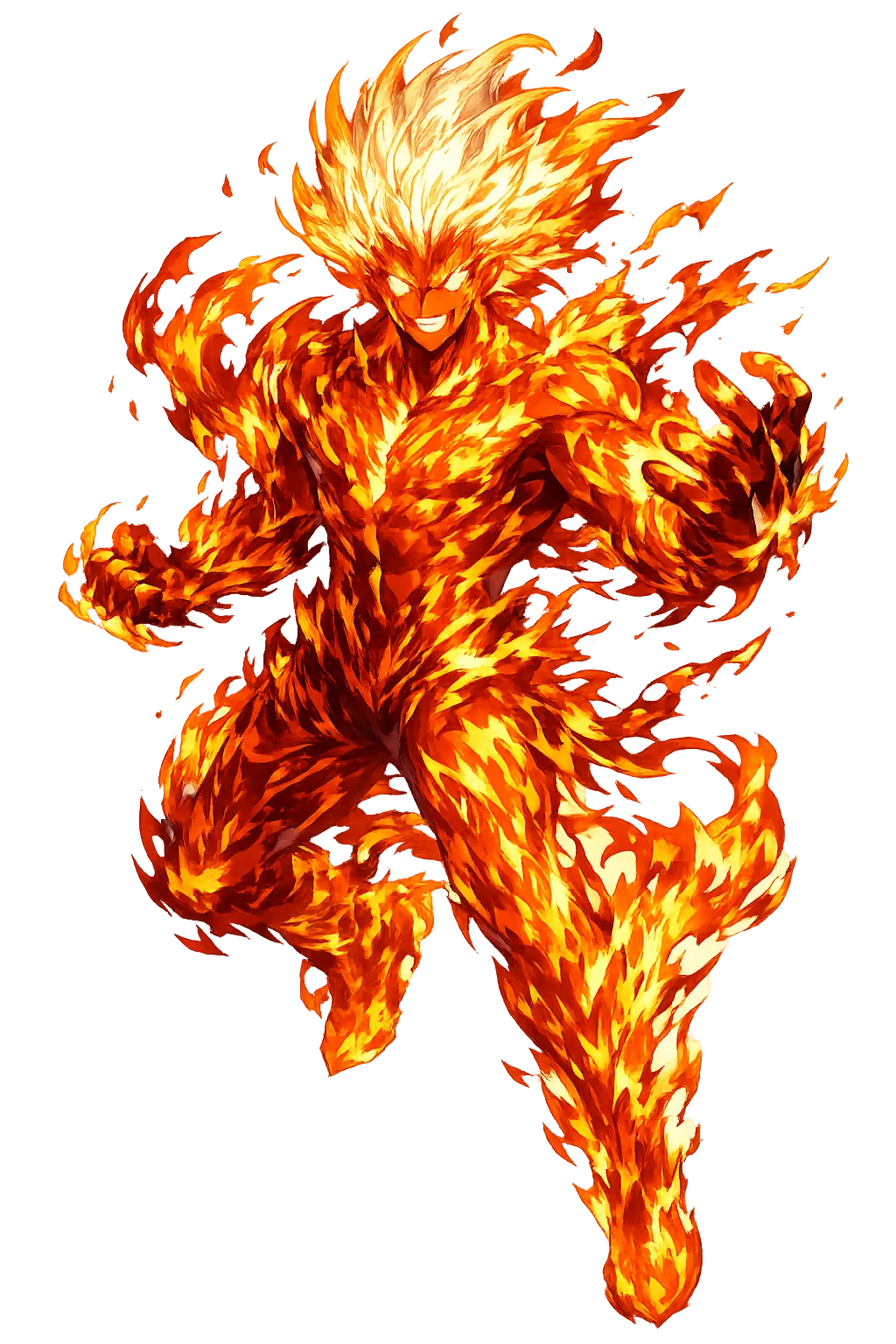
Pŷr is elemental and mythic at once. It is the stolen gift of Prometheus, the cosmic arche of Heraclitus, the threshold-light of the mysteries, and the fire on Mount Oita that burned a mortal into a god.
At Mecone, Prometheus tricked Zeus in the division of the sacrifice, wrapping the good meat in the ox's paunch and the bones in a layer of glistening fat; Zeus, seeing through the trick, chose the fat — and in anger withheld fire from mortals (Hesiod, Theogony 535–570). Prometheus stole it back, hiding the flame in a hollow fennel stalk and carrying it down to earth. Zeus answered with a two-fold punishment: he bound the thief to a crag in the Caucasus, where an eagle daily devoured his regenerating liver, and he had Hephaistos mold the first woman, Pandora — a 'beautiful evil' — whose jar released every affliction upon the human race (Works and Days 50–105). Aeschylus' Prometheus Bound dwells on the theft's aftermath and the catalogue of gifts — not fire alone but hope, medicine, number, and the arts. Fire is civilization's founding theft, and the myth prices it at an eagle's daily meal: every human warmth carries a debt somebody else is paying.
Heraclitus of Ephesus declared that 'this ordered world, the same for all, no god made nor man, but it ever was and is and shall be ever-living fire, kindling in measures and going out in measures' (DK 22 B30). All things are an exchange for fire, and fire for all things, 'as goods for gold and gold for goods' (B90); even the sea is liquefied and measured fire. Strife, want, and surfeit are the measures by which the flame stays alive; the thunderbolt — purest fire — 'steers all things' (B64). Aristotle reports the doctrine at Metaphysics 983b and made fire one of his own four elements, while the Stoics converted Heraclitus' ever-living fire into the logos-pneuma that permeates and governs the cosmos, a conception Cleanthes hymns in his Hymn to Zeus. To call the world fire is to call it a verb: the only element that is pure process, whose identity is transformation itself.
When Demeter searched the world for her stolen daughter, the Homeric Hymn to Demeter (47–50) gives her burning torches, wrenched from the volcanoes of Aetna — fire as the grief that searches the dark. The mystery rites at Eleusis built on that image: torchlit processions along the Sacred Way from Athens, lamps and blazing bowls in the night rites, and the fire that marked the boundary between the uninitiated and those who had seen. Plutarch compares the experience of the mysteries to the soul's passage at death, and Lucian's account of Alexander of Abonoteichus shows how cheap the imagery became when copied without awe. Fire at the threshold does not illuminate fully — that would profane — it marks the crossing: the initiate walks from torchlight into darkness and back, and the flame is the proof that someone carried light through on their behalf. The mystery made fire the syntax of secrecy: visible from far off, unreadable up close.
Heracles, poisoned by the blood of the Hydra on the robe his wife Deianira sent him, commands his son to build his funeral pyre on the summit of Mount Oita (Sophocles, Trachiniae 1191–1278; Apollodorus, Library 2.7.7; Diodorus Siculus 4.38). The poison is burning him alive from within, and he longs for the fire to finish what the robe began — but no mortal dares light it. In the common version the archer Philoctetes (in some accounts his father Poeas) kindles the pyre and receives the great bow in payment; as the flames rise, a cloud takes the hero up, and from the pyre's heart he is received among the gods on Olympus. Ovid tells it with terrible beauty at Metamorphoses 9.229–272: 'I, who conquered a thousand monsters, am conquered by the poison I myself once conquered.' Fire is the only element that can do what the gods alone require — consume the mortal part and release the rest. The pyre turns death inside out: what it destroys is the body, what it saves is the man.
Transformation, Purification, Cosmic Process
Pŷr is the Greek word for fire, an element that transforms, purifies, destroys, and illuminates. For Heraclitus it is the very substance of becoming; for cult it is the medium through which mortals communicate with gods; for tragedy it is the price and the door of immortality.
Heraclitus made fire the arche: all things are an exchange for fire, and fire for all things.
Greek worship centered on altars where fire carried offerings upward to the gods.
Fire cleanses metals, bodies, and cities; it is both punishment and renewal.
The torch, the hearth, the beacon: fire as knowledge, safety, and communication.
From the original script to the living URL
Πῦρ
The name in its original Greek form. Pŷr (Πῦρ) is attested in the source tradition — “Fire”. Its acute accents carry the full phonetic and orthographic weight of the source tradition.
pyr
Reduced to plain pyr, the name loses everything that made it specific: acute accents. What remains is an ASCII string that machines can parse but that no longer speaks with its original voice.
Pŷr
The Unicode restoration recovers what ASCII flattened. Pŷr restores acute accents, returning the name to its original written dignity. The domain encodes to Punycode, but the browser displays the truth.
Pŷr.com → xn--pr-hva.com
The non-ASCII characters in Pŷr are encoded while the ASCII remains visible. To the DNS, it is Punycode. To humanity, it is Pŷr.
Owned, ideal, and ASCII forms of Pŷr
Pŷr
Restores Πῦρ. The live temple domain — pŷr.com.
pyr
Flattens Πῦρ. The plain ASCII fallback — what DNS and legacy systems see.
How Pŷr was spoken
How Pŷr is preserved in writing
A bespoke provenance study for Pŷr is being prepared by the PUNICODEX scholarly team.
Contribute scholarly provenance →The lore you have read is the living myth. Extended Lore opens the scholarly vault beneath it: the cult and its material remains, a history of the image, the name after antiquity, a meditation on what the name still means, and the full scholarly apparatus — etymology, orthography, sources.
Enter Extended Lore